Friday, February 23, 2007

Letter to the Auditor (2)

Wms in office
Auditor Trent Williams asks for another raise


Mr. Williams:

Because I did not receive an answer to my previous email of 2/21/07, I visited your office yesterday and you assured me a reply would be coming soon, which I am sure it will. But a story in the Daily Times today about your request for a $994 raise, in addition to the $10,000 you received recently, prompts me to add questions to those I posed in my last email.

  1. Is it true that you do not have any education beyond high school, and specifically you have no degree, 2-year or 4-year, in accounting?
  2. Since graduating from high school, have you had any job experience outside of employment in local government, on the public payroll?

I ask these questions because I find it hard to understand why you believe you deserve more than the $50,700 salary I am told you now receive. To say that other department heads in the city building earn more than you hardly seems enough justification for giving you another raise.

The two candidates you will face in the upcoming election both have college degrees. Russ Doyle, an ordained minister, has a bachelor’s degree in engineering from the University of Cincinnati, and Crystal Gifford, the mother of two children, has a B.A. from Shawnee State in accounting, has a Master’s degree in the same area from Ohio U., and is now pursuing a Ph.D. in accounting while she is also teaching accounting part-time at Shawnee State. In spite of being a parent, she has found time to get an extensive education in the field of accounting.

I have to wonder whether someone with a solid education and background in accounting would not be able to run the auditor’s office more efficiently and economically than you have. The award the city recently won for accounting actually cost the city at least $25,000, which was the fee you paid to an outside firm to help you with the annual audit that won the award. Who gave you that award? Another outside trade group to which you belong and the membership fees for which I requested in my last email. I now suspect those awards, which are widely distributed to members of the awarding organization, are useful to members to post on their office wall and to publicize during election campaigns, but I wonder if they are really reliable measures of the quality of work that is being done in-house, by the recipients of the awards.

That you would ask for another raise during an election year suggests you may not be able to run a political campaign any more effectively than you are running the auditor’s office. Are you so confident of being reelected that you think you can ask for another raise without the voters strongly objecting? Enough voters may decide that they want someone as auditor who does not have to rely as much on highly paid outside accounting firms. One way to reduce the projected $300,000 to $600,000 deficit is for the auditor’s office to do more of the accounting work in-house. I can believe that it is the mayor who is primarily responsible for the large city budget deficit, as you told me yesterday, but even without a degree in accounting I think I can figure out that the deficit would be less if the auditor's office was not spending as much money as it is on outside accountants.

Thank you.

Robert Forrey, Ph.D.


[On 2-23-07, I received a prompt three-page reply in a pdf format to my Letter I (see my previous post) from auditor Williams. I have tried to transfer his reply to River Vices, but I have had trouble making a readable copy. So I asked Teresa Mollette to post the auditor's reply on her excellent website, Portsmouthcitizens.info, which deserves an award for excellence. I urge readers to read the auditor's clearly written and well organized reply. I will respond to it in my next posting. For the auditor's reply, click here.


Tuesday, February 20, 2007

Letter to the Auditor

wms on steps

Award-winning Auditor Trent Williams


Feb. 20, 2007

Dear Mr. Williams:

This is a formal request under Ohio
's open records statutes.

What I am requesting are any records and letters relating to the membership of the city of Portsmouth
, the Auditor's office, and you individually in the Government Finance Officers Association. I would like to know what membership fees or payments of any kind are made to the GFOA.

I would also like to look at the Comprehensive Annual Financial Report (CAFR) to see if there are pages I would like to have copies of.

The report on the front page of the Daily Times (Feb.15, 2007) began with sentence, “With a projected budget deficit for 2007 ranging between $300,000 and $600,000, it’s hard to find any good news in the city.” I want to better understand how a city in such precarious financial shape is able to win an award for anything, but especially an award “for excellence in accounting and financial reporting.” Have you reported that the city faces a deficit of between $300,000 and $600,000? Is that part of your award winning performance? It is questions like these that as a citizen of Portsmouth
I would like the answers to.

When you have copies of the records and letters, and have a copy of the CAFR for me to peruse, please notify by return email. I trust you will do this with the promptness that Ohio
’s open records law calls for.

Please be advised that I will make emails available to the public, since I know there are others who are as puzzled as I am by a city in a financial crisis, and facing a deficit of from $300,000 to $600,000, getting an auditing award.

Thank you in advance for your anticipated cooperation.

Robert Forrey, Ph.D.

Monday, January 08, 2007

Rife with Corruption

Riffe mural
Vern Riffe floodwall mural, Portsmouth


As an English professor newly arrived in south-central Ohio in 1989, I thought it was ironic that the name of the most powerful politician in Scioto County, and some might argue the second most powerful politician in the state of Ohio, was named Riffe, Vernal G. Riffe, Jr. (1925-1997), the now deceased long-time speaker of the Ohio House of Representatives. The irony is that there is an adjective, rife, pronounced like Riffe, which means very prevalent or abundant, especially in regard to something harmful or bad, such as diseases, crime, or corruption. The word rife is often accompanied by the preposition with, as in “rife with corruption.” Familiar with the East Coast ethnic variety of crime and corruption, it took me a while to recognize just how rife the crime and corruption in an Appalachian river town could be. Pious, self-righteous, and hypocritical, it has a style all its own. Instead of the mob, you have to beware of “foundations”; instead of “goombahs,” you have to watch out for “philanthropists.” When I started this blog several years ago, I had no trouble coming up with a name: River Vices.

But I did not think Vern Riffe was responsible for our river vices. Sure, he cut ethical corners and did not tolerate dissenters, and he had no patience with people who did not follow his wishes, but he was a masterful politician, working effectively with his Democratic colleagues and Republican allies on behalf of his constituents. He brought home the bacon to southern Ohio, and Shawnee State would not have become a university without him. Riffe reminds me of Ralph Waldo Emerson’s famous observation, “An institution is the lengthened shadow of one man.” Shawnee State University is certainly the lengthened shadow of Vern Riffe, whose friendship with Republican Governor James A. Rhodes (1909-2001), demonstrated how successful and shrewd a politician the New Boston native was. The good that the university has done in making higher education accessible to Appalachian residents would not have been possible without “the Speaker,” as he was often reverently called.

But there was a price to be paid for all the financial and material assistance Riffe funneled into his district. Political pork is bad for the soul of any community that depends on it, and few communities became more dependent on pork than Portsmouth in the Riffe era. Pork doesn’t produce prosperity; it produces dependency, patronage, and corruption. It turned Portsmouth into Porksmouth. I realized this when, as president of the faculty union, I became involved with the chronically poisonous politics of the university. Shawnee State University, to use a Calvinist metaphor, was conceived in sin, in political sin, you might say, and it has not yet transcended its shady origins. SSU was born out of wedlock. Authorities in Ohio higher education did not want it. Taxpayers elsewhere in Ohio, to the extent that they were aware what was happening, did not want it. But Riffe wanted it and given his influence and power, he got it, even if he had to knock up the state of Ohio to get it.

Most of the oldest universities in America were founded by or closely associated with religious denominations. Shawnee State was founded by and closely associated with one Democrat, with a big assist from a Republican, Governor Rhodes, who unfortunately will be remembered not for what he did for the students of Shawnee State but what he did to the students of Kent State when he ordered out the National Guard in May 1970 with accompanying inflammatory remarks that some feel contributed to the killing of four students and the wounding of nine others, some of whom had nothing to do with the demonstrators. When I look at the James A. Rhodes Athletic Center at Shawnee State, I cannot help remembering Kent State, and I cannot help remembering being at the dedication of the Rhodes Center, when Rhodes and Riffe, the controversial father and godfather of the university, shared the same platform. At the end of his career, Riffe was in trouble over campaign ethic violations.

While he was alive, Riffe kept control of Shawnee State, as he did of the Ohio House, with an iron hand in a kidskin glove. The Wikipedia Encyclopedia says SSU is sometimes known as “Vern Riffe State. U.” Academic standards and academic freedom were not Riffe’s highest priorities. When Ralph Nader was allowed to speak on campus about the shenanigans of the insurance industry, to which Riffe was closely tied, there was hell to pay on campus, and the SSU president who declined to un-invite Nader lost his job as a result. Or so I’d heard. With Riffe’s death, control of the university passed as a matter of course to the local Republicans, who ran SSU, following Riffe’s example, as a political fiefdom. In the first ten years of its existence, from 1986 to 1996, in spite of millions of dollars allocated to it by the Riffe-controlled legislature, the university was annually ranked as one of the worst in the nation by U.S. News. This continued to be the case even after Riffe was gone, for traditions of incompetence and corruption die hard, whether Democrats or Republicans are in control. Unfortunately, the Republicans lacked Riffe’s political adeptness and made things at the university even worse.

Vernal G. Riffe, III

The name Vernal G. Riffe lives on in southern Ohio in the person of Vernal G. “Skip” Riffe, III, the Speaker’s son, who has served as the County Commissioner for a number of terms. He was easily reelected last November. Rumors about the junior Riffe’s personal life have circulated locally for a number of years, as did rumors about his father’s personal life. Rumors like these circulate about politicians whether there is any truth to them or not. But in the last several months, the rumors about the Speaker's son have gained some credence because a woman from northern Ohio, identifying herself only as “Liv,” short for Olivia, began communicating by email and telephone with several people in Portsmouth, claiming to have been Skip Riffe’s mistress for several years, and to be pregnant with his child. The possibility of Olivia making these charges public during a political campaign was not something even a Riffe could ignore, so he reportedly made efforts to pacify her prior to the election. But in the meanwhile it had become evident she was pregnant.

livatriv
Olivia in Portsmouth, 2004

Emails purporting to be from him to her are appearing on Moe’s Forum, where their affair, though not their names, was first revealed by Lee Scott in a posting headed, “Local politician to become a Dad again . . . Not by wife.” Threads are now running on Moe’s Forum under “Mistress” and “Love Affair,” and those threads can be expected to get longer and longer.

If this was all Olivia claimed, that she was the mistress of and made pregnant by Riffe, I would not be writing about her here, because private consenting relationships by adults, whether married or not, is their business. If all local politicians and public officials who have been guilty of adultery were stoned to death, as women once were, many public meetings and perhaps city and county government would grind to a halt. The Portsmouth City Council could probably not muster a quorum. But it is not adultery or pregnancy but the apparent abuse of power and influence, and the expenditure of public funds by a public official, that is the important issue. Whether or not Olivia is pregnant and whether or not Skip Riffe is the father of her soon-to-be-born-child, and whether or not he abandoned her or treated her shabbily – all this is not the public’s business: but state business is the public’s business and if he was mixing business with pleasure, then that is another matter. Olivia claims, and has posted emails to back up her claims, that in the course of their relationship she usually was his companion on official state-business trips, driving in official vehicles and sharing his state-paid-for motel rooms and meals. She was a part of his public as well as his personal life, and she claims to have been with him when he met other county officials, including law enforcement officers. She was the unofficial first lady of Scioto County.

In a Family Way


Though now seven months pregnant (as shown left on her MySpace blog), Olivia is not an innocent victim. She knew she was getting involved with a married man. I have learned that she bore another child out of wedlock about fifteen years ago, and has had a troubled relationship with the father of that child. History seems to be repeating itself. Because she claims to be carrying the child of a Riffe, she must not give even the appearance of trying to hold Scioto County’s first family up for ransom. If going public was her way of trying to get him to accept responsibility, then she should look for opportunities to settle with him privately, and not continue to raise the stakes higher than she needs to. If she just wants to punish him, she will probably end up punishing herself and her teen-aged child, as well.

We can understand why she is furious with Skip. What was he thinking when he carried on openly with her? Or was he thinking at all? Carrying the name Vernal G. Riffe, in addition to being an advantage, must be a burden. The Riffes are the equivalent of Appalachian royalty. As the sign on Route 23 says, south-central Ohio is Riffe Country. But there are limits to the lattitude residents of Riffe country will allow those bearing the name Riffe. Vernal G. Riffe, III, may be about to find out what those limits are. Even in the middle of this mild winter we are having, this matter, if not resolved soon, is going to snowball, as the posting of this blog should indicate.

Skip and Alice Cooper_edited

Skip Riffe posing with Alice Cooper in photo from MySpace blog of Vern Riffe IV.


Thursday, December 28, 2006

The Old & the New

OLD & NEW


“In its final report, a building committee formed by City Council President Howard Baughman last summer has recommended that the new city building be constructed on the former Adelphia Cable property and adjacent parcels.”

Community Common, Dec. 17, 2006


(The following imaginary dialogue took place between the old and new year)

  • Now that I’m about to take over, will you answer some questions for me, Pop?
  • Shoot, Sonny.
  • Why will a new building for city offices be located on the site of the former Adelphia building, on Washington Street?
  • To begin with, to call it the Adelphia building is misleading. The building was owned by Dr. Irving Singer, of Los Angeles, an absentee landlord who rented it to Adelphia Cable.
  • Why is that important?
  • Because it was Dr. Singer who hired Neal Hatcher to try to find another tenant or a buyer for the so-called Adelphia building.
  • And Hatcher was not able to find another tenant or buyer?
  • Obviously not.
  • Why not?
  • Because the building was old and in poor shape. Before Adelphia rented it, the building was the site of a car dealer. A few old timers claim that before the car dealer, a restaurant occupied the building. So the building was old, had no architectural value, had serious leaks, and as we now know, had a very serious mold problem. If there weren’t serious problems, why would Adelphia have moved out?
  • So Hatcher couldn’t find another buyer or renter for the building. Then what?
  • Then Singer did not pay taxes on the property. Those began to pile up, and they would continue to pile up for as long as Singer owned the property.
  • He had a problem?
  • He had the same problem any businessman or landlord has when a property loses its value.
  • They can’t give it away?
  • They can’t give it away because it is no use to any business, which would still have to pay the taxes on it.
  • So what then?
  • Well, in Portsmouth what you do is unload otherwise worthless property off upon the public by selling it to the city, county, or state.
  • But the city, county, and state were not buying?
  • That’s right.
  • But didn’t the city buy the Marting’s building, for almost two million dollars, even though it was much older than Dr. Singer’s building, even though it had been empty for a longer period of time, and even though it had leaks and asbestos and who knows what else?
  • That’s true, but Clayton Johnson turned the Marting Company into the Marting Foundation, and in the name of philanthropy and in the name of the sacred cause of reviving downtown Portsmouth, he was able to unload the Marting building and its many problems off on the city and get almost two million dollars in the bargain.
  • But wasn’t the Marting building as worthless commercially as Dr. Singer’s building, the so-called Adelphia building?
  • Yes it was. But the Marting Foundation wasn’t selling the Marting building as a commercial property. It was selling it as the future home for the Portsmouth city government. No business in its right mind would have bought the Marting building in the condition that it was in and at the location that it occupies, and at anywhere near the price the city of Portsmouth paid for it.
  • No business would buy it but the city of Portsmouth would?
  • The city of Portsmouth would buy the Brooklyn Bridge if Clayton Johnson and Neal Hatcher were doing the selling.
  • Even though we already have a bridge?
  • Even though we already have a bridge. We already have a football stadium, but Johnson and Hatcher are selling the city the land on which the superintendent of schools wants to build a new football stadium.
  • What did Dr. Singer do when he couldn’t sell his property to the city?
  • He did the next best thing. He donated it to the city with the stipulation that the city had to use it for some public purpose.
  • Like a city hall?
  • Or a police station.
  • Why did he stipulate that?
  • Because then he could get a tax write-off from the U.S. government.
  • But only if it was used for some public purpose?
  • Right.
  • Wasn’t that pretty clever of him?
  • It was probably pretty clever of Neal Hatcher and Mike Mearan, who was Singer’s lawyer.
  • So the city took ownership of Singer’s building and his land?
  • Yes, but the city later learned from the Building Committee that the building was in poor condition and that the mold made it unsalvageable.
  • So, then the city had a worthless building that had to be torn down, but it was still obligated to use the site for a public purpose?
  • Right.
  • How did it become the site for a new municipal building? What about Marting’s?
  • The Marting building is almost as useless as Dr. Singer’s building. If the Marting building had been torn down, the new municipal building could have been built there. That site makes more sense than the site up on Washington St.
  • Then why wasn’t the Marting building torn down?
  • It would be expensive to tear that monstrosity down, and more importantly, the Marting Foundation and its tools in the city government were committed to the lie that the Marting building was valuable and worth saving.
  • So they got trapped in the web of lies that they wove about the Marting building?
  • Yes. But the mayor is so dense he may not know they are lies.
  • What would be the best site for a new municipal building?
  • The best site would be where the Municipal Building now sits.
  • Then why not tear the Municipal Building down and build there?
  • Because some developer wants that site.
  • Why?
  • Allegedly to build a new hotel and conference center.
  • Conference Center? Who the hell is going to want to come to a conference in Portsmouth?
  • The real reason is probably that the site would be very valuable if gambling comes to Portsmouth.
  • And is Neal Hatcher the developer who wants that site?
  • That’s the rumor.
  • So whoever the developer is, he doesn’t really want to build a hotel?
  • No businessman with any sense would want to build a hotel in downtown Portsmouth.
  • Why not?
  • Because the Ramada Inn, known as the Queen of the Rust Belt, is located right across from the Municipal Building and has been living on scraps of pork the city and university have been throwing it for years.
  • So a hotel makes no sense unless gambling comes?
  • That’s right.
  • I guess last year was a hell of a year in Portsmouth, Pop?
  • Sonny, you ain’t seen nothing yet.

Thursday, December 07, 2006

Merry Marting's To All

wreath


T’was the night before Christmas and all through the store,
Not a councilman was stirring, not even a Mohr;
The stockings were hung by the chimney with care,
In hopes that some payoffs soon would be there.
The Johnsons were nestled all snug in their beds;
Visions of Hilton Head danced in their heads.
And Jim in his longjohns and Allison in her cap
Had just settled down for a long council nap,
When out on the street there arose such a clatter,
He sprang from his bed to see what was the matter.
Away to the display window, he flew like a flash,
Tripping over decorations as if they were trash.
The moon on the breast of the new-fallen snow
Gave a ghostly look to the scene below,
When what to Jim’s sleepy eyes should appear
But thousands of women, from far and from near,
Gals from the past, from the nineteen-forties,
Slim ones, plump ones, tall ones, shorties,
So many gals he knew he had to act quick,
So he opened the doors with his lottery pick.
More rabid than bobbysoxers, inside they came,
And he smiled and laughed and called them by name:
“Hi, Denise, Hi, Doris, Hi, Trixie, you vixens,
You luscious dishes with all the fixin’s!
Come in to Marting’s, the heart of the Mall,
And Shop away! Shop away! Shop away, all!”

Waving their charge cards and eager to buy,
They went straight to menswear for their favorite guy,
And then up the escalator, like doves they flew,
Buying pill hats and furs and lingerie too.
And then in a tinkling, Jim heard on the roof,
The sound of leaks leaking, and then, poof!
They were gone forever, those gals, with a bound,
Gone without a trace, gone without a sound,
Like Christmas stockings without the loot,
Like New Year’s horns without the toot.
Weren’t they real and would they never be back,
For a shopping feast or even a snack?

He’d tried his dangdest to make Marting’s merry,
He’d decorated her with holly and berry,
He’d repeatedly said, “Hell, no!
She shouldn’t have been torn down ages ago!
She’s not like a mummy with bad teeth,
She’s not hiding behind a Christmas wreath,
She’s not an Old Maid, so damp and so smelly,
She’s a gorgeous lady, like Grace Kelly,
She’s old but well-preserved, like Liz Taylor herself,
She won’t be 125 till January 12th.
She’s just rusting – I mean resting. She’not dead.
And I don’t give a frig what the voters said.
So what if I’m only a grocery clerk?
The average voter is a stupid jerk.
We need shoes, we need socks, we need clothes,
And Marting’s is where the smart shopper goes.”

Behind the façade, behind the faux-brick bustle,
There’s a typical Portsmouth two-million dollar hustle.
And I heard Jim exclaim, as he turned out the light,
“Merry Marting’s to all and to all a good night!”


martingno

Monday, November 13, 2006

Legacies

legacycartoon


Boola-Moola

In spite of its reputation for academic excellence, Yale has produced a trio of politicians whose incompetence and poll numbers have reached bathyspheric depths. I am referring to George W. Bush (B.A. 1968), John Kerry (B.A.1966), and Bob Taft (B.A. 1963). Bush has made it to 31% in a Newsweek post-election poll, but he’s not done yet. And Kerry would probably be even lower after his recent gaffe, in which he couldn’t get straight the punch line of a joke about how stupid Bush is. Kerry ended up instead appearing – at least to people of limited intelligence – to insult the intelligence of troops in Iraq. Kerry, who was a D student in his freshman year at Yale, is no one to be making jokes about anyone else’s intelligence. What these three Yale graduates – Bush, Kerry, and Taft – have in common, in addition to their by now legendary incompetence, is that they are what the Yale Office of Admissions calls “legacies.”

There are in any given class at Yale, and other prestigious universities, a percentage of not-too-bright and not-too-talented students who probably would not have been admitted if they had not come from wealthy and influential families with close ties to that institution. Yale could not afford to exclude George W. Bush from the class of 1968, however embarrassing a Yale grad he might promise to be, because as a private university, Yale is heavily dependent on wealthy alumni for financial support. There can’t be boola-boola without moola-moola, and the Bushes, partly because of their business ties to anti-democratic governments, such as those in Nazi Germany and Saudi Arabia, have never been short of moola.

In a perfect academic world, all applicants would be judged on merit; but in the real world money is usually more important than merit, and who you know more important than what you know. Bush’s father George H. W. “Poppy” Bush (B.A. 1948) and his grandfather Prescott Sheldon Bush (B.A. 1917) were Yale graduates of wealth and influence. They were also, to a degree, well-rounded. If they weren’t brilliant, they were smart enough, and they had a degree of social grace. Father and grandfather also had some athletic ability, usually a redeeming feature in even the worst putz in a class. Poppy was possibly a legacy, but maybe he was good enough at first base to have gotten into Yale even if Prescott Bush had not been his father. Maybe.

Prescott Bush and George H. W. Bush had also served in the military in theaters of war, the grandfather in Europe in the First and the father in the Pacific in the Second World War, but anyone familiar with their military service knows there are questions on that score. But the legacy of legacies of the Bush line, George W. “Dubya” Bush, would not serve in any theater of war. He would serve instead in the Texas Air National Guard, in a sweetheart deal designed to keep the draft-aged cut-up from having to fight for his country. He got no closer to Vietnam than Alabama, where he lived it up as an AWOL pilot in a unit that had no airplanes. He was not so much Audie Murphy in To Hell and Back as he was John Belushi in Animal House. Except for his family connections, George W. had nothing going for him. He was smart-alecky, not smart; he was a cheerleader, not an athlete, he was Hung-Over, not Dink Stover.

Skull and Boneheads

There was a grade at Yale known as the “gentleman C.” Dubya’s grades at Yale were frat brat C’s, which are worth even less than Gentleman C’s. Grade inflation began in the 1960s, when not only A’s but also C’s became easier to get. Instead of letting a smile be his umbrella, the heller developed a smirk as a sign of his defiance to everyone whose grades were higher than his, which was just about everybody. That both Bush and Kerry were members of Skull and Bones suggests that a more appropriate name for that secret Yale group might be the Skull and Bonehead Society. And if that death cult has degrees of membership based on the number of skulls and bones a member has created, then Dubya has to be some kind of Grand Dragon.

As Peter Dreier wrote in American Prospect, “Bush, a mediocre student, got into Andover, Yale, Harvard Business School and the Texas National Guard’s pilot-training program because he was rich and well-connected. His subsequent business career – including his early efforts to start an oil company, the financial favoritism that allowed him to buy part of the Texas Rangers baseball team with hardly any of his own money, the political favoritism that allowed him to persuade the city of Arlington, Texas, to subsidize a new stadium – was due in large part to his family and social connections. These connections laid the groundwork for Bush to enter politics and helped catapult him to the presidency.”

To Bush’s credit, he was not completely oblivious to his egregious inadequacies. He was aware, when he wasn’t abusing substances, that the dice had been loaded against him in the genetic crap shoot, especially in the I.Q. department. When Dubya was about to be admitted as a legacy at Yale, “Things Go Better with Coke” was the slogan of the day, and he found that to be the case. He needed something to deal with the shame of being a legacy, with knowing he never would have gotten into Yale, would never have gotten to first base in life, without Poppy.

Yale aided and abetted Bush’s undergraduate career as a legacy, but Harvard was his finishing school. Of Dubya’s performance at the Harvard School of Business, we have the recollection of a Japanese visiting professor who said of him, “He showed pathological lying habits and was in denial when challenged on his prejudices and biases. He would even deny saying something he just said 30 seconds ago. He was famous for that.” Yes, over 30 years ago, Bush was already famous for saying one thing and then denying he had said any such thing, just as he has recently stayed the course right up until the time he denied he had been staying the course. We aren’t talking about character flaws here. How can there be character flaws when there is no character?

Bush’s Brain

According to Bush’s Brain, in Bush’s first try for public office, for a congressional seat in Texas, Bush’s opponent accused him of having been born in New Haven and of having been “educated in the pointy-headed environs of Harvard and Yale.” After a radio debate, Bush was furious at the moderator for having raised the same issue, and when the microphones were off called him an “asshole.” That was the first and last election Bush would lose. Dubya or more accurately Karl Rove was smart enough to realize that any sign of Bush’s elite East Coast education was the kiss of death politically, especially in Texas, so he transformed himself from a Yalie into a tough talking if stuttering and self-consciously strutting cowboy. And it worked like an electoral charm until Tikrit hit the fan. It worked like a charm until the recent midterm Republican debacle, after which a reporter reminded him that Nancy Pelosi had said he was naked (an emperor without clothes), incompetent, and dangerous. Bush responded by saying people say things in campaigns they don’t mean. Hadn’t he vowed just a few days before the election that Rumsfeld was going to remain the Secretary of Defense come hell or high water? And wasn’t Rumsfeld history a day after the election? Wasn’t this the kind of behavior that Bush got away with as a legacy at Yale and Harvard? Wasn’t he the same pathological liar he had been in that Business School class when he would deny saying something he had said 30 seconds earlier? He wasn’t just dumbing down during an election: he was simply living up to Yale’s low expectations of a legacy: he was not making the grade, in spades.

Yale must bear some of the responsibility for the long-range consequences of admitting students who do not meet even the minimum standards of intellect and character that their classmates were required to meet. Granted the cost of running a large university is enormous and that bills must be paid, the admissions people at Yale must recognize that even the most well-heeled legacy might not be worth it, and that someday, drawing on the prestige of the university and its privileged political networks, including its Skull and Bones skullduggery, he might stumble forward to become Commander in Chief and president of the United States. In that case, not just the country but the whole world could end up having to pay the piper. The full price in lives and treasure the world will eventually have to pay for George W. Bush being president, not to mention the years lost in combating terrorism and global warming is, at this time and perhaps for many years to come, beyond calculation. But we can already attribute hundreds of thousands of lives and billions of dollars to his incompetence, close-mindedness, and psychopathic lying. And now we have to wait and see if Poppy’s pals can bail Dubya – and us – out yet again from what is clearly the mother of all his messes. Heaven help us!

If Bush and Kerry appeared to be neck-in-neck the last ten years to see who can screw up more, they are tortoises to Bob Taft’s hare. In one survey, Gov. Taft’s poll numbers sank to 6.5, the lowest ever recorded for any politician. Time Magazine rated him as one of the three worst governors in the country, but the rumor was he was considered the worst of the worst. And how much can we read into the fact that Bob Taft was not tapped for Skull and Bones, in spite of the fact that his father, Senator Robert A. Taft, and his grandfather, President William Howard Taft (B.A. 1878), were members, along with seven other Tafts, including Alphonso Taft (B.A. 1833), who was one of the founders of Skull and Bones? Was Bob Taft that bad, or that good, that he did not qualify?

Duck Run

Whatever the limitations of the current Governor-elect of Ohio may prove to be, being a “legacy” is not one of them. One of nine children, son of a steelworker, a graduate of Bible-oriented Asbury College (B.A. 1963), in Kentucky, Ted Strickland is not a child of privilege. There is no boola-boola in his background and not much moola. He has made a career of helping the underprivileged and the troubled. An ordained minister and a trained psychologist, he has worked at the prison in Lucasville, Ohio, the town where he grew up, in a rural area named Duck Run. He also taught evenings as an adjunct at Shawnee State University, in Portsmouth, Ohio, where many of the students were the first in their Appalachian families to attend college, which was also the case with him. His grandfather and father were in no position to see that doors were opened for him. In fact, there were those who tried to shut doors on him. When he ran for and was elected to Congress, a member of the Republican dominated Board of Trustees reportedly vowed that Strickland would never teach at Shawnee State again. Shawnee State’s loss has been the state of Ohio’s gain. Let’s hope that Strickland as governor leaves a lasting legacy to the Buckeye state.

Wednesday, November 01, 2006

Ohio Halloween Nightmare

hollowjean


Last night, I had an Ohio Halloween nightmare.

I dreamed I lived in Ohio, in Portsmouth, in the First Ward, where Timothy Loper had been elected to the First Ward seat as a reform candidate but then had sold out to the rich white trash who run Portsmouth. I dreamed I filed charges against Loper with the County Board of Elections charging he was not living in the First Ward, as the City Charter required, but was a carpetbagger living in the Fourth Ward. I dreamed Loper had then been removed from office by the County Board of Elections.

I dreamed I was next represented on the city council by lawyer Mike Mearan, who was appointed, not elected, to replace Loper. I dreamed Mearan was involved in prostitution and drugs. I dreamed Mearan’s 24-year-old stenographer was arrested for transporting Oxycontin from Columbus to Portsmouth in an automobile rented to Mearan.

I dreamed Portsmouth’s previous mayor, a failed businessman named Greg Bauer, had conspired with the rich white trash to pay the Marting Foundation $2 million dollars for an empty, virtually worthless former department store. I dreamed Mayor Bauer, because of the Marting scam, was recalled from office by a large margin, as were two other council members.

I dreamed the Marting sale to the city was ruled invalid by the courts after a suit was brought by a crusading couple, Teresa and Bob Mollette.

I dreamed the current mayor of Portsmouth was James Kalb, who had never risen above the level of grocery clerk at the local Kroger’s Supermarket but had made a career for himself in city politics by being the tool of the rich white trash. I dreamed Kalb conspired with other members of the city council to get the rich white trash off the hook by absolving them of any blame in the Marting scam and taking the Marting building off their hands, with them keeping the $2 million, and the city resuming its plans to convert the Marting building into a city hall. I dreamed that an employee of Kroger’s told me Kalb had never amounted to much at Kroger’s because he was lazy and not too bright, and that he was now using his union rights to to keep his Kroger job open in case he wanted to return to it someday, thus keeping someone younger who needed a job from filling it.

I dreamed I was a member of the Concerned Citizens Group, which managed to get the city’s plan to convert the Marting building on the ballot as a referendum, where the voters rejected the city plan by a wide margin.

I dreamed Portsmouth police chief Horner had denounced citizens who conducted recall campaigns of local officials as “domestic terrorists.” I dreamed the police chief refused to account for how he used a private discretionary police fund, consisting of money obtained in drug busts. I dreamed the police chief’s son was dealing drugs at Damon’s Restaurant, directly across the street from the Portsmouth police station. I dreamed the chief’s son was arrested and convicted but that his arrest and conviction were expunged from public records.

I dreamed the Ohio Secretary of State was Ken Blackwell whose own wife does not campaign with or for him. I dreamed he was accused of using his position as head of Ohio elections to help elect George Bush in 2004. I dreamed Blackwell was described in a poem by Cincinnati’s African-American poet Nikki Giovanni as “a political whore.”

I dreamed that one of Ohio’s senators in Washington was Mike DeWine, who had a promiscuously sexual staff assistant who used to tell people, according to the Washington Post, that her job in DeWine’s office consisted of throwing out “ the stacks of letters from earnest voters who believe members of Congress actually care what they think.” I dreamed this promiscuous staffer, shown here exposing her breast in front of the Capitol, was screwing everyone in Washington and that DeWine was screwing everyone in Ohio.

I dreamed my representative in congress was Jean Schmidt, who had denounced Congressman Murtha on the House floor as a cut-and-run coward, even though Murtha was a decorated war hero. I dreamed Schmidt had been voted one of the ten dumbest members of the House, and that in her latest campaign brainstorm she had raised the possibility of making part of her district a nuclear waste site.

I dreamed the governor in Columbus was Bob Taft. I dreamed I read on Wikipedia, the online encyclopedia, that Taft “is known beyond the state’s boundaries for the recent corruption scandals under his administration, particularly Coingate.” I dreamed that Time Magazine judged him to be one of the three worst governors in America, opining that “The only thing more stunning than the spectacle of a quivering, hangdog Ohio Governor pleading no contest in August to criminal charges is the fact that he is still in office.” I dreamed that Ohio’s slogan, “The Heart of It All,” meant the heart of all the corruption and election tampering.

I dreamed the president in the oval office was George W. Bush, who is considered by some historians to be the stupidest and most incompetent chief executive in the history of the United States, and as the president who has presided over the most corrupt administration in the history of the United States. As Ohio goes, so goes the nation.

I dreamed this and much more, and when I awoke I realized, “Oh, my God, the nightmare is true. I live in the First Ward of Portsmouth, in Ohio, in the United States of America, and Mearan is the First Ward councilman, Horner is the chief of police, Kalb is the mayor, Blackwell is the secretary of state, Schmidt is the congresswoman, DeWine is the senator, Taft is the governor, and Bush is the president.

Shit! This is not a Halloween nightmare. This is an everyday reality!

Bush no exit


Monday, October 23, 2006

Bridge to the Past

Grant Bridge


Portsmouth has a beautiful expensive new bridge, but the celebrating is over, and now it’s time to come to terms with reality and face the costs of that project, and not just in terms of dollars. On October 15th, the Community Common published a pathetic Sunday supplement called “Bridging the Past to the Future.” Contrary to the claim of the Common’s headline, the U.S. Grant Bridge is not a link to Portsmouth’s future, only to its past. The Grant Bridge is a 38 million dollar pork project, which cost millions more than it was projected to cost and experienced so many delays that it ended up taking longer to construct than the Golden Gate Bridge. The C.J. Mahan Company – which has been in trouble with the EPA, with its sub-contractors, with its endangered workers, and with the widow of one of its original partners – should not do any bragging about the Grant Bridge, for the sad irony is Mahan appears to be better at making excuses than building bridges.

Death of a Salesman

I heard somebody recently express disappointment that the bridge did not have a walkway for pedestrians, but there are advantages to excluding pedestrians. No homeless soul or depressed drug-addicted prostitute or destitute gambler (should the casinos come) are going to be able to walk out on the bridge and jump off, adding to Portsmouth’s “image problem.” People have been persistently jumping off the Golden Gate Bridge from the time it was built, but San Francisco is large enough and has enough going for it that millions of tourists have left their hearts there without thinking about Golden Gate suicides. But picture some clinically depressed traveling salesman calling up for reservations at Portsmouth’s downtown Ramada Inn, dubbed by one critical traveler the “Queen of the Rust Belt,” and asking, “Are you within jumping – I mean walking– distance of the Grant Bridge?” It would be bad for business, and there is little enough of that as it is. Instead of claiming to be “The Gateway to Southern Hospitality,” Portsmouth,with a walkway on the bridge, might have become known as “The Jumping off Spot for World Weary Travelers.”

Speaking of death, those who work with and for Mahan run financial and personal risks, including death itself. The bridge Mahan built across the Big Sandy River, the Perry and Gentry Memorial Bridge, is named after two workers who lost their lives building it. The barge that sank and the crane that went with it on the Grant project slowed things down, but fortunately no lives were lost. While the Grant Bridge was falling further and further behind schedule, partly as a result of serious design faults, Mahan was being sued by the wife of his original partner, who died unexpectedly. The widow claimed Mahan had cheated her out of her fair share of the company while awarding himself a super-sized salary and expense account. Court records show his annual salary in the mid-90s was $580,000 and his draw account alone was $355,000. In reviewing the judgment on the widow’s case, the courts decided that “there is competent, credible evidence to support the jury’s finding that Mahan received excessive compensation for the years 1996 and 1997.” If that’s what he was paying himself ten years ago, what must he be taking home now? The $900,000 in bonuses he has allegedly been awarded by Ohio Department of Transportation to get him to finally finish the Grant Bridge have understandably outraged taxpayers. Since when are huge bonuses awarded for being two years behind schedule? Instead of giving bonuses, the ODOT could have done what others who have grievances against him have done: sue him.

Considering what Ohio taxpayers will get for their money, the Grant Bridge is pork not just because of Mahan’s poor performance but because the 38 million dollars of public dollars that have been expended on it could have been better spent. If it is not as questionable as Alaska’s infamous “Bridge to Nowhere,” the Grant Bridge is a luxury, not a necessity. What justification was there in the first place for building the new Grant Bridge when the Carl D. Perkins bridge is about a mile down the road and has served as Portsmouth’s link to Kentucky in the five years that the Grant Bridge has been under construction? Trucks have used the Perkins Bridge since it was built in 1980 to avoid downtown Portsmouth, and during the five years (2001-2006) Portsmouth was without the Grant Bridge, motorists driving on Route 23 could use the Perkins bridge as a detour. For those motorists who had no reason to stop in Portsmouth, using the Perkins Bridge was no inconvenience. They drove a few more miles than if they had driven through Portsmouth, but they lost little time since they did not have to deal with all those traffic lights on Chillicothe Street. (Chillicothe St. is that quarter mile stretch of Rte. 23 that runs through downtown Portsmouth and has seven traffic lights.)
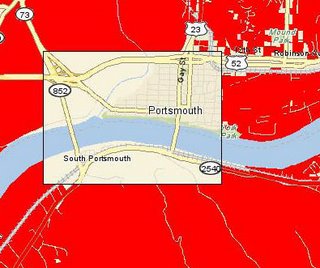
Map showing one mile distance between Perkins and Grant Bridges.

If the 38 million was not spent to save motorists a couple of minutes and a couple of miles driving on Rte. 23, then who or what was it spent for? The answer is the 38 million was spent to help revive Portsmouth’s depressed downtown district. That’s in addition to the millions that had already been spent for that purpose. The unfortunate truth is downtown Portsmouth died about a quarter of a century ago, and misguided politicians and Portsmouth con artists posing as community leaders have been claiming to have a plan to revive it ever since. The advocates of downtown Portsmouth are like those operators who were still milking the Missing in Action movement twenty years after the Vietnam War. The Marting scam would not have been possible without the Save the Downtown mentality, as if the downtown and the downtown alone was the key to the city’s salvation. When the industrial base of the Portsmouth area began disappearing a half century ago, many of the retail and commercial businesses in downtown Portsmouth that served and prospered from that industrial base, began to close shop. Even before the old Grant Bridge closed in 2001, downtown Portsmouth was in bad shape. Yes, the closing of the old Grant Bridge made a bad situation worse, but the spending of 38 million dollars to return to 2001 hardly seems a wise investment. “I would like to see all the buildings up and down Chillicothe Street occupied like they used to be when I came to Portsmouth in 1947,” an elderly Portsmouth resident told the Portsmouth Daily Times on the Bridge Day celebration. It ain’t going to happen, lady.

Insulting Consulting

According to the Oct. 18 Daily Times, we have yet another publicly funded study being done on how best to revive downtown Portsmouth. “Oh, my god!” a longtime resident of Portsmouth exclaimed on hearing about the study. “Not another one!” Having established that it is incapable of coming up with any solutions to the downtown Portsmouth problem on its own, the city government regularly insults the intelligence of the taxpayers by bringing in these so-called experts to do a study. The latest study is being conducted by a Cincinnati consulting firm, Edwards and Kelcey, whose fee is being paid in part by the city government, which is providing $23,000. More pork! If all the money spent on all the studies of downtown done in the last half century were put in a pot, the city would have enough to put a new roof on the leaking Municipal Building and have enough left over to provide Mayor Kalb with the luxury SUV he feels a man in his position should have. How can we take seriously any out-of-town consulting firm that knows so little about Portsmouth as to hold its initial public meeting in what is known unaffectionately locally as the UnWelcome Center. The UnWelcome Center is just another Portsmouth pork project that houses the offices of the Chamber of Commerce and the SOGP, Portsmouth's axis of evil, which has a stranglehold on the city. Not that the consulting firm had much choice. Folks at the the SOGP are probably behind this “study,” just as they were behind the Marting scam. And how can we take seriously a consulting firm that comes up with a gimmick of audience participation.

Those who attended the charade at the UnWelcome Center were encouraged to play the equivalent of pin-the-tail-on-the donkey, which would be more appropriate in a grade school than at a meeting of adults. The Edwards and Kelcey people put up a list of possible solutions to downtown Portsmouth on the wall, and those in the audience were invited to put red stickers on solutions they liked best. This is democracy at work, you see. But absent from the list of solutions was the most important one of all: Get Rid of the Goddamn SOGP! We ended up paying 38 million bucks for a bridge to revive downtown Portsmouth, and now we have to pay thousands of more public dollars to yet another consulting firm for yet another study on how to revive downtown Portsmouth. Why do we have so much faith in outside consultants anway? Do we assume they’re smarter than us because they don’t live and work in Portsmouth? What is an outside consultant after all if not somebody you pay to pick your pocket to tell you how much money you don't have?

Downtown Portsmouth is the Terri Schiavo of South Central Ohio. It has been on life-support for so long that not even Senator Frist would deny that it is in a persistent vegetative state. And when you consider the level of intelligence of the politicians in the Municipal Building, you could also say downtown Portsmouth is brain-dead. Any community planners with sense would see that any attempt to revive downtown Portsmouth as a retail and commercial center, as it was in the 1940s, is suffering from pernicious nostalgia. All the pork projects in the world, including a 38 million dollar bridge, or an 8 million scam project like the Marting building, is not going to bring back downtown Portsmouth. Not bring it back to anywhere near what it was anyway. A few years ago, Adelphia Cable (since absorbed by Time-Warner) moved its offices from downtown to the uptown Viaduct area, which is where Verizon later moved its downtown offices. And the Fifth/Third Bank is reportedly going to move out of its present downtown offices on Chillicothe St. If the few remaining corporate businesses are moving out of downtown, what do you think of our chances of getting others to move in? The overseers of these businesses are not brain dead. They know that downtown Portsmouth is a graveyard and buildings left behind, like the Marting building, are tombstones testifying to that fact. They know that building a 38 million dollar bridge to a graveyard doesn’t raise the dead. They know that downtowns are no longer the place to do business, at least not business as we know it. They know you don't make fire by rubbing two wet noodles together.

Not just downtown but all of Portsmouth is going to have to reinvent itself. Massive changes in industries, cities, and roads and transportation have taken place in the last half century. Portsmouth, along with the rest of America, is drastically different from what it was back then. American know-how was been replaced by American no-how, American enterprise by American porkbarreling. Those antique cars that were part of the Bridge Day parade could be accommodated in the old downtown Portsmouth. But vehicles are bigger and there are millions more of them. Half of downtown Portsmouth would have to be razed to accommodate the cars that a large shopping might attract, and I emphasize might. A shopping mall has been Portsmouth’s pipedream for a quarter of a century.

Gambling on the Future

What a few wheeling and dealing developers, lawyers and politicians are counting on is casino gambling coming to Ohio and Portsmouth. As long as we are fed and continue to swallow the line that downtown Portsmouth can be revived like it was in the 1940s, that we can go forward to the past, the more likely is it that gambling is in our future. That’s the future they’re counting on. If you build casinos, they will come. Millions of dollars would be pumped into the local economy. But at what cost? The human hazardous waste gambling generates gets buried in the local community in the form of increased crime, corruption, drug abuse, divorce, and suicide rates. Already one of the most corrupt and crime-ridden cities in Ohio, Portsmouth would become Sodom-on-the-Ohio, utterly degraded by gambling dollars, which there will not be as many of as promoters promise but enough to create more serious social problems. Considering what a problem drugs and prostitution now are in Portsmouth, what will they be like with gambling money flowing like crack through the veins of the local economy? Gambling addicts, whose numbers are estimated by pro-gambling sources at 1% and by gambling opponents at 5%, will be a problem far beyond the 1 to 5%, because families, relatives, and employers are affected. It is called the ripple effect.

I grew up in Revere, Massachusetts, when it was known as “The Gambling Capital of New England,” so I am not basing what I say on some outside consultant’s study of the effects of gambling on Portsmouth, although we are going to get those studies, rest assured, studies probably paid for by gambling interests, studies that will say yes, there may be problems, but the overall effects of gambling are positive. The toxic effects of gambling are not limited to the casinos and the gamblers. Gambling is like mercury poisoning and PCB’s. Gambling contaminates whole communities – the political, social, and spiritual environment. The American dream of succeeding through hard work and honesty is replaced by the dream of instantly striking it rich. Life becomes a lottery. People dream about lucky numbers or combinations to play. If gambling comes, our current mayor will no longer have to drive across the river to gamble in the economy model city car he’s ashamed of. He can do his gambling in Portsmouth.

The indirect influence of gambling has been observable in Portsmouth for the last fifteen years. The deliberate neglect of the Municipal Building and the calls to tear it down are indirectly related to gambling. A developer has wanted that land for gambling-related purposes for a number of years. The longer we fall for the “forward to the past” line, the more likely we are going to wind up tearing down the Municipal Building and replacing it with a casino. Then adults will really be playing games, and it won’t be the pin-the-tail-on-the-donkey variety.

Bridge to the Future

One thing that we might do is try to change Portsmouth politically, and see if political changes might help the economy. Lee Scott believes getting rid of the city charter might work wonders. I think what needs improving is the quality of the people who gravitate toward city government. It is too much to expect that the best and the brightest would want to get involved in city government, but do we have to settle for the worst and the dumbest, who become pawns in the hands of the richest and the slickest? Shawnee State University could be one institution to help raise the intellectual and ethical level of local government. Employees at the university and the students and faculty in particular have to care about and get involved more with Portsmouth politically.

Little did the richest and slickest realize when they lobbied for a university what the consequences would be, because along with those millions of pork dollars that were pumped into the community came also students and faculty, who are not as easy to bamboozle as the general public. The Shawnee Sentinel was the creation of Shawnee State students, and since the paper first appeared back in the mid-1990s, news reporting in Portsmouth has not been the same. The appalling level of incompetence and dishonesty in local politics has been the main focus of the Shawnee Sentinel, but that newspaper arose in spite of harassment from the administration and from university lawyer, Stephen P. Donohue in particular.

The sick condition of Portsmouth’s economy and the corruption in government is a scandal that the university, a public institution, is ethically obligated to do something about. It should not be left to outside consultants who have no roots or stake in the city. In Athens, faculty members from Ohio University have actually served on the city council. Imagine having somebody connected with the university be mayor of Portsmouth instead of having men who never amounted to anything, like the present and former mayor? There should be some interdisciplinary program or institute established at SSU that directly relates to the political and economic affairs of Portsmouth. But the university is not likely to make much of a difference in the quality of life in Portsmouth without major changes first taking place there, which is unlikely since it is now controlled, like most things in town, by the SOGP, acting through the Board of Trustees. As long as trustees like George L. Davis III, George Clayton and the current trustee chair Kay Reynolds are in control of the university, and as long as Stephen P. Donohue is the Vice President of Everything and de facto SSU president, no constructive changes are likely to take place at SSU. However, with a former dedicated instructor at SSU in the governor’s office, perhaps something can be done about SSU, if only through the trustees he will have the opportunity to appoint.

SSU developed a terrible reputation over the last twenty years, when it was treated locally as another publicly funded pork project, another public feeding trough. The number of land scams and housing shenanigans that took place as the university expanded should be the study of a dissertation someday. We saw what happened to the one president of SSU, James P. Chapman, who was not a tool of the SOGP and who began to make a difference. People with a little more education, vision, and ethics, who are not lapdogs for local multimillionaires, could help build our bridge to the future. And is it too much to hope that that education bridge will not continue to be a pork project, costing hundreds of millions of dollars without taking the city anywhere? Is it too much to hope that someday somebody who is not the equivalent of C.J. Mahan will be in charge of building our bridge to the future, and that somebody other than a consulting firm of Edwards and Kelcey’s ilk will be offering us advice on how to proceed instead of inviting us to pin-the-tail-on-the-donkey, as if we were all, like those politicians in the Municipal Building, jackasses?

Dramatic political changes may take place after November 7 at both the state and national levels. Kevin Tillman, brother of former pro football player Pat Tillman, has published an extraordinary indictment of American politicians and policies, titled “After Pat’s Birthday.” “Somehow,” Kevin Tillman wrote, “the same incompetent, narcissistic, virtueless, vacuous, malicious criminals are still in charge of this country.” But is it too much to hope that on November 7 some important political changes might begin to take place not only at the national and state but at the local level as well? The same old virtueless, vacuous, malicious crooks are still in control of Portsmouth, but could their days be numbered?