Wednesday, March 01, 2006

Porksmouth

pigguy


I’ve heard Republicans blame the unions for Portsmouth’s decline. I’ve heard Democrats blame the bosses. I think neither the workers nor the bosses are to blame.

The fundamental reason for greater Portsmouth’s economic decline, and for the general decline of American industry in the last half century, is globalization, which is a term for economic changes that have been going on internationally for over a century but which accelerated after the Second World War. Globalization is international economic integration, or, to its critics, globalization is the internationalization of economic exploitation.

As the U.S. declined industrially as a result of globalization, those regions and sectors of the American economy most affected by the decline came to depend more and more upon the state and especially the federal government for financial assistance. Large chunks of this financial assistance were in the form of pork, which is defined on Porkopolis, a conservative pork-alert blog, as “a government project, appropriation or appointment that yields jobs or other benefits to a specific locale and patronage opportunities to its political representative.” One of the features of Porkopolis is a series on Pork in Portsmouth.

Porking Portsmouth

When did the porking of Portsmouth begin? When did Portsmouth become Porksmouth. I’m not sure, but in March 1964, the Portsmouth City Council made a momentous decision. In a resolution, numbered unlucky #13, the council turned much of the economic control of the city over to a private “non-profit” corporation named the Portsmouth Area Community Improvement Corporation (PACIC).

In Resolution #13, the Portsmouth City Council granted PACIC an extraordinarily broad mandate. The mandate of this private corporation, consisting mainly of businessmen, bankers, and lawyers, was no less than “To promote the health, safety, morals and general welfare of the inhabitants of the community . . .” In the following year, 1965, the Ohio state legislature passed a law allowing municipalities to designate community improvement corporations, such as PACIC, as their agent. As if PACIC hadn’t already been granted extraordinary power in Resolution #13, for the health, safety, morals and general welfare of the people of the Portsmouth area, the Portsmouth City Council passed another resolution, #30, designating PACIC as the city’s official agent, or legal representative.

The previous, pre-war, heavily industrialized but now depressed post-war city of Portsmouth became classified by the USDA as a “rural area,” part of the Appalachian region, thereby making it eligible for USDA pork. I was told by a native of Portsmouth, who moved back after spending most of his adult life elsewhere, that he was surprised to discover upon his return to Portsmouth that he had grown up in Appalachia. To someone growing up in Portsmouth back in the 1940s and 1950s, being Appalachian had more disadvantages than advantages, and was more likely something to be ashamed than proud of. Beginning in the 1960s, when President Johnson declared war on poverty, that situation changed. Because it was repackaged as an Appalachian community, Portsmouth qualified as underprivileged and neglected and a candidate for special government assistance. If you were Appalachian, you were assumed to be a victim of poverty, and the government was obliged, perhaps as a holdover of the Great Depression, to assist the victims of poverty as much possible.

As far as Ohio is concerned, Portsmouth is at the top of the Federal Pork Barrel. The primary governmental pork provider for Portsmouth is the U.S. Department of Agriculture (USDA). To facilitate the funneling of federal dollars into south-central Ohio, the USDA designated the Portsmouth area as the Greater Portsmouth Enterprise Community (GPEC), a kind of most-favored-pork-district classification. Apparently, no other Ohio area enjoys this distinction. I don't know whether the late Vern Riffe had anything to do with it, but Portsmouth is unique

Incidentally, when it provides relief, the US government prefers, in Orwellian fashion, to convey it in the language of entrepreneurial capitalism, in which “enterprise” is a sacred word. In urban areas there are “Enterprise zones,” in rural areas “Enterprise Communities.” Lord help those who live in neither, because the government apparently will not.

Privatizing Pork

With the creation of PACIC, in 1964, important functions of the Portsmouth city government were essentially privatized. However high-minded its original objectives might have been, PACIC and its successor, the Southern Ohio Growth Partnership, assumed the role of a private agency responsible for the acquisition and distribution of government funds. To put it bluntly, PACIC-SOGP became a pork dealer, with none of a public agency's obligation to openness. John Welton (Doug Deepe) reports that members of the SOGP are sworn to secrecy.

In this economic twilight zone of enterprise zones and enterprise communities, the only real competition is among those vying for government assistance. It is a rare “entrepreneur” in the “enterprise community” of greater Portsmouth who does not begin by asking the SOGP for some kind of federally or state financed special assistance. According to the folklore of American capitalism, in the old days entrepreneurs pulled themselves up, Horatio Alger style, by the bootstraps. Now they pull themselves up by government pork straps. Horatio Alger, Jr., incidentally, was the son of a Protestant minister who went bankrupt trying to make a killing in real estate in my home town, Revere, Massachusetts, and Horatio Alger, Jr. himself was a minister who was defrocked after sexually molesting boys in his Cape Cod parish. These are not the kind of facts that get taught in public schools, memorialized in murals, or acknowledged by the Horatio Alger Association of Distinguished Americans (HAADA).

The politically conservative HAADA gives annual awards, nicknamed “Horatio’s,” to those who have allegedly pulled themselves up by their bootstraps. Enron CEO and President Bush buddy Ken Lay was one of those awarded a “Horatio” by the HAADA. Since then Enron has collapsed and Lay has been indicted. Did the entrepreneurial Kenny-boy” ever benefit from government favors? Did Portsmouth real estate developer Neal Hatcher ever get an abatement from the SOGP or a sweetheart dormitory deal from the local state university?

Taps for Private Piggy

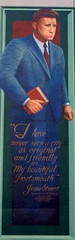
Jesse Stuart, the Kentucky author (shown left in a misleading floodwall mural), became the region's anti-pork prophet. Pork drove him to distraction and arrested his artistic development. It was downhill after his second novel, Taps for Private Tussie, a neglected classic of American literature. Hatred of pork drove Stuart further and further to the right politically until in the end he was reduced to a reactionary polemicist, romanticizing Kentucky and excoriating Ohio, extolling the land and denouncing the federal government, the satanic purveyor of pork and dependency.

What Taps for Private Tussie revealed is that, in addition to fierce independence, there is a strand of dependency in Appalachian culture that is vulnerable to governmental paternalism. "The fault lies not in our government but in ourselves," is one of the unpopular ideas subtly dramatized in Stuart's novel.


Pork Zones

In its operations, the SOGP, along with the other acronym agencies that were subsequently formed, provide public feeding tubes to keep the Portsmouth area alive, even if that area appears at times, judging by the city council, to be brain-dead. We owe our soul not to the company store but to the SOGP. Since the SOGP controls the pork strings, it controls the city's purse strings, just as the Community Action agency, another creation of USDA, controls the county’s. Portsmouth may once have been a company town, and the companies may have controlled city government, but at least the companies provided jobs. Now the companies are gone and all classes in Portsmouth, under- and over-privileged, have come to depend upon government money for survival. Portsmouth’s culture of dependency is nowhere depicted on the floodwall murals, of course, because the history celebrated there is the version propagated by the Chamber of Commerce and the SOGP. The style in which the floodwall murals are painted is photographic realism, or trompe l'oeil, but the history purveyed is at best romantic and mythic and at worst Chamber of Commerce boosterism.

Maybe the SOGP and its acronymic cousins are necessary evils. The city government may not have been up to the challenge of getting and managing all the pork the city has become dependent on, especially since some of Portsmouth’s worst addicts are the over-privileged on "the Hill." In keeping with the relatively low salaries and low respect for public employees, Portsmouth city government, with a few notable exceptions, has been run by the dumb and the dishonest, by the losers and the loudmouths. We get what we don’t pay for. From Portsmouth’s first disreputable mayor, whose business was rum and pork, to Greg Bauer and our current mayor, we have had our share of bad or crab apples. Mayor George Wear, who signed off on the creation of PACIC, later hanged himself, though if there is anything to rumors surrounding his death, there might be material there for a lurid mural.

Bush Pork

Speaking of murals, I will close with the most recent example of a SOGP murals-related pork project. The 2003 Executive Report of the Greater Portsmouth Enterprise Community (GPEC) included the following statement: “SOGP is . . . the lead agency in development of the new Welcome Center.”

From start to finish, the Welcome Center has been a pork project, as were the floodwall murals that preceded it. The funds for the Welcome Center came, like so much of the pork in Portsmouth, from the USDA. Rep. Rob “Porkman” was given credit for being the Jimmie Dean sausage maker of this deal. In his campaign speech (10 Sept. 2004) at Shawnee State U., President Bush began by praising the murals and praising Portman for making the Welcome Center possible. A former economist in the Reagan administration has published a book criticizing President Bush’s economic and tax policies and pointing out that during Bush’s years in the White House, pork projects and the deficit have reached financially obscene levels. The title of the book is The Imposter, and that’s what Bush was when he praised the Welcome Center, an imposter, because the center was a dyed-in-the-rind pork project, which fiscally conservative Republicans should be scandalized by and that the president should have had the decency not to mention in mixed company.

I want to thank my friend Rob Portman, Congressman Rob Portman,” Bush told the faithful at the Portsmouth rally. “He's a – here's typical Portman. He says, ‘Take credit for the visitors center.’ I said, ‘Wait a minute. You did all the hard lifting. All I did was see to it that it happened.’”

Like many of Bush’s unscripted elliptical-cryptical moments, this needs translating. What Bush meant is that Portman had told him not to forget to mention the Welcome Center in his speech, because it was important that Republicans and Portman and the president in particular get credit for this local pork project. The president, naturally, did not admit it was pork, anymore than the Vatican has ever admitted that the Sistine Chapel is pornography, but the cognoscenti in such situations understand what's what: here is a special gift, a pet project, a French postcard, just for you folks. Pork is one of the guilty pleasures of politics, and you disapprove of it only when it lands on somebody else's plate.

The president did say that Portman, modest (wink-wink) public servant that he is (“Here’s typical Portman”), should really be given the credit for this particular obscene project. In an attempt to exorcise the hint of the school-marmish unmanliness that haunts his father's political persona, and the cheerleading draft-dodging one that haunts his own, Bush resorts to macho posturing, to walking and talking and governing in a real hombre way. That's probably why Bush in referring to his buddy Portman's role in regard to the Welcome Center resorted to a masculine metaphor: “You did all the hard lifting.” If sneaking obscene pork projects into bills is a form of weightlifting, most congressmen are Arnold Schwartzenegers.

"Lifting" has another meaning, stealing, that is appropriate in this case, because that is what the Welcome Center is, a theft from the public treasury. One of Portsmouth’s over-privileged Republican businessmen, George Clayton, had an empty department store and adjoining property in Portsmouth’s depressed downtown area. There is an unwritten law in Portsmouth that the over-privileged with distressed property must be rescued with public funds, and George Clayton was. Commercially, Clayton's property was virtually worthless, but politically, in Portsmouth's twilight-zone "enterprise community," it was worth millions.

The floodwall murals had been promoted as a way of attracting tourist dollars to Portsmouth, but when that project attracted far fewer tourists than had been forecast, it was decided that a Welcome Center was what was really needed to increase mural visitors. Originally a Kroger’s supermarket, Kenrick’s department store was turned into a box-like, unattractive Welcome Center, at a rumored cost of millions. In Portsmouth, buildings of architectural importance are torn down, while buildings like Kenrick’s and Marting’s are treated as architectural treasures that justify the expenditure of millions of public dollars on their conversion to public buildings. The real reason they escape the bulldozing they deserve is they belong to the over-privileged who are exempted from paying the price failed businesses outside of “enterprise zones” and “enterprise communities” have to pay.

What an architect could do in the way of attractiveness and functionality was severely limited by the grocery-department store provenance of the building. You can't make a Taj Mahal out of an outhouse. The Welcome Center should help the city council understand why the Marting building cannot be made into a suitable home for the city government. We have a new attractive state-of-the-art county jail, built from scratch. Don't visitors to Portsmouth deserve as much as the inmates of the county jail?They do, but unfortunately they are prisoners of the SOGP and Portsmouth's pork-ridden politics.

countyjail
State-of-art jail: Putting inmates before tourists

Since its opening, the Welcome Center has proved to be much less tourist friendly and much more SOGP friendly than even the project’s critics had expected. The Welcome Center has been closed on weekends and holidays, when it is most likely to be of service to tourists. But the number of tourists, even in the summer, is not likely in the near future to justify the money it has taken for the creation of the murals and the conversion of a commercially worthless empty department store into a welcome center.

What the Welcome Center is useful for is as headquarters for the SOGP, which has its offices there. Like those social clubs in New York that serve as fronts for Mafia families, the Welcome Center is the front for the SOGP. The secret deals that are going to made in the Welcome Center are going to be much more important than the decisions made by the city government in the Municipal Building, which is deliberately and cynically being allowed to fall further into neglect and disrepute as a prelude to tearing it down. It is regrettable that the Municipal Building is not owned by one of the over-privileged of Porksmouth, like the Kenrick, Marting, and Adelphia buildings. If the Municipal Building was owned by one of the favored few, then it would be viewed as a Taj Mahal, and porked to the max. But it is located in Portsmouth, not Porksmouth, and owned by the people, not the over-privileged, and is occupied by the city government, not the SOGP, and that makes all the difference.

Welcomectr
Welcome Center: Putting the pork before the cart


Tuesday, February 21, 2006

Odds

kalbkroger
Mayor back when he worked for a living

I heard Mayor James Kalb recently drove over to Kentucky in a city vehicle to purchase Powerball lottery tickets. His chances of winning the Jackpot were about 1 in 146,000,000. Those are pretty high odds, and they set me thinking about what the odds might be on other unlikely events involving His Honor and other members of the Portsmouth City government.

For example:

1. What are the odds that former councilman John Thatcher will not again fleece Ohio taxpayers as he did when he unloaded his Franklin Blvd. house on Shawnee State University at a wildly inflated price?

2. What are the odds that former city council candidate Michael Malone, brother of councilman David Malone, will not forge another check?

3. What are the odds that Ward 1 councilman Timothy Loper will not continue to live outside Ward 1 in violation of the city charter?

4. What are the odds that councilman Timothy Loper will not continue to be played for a dummy by those with more brains than he has?

5. What are the odds that councilman Jerrod Albrecht will not continue to occupy his council seat illegally?

6. What are the odds that councilman Jerrod Albrecht will not doze off during council meetings?

7. What are the odds that city solicitor Kuhn will not further lower the already abysmal ethical level of city government?

8. What are the odds that councilman Rev. David Malone will not commit adultery with another member of his congregation?

9. What are the odds that Rev. David Malone will not preach on the steps of the city hall and call on God to smite all the sinners of Portsmouth (except himself)?

10. What are the odds that city clerk JoAnn Aeh will not obstruct recall candidates?

11. What are the odds that city clerk JoAnn Aeh will not hold a government job?

12. What are the odds that councilman Robert Mollette will not continue to drive his fellow council members crazy by being honest and well prepared?

13. What are the odds that councilman Marty Mohr will not embarrass himself, his family, and the citizens of Portsmouth at every council meeting?

14. What are the odds that councilman Howard Baughman will not be the smarmiest politician in Scioto County?

15. What are the odds that Daily Times reporters will not be camp followers of the city council?

16. What are the odds that police chief Horner will not accuse critics of the city council of being “domestic terrorists”?

17. What are the odds that the city council will not continue to hornswoggle the taxpayers of Portsmouth by burdening them with the Marting building?

18. What are the odds that Mayor Kalb will not come up with another scheme to tax the tenants and landlords of Portsmouth?

19. What are the odds that Mayor Kalb will not continue to try to bring gambling casinos to Portsmouth?

20. What are the odds that Mayor Kalb will not continue to drive to Kentucky in a city vehicle to play the Powerball lottery?

KALBLOT
Kalb seeks Jackpot in Kentucky

[For a previous blog on gambling in Portsmouth, click here ]

Tuesday, February 14, 2006

Hops, Shoots, & Quails

quail_2003_tx
Texas (Gambel's) Quail


Quail is both a noun and a verb. The noun refers to a beautiful smaller bird that some people consider sporting to shoot. The slang meanings of quail as a noun are numerous and usually sexual in nature. As early as Elizabethan times, quail was slang for prostitute.

As a verb, quail means acting cowardly, shrinking away, or seeking cover.

Quailing is very much in the news this week. There was an accident in Texas involving quail that was potentially extremely embarrassing to the Bush administration. Not since 1994, when George W. went hunting pigeons, shot a rare bird (charadrius vociferous) by mistake, and paid a $130 fine have Texas Republicans been so chagrined.

The current VP, the secretive Dick “No Tracey” Cheney (halliburtanus pusillanus), engaged in one of his favorite pastimes: shooting quail, perhaps bobtail (colinus v. texanus). Except in this case Cheney by mistake shot Harry Whittington, who is not a rare bird but a familiar species of well-heeled senior Texas Republican (septuagenanus texanus).

The typical first reaction to bad news by the Bush administration is to try to cover it up, which the VP and his party may have been foolish enough initially to think they could do. No such luck, because the buck-shotted Whittington, even if buck naked, will for the rest of his life be unable to pass through a metal detector without setting off the alarm. No, the cover-our ass tactic didn’t work, but Carl Rove (odious toxicanus) was involved and when Rove is the name, blaming others is the game. Rove kicked the well-heeled Whittington in the ass. Rove swift-booted him. “The geezer is at fault. The geezer is practically senile. The geezer didn’t know what the hell he was doing. The geezer blindsided the innocent VP.” The Mercury News reported that “The White House blamed the 78-year-old man whom Vice President Dick Cheney shot during a weekend quail hunting trip in Texas for the incident, as officials struggled Monday to explain why they waited nearly 24 hours before making the news public.” Loyal Texas Republican that he is, Whittington took the fall, like a dying quail. He even suffered a “minor” heart attack when one of the pellets migrated to his heart.

Quails and Chicken Hawks

Why was the quail story such bad news for the administration? Because Cheney, who is very unpopular with the electorate, had avoided serving in the military, and shooting off anything in defense of his country except his mouth was never one of his priorities. Unfair or not, the impression is out there that the tough-out-of-the-side-of-his-mouth-talking Cheney is a craven coward. He was gung-ho for invading Iraq even while he was hiding, or quailing, in bunkers. The Texas quail story was potentially very bad because a hunting accident in which he was driven to his quail by a rich host lobbyist and then allowed to carelessly shoot his hunting partner would only call attention to Cheney’s, and the president's, quail- accomplished Chicken Hawk image.

There is also the possibility that the administration tried to kill the story because alcohol was involved. If not during the hunting, then possibly before; either the VP or Whittington, or both, might have been drinking, not necessarily very much but enough to impair somebody’s judgment or reflexes. It is only a possibility, but that possibility would have been eliminated if the accident had been promptly reported and Cheney, perhaps playing hopscotch, had not avoided the media. The sheriff later reported no alcohol was involved, but since officers were initially turned away from the Armstrong ranch, what kind of investigation did he conduct? You can bet the VP will be sober as a Judge Scalia when he does face the public and the media.

Humulus Lupulus: Wolf Among Sheep

John Nichols, author of a book on Cheney’s controversial career, points out in a posting in The Nation that, as an undergraduate at Yale, Cheney hit the bottle harder than he hit the books, which was one of the reasons he flunked out. GW drank heavily, too, but he later swore off the stuff. Cheney did not. He earned two DUI's in his 20s. Nichols also points out that Katharine Armstrong, the quail hunt hostess, has admitted that some drinking took place on the day of the hunt, but she said, vaguely, it wasn’t much, “a beer or two.” Will we ever learn who quaffed how many hops at the quail hunt? And was the delay part of the attempt to cover up how much the VP consumed? Incidentally, the scientific name for hops (humulus lupulus), shown above, means wolf among sheep, because the potent hops used to grow, or prowl, among willows.

Since a lobbyist was the host of the Texas quail hunt, that also did not look good, not now that Jack Abramoff, beginning to sing like a canary, is causing the administration so much acid reflux. Abramoff donated to an organization of Israel sharpshooters when what was really needed was a practice range for Republican quail hunters. In a New Yorker piece, Jane Mayer dubbed quail hunting Cheney’s “contract sport.” She reported that in 1998, Cheney negotiated a $7.7 billion contract for Halliburton during a weekend of quail hunting. No wonder the VP has such an enormous nest egg.

Most state laws are very liberal where hunters are concerned because legislators at all levels quail before the NRA. In a hunting accident, only a fatality requires the hunters to notify authorities. Imagine if that were the case in automobile accidents. GW had been arrested for driving under the influence, and now Trigger Finger Dick ran the risk of being arrested for shooting a septuagenanus texicanus under the influence and without a license. Not having the right stamp to hunt was also, of course, somebody else’s fault, not the VP's.

The next best thing to covering up the accident completely was to put a spin on it by releasing the story to a subservient local newspaper, the Corpus Christi Caller-Times, so that the story could start being spun in the administration’s favor. Kathryn Garcia, a reporter for the Caller-Times said on MSNBC's Countdown that the relationship between the paper and the Armstrong family had been very friendly for a long time. We in Portsmouth know about the cozy relationship between the local newspaper and local over-privileged.

Following the shooting, the VP immediately ran for cover, where he will probably remain until such time as Rove can arrange a press conference in which Cheney and his victim, preferably out of his hospital bed, can exchange wisecracks, and repeat the spin Rove had already begun for the story: It wasn’t the Vice President’s fault; it wasn’t a serious injury; it was only a minor heart attack; it wasn’t a big deal.

Cowards Shoot “Quail” near Kroger's

Before Cheney went quail hunting in Texas, somebody was hunting quail, i.e., prostitutes, in Portsmouth. The Shawnee Sentinel is an alternative on-line newspaper that prints all the news that the Portsmouth Daily Times (PDT) considers unfit to print, all the news that reflects poorly on the over-privileged who control Portsmouth economically and politically. In a story dated Feb. 10, a writer reported, “The Sentinel has learned there is a new so-called ‘sport’ in town called ‘painting hoes.’ Cowardly men are practicing drive-by shootings [using paint-filled projectiles] of prostitutes in Portsmouth. A recent shooting that Sentinel reporters are aware of took place right across the street from Kroger's in broad daylight.”

It is fitting that the cowardly quail hunters of Portsmouth are doing their shooting in the neighborhood of Kroger’s because that is where the current Portsmouth mayor, James Kalb, was previously employed. Though a Democrat, Kalb likes to serve the needs of Portsmouth’s rich over-privileged Republicans. Birds of a feather flock and hunt quail together. Kalb's platform is to tax the middle and lower classes and abate and abet and abase himself before the over-privileged. He is doing all he can, figuratively and literally, to tear down the Municipal Building so that some developer can acquire the land on which it rests. As a council member and now as mayor, he has been an architect of the scam by which a local lawyer is palming off a hundred-year-old empty department store as the future home of the city government.

A duck allegedly trapped in storm drain was a front-page story in the PDT, but the shooting of prostitutes around Kroger’s is not the kind of news they want to investigate. And not all the prostitutes in Portsmouth work the streets and not all of them are women. Just as street prostitutes serve the sexual needs of their clients, the prostituted PDT reporters serve the political needs of their clients – the politicians and over-privileged of Portsmouth. The quailing reporters of the PDT duck the news, like the anthrax hoax at Shawnee State, and decline to publish anything that might reflect unfavorably on their clients. A letter-to-the-editor from a seventy-seven-year-old Portsmouth woman, a subscriber to the newspaper for a half century, was withheld from publication because she dared to criticize the mayor's craving for secrecy and his closed door policy in regard to public documents. The similarity between what is happening in the Municipal Building and what is happening at the White House is uncanny.

We are all sitting ducks and pigeons for those running the government, in Washington and Portsmouth, and we will continue to be so until we stop quailing.

Saturday, February 11, 2006

Propinquity

syringeshot


Portsmouth Police chief Charles Horner has accused local websites of “crucifying” him and his family. What did this crucifixion consist of? John Welton had revealed that David Horner, the chief’s son, had a history of drug abuse, and that he had been arrested for selling drugs. The website’s publicizing of David Horner’s drug-dealing apparently felt to the chief like a crucifixion.

Since I posted my last blog, I have learned from several sources that one of the places David Horner did his drug dealing was at Damon’s Restaurant, which is located in the Ramada Inn, directly across the street from the Portsmouth Police Station. Drug-related activities have reportedly been going on at the Ramada and at the restaurant, now operating as Damon’s, for a long time. That the Ramada is a reputed drug hangout triggered memories and prompted the following reflections:

When I came to Portsmouth fifteen years ago for a job interview, Shawnee State University reserved me a room at the Ramada. The culture shock I experienced in coming to Portsmouth reminded me of what I had experienced when I taught as a Fulbright exchange professor in communist Poland, in 1971-1972, and what I felt when I visited Third World countries in the 1973-1975, when, under the sponsorship of the U.S. State Dept., I was helping to organize international American Studies conferences to celebrate America’s bicentennial. Staying at Portsmouth’s Ramada Inn in 1989 was like staying at the best hotel in a provincial Polish city or at the “best” hotel in some poor Third World country in 1974.

I had grown up and gone to school in New England and had taught in California, but I had never been anywhere in the United States that was like Portsmouth, and I had never stayed at a hotel that was anything like the Portsmouth Ramada Inn, except in a Third World Country. The “best” hotel in a poor town attracts the worst, because it represents a degree of luxury or least an escape from poverty and depression. Pimps, prostitutes, drug-dealers – these are some of the unsavory characters who are attracted to the best hotel in a poor town, whether the hotel is in Africa, Poland, or southern Ohio.

If you try to learn about the Ramada by surfing the Internet, what you get is the folksy description that the Inn supplies to Yahoo, etc. “The Portsmouth Ramada Inn offers the old history and charm of a river city with all the comforts of a modern full service hotel.” That is what the Ramada says about itself. By contrast, what follows is part of a review by a guest at the Ramada. The title of the review, dated March 2005, is “Ramada Inn Portsmouth, Queen of the Rust Belt: Don't Drink the Coffee!”

The Ramada Inn chain has recently fallen on hard times; nowadays their properties are restricted to dilapidating high-rises near city centers, buildings that just can't quite match the glitz of the newer chain motels out by the interstate. Well, Portsmouth, Ohio, doesn't even have an interstate, but you get the picture. In Portsmouth's case, the Ramada is a five-story 1960s-style building just a block off the Ohio River (and two blocks from the US 23 bridge that's been closed for two years and will be for three more). The building and its large, free parking lot are sandwiched between a discount medical supply emporium and a convenience store that, on Sunday nights, apparently sells more Bud Light (by volume) than gasoline. Inside, the Ramada has a noticeable case of the shabbies. It’s not dirty, mind you, just rather shopworn. Carpets are threadbare and loose in the corners, elevator buttons have long since lost their paint, metal surfaces are dented, and paint is scratched and chipped. Take the elevator to your fourth-floor room, and the theme continues.” This is pretty much the way the Ramada appeared to me, fifteen years ago, not decrepit but shabby.

Sometimes people who have not lived outside of southern Ohio ask me, “Are other towns like Portsmouth?” My short answer is “No,” because there’s something unique about Portsmouth, and the uniqueness is not simply a matter of space but also of time. Not only did coming to Portsmouth feel like being in a Third World Country, it also felt like being back in the 1940s, perhaps because that was when Portsmouth, as a healthy, self-sufficient city, began slowly dying. The sense that Portsmouth is in a time-bubble, or is like an insect preserved in amber, remains with me to this day.

In my first few years in Portsmouth, certain statistics struck me. For example, I heard the pregnancy rate among teen-age white girls in this region of the country was off the charts. And the largest cash crop in a fifty-mile radius of Portsmouth was marijuana. Somebody gave me a photocopy of a column that made the claim that the Appalachian white males felt like the most discriminated-against ethnic minority in America. It was always open-season on rednecks. It was if the youth of this dying city could find nothing better to do than smoke dope, produce babies out of wedlock, and complain about being a crucified minority. And that was before things got really bad.

The Ramada Inn was not doing so hot either. I’ve been told it has been on the verge of bankruptcy for much of its existence. The expansion of the university, a publicly funded enterprise, provided financial relief, not only by sending visitors to the university there but also in providing students to live in rooms that would otherwise remain unoccupied.
Ramada
Queen of Rust Belt: Drug deals across from police station?

I was president of the union at Shawnee State U. during some politically tense times. The university was helping keep Ramda from going under financially, and they were grateful. I recall trying to contact members of an accrediting team who were visiting Shawnee during the controversial administration of Clive Veri. The visiting accrediting team was staying at the Ramada, but the suspicious management would not allow me to contact them. Whether or not they knew who I was, and I doubt they did, they knew Veri would like to insulate them from his many critics. I was reminded Portsmouth was not so different from communist Poland.

Here’s a curious thing. Mayor Kalb has said publicly that somebody is interested in the land on which the Municipal Building is located, which is the building athe police department is located in. There is a rumor that the party interested in acquiring the land is the owner of the Ramada, and that he wants the land to build another hotel. In other words, across the street from the site where the Ramada Inn has been unable to make a go of it from time immemorial without leeching on to a publicly funded institution, Shawnee State, the owner of the “Queen of the Rustbelt” wants to build another hotel, no doubt with abatements and pork renderings up the wazoo.

Propinquity means nearness in terms of blood relations and nearness in terms of place and time. Iniquity means a wicked act or thing, like drug-dealing. When it comes to the Queen of the Rustbelt, the propinquity of the iniquity is too much, even for Portsmouth.

The relocation of the police station to the building formerly occupied by a cable company, and of the city government to the Marting building, will have at least this advantage: The police station and the city offices will no longer be located directly across the street from a favorite haunt of drug-dealers, and the addicted relatives of the police chief, the politicians, and the over-privileged of Portsmouth will be able to breathe, or snort, a little easier.

Wednesday, February 01, 2006

Police State

Hornerbw
Police Chief Charles Horner


Dispatching Portsmouth

On June 20, 2004, the Columbus Dispatch published an investigative story by reporter Andy Ludlow on the Marting scandal. In that story, councilman Marty Mohr was quoted as saying the Marting building, which the city had paid $2 million dollars for, “ain’t worth anything.” The mastermind of the Marting deal, local lawyer Clayton Johnson was not quoted as saying anything, because he did not return The Dispatch reporter’s calls, nor did Robert Huff, head of the Chamber of Commerce. When the lights went on, these gentlemen, like certain household insects, scrambled for cover.

The Dispatch report on Marting’s was one of the reasons Mayor Bauer and two members of the Portsmouth City Council were recalled from office by irate voters. The Portsmouth Daily Times (PDT) could not have done this kind of investigative reporting because it operates under the thumb of the Portsmouth Chamber of Commerce and the Southern Ohio Growth Partnership. The Dispatch reported on the pressure that had been put on the PDT to follow the chamber of commerce’s political line. The Dispatch explained: “Some traditional advertisers did not buy ads in the special issue on development after the chamber [of commerce] called for a boycott of the edition, said Rick Greene, the newspaper’s managing editor.” Unlike the PDT, The Dispatch is not under the thumb of the Portsmouth Chamber of Commerce. The publication of The Dispatch story on the Marting deal helped publicize the scandal, and Bob Mollette and his wife Teresa, as irate as any Portsmouth voters, brought a suit that resulted in the ruling that the Marting sale was illegal.

Judge Marshall invalidated the Marting sale to the city because of the secret meetings in which that sale was hatched. Undeterred and brazen, city officials had tried to conduct city government in secret, as had been the case in the past. Through the courts and Judge Marshall's ruling, the Mollettes prevented them from doing so.

Fast forward two years. Now the Portsmouth City Council is up to its same dirty tricks, trying to foist the Marting building off on the city by means of a follow-up Rube Goldberg scam they have worked out with Clayton Johnson. But they have not succeeded yet. A referendum in May will put the fate of the Marting building up to the voters. The publication in 2004 of the Dispatch report on the Marting scandal awakened many Portsmouth voters, and the results of the May referendum should show whether or not those voters have gone back to sleep.

Portsmouth: Drug Pipeline

Now we have another Columbus Dispatch investigative story on a much worse Portsmouth problem – the rampant drug trafficking in our city. The January 22 front-page story was headlined, “Pipeline Down Rte. 23: Columbus’ crack trade takes root in Portsmouth.” In Ohio we have a deer hunting season that limits hunters to certain months of the year, but in Portsmouth there is, to use The Dispatch phrase, an “open season” for drug dealers, which lasts all year. President Bush said in his recent state-of-the-union address that the U.S. “was addicted to oil.” Portsmouth, which is addicted to crack – and pork – should be so lucky.

The Dispatch story has already had immediate political consequences. Who was damaged politically by it? The whole city government has been put on the defensive, but nobody has more to explain than the Portsmouth police chief, Charles Horner. To defend himself and the Portsmouth Police Department against the damaging implications of The Dispatch story, Horner addressed the city council in the conference session of the Jan. 23, 2006 council meeting. (Since the conference sessions of council meetings are not recorded in council minutes, I have relied on the audio recording of Horner’s remarks that are available on Teresa Mollette’s resourceful website.

Horner in a Corner

Because Horner has been police chief for the last four years, he has some explaining to do about why Portsmouth has become infamous as southern Ohio’s drug capital. Horner did not dispute that the city has a terrible drug problem. He told the council that Portsmouth is very high on the FBI’s national Crime Index. Horner could also have told the council that among other shameful distinctions, Portsmouth is one of only two Ohio cities that have made the list of the “Top 100 Least-Safe Cities in the U.S.A. The only other Ohio city in the Top 100 Least-Safe list is Akron.

But Horner insists Portsmouth’s high drug-crime rate is not his fault. Not by any means. He told the city council on Jan. 23 that he is proud of the many years he has served in the war against drugs. He claims he has not sat behind a desk: he has been in the trenches. If there were battle ribbons for this war, he implies he would be the most highly decorated cop in the county. Horner in his remarks to the city council was in effect telling himself, "You're doing a heck of a job, Chuckie." What he told the council, in his own words, was “I spent many a long night and many a long day away from my family to address the drug problem.” He boasted, “I will put my stats up against anybody in this county.”

What stats is he talking about? The stats that put Portsmouth high on the FBI's Crime Index? The stats that make Portsmouth one of the two most dangerous cities in Ohio? Even if stats exist for individual cops, what decorations do you deserve for being captain of a police force in a city that is one of the 100 most dangerous cities in the country and one of the two worst in the state? Portsmouth is making these shameful lists on Chief Horner’s watch.

Keystone Cops

There is a sign on the river side of the flood wall boasting of Portsmouth selection in 1979-1980 as an “All-American City.” Ironically, Akron (the other most dangerous Ohio city) was selected as an “All-American City” the following year. In 2006 the only sign Portsmouth deserves on the flood wall is “Portsmouth: Columbus' Drug Pipeline.” Because Portsmouth’s “war” on drugs has been so humiliatingly, so pathetically, so chronically unsuccessful, there is a comic quality to Horner’s extravagant claims for himself and the Drug Task Force. When it comes to fighting drugs, the Drug Task Force, under Horner’s command, has, sadly, become something of a FEMA, something of joke, a kind of Keystone Cops operation.

If Horner as a long-time drug cop and now police chief does not bear responsibility for Portsmouth’s reputation, then who is to blame? Why, his former nemesis, former mayor Greg Bauer. In his remarks to the city council, Horner said that soon after he became chief, “I attempted through the then-mayor [Bauer] to address the crime-drug issues facing the city.” Horner said he sought the aid of Portsmouth business people, but Bauer tied his hands. “Due to the intervention of the previous mayor,” Horner said, “my efforts failed.”

Why did Mayor Bauer (shown at left) prevent the chief from cracking down on narco-criminals? In his Jan. 23 remarks to the city council, Horner did not offer an explanation. However, it was rumored that Mayor Bauer abused drugs. Lee Scott told me in an interview in my 2004 DVD Recall of Mayor Bauer (available at the Portsmouth Public and SSU Clark Library) that Bauer’s drug use was “very well known in the city.” Although Horner had five criminal investigations of Mayor Bauer going at one time, he apparently did not investigate Bauer's drug activities, perhaps because it is unwise for those who live in glass houses to throw stones.


All in the Family

Because drug dealers are so pervasive, especially in Portsmouth, no family can completely protect their children against them. Drug abuse among all social classes is now the rule. Those of us lucky enough to have children who did not develop drug problems should count our blessings and not point fingers at parents who were not so lucky. Horner is one of those unlucky parents, for he has a son, David, who has a history of drug problems, and a conviction, Doug Deepe (John Welton) provided case numbers and background information on back in 2003. http://portsmouthohio.info/david_horner.htm.

So not only did we have a mayor reputed to be abusing drugs, we have the son of the police chief apparently selling them as well. But if it weren’t for the investigations by bloggers like Welton and Teresa Mollette, who would know? An online search of public records now will turn up nothing on David Horner, because on Nov. 6, 2002, he filed to have his criminal records expunged, and on Dec. 12, 2002, those records were expunged by order of Portsmouth Municipal Court Judge Richard T. Schisler.

A police chief who has a son dealing drugs has a potential conflict of interest – a conflict as a public law enforcer and as a father. John Welton accused Chief Horner not only of helping expunge his son’s drug arrests but also of arranging for the surveillance of a New Boston police officer who was investigating his son for drug dealing in New Boston. Horner told the city council that he did not want to "emotionalize" the drug issue. But that is exactly what he did when he accused bloggers of having "crucified" him and his family, by which he meant Welton's publicizing David Horner's drug arrest and Judge Schisler's subsequent expungement of that arrest and suspended sentence from public records.

It was rumored that Mayor Bauer was about to fire Horner, but before Bauer could fire him, Horner made charges against the mayor that led eventually to the mayor’s recall by the voters. Russell Cooper, claimed he was targeted by Horner because he attempted to recall councilman David Malone. The New Boston police officer who was investigating Horner's son claimed he was being set up by Horner. Lee Scott, who was a central leader of the recall of Mayor Bauer, has recently made a similar charge against Horner in a Jan. 21 letter, which he posted on Moe’s Forum.

Lee Scott Accuses Horner

Attention - Horner, Donnini, DEA & others.

Please stop sending drug dealers to me.... I am not a dealer and am not interested in buying the two pounds offered yesterday. It is just as illegal for you to try to sell drugs as it is for me to buy them. I am not interested in going back to prison and the next person you send (friend of mine or not), I will deal with them like I would any other piece of crap that is trying to harm me or mine and then-----IT IS YOUR TURN.

PLEASE - try and concentrate on the real problems (some are your very own) and leave me out of your setups with busted snitches----
Thank You----- LEE

Molletttes in Horner's Crosshairs

Bob and Teresa Mollette, active in the reform movement, also appear to be in Horner’s crosshairs. If Horner showed half as much determination to crack down on drug-dealers as he has on blogging citizens identified with the reform movement, then maybe the city’s reputation for crime and corruption would not be quite as bad as it is. Chief Horner and Mayor Kalb are determined to stifle the political reform movement in Portsmouth and to curb the Mollettes in particular from revealing the shenanigans of public officials on their websites. Bob Mollette's very professional and informative site is driving them crazy.

The mayor and the chief of police are doing everything they can to frustrate the Mollettes from bringing transparency and honesty to city government, and they are coordinating a public relations effort, with the complicity of the Portsmouth Daily Times, to discredit the Mollettes, the two citizens who are currently doing the most to reform our corrupt city government.

Mollettesites
Mollettes' websites front-page news in Daily Times

The Portsmouth City Council is now trying to change the city charter to make it more difficult for voters to recall elected officials. This puts Horner and the current mayor in a very awkward position, because they would probably not be chief and mayor if Bauer had not been recalled. “I have seen the best of recalls and I have seen the worst of recalls,” Horner told the city council. The recall of Bauer, which saved Horner’s job and put Kalb in the mayor’s chair, was good, but the more recent attempts to recall other city officials are bad. Or so he implies.

Up to his eyeballs in city politics, in which he may one day drown, Horner has become the cheerleader as well as the tool of the current city administration because his continuing as chief of police, in the face of Portsmouth’s notoriety as a drug hotbed, depends upon the support of the city council and the mayor. If they will protect him and his job, he will protect theirs from recall. In an extraordinary statement to the city council, on Jan. 23, Horner claimed that those who have recently attempted to recall public officials are “domestic terrorists.”

Domestic Terrorists

In nothing has Horner and the police department been as diligent and thorough as in investigating what Horner characterized as an alleged “series of improprieties” in the recall petitions of reform candidate Russell Cooper a native America who was trying to mount a challenge to David Malone, the rubber-stamp councilman of Ward 2. Cooper’s purported improprieties received the kind of high priority, all court police press that in other cities might be used in the war against drug dealers. But in Portsmouth it is not narco-criminals but those who challenge the city government who are perceived as the most serious threat, who are denounced as “domestic terrorists.”

Mollettes
Teresa and Bob Mollette: Domestic Terrorists?

We have the example of the Bush administration playing the terrorist card to cover up its own corruption and incredible incompetence, so it should not come as a surprise to see the chief law officer of Portsmouth, a city awash in drugs and corruption, try the same desperate and irresponsible trick. With each passing week I am more and more struck by how political developments in Portsmouth resemble those in Washington, and I wonder how much longer the one and the other administration will be able to keep it up and how much further they will go in trying to stifle their critics. Corruption, incompetence, lies, surveillance, the erosion of civil liberties in the name of fighting terrorism – that unfortunately is the state of the union and the state of Portsmouth.