Friday, March 17, 2006

House of Ill Repute

loperlair

519 Third Street


In recent blogs, in “Grossly Misrepresented” and “Miserable Failures,” I made the case that, at this particular time, for those of us who live in the First Ward, in the city of Portsmouth, in the state of Ohio, in the United States of America, things could not be worse politically, considering who we have representing us as president, governor, congresswoman, mayor, and councilman. I want to say more, now, about Timothy Loper, the councilman in question. I will elaborate on what I had written about him in an earlier blog, “Lord, Help Us!” Rumors that Loper has recently undergone a religious conversion only adds to the eerie symmetry between the highest and the lowest, between the White House and the First Ward. All I can say is that when incompetence, criminality, and Pentecostalism combine, “Lord, help us!”

I first heard the name Timothy Loper in 2004, when he announced he would run as the reform candidate to replace councilwoman Ann Sydnor, who had angered voters in the First Ward by supporting the controversial purchase of the Marting building. At the time, I was making a documentary on the recall movment, and I arranged to interview Loper. Up until that time, I knew very little about Portsmouth’s politics, but in the process of making the Recall of Mayor Bauer I learned that the politicians and the over-privileged of the city were, as Roy Rodgers, Portsmouth’s adopted native son, might have put it, “as crooked as rattlesnakes.”

When I told an acquaintance whose opinion I respect that I was going to interview Loper, I was warned he was “worthless,” unable or unwilling to hold a job, and like other Lopers, prone to lawbreaking and violence. I knew that Carl Loper, a member of the Portsmouth Police Dept., had slain his estranged wife with a shotgun. I knew that Carl’s son, Zane Loper, a part-time policeman, had been convicted of sexually molesting retarded children at the Mental Retardation and Developmental Disabilities (MRDD) center, and that he was serving a long prison term. Timothy Loper was not in their league, of course, but my acquaintance warned me that I and anyone else in the reform movement who helped him get elected would live to regret it.

In spite of these warnings, I interviewed Loper on the porch of his home on Madison Avenue on a humid afternoon. His wife came to the door once during the interview and one of them asked the other if the dog had been fed. They spoke like caring dog owners and like loving parents, which I'm sure they are. Loper told me of his difficulty in finding work in the Portsmouth area. He expressed frustration at those who controlled the city, those in the Southern Ohio Growth Partnership (SOGP), for failing to bring in new industries and jobs to the area. He expressed strong disapproval of the purchase of the Marting building by the Portsmouth City Council. “I’m in there writing a letter-to-the editor,” he told me. “It don’t make sense,” he said, “paying two million for a building they could’ve got for half that.” Listening to him, it was easy to believe he was a concerned citizen, a sincere reformer, the genuine article. So even though he had no experience in public life; even though he was a high school dropout; and even though I had been warned against him, I voted for him.

Only later did I learn that Loper himself had not been part of the recall movement. I recently talked to someone who had collected signatures in the First Ward for the recall of Sydnor. "How many signatures had Loper collected, I asked? I was told, "One!" While he did none of the work that made the recall vote on Sydnor possible, Loper offered himself as a recall candidate, much like someone who watches others plant and nurture a crop and then volunteers when it is ripe to harvest it, for himself.

It was a very close race, but Loper was finally declared the winner. But not long after he took his seat on the city council, he changed his tune and supported the Marting’s scam and voted with those other council members who are in the pocket of the SOGP, which controls Portsmouth economically and politically. He had cashed in on the reform movement and then sold it out. In August 2005, Loper told Julie Stout that after he was first elected to the council he was brought to meet Clayton Johnson, the capo of the SOGP. Like the dog in the old RCA advertisement, Loper learned to recognize his master’s voice. He was not going to bite the hand that might feed him.

If I had checked out Loper’s rap sheet on the Portsmouth Municipal Court website, as Lee Scott was urging people in the recall movement to do, I might not have been so surprised at what a lowlife Loper showed himself to be. Among other things, his rap sheet reveals that he has a drinking-and-driving problem. He has been arrested for driving under the influence, driving with a suspended license, driving with expired tags, and driving well over the speed limit. In May 1998, his traffic problems resulted in a thirty-day sentence in the county jail, which was suspended, but he was put on probation for a year.

If driving and drinking are a problem for Loper, so is handling money. In March 1995, he and his wife were taken into court and ordered to pay a West Virginia finance company $3,653, plus interest. In July 1997, there was another judgment against him for $1,766. In March 1999, he was taken to court for a $1,662 debt, which was garnished from his salary at Mills Pride from Sept. of 1999 to Feb. of 2001. For his failure to pay taxes, in February 2005, the Ohio Dept. of Taxation put a lien on his Madison St. house. In March 2005, in a court action, the mortgage on their house was foreclosed and the house was ordered sold at a sheriff’s auction, which took place on 17 August 2005. If what Loper told Julie Stout shortly afterwards was true, he not only lost his house but he came close to losing his wife. A separation was at least a possibility.

Those are the financial and personal difficulties Loper was in at the time he decided to run for public office, first as a recall candidate, in 2004, and then for a full term, in November 2005. It seems some people, when they fail at everything else, when they are desperate enough and have no where else to turn, turn to religion and to politics. To revise a famous observation of George Bernard Shaw: Those who can, do; those who can’t do anything else, run for public office, whether it’s for the presidency of the United States or for the Portsmouth City Council. Talk about miserable failures, from the very top to the very bottom, from the White House to the First Ward, we’ve got them.

Councilman Loper

The high school dropout who has trouble handling alcohol, automobiles, and money, found himself as a councilman with something other people finally were willing to pay for: his vote. He had found his calling. Like a surfer who takes somebody else's surfboard, he had ridden the recall wave into office and then had joined with those who want to make recalls even harder than they already are. Recalls are already harder, under the Portsmouth city charter, than they are in those cities that follow the Ohio Revised Code. So Loper and Mayor Kalb agreed that recalls should be curbed. It is like two guys who used somebody else's surfboard to ride into office, then turn around and want to practically outlaw surfboards. I say practically outlaw because the city solicitor would be the one to decide if recalls can get on the ballot. Putting David Kuhn in charge of recalls is like putting Michael Jackson in charge of a kindergarden.

Having been elected to the city council as a reform candidate in the special recall election of 2004, Loper was determined not to let his campaign promises and the city charter stand in his way of being reelected in November 2005. Since he was running unopposed, his chances of reelection looked good. There was one serious problem, however. Loper and his wife had moved out of the First Ward following the auctioning off of their Madison St. house. How could he get around the First Ward residency requirement, stipulated by the city charter, when he was living at 4024 Pleasant St., in the Sixth Ward? He got around it with the help of some friends from West Portsmouth and from city solicitor David Kuhn.

519 1/2 Third St.

519 1:2 3rd St

There is a house in the First Ward at 519 Third Street. A couple named Flailey had bought the house in Sept. 2002, only to sell it the following year, 2003, to Bart and Mary Journey. In 2004, the house was in the name of a BBC trust. The following year, August 2005, it was in the name of the Journey Family Trust, of West Portsmouth. Several Journeys of West Portsmouth had gained notoriety in the past as a result of an insurance scam that resulted in convictions and prison terms for at least two of them, Mark and Bart Journey, apparently the same Bart Journey who bought 519 Third St. in 2003.

The Scioto County Auditor lists 519 Third St. as a two-family dwelling,with the owners reportedly occupying the bottom floor, with another apartment occupying the second floor. Since auditor’s records show there is only one bathroom in the house, it must have been an unusual arrangement between the occupants on the first and second floors. A note on the auditor’s listing says, referring to the apartment on the second floor, “CHECK IT OUT.” I wonder if anyone ever did.

The Third St. house was built in 1900, as a private residence. At some point a shed in the rear and a narrow annex were added on the eastern side of the building. The auditor’s records suggest and others have told me that a shoe repair shop once occupied the narrow annex. The annex has been referred to more recently as a “storeroom,” and even more recently as the residence, or office, of Third Ward councilman Timothy Loper. There is an attempt to make it look like somebody lives at 519 and at 519 1/2 Third St. The chairs outside the house have been there all winter, but I have never seen anybody sitting in them, winter or summer. There is an orange traffic cone in front of the front door, which might suggest there is a lot of traffic going in and out, but I have never seen any, though I have heard a rumor of drug trafficking.

Whenever it was added, the white vinyl façade on the front lower half of the house, like the façade on the Marting’s building, is meant to hide its age. A photograph of the rear of the shingled house gives a more accurate indication of the decay – the loose shingles, the rotting gutters, the sagging frame. Judging by the exterior and especially interior condition of the house, it is very unlikely anyone lives there now. When anybody last actually lived in the house is not clear.

On 18 Oct. 2005 in a memo to the city council, with a copy to Harald Daub, who had asked for an investigation of Loper’s claim that 519 1/2 Third was his legal residence, City Solicitor David Kuhn wrote that he had viewed the outside and inside of the property. “The property is being remodeled, with new electric, plumbing and drywall work, and the First Ward Councilman is paying for the renovation, even though the property is owned by the Journey family. The First Ward Councilman has telephone service and internet service there, and receives mail there. Until the renovation is completed, the First Ward Councilman is temporarily residing out of the First Ward, but he intends to resume residing at 519 1/2 Third Street after the renovations are completed.” Yes, and you better not question the truthfulness of this malarkey, or you might end up in the hospital, as Harald Daub did after Loper sucker-punched him one evening. Daub tried to file charges, but there were no witnesses. Loper, like the city council, likes to do his dirty work in the dark.

Having asserted that 519 ½ Third is Loper’s bonafide residence, Kuhn concluded the First Ward is where Loper is entitled to vote. “The standards employed by the Board of Elections to determine a person’s voting residence,” Kuhn wrote, “includes the provision that if the voter temporarily leaves the residence at which he is registered to vote, and intends to return, the voter is considered to be validly registered to vote at the address to which they intend to return.” The reason where Loper is legally qualified to vote is an important issue is that he could not continue to sit on the city council if his legal residence was no longer the First Ward.

5193rdrear
Rear of 519 Third St.

Kuhn claimed last Oct. that Loper intended to renovate, but the only permit that has been issued for 519 Third St. was for electrical work, in June 2002. That permit expired in June 2003, before Loper made his claim that 519 1/2 was his residence. Loper’s allegation that 519 ½ is his residence and that he intends to renovate it, at his own expense is a ruse, concocted by him and the city solicitor, to enable Loper to continue, in violation of the city charter, to live with his wife in the Sixth Ward while representing the First Ward on the city council, or I should have said while representing the SOGP on the city council.

Loper’s Madison St. house was auctioned off by the sheriff because Loper had failed to keep up with the mortgage and the taxes. How he would be able to come up with the money to renovate part of a house owned by somebody else is just one of the curious matters connected with 519 Third St. Loper has also made the claim that 519 1/2 is his office. An “office” does not qualify as a residence, a name on a mailbox does not establish residency, and over six months with no renovations on the house having been completed, is hardly “temporary.”

In a notarized affidavit, Julie Stout testified “That Timothy Loper told me that his wife had no interest in moving back to the First Ward, and so he would find an apartment within the First Ward to fraudulently claim as his residence while continuing to reside at his current address outside the ward.” Stout also swore that Loper “hinted that money would not be an issue with him acquiring a new residence in the First Ward. I [Stout] asked him how he would get the money to get a new place that was better that the house on Madison that his wife found so unsatisfactory. He told me he knew some people who would set him up with an apartment.” Who are these people he knew who would set him up in an apartment? The ex-convicts from West Portsmouth or the con artists of Portsmouth?

The provision of the ORC that the city solicitor alluded to but, characteristically, did not specify in his 18 Oct. 2005 memo to the city council, was ORC 3503.02 (A). That provision states “That place shall be considered the residence of a person in which the person’s habitation is fixed and to which, whenever the person is absent, the person has the intention of returning.” This rule to allow someone to vote in a ward from which he or she is temporarily absent does not cover Loper’s case. Loper’s fixed place of habitation was 114 Madison St., where he and his wife lived for years. When that home was auctioned off, Loper and his wife lost their fixed place of habitation. They moved to another house in another ward, and only then did Loper begin to look for a place to use as his new address in the First Ward. The attempt by Loper to claim 519 1/2 Third St. as his fixed place of habitation to which he intended to return is an obvious attempt to remain qualified to be councilman from the First Ward. But 519 1/2 Third St. never was his fixed place of habitation, so his declaration of his intention to return to it is a legal and logical absurdity. You can not return to live in a place you have never lived in. Something has been “fixed” here, but it is not the habitation, and the fixer is the city solicitor.

The issue of which ward Loper has the right to vote in is directly related to issue of whether he has the right to remain as councilman from the First Ward. If he does not have the right to vote in the First Ward, he does not have the right to serve as its councilman. If his primary residence is in the Sixth Ward, he is not qualified to remain on the city council. The Portsmouth City Charter (Section 3) states that “Any member of Council elected from a ward shall forfeit his office if he removes from said ward, and then Council shall at once fill the vacancy for the unexpired term.”

Kuhn’s claim that Loper’s living with his wife in the Sixth Ward is only temporary is something that Loper and his wife will have to swear to, because I have filed a formal challenge to the Board of Elections, asking them to investigate and hold a hearing on the matter. I believe the Board of Elections, at a minimum, has a responsibility to question Timothy and Teresa Loper to determine where they and their dog now live, and whether Loper, his wife, and his dog intend to settle permanently in that storage room at 519 1/2 Third St.

Loper should not be allowed to continue to lie about his place of residence, because it makes a mockery of the Portsmouth City Charter, the Ohio Revised Code, and the spirit of honest democratic government. This shameful situation raises the question of whether Portsmouth is a city of laws or a city where the law can be debased in order to keep in office a corrupt councilman who is useful to the rich and the powerful. In what other city would such fraudulent, patently deceitful electoral shenanigans be tolerated?

Think of 519 Third Street as the house where Portsmouth’s culture of prostitution is shamelessly practiced, as a kind of annex to the city council chambers, and when every church and building of notable architectural and historical importance in Portsmouth is torn down to make way for parking lots and shopping malls, let 519 Third St. remain, along with the Marting building, as a monument to the vices of our river city, so that a hundred years from now parents can take their children by it and say, “There, ninos, is the house of ill repute, where a gringo councilman claimed he lived, back in the days when criminals and corrupt politicians and developers controlled this city, and no one believed it could ever be any different.”


519 1:2

Wednesday, March 08, 2006

Miserable Failures

Terrorism For Dummies
Terrorism for Dummies (click)


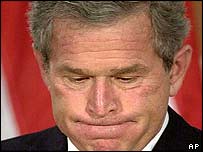
When George W. Bush made his campaign appearance at Shawnee State University in Portsmouth on September 10, 2004, I was one of those peacefully demonstrating on campus against his administration and his policies. I held up a hand-lettered sign that read: BUSH: A MISERABLE FAILURE.

I was quoting a phrase Dick Gephardt had used to describe Bush's career. Referring to that phrase in The Atlantic Monthly, Jack Beatty had written, With one phrase Dick Gephardt has defined the issue to be decided next November. Can a ‘miserable failure’ of a president win re-election? Bush's victory would testify to a civic failure more dangerous to the American future than any policies implemented or continued during a second Bush term. A majority would have demonstrated that democratic accountability is finished. That you can fail in everything and still be re-elected president.”

I and the other demonstrators had been corralled on a traffic island at the entrance of the university, surrounded by yellow police tape, as if we were at the scene of a crime or accident. As we would learn, we were being quarantined, so the dissent we represented could be confined and insulated from the president. We were not going to be allowed to pop Bush’s bubble. Most vehicular traffic coming from the north, down Chillicothe St., would have passed our traffic island to enter the university, so we were under the illusion that the Bush bus entourage would have to pass us and possibly see our signs. We were naïve enough to think we were being given a chance to be seen, however fleetingly, by the President and his entourage. But those who planned Bush’s visit had directed his entourage to take a sharp right turn, instead of arriving at the university by the front door, they entered by the back, avoiding us demonstrators. His entourage drove to the university along Front St., where he could catch a glimpse of the murals. He was given a picture postcard view of Portsmouth’s past instead of having to look at the angry realities of America’s present. Bush had campaigned in 2000 as a unifier , not a divider, but he had polarized the nation like no one since Richard Nixon. As a unifier, at least, he was a miserable failure.

Through the efforts of an electronic prankster, George Johnson, who wanted to break through the Bush Bubble, web surfers who Googled the phrase “miserable failure” were directed to Bush’s official biography on the White House website. With Karl Rove at the wheel, the sharp right turns the Bush administration had been taking ever since 2000, had alarmed and angered many Americans. Bush handlers could maneuver the president away from demonstrators in Portsmouth, but electronically, out on the internet highway, “miserable failure” led directly to the White House. The name George Bush had become synonymous on the internet with miserable failure.

Keeping protestors out of sight, squelching or Swiftboating opponents and critics – this was standard operating procedure for Bush’s 2004 reelection campaign and an integral part of what came to be known as Bush’s “Bubble Presidency.” Bush became the Bubble Boy. As he was in Portsmouth on Sept. 10, 2004, Bush has been carefully shielded from political reality, has been allowed to persist in a catastrophic foreign policy, resulting in the loss of tens of thousands of lives, hundreds of billions of dollars, and precious opportunities to deal with America’s real enemies. From Social Security reform to Medicare, from FEMA to domestic wiretapping, Bush’s domestic policies have for the most part been dismal failures. If people were justified in the fall of 2004 talking about Bush as a miserable failure in his first term, what can we possible say, what adjective will be equal to the challenge of adequately describing his performance, foreign and domestic, in the sixteen months since then? “Miserable” no longer seems equal to the task. “Horrendous” would now be more appropriate.

In the 2004 campaign, Bush avoided visits to large universities, even avoiding the University of Texas, where the demonstrators would have protested in such large numbers that they would have burst any bubble his handlers tried to blow. They could not have corralled Texas students behind yellow police tape on a small traffic island. Bush campaigned instead at religious and military schools and on smaller universities in conservative areas, like southern Ohio. But because of Bush’s miserable failures, southern Ohio was no longer as conservative as it had once been, which was why a bubble was necessary even in Portsmouth.

From the transcript of Bush’s rally inside the Shawnee gymnasium, I can begin to get a sense of what it was like inside the Portsmouth bubble: a crowd of conservative, carefully screened Fox News junkies, a few prescreened, prescripted softball questioners, and a few Democratic turncoats, or “discerning Democrats,” as Bush called them in his Portsmouth speech. “I know this part of the world is like parts of Georgia and like parts of Texas,” Bush said, “where there's a lot of what we call discerning Democrats who – with whom we share a lot.”

Zell Miller: Working Both Sides of the Street

A “discerning Democrat” was with Bush at the rally at SSU, namely 72-year-old Senator Zell Miller, of Georgia, an experienced political prostitute for both political parties. In a speech at the Democratic national convention in Madison Square Garden that had nominated Bill Clinton twelve years earlier, Miller had given a rousing yellow-dog Democrat speech in favor of the Man from Hope, as Clinton had been packaged by his handlers. Miller had not settled for just praising Clinton, he had belittled President Bush’s father as “a timid man who hears only the voices of caution and the status quo” and a “commander-in-chief [who] talks like Dirty Harry but acts like Barney Fife.” Miller had not only questioned the senior Bush’s politics; he questioned his manhood. That was at Madison Garden, back in 1992.

Miller had been out of office when he was appointed to the unexpired term of Georgia’s Senate Republican in 2000, and he showed his gratefulness to Republicans by becoming as Zell-ous a Bush supporter as anyone in Bush’s rightwing base.

In the same Madison Square Garden on Sept. 1, 2004, working the other side of the street, Miller was the keynote speaker at the Republican Convention. Just as he had in 1992 questioned the manhood of the senior Bush, who had been a fighter pilot in the Second World War, Miller impugned the patriotism and manhood of John Kerry, a decorated veteran of the Vietnam War. Miller’s attack on Kerry was so stupid and vicious that it produced an immediate backlash in the media, forcing Bush’s brain, Karl Rove, to keep Miller away from Bush for the rest of convention. Rove was only too happy for others to do the President’s dirty work, and swiftboat the Democratic candidate, but he did not want those accusing Vietnam veteran Kerry of cowardice to get close to the President and Vice President, lest people be reminded of Bush and Cheney’s aversion for combat in Vietnam. The president and vice president wanted no part, thank you, of shooting anything larger or more threatening than an endangered species of bird or wing-clipped quail. A ranch in Texas, not a rice paddy in Vietnam, was where they preferred to prove their marksmanship.

So Miller did not sit in the presidential box at the Republican Convention at Madison Square Garden, reportedly because the president and the first lady were somewhat embarrassed by his attack on Kerry. “GOP backs away from Miller’s blast,” was the headline of an MSNBC report. “After gauging the harsh reaction from Democrats and Republicans alike to Sen. Zell Miller’s keynote address at the Republican National Convention, the Bush campaign — led by the first lady — backed away Thursday from Miller’s savage attack on Democratic presidential nominee John Kerry, insisting that the estranged Democrat was speaking only for himself.”

That was the Rove spin on things in the first week of Sept. But in Portsmouth, on Sept. 10, the traitorous Miller was the lionized political hero of Bush’s entourage. Bush flattered the “discerning Democrat” and praised him for the speech he had given at the Madison Square Garden convention. “And Zell gave a heck of a speech the other night, too,” Bush told the Portsmouth faithful.

Teddy Roosevelt, a Republican with insecurities about his cajones, liked to carry a big stick and travel to Africa to shoot big game. By contrast, Republicans leaders today who need to prove their manhood go to Texas to shoot small birds bred and clipped for just that purpose, and strut around in hunting clothes and flight jackets talking tough, “bring ‘em on,” and declaring missions, in which they had not fought, accomplished.

Success is counted sweetest
By those who never succeed.

There was at least one other Democrat at the Portsmouth rally, the mayor of Portsmouth, Jim Kalb. “I want to thank the mayor, Jim Kalb, for being here,” the president said. “Mr. Mayor, I'm honored you're here. Appreciate you taking time.” Whether he was a “discerning Democrat” and whether he ended up voting for Bush only Kalb knows for sure. But like Zell Miller, Jim Kalb is a politician who knows how to work both sides of the street. He has the support of the corrupt Republicans who control Portsmouth economically and he has the support of unions and the Democratic Party. Ted Strickland, the Democratic candidate for governor, swore Kalb into office.

Kalb became mayor of Portsmouth as a result of a recall election for which he got the ball rolling. Kalb turned over to the police chief, Charles Horner, evidence that the former Republican mayor, Greg Bauer, a failed businessman, had been engaging in criminal actions in connection with the city’s purchase of an empty old department store for $2 million. President of the Portsmouth City Council at the time, Kalb would automatically become mayor if Bauer was recalled. Police chief Horner also had a stake in Bauer’s recall, because Bauer was reportedly about to fire him because of his own shenanigans. Portsmouth has a serious drug problem, and the chief’s son David, an addicted drug dealer, was reportedly shown preferential treatment, including having his drug convictions expunged from court records. The chief was also accused by the Shawnee Sentinel of creating a personal bank account out of money obtained in drug busts.

Unfortunately, when some people who are much more ambitious than they are talented reach the end of their rope, when their failures in the real world finally convince them they can’t make it any other place, they go into politics. This was the case not only with George Bush, whose failures in the oil business and baseball preceded his failures in politics, but also with Kalb, who had gone about as far as he was going to go at the local Kroger’s supermarket, where in an example of the Peter Principle, he rose to be manager of one of the departments, a glorified "shelf-stocker" the Sentinel called him, but he rose no higher, apparently lacking the native intelligence, education, and executive ability to be a Kroger manager. To rework an aphorism attributed to George Bernard Shaw, “Those who can, become managers at Kroger’s; those who can’t, become mayors of Portsmouth.”

As a result of Kalb turning him in, Mayor Bauer was recalled from office, but neither he nor anyone else in city government was ever indicted for crimes in connection with the department store. It was only a game of musical chairs. Once in office Kalb became as enthusiastic a supporter of the purchase of the 100-year-old department store and its conversion into a “new” city hall, as Bauer had been.

Just as President Bush Kalb turned out to be America’s miserable failure, Kalb has turned out to be Portsmouth’s. Like Bush, the best thing Kalb likes about his job is the vacations. He also engages in bizarre personal feuds on Moe’s Forum, a local internet chat room, and behaves strangely at times in public, as I observed on one occasion when he and his wife Allison invited themselves to a meeting of his critics. Kalb has accused the councilman Bob Mollette of being a pawn in the hands of Teresa, his wife, who is an outspoken Kalb critic. Mollette isn’t a real man, the same charge Zell Miller had made against Bush Sr. and against Kerry. The irony of this charge is that Kalb does not do anything without first checking with his wife, who is to the mayor of Portsmouth what Karl Rove is to the president of the United States. If Rove is George Bush’s brain, she is Jim Kalb’s.

When Portsmouth’s mayor and first lady had been seen driving in a city car to buy Powerball tickets in Kentucky, she reportedly began putting a spin on it when they got back to Portsmouth. What did she tell people they had been doing before they made their excursion to Kentucky? They had been visiting the display of hundreds of American flags in Tracy Park, across the street from Kroger’s. It was a spin worthy of Karl Rove. How could they be doing anything wrong if they had just previously been honoring the nation's most sacred image and those who had died in defense of it? If politics is the first refuge of miserable failures, patriotism is the last.


Wednesday, March 01, 2006

Porksmouth

pigguy


I’ve heard Republicans blame the unions for Portsmouth’s decline. I’ve heard Democrats blame the bosses. I think neither the workers nor the bosses are to blame.

The fundamental reason for greater Portsmouth’s economic decline, and for the general decline of American industry in the last half century, is globalization, which is a term for economic changes that have been going on internationally for over a century but which accelerated after the Second World War. Globalization is international economic integration, or, to its critics, globalization is the internationalization of economic exploitation.

As the U.S. declined industrially as a result of globalization, those regions and sectors of the American economy most affected by the decline came to depend more and more upon the state and especially the federal government for financial assistance. Large chunks of this financial assistance were in the form of pork, which is defined on Porkopolis, a conservative pork-alert blog, as “a government project, appropriation or appointment that yields jobs or other benefits to a specific locale and patronage opportunities to its political representative.” One of the features of Porkopolis is a series on Pork in Portsmouth.

Porking Portsmouth

When did the porking of Portsmouth begin? When did Portsmouth become Porksmouth. I’m not sure, but in March 1964, the Portsmouth City Council made a momentous decision. In a resolution, numbered unlucky #13, the council turned much of the economic control of the city over to a private “non-profit” corporation named the Portsmouth Area Community Improvement Corporation (PACIC).

In Resolution #13, the Portsmouth City Council granted PACIC an extraordinarily broad mandate. The mandate of this private corporation, consisting mainly of businessmen, bankers, and lawyers, was no less than “To promote the health, safety, morals and general welfare of the inhabitants of the community . . .” In the following year, 1965, the Ohio state legislature passed a law allowing municipalities to designate community improvement corporations, such as PACIC, as their agent. As if PACIC hadn’t already been granted extraordinary power in Resolution #13, for the health, safety, morals and general welfare of the people of the Portsmouth area, the Portsmouth City Council passed another resolution, #30, designating PACIC as the city’s official agent, or legal representative.

The previous, pre-war, heavily industrialized but now depressed post-war city of Portsmouth became classified by the USDA as a “rural area,” part of the Appalachian region, thereby making it eligible for USDA pork. I was told by a native of Portsmouth, who moved back after spending most of his adult life elsewhere, that he was surprised to discover upon his return to Portsmouth that he had grown up in Appalachia. To someone growing up in Portsmouth back in the 1940s and 1950s, being Appalachian had more disadvantages than advantages, and was more likely something to be ashamed than proud of. Beginning in the 1960s, when President Johnson declared war on poverty, that situation changed. Because it was repackaged as an Appalachian community, Portsmouth qualified as underprivileged and neglected and a candidate for special government assistance. If you were Appalachian, you were assumed to be a victim of poverty, and the government was obliged, perhaps as a holdover of the Great Depression, to assist the victims of poverty as much possible.

As far as Ohio is concerned, Portsmouth is at the top of the Federal Pork Barrel. The primary governmental pork provider for Portsmouth is the U.S. Department of Agriculture (USDA). To facilitate the funneling of federal dollars into south-central Ohio, the USDA designated the Portsmouth area as the Greater Portsmouth Enterprise Community (GPEC), a kind of most-favored-pork-district classification. Apparently, no other Ohio area enjoys this distinction. I don't know whether the late Vern Riffe had anything to do with it, but Portsmouth is unique

Incidentally, when it provides relief, the US government prefers, in Orwellian fashion, to convey it in the language of entrepreneurial capitalism, in which “enterprise” is a sacred word. In urban areas there are “Enterprise zones,” in rural areas “Enterprise Communities.” Lord help those who live in neither, because the government apparently will not.

Privatizing Pork

With the creation of PACIC, in 1964, important functions of the Portsmouth city government were essentially privatized. However high-minded its original objectives might have been, PACIC and its successor, the Southern Ohio Growth Partnership, assumed the role of a private agency responsible for the acquisition and distribution of government funds. To put it bluntly, PACIC-SOGP became a pork dealer, with none of a public agency's obligation to openness. John Welton (Doug Deepe) reports that members of the SOGP are sworn to secrecy.

In this economic twilight zone of enterprise zones and enterprise communities, the only real competition is among those vying for government assistance. It is a rare “entrepreneur” in the “enterprise community” of greater Portsmouth who does not begin by asking the SOGP for some kind of federally or state financed special assistance. According to the folklore of American capitalism, in the old days entrepreneurs pulled themselves up, Horatio Alger style, by the bootstraps. Now they pull themselves up by government pork straps. Horatio Alger, Jr., incidentally, was the son of a Protestant minister who went bankrupt trying to make a killing in real estate in my home town, Revere, Massachusetts, and Horatio Alger, Jr. himself was a minister who was defrocked after sexually molesting boys in his Cape Cod parish. These are not the kind of facts that get taught in public schools, memorialized in murals, or acknowledged by the Horatio Alger Association of Distinguished Americans (HAADA).

The politically conservative HAADA gives annual awards, nicknamed “Horatio’s,” to those who have allegedly pulled themselves up by their bootstraps. Enron CEO and President Bush buddy Ken Lay was one of those awarded a “Horatio” by the HAADA. Since then Enron has collapsed and Lay has been indicted. Did the entrepreneurial Kenny-boy” ever benefit from government favors? Did Portsmouth real estate developer Neal Hatcher ever get an abatement from the SOGP or a sweetheart dormitory deal from the local state university?

Taps for Private Piggy

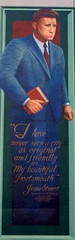
Jesse Stuart, the Kentucky author (shown left in a misleading floodwall mural), became the region's anti-pork prophet. Pork drove him to distraction and arrested his artistic development. It was downhill after his second novel, Taps for Private Tussie, a neglected classic of American literature. Hatred of pork drove Stuart further and further to the right politically until in the end he was reduced to a reactionary polemicist, romanticizing Kentucky and excoriating Ohio, extolling the land and denouncing the federal government, the satanic purveyor of pork and dependency.

What Taps for Private Tussie revealed is that, in addition to fierce independence, there is a strand of dependency in Appalachian culture that is vulnerable to governmental paternalism. "The fault lies not in our government but in ourselves," is one of the unpopular ideas subtly dramatized in Stuart's novel.


Pork Zones

In its operations, the SOGP, along with the other acronym agencies that were subsequently formed, provide public feeding tubes to keep the Portsmouth area alive, even if that area appears at times, judging by the city council, to be brain-dead. We owe our soul not to the company store but to the SOGP. Since the SOGP controls the pork strings, it controls the city's purse strings, just as the Community Action agency, another creation of USDA, controls the county’s. Portsmouth may once have been a company town, and the companies may have controlled city government, but at least the companies provided jobs. Now the companies are gone and all classes in Portsmouth, under- and over-privileged, have come to depend upon government money for survival. Portsmouth’s culture of dependency is nowhere depicted on the floodwall murals, of course, because the history celebrated there is the version propagated by the Chamber of Commerce and the SOGP. The style in which the floodwall murals are painted is photographic realism, or trompe l'oeil, but the history purveyed is at best romantic and mythic and at worst Chamber of Commerce boosterism.

Maybe the SOGP and its acronymic cousins are necessary evils. The city government may not have been up to the challenge of getting and managing all the pork the city has become dependent on, especially since some of Portsmouth’s worst addicts are the over-privileged on "the Hill." In keeping with the relatively low salaries and low respect for public employees, Portsmouth city government, with a few notable exceptions, has been run by the dumb and the dishonest, by the losers and the loudmouths. We get what we don’t pay for. From Portsmouth’s first disreputable mayor, whose business was rum and pork, to Greg Bauer and our current mayor, we have had our share of bad or crab apples. Mayor George Wear, who signed off on the creation of PACIC, later hanged himself, though if there is anything to rumors surrounding his death, there might be material there for a lurid mural.

Bush Pork

Speaking of murals, I will close with the most recent example of a SOGP murals-related pork project. The 2003 Executive Report of the Greater Portsmouth Enterprise Community (GPEC) included the following statement: “SOGP is . . . the lead agency in development of the new Welcome Center.”

From start to finish, the Welcome Center has been a pork project, as were the floodwall murals that preceded it. The funds for the Welcome Center came, like so much of the pork in Portsmouth, from the USDA. Rep. Rob “Porkman” was given credit for being the Jimmie Dean sausage maker of this deal. In his campaign speech (10 Sept. 2004) at Shawnee State U., President Bush began by praising the murals and praising Portman for making the Welcome Center possible. A former economist in the Reagan administration has published a book criticizing President Bush’s economic and tax policies and pointing out that during Bush’s years in the White House, pork projects and the deficit have reached financially obscene levels. The title of the book is The Imposter, and that’s what Bush was when he praised the Welcome Center, an imposter, because the center was a dyed-in-the-rind pork project, which fiscally conservative Republicans should be scandalized by and that the president should have had the decency not to mention in mixed company.

I want to thank my friend Rob Portman, Congressman Rob Portman,” Bush told the faithful at the Portsmouth rally. “He's a – here's typical Portman. He says, ‘Take credit for the visitors center.’ I said, ‘Wait a minute. You did all the hard lifting. All I did was see to it that it happened.’”

Like many of Bush’s unscripted elliptical-cryptical moments, this needs translating. What Bush meant is that Portman had told him not to forget to mention the Welcome Center in his speech, because it was important that Republicans and Portman and the president in particular get credit for this local pork project. The president, naturally, did not admit it was pork, anymore than the Vatican has ever admitted that the Sistine Chapel is pornography, but the cognoscenti in such situations understand what's what: here is a special gift, a pet project, a French postcard, just for you folks. Pork is one of the guilty pleasures of politics, and you disapprove of it only when it lands on somebody else's plate.

The president did say that Portman, modest (wink-wink) public servant that he is (“Here’s typical Portman”), should really be given the credit for this particular obscene project. In an attempt to exorcise the hint of the school-marmish unmanliness that haunts his father's political persona, and the cheerleading draft-dodging one that haunts his own, Bush resorts to macho posturing, to walking and talking and governing in a real hombre way. That's probably why Bush in referring to his buddy Portman's role in regard to the Welcome Center resorted to a masculine metaphor: “You did all the hard lifting.” If sneaking obscene pork projects into bills is a form of weightlifting, most congressmen are Arnold Schwartzenegers.

"Lifting" has another meaning, stealing, that is appropriate in this case, because that is what the Welcome Center is, a theft from the public treasury. One of Portsmouth’s over-privileged Republican businessmen, George Clayton, had an empty department store and adjoining property in Portsmouth’s depressed downtown area. There is an unwritten law in Portsmouth that the over-privileged with distressed property must be rescued with public funds, and George Clayton was. Commercially, Clayton's property was virtually worthless, but politically, in Portsmouth's twilight-zone "enterprise community," it was worth millions.

The floodwall murals had been promoted as a way of attracting tourist dollars to Portsmouth, but when that project attracted far fewer tourists than had been forecast, it was decided that a Welcome Center was what was really needed to increase mural visitors. Originally a Kroger’s supermarket, Kenrick’s department store was turned into a box-like, unattractive Welcome Center, at a rumored cost of millions. In Portsmouth, buildings of architectural importance are torn down, while buildings like Kenrick’s and Marting’s are treated as architectural treasures that justify the expenditure of millions of public dollars on their conversion to public buildings. The real reason they escape the bulldozing they deserve is they belong to the over-privileged who are exempted from paying the price failed businesses outside of “enterprise zones” and “enterprise communities” have to pay.

What an architect could do in the way of attractiveness and functionality was severely limited by the grocery-department store provenance of the building. You can't make a Taj Mahal out of an outhouse. The Welcome Center should help the city council understand why the Marting building cannot be made into a suitable home for the city government. We have a new attractive state-of-the-art county jail, built from scratch. Don't visitors to Portsmouth deserve as much as the inmates of the county jail?They do, but unfortunately they are prisoners of the SOGP and Portsmouth's pork-ridden politics.

countyjail
State-of-art jail: Putting inmates before tourists

Since its opening, the Welcome Center has proved to be much less tourist friendly and much more SOGP friendly than even the project’s critics had expected. The Welcome Center has been closed on weekends and holidays, when it is most likely to be of service to tourists. But the number of tourists, even in the summer, is not likely in the near future to justify the money it has taken for the creation of the murals and the conversion of a commercially worthless empty department store into a welcome center.

What the Welcome Center is useful for is as headquarters for the SOGP, which has its offices there. Like those social clubs in New York that serve as fronts for Mafia families, the Welcome Center is the front for the SOGP. The secret deals that are going to made in the Welcome Center are going to be much more important than the decisions made by the city government in the Municipal Building, which is deliberately and cynically being allowed to fall further into neglect and disrepute as a prelude to tearing it down. It is regrettable that the Municipal Building is not owned by one of the over-privileged of Porksmouth, like the Kenrick, Marting, and Adelphia buildings. If the Municipal Building was owned by one of the favored few, then it would be viewed as a Taj Mahal, and porked to the max. But it is located in Portsmouth, not Porksmouth, and owned by the people, not the over-privileged, and is occupied by the city government, not the SOGP, and that makes all the difference.

Welcomectr
Welcome Center: Putting the pork before the cart