Showing posts sorted by date for query sluts and slots. Sort by relevance Show all posts

Wednesday, November 26, 2008

Gambling


The most recent unsuccessful attempt by Mayor Kalb and his cronies in city government to convert the Marting department store into the seat of city government at public expense, and the shyster Mike Mearan’s attempt to cut his Los Angeles absentee landlord client Dr. Singer in on the stick-the-public-with-worthless-property-scam neither of these crooked deals would have bedeviled Portsmouth for the last six years if it had not been for gambling, or the possibility of legalized gambling, coming to Portsmouth.

The unmarketable Marting building on Chillicothe St. and the worthless Singer property on Washington St. became hot properties only because the city could not hand over the municipal property to the crooked developers and shyster lawyers until a new home could be found for city offices. It was the need to find someplace, anyplace, to move city offices to, as soon as possible, that made these worthless properties have any value. No sucker had been found in the private sector to take the Marting building off the hands of the Marting Foundation, even though a ruse was employed to make it appear there was more traffic on Chillicothe St., near the Marting building. Nobody in the private sector was foolish enough to throw their money away on the Marting building, or on Dr. Singer’s toxic Washington St. building, so Clayton Johnson and the Marting Foundation and Mike Mearan unloaded these worthless structures on the city – in the case of the Marting building for $2 million, in the case of Singer’s property for the delinquent taxes Singer owed on the property and for an IRS write-off he could get after the city put it to public use.

Gambling is the domino that started the chain reaction: lose sight of that and you lose sight of the craze, the casino craze, of the last six years. Some downtown businessmen saw casino gambling as Portsmouth's salvation. "Kevin Johnson, co-owner of the Emporium of Portsmouth," reported the Portsmouth Daily Times in June 2005, "said there are a number of reasons he is supporting legalized casino gambling, including the potential for significant economic development." Analyze the current political impasse without factoring in gambling and you are analyzing nothing but the limits of your own understanding of Portsmouth and why some Portsmouth lawyers are reportedly buying up land across the river, in Kentucky. Gambling explains the deliberate neglect of the Municipal Building over the last ten or fifteen years. Gambling explains the empty Marting department store being unloaded on the taxpayers. Gambling explains the leaking and moldy Adelphia building becoming the proposed site for a Justice Center. Gambling explains what has happened with these buildings, and whatever other unmarketable properties the city might yet try to unload on the taxpayers as a possible site for city buildings. If Singer’s property turns out not to be the site for a new city buildings, the Fifth Third Bank building could become a possibility again. Mearan was at one time floating the Fifth Third as a possible home for city offices. Whether or not Fifth Third is still in the picture, the important point is that, given the scheme that Kalb & Co. have concocted, renovating and restoring the Municipal Building is absolutely out of the question because that would mean the land under it would not become available to developers for gambling-related purposes. That literally is what’s at the bottom of the city’s current political mess. The problem is not the alleged irreparable condition of the Municipal Building but the land, the potential goldmine, under it.


Hatching the Scheme

There are those who criticize Kalb and the city government for having no plan for the city. They are wrong. Kalb and Co. have a plan, or more accurately a scheme, even though they won’t admit it. The scheme is to turn over in a sweetheart deal the land on which the Municipal building currently sits to local developers and lawyers who will make many millions if casino gambling comes to Portsmouth and vicinity. That plan was first hatched more than ten years ago. Kalb said publicly more than once in the past that the municipal land is “prime real estate,” and that a local developer was very interested in it. More recently, he has become more cagey, claiming there is no party in particular interested in the property, just a general interest. He is, of course, protecting the identity or identities of those whose useful tool he is.

What else can we expect from a mayor who is addicted not only to nicotine but to gambling, who drives a city vehicle to Kentucky not only for his smokes but for his lottery tickets, a man who could be a poster child for the harmful effects of prolonged use of marijuana?

It doesn’t really matter how far from downtown the city offices will be as long as the site of the present Municipal Building is torn down to make way for gambling related development. Shawnee State U. could play an important role in helping Portsmouth out of the hole it’s in, but not as long as the university is in control of the kind of characters who have dominated the Board of Trustees for the last quarter of a century. If the trustees, led by George Clayton, could stash the president of Shawnee State university in an unmarketable house a couple of miles away from the downtown campus, at the top of Camelot Drive, where it had to be buttressed to stop it from sliding down the unstable hill, then what’s to stop the low-lifes in city government from erecting a new city building on the Singer property, in no-man’s land, in the shadow of the billowing Osco factory? They would build a city in Timbuktu, just as long as they could move out of the Municipal Building and let the bulldozers and the developers take over.

All claims that the Municipal Building is irreparable must be seen in the light of gambling. All claims that the decrepit Marting building, which is a half century older than the Municipal Building, would be a great place to relocate city offices must be seen in the light of gambling. The U.S. Post Office was built at about the same time and in the same style and of similar materials as the Municipal Building, but nobody claims that it is about to collapse. Nobody has neglected upkeep of the Post Office with the aim of tearing it down to make way for a “Convention Center.” Convention Center! Who the hell is going to come to a convention in Portsmouth? The National Society of Five Dollar Hookers? The Amalgamated Union of Drug Dealers and Crack Heads? The only thing a Portsmouth “Convention Center” would attract is gamblers and a higher class of hookers. Only the incorrigibly foolish expected a $6 million makeover of the Marting building was going to revive downtown Portsmouth when a $38 million dollar bridge to downtown Portsmouth did not. Voters knew that converting the leaky-creaky Marting department store into city offices and into a place to buy a newspaper and a cup of coffee was not going to revive downtown Portsmouth. By a large majority, voters made it clear twice, in elections in May 2006 and November 2008, that they wanted no part of that scheme.

Nobody is going to revive downtown Portsmouth as a retail shopping center. Nobody could in 1980 and nobody could in 2008. We are about to get instead a sprawling non-revenue producing high school athletic complex in downtown Portsmouth on land that Neal Hatcher tried and failed to build a large downtown shopping mall. Let the high school games begin! Hatcher gambled but, playing by rules that are all in his favor, it was the taxpayers who lost, as it will be if casino gambling ever comes to Portsmouth. The risk that has been wrung out of the local economy by and for the few who who have a chokehold on it would be reintroduced, in a distilled form, in casino gambling. The wheels of industry would be replaced by the wheel of fortune, the entrepreneur by the croupier, as I suggested in an earlier posting "Slots and Sluts."

Casino Capitalism

Kalb & Co.’s passion for casinos should be seen in the larger context of the financial crisis that now exists throughout the world as a result of what economist Robert Kutner calls Casino Capitalism, which to escape from creeping socialism has been snowballing ever since the beginning of rampant deregulation during the Reagan administration. Banks and other financial institutions whose names are now notoriously familiar have enticed and tricked the trusting and the desperate, the gullible and the elderly, into living beyond their means by piling up credit card debt and by taking out mortgages on property they couldn’t afford. Thomas Friedman in the NY Times called attention to a Mexican strawberry picker in California who, “with an income of $14,000 and no English, was lent every penny he needed to buy a house for $720,000.” Even some of those who had paid off their mortgages and owned their homes free and clear were bamboozled into remortgaging their homes with high-risk, high-interest loans. Peter J. Boyer in the New Yorker recounted the plight of a ninety-year-old African-American widow in Dayton, Ohio, who was talked into remortgaging her home, which she owned free and clear, and who when she couldn’t keep up with the high payments of the new mortgage and faced eviction, tried to shoot herself.

Casino Capitalism in America was not confined to the last twenty years. In his account of his experiences as a bond trader thirty years ago on Wall Street, in the 1980s, Michael Lewis in his book Liar’s Poker chronicled the astonishing greed of the people he worked with and for on Wall Street, and the contempt they had for anyone who made less money than they did. For the last four years in River Vices I have been blogging about similar greedy characters in Portsmouth, and three of them in particular who appear dehumanized by their lust for money, and one of whom, in a story I have heard a number of times, and find not hard to believe considering the man’s reputation, was asked how much money it would take to satisfy him. “There will never be enough money,” he reportedly replied.

The presumption prevails that a business that caters to a human vice, such as gambling, will always have plenty of money and can never go broke. Nevada, the gambling and prostitution capital of America, was once thought to be recession proof. Not any more. Nevada was one of seven states that led the way into the current recession. Nevada led the country per capita in subprime mortgages, which is the financial Russian roulette form of gambling that triggered the current world financial crisis. Las Vegas was hoisted on its own Peppard. ( I am thinking of “The Rabbit Who Ate Las Vegas” episode of the TV Series The A Team, starring George Peppard, in which an otherwise absent-minded professor devises a gambling system to beat the Las Vegas casinos.) What happened in Las Vegas, the gambling, didn’t stay in Las Vegas. It infected the rest of the country, and then it returned to Las Vegas in the form of subprime mortgages. Gambling is a parasitic industry that depends on a non-gambling host for its survival, and on otherwise normal people in surrounding states and regions who actually work for a living. The slice of the pie gets smaller and smaller as more states and localities take the gambling route and fewer and fewer people are gainfully and productively employed. When the whole economy becomes a gamble, when gambling becomes America’s national pastime, with the stock market as its field of dreams, and when Free Market Fundamentalism becomes our financial religion, even Las Vegas became a shit hole to Wall Street plungers.

Getting out of the economic hole that Portsmouth has been sinking into for almost a half century is going to be very hard, and there is no guarantee that it will ever get out of it, but what Portsmouth needs to give up is the illusion of finding prosperity through gambling. (Remember Rev. David Malone’s “City of Prosperity” program, not long before he pleaded for forgiveness for committing adultery with a member of his congregation?) The people of Portsmouth need to replace Malone, Kalb, Albrecht, and Mearan, as they have already recalled or helped forced out Bauer, Caudill, Sydnor, Loper, Mohr, Horner, and now Howard “I’m not really a politician” Baughman. Portsmouth needs to put more honest people in public office and more crooks in jail. It needs to stop the Southern Ohio Growth Partnership from fixing the game.

Above all, Portsmouth needs to stop believing the myths of the past, such as that three evil council members sabotaged "the Mall" back in 1980, and the myths of the present, perpetrated by Art Kuhn at the Portsmouth Daily Times, that a handful of "naysayers" are all that stand in the way of Portsmouth's revival. What Kuhn really can't stand is democracy and free elections in which the "naysayers" outvote him and those who listen to him by overwhelming margins. Portsmouth has got to stop listening to Kuhn's lies and stop gambling with its future.

Friday, March 21, 2008

Selling Out: Kevin W. Johnson


The Emporium: A Historic Landmark?


      Portsmouth businessman Kevin Johnson is playing an important role in helping the city’s corrupt politicians recycle the Marting Scam, which has morphed into the “City Center Scam.” The City Center Scam is a scheme to turn the 124-year-old decrepit Marting building into a home for city offices, with mom and pop kiosks on the ground floor to sell notions and newspapers. You can bet on the featured newspaper being the Portsmouth Daily Times, which fires reporters who even accidentally happen to report news embarrassing to the over-privileged who run the city. But why did Richard’s News close shop if there’s money in selling newspapers and magazines in downtown Portsmouth?

      The citizens of Portsmouth rejected the Marting Scam by more than 2 to 1 in a referendum in May 2006, but the crooks are back again in 2008, recycling what they failed to sell the first time, repackaging it as the City Center, with Kevin W. Johnson up to his neck in the lies and “petitions” being circulated to fool the public into thinking that the old, unoccupied, leaking Marting building, with its ugly phony-brick 1950's façade, is the key to the revival of downtown Portsmouth. After my legal challenge to First Ward councilman Tim Loper resulted in his removal from office, Johnson harbored political ambitions of being appointed to replace him. But the city chose Mike Mearan over Johnson, perhaps with the philosophy of “better the devil you know.” Now Johnson, as a member of the City Building Committee, has shown he is a team player who follows the rules by which the crooked game is played.
Nefarious Building Committee, with Johnson in center

The Emporium

      Kevin W. Johnson, or Kevin Warren as he is listed on the Scioto County Auditor’s website, is the co-owner of the Emporium antique shop, at 607 Chillicothe St. His partner is Paul  E. Johnson, whose last name he has apparently taken. The irony is that Kevin W. Johnson, or Kevin Warren, this crusader for the revival of downtown Portsmouth, is reportedly trying to sell the Emporium. He’s going to sell out, after about five years in business, if he can find a buyer as foolish as himself and his partner to sell to. He’s going to sell out and move out, although a case could be made that he had already sold out when he became a member of the nefarious City Building Committee, chaired by Mike Mearan. His sellout may in the end help him unload the Emporium.

      What a poster boy Johnson is for downtown renewal! What in the world were he and his partner thinking when they opened another antique shop in Portsmouth? The Emporium is all the evidence you need that downtown Portsmouth died forty years ago but nobody buried the corpse, of which the Marting building is the stinking head. The people in our down-at-the-heels-crime-ridden-community needed another antique shop like they needed another dozen prostitutes on John St., or more doped-up drug dealers on Waller St., or like they needed another chop shop/oxycontin dealership like West End Auto. Who among us needs a Marting Shoe Polisher can, a life-sized cut-out of Marilyn Monroe having her skirt blown up over a subway grate; or a copy of a 33 1/3 Velvet Underground vinyl record (shown left); or a Black Forest Cuckoo Clock? Yes, a Black Forest Cuckoo Clock! Doesn’t Kevin W. Johnson realize that the local rednecks don’t even know, according to Clayton Johnson, how to set an alarm clock? Would potential customers who don’t know how to set an alarm clock pay $125 for an antique cuckoo clock? Antique cuckoo clocks? How about antique VCRs, the kind that used to drive everybody but children nuts fifteen or twenty years ago when they tried to program them. We really need to get some of those VCRs in the hands of senior citizens to bring back the good old days. Maybe Hill View could bus seniors down to the Emporium to shop for antique VCRs, the way they may be bussed down to the Hotel/Convention Center if gambling ever comes to Portsmouth.

      All those little downtown stores that useful businesses had long ago moved out of were like empty shells for hermit-crab antique dealers to move in and out of every six months. The Emporium had moved into the empty building that had previously been occupied by Stapleton Office Supplies, which had held on as long as it could before heading for greener pastures, heading for anywhere, that is, other than downtown Portsmouth, just as Sears Roebuck had previously moved out of that same building. Ah, where are the Sears Roebucks and Montgomery Wards of yesteryear? Why did Kevin W. Johnson think there would be any more customers for antiques than there had been for office supplies, or for pet grooming, or for Speedo bathing suits, or quilts, to name some of the businesses that have come and gone in the last twenty years on Chillicothe Street? Portsmouth was already the antique/junk shop capital of south-central Ohio before the pair of Johnsons arrived. Having another antique shop was like bringing coke to New Boston or Oxycontin to Portsmouth. We’ve already got enough of that stuff.

      I was in Stapleton’s the week before it closed, and talked to employees. It was a sad occasion, but the folks there understood the time had come to get out, something that proponents of reviving downtown refuse to recognize. The Marting Foundation is trying to con everyone into believing downtown can be revived, as it once was, as if dinosaurs can be replicated by DNA, as in Jurassic Park. The dream of recreating the bustling downtown Portsmouth of 60 years ago is a myth that Clayton Johnson and others perpetrate and exploit, just as unscrupulous evangelists exploit the hope of everlasting life. Unfortunately, the only thing that is likely to revive downtown Portsmouth is casino gambling, and that is what Neal Hatcher is banking on, not the return of Sears or Marting’s or even Stapleton’s. No, Hatcher knows better, which is why he’s betting on the Hotel/Convention Center that will replace the Municipal Building.

      That’s probably what Kevin W. Johnson was betting on too when he opened the Emporium. As I reported in an earlier River Vices blog, “Sluts and Slots,” the Portsmouth Daily Times (28 June 2005) ran a front-page story with the headline “Gambling Draws Local Support.” What did this local support consist of? Two people, the pair of Johnsons. The PDT reported Kevin W. Johnson was in favor of legalized land-based gambling in Portsmouth. Johnson pointed to unspecified cities in Colorado and South Dakota as places where legalized gambling has been a good thing, and what’s good for cities in Colorado and South Dakota, he implied, will be good for Portsmouth. Kevin W., the PDT reported, “said casinos could mean turning around the local economy.” Maybe gambling would eventually turn around the local economy, with serious moral and social consequences, but not soon enough, as it turned out, to turn the Emporium into marketable real estate.

      Will someone buy the Emporium or will it remain on the market for a long time? If the City Center becomes a reality, maybe Kevin W. can attract buyers for the Emporium by claiming, falsely I believe, that things are looking up downtown. As somebody with a lot of white elephants on his hands, he has a vested interest in the proposed City Center, which may explain why he has ended up being a strong proponent of the city investing millions of dollars in the Marting building, though many citizens are adamantly opposed to it. Kevin W.'s  hopes for gambling in Portsmouth did not bail him out, but maybe the City Center will. Beware of businessmen in Portsmouth who have property they want to unload. If they can’t unload it on some private party, then the public better beware because the city or county might come to the rescue with tax dollars. Remember Clayton Johnson and the Marting building? Remember George Clayton and Kendrick’s retail store? Kevin W. is trying to make the case  that the building the Emporium is located in has architectural and historical importance. In other words, a similar case is being made for the Emporium building that has been made for the Marting building. “In recognition of our [restoration] efforts,” the pair of Johnsons tell us on their Emporium website, “the City of Portsmouth designated our building as a historic site in late 2002, and plans are to restore the exterior of the building in the near future.”

Caveat Emptor

     The city has done everything to physically and verbally tear down the Municipal Building, which has historic value, which is 50 years younger than the Marting building, and which has housed the city government for 75 years. By contrast, the city has declared the Emporium building a “historic site.” What malarkey! There is nothing historic or artistically significant about the Marting and Emporium buildings. Perhaps we should be thankful that the pair of Johnsons have not restored the exterior of the building, as they planned to do, because that might have consisted of nothing more than a façade to cover up its undistinguished exterior, a la the Marting building.

      So Kevin W. is part of the crew of underhanded types, in and out of government, who are trying to stir up the populace as they did back in 1980, when three City Councilmen were accused of sabotaging a new mall, a mall that has gone down in Portsmouth mythology as the city’s last lost great opportunity. That mall was a scam and so is the City Center. Fortunately, we have one of those councilmen from 1980, Harald Daub, with us still, and he along with thousands of other Portsmouth residents are still opposing scams like the City Center. There’s one thing you can say for Harold Daub. Unlike Kevin W.  he never sold out.


Tuesday, August 29, 2006

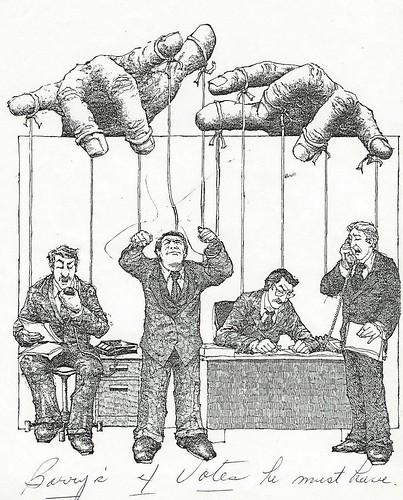
Political Puppets of Portsmouth

feldpuppet

Portsmouth Political Puppets, 1980:
Not much has changed.


Though I am still involved with another web project, I want to take a break and report on the shenanigans of the recently appointed City Building Committee.

I will summarize my report in ten points.

1. The citizens of Portsmouth have got problems, many problems in the city government. The latest is the City Building Committee (CBC). The first problem is that CBC thinks it’s the Portsmouth City Council. Imagine a gerbil that thinks it can fly, or a Chevrolet Aveo that thinks it’s a Cadillac Escalade. Maybe that’s what happens when two aspiring politicians, who wanted to be appointed to replace Tim Loper on the city council – Kevin Johnson, an antiques dealer, and James Robinson, a pawn broker – end up getting appointed instead to the City Building Committee. Instead of focusing on making a recommendation on a city building, the CBC is spinning its wheels all over the place. It is out of control, like a Chevrolet Avio with a driver high on Oxycontin. Too much time has been spent at CBC meetings on “marketing.” Marketing is not what the CBC should concern itself with, but antiques dealer Johnson considers himself a marketing guru, and he has turned the CBC into a marketing committee. The marketing of downtown Portsmouth and the marketing of the Marting’s building may be something that should be done, but the CBC is not the committee to be doing it. The CBC is definitely not the City Council and it is definitely not a marketing committee. IT IS A BUILDING COMMITTEE. But if the committee is confused, is it any wonder? Consider that in the charge that the not-too-bright president of City Council Howard Baughman gave to the CBC, he included the recommendation that they “look at and review any and all things . . .” ANY AND ALL THINGS! And that’s just what marketing guru Johnson is leading the CBC to do. At the 8-7-06 meeting of the CBC, Johnson presented a plan for the “Marketing of Marting’s Building.” That plan included the proposal to “Establish a business and community involved committee or sub-committee to develop a marketing plan which is to include finance options for encouraging a national or regional retail establishment to utilize the Marting’s Building.” So right off the bat Johnson proposed the CBC create a sub-committee to market the Marting building. The problem with Johnson’s proposal was that Mayor Kalb is still trying to make the Marting building the new city building. Just because the voters of Portsmouth recalled former mayor Bauer and two other members of city council because they tried to foist the Marting building on the city, and just because the voters as recently as last May soundly rejected a referendum to convert the Marting building into a new city building, Mayor Kalb has not given up trying to pull Clayton Johnson’s old chestnut of a building out the fire. All the voters in the world could not deter Kalb from his appointed task, which is to arrange a shot-gun wedding of the city to the old-maid Marting building. Kevin Johnson apparently didn't understand that, even though he was a strong supporter of Kalb in the mayoral race and even though he probably would not have been appointed to the CBC without Kalb’s support.

2. So Kevin Johnson, having unwittingly stepped on the toes of the gent who brought him to the dance, went back to his marketing drawing board. At the 8-28-06 meeting, Johnson proposed the CBC pass a resolution to the effect that the city should try to market not the Marting building but the Marting’s Annex. Now, that’s more like it. That’s all right with Kalb. It’s the Marting building itself that Kalb does not want anybody to market, because he still has hopes of sticking it to the citizens and taxpayers again. Back on Oct. 25, 2005, Jeff Barron wrote a Daily Times front-page story titled, “Marting’s Fate in Voter’s Hands.” Barron was wrong again. The fate of the Marting’s building is not in the voters’ hands. It is in the hands of the City Council and Mayor Kalb, and they have shown their customary contempt for that strong majority of voters who decided the city should not convert the Marting building into a city building. The CBC is a puppet committee created by the City Council to get around the voters.

3. The City Building Committee at the 8-28-06 meeting also passed a resolution on the Adelphia building. Members of the CBC have already made a visit to the Adelphia building, and Kevin Johnson gave a strong endorsement on converting the building to a new police station. The CBC should not be passing resolutions or making a decision on the Adelphia building until it considers all possible sites for the new city building. Why should it tie its hands on a possible site for a new city building by making a commitment on where the police station is going to be? Maybe there’s a site or plan where the police and city offices could be together. At the present time, the Adelphia building is the tail wagging the dog, just as Clayton Johnson is the tail wagging the city.

4. The reason the City Building Committee is making the Adelphia building a high priority is because the chairman of the CBC, Mike Mearan, in 2005 negotiated a deal whereby his client Dr. Singer, the absentee tax-defaulting Los Angeles landlord, unloaded that building on the city, just as Clayton Johnson unloaded the Marting building on the city. Unless the Adelphia building is used by the city for some public purpose, such as a police station, Singer will lose out on his tax write-off scheme. According to Portsmouth City Council minutes (3-14-05), “Mr. Mearan said that in order for Dr. Singer to take advantage of certain IRS regulations the City could not sell or lease the building because that would set a value on the property and would restrict the amount Mr. Singer can claim as a donation to the City. Mr. Mearan stated that with the understanding that the City would accept the property and use it for City purposes [emphasis added], with a restriction of ten years, after which if the City wants to get rid of the building or do whatever they want with the building they could do so.” After ten years, the city can shove the Adelphia building, as far as Singer is concerned, because by then he would have gotten his full write-off from the I.R.S. One of the reasons Mearan is chairing the CBC is obvious. He is going to make sure that the Adelphia deal with the city is consummated and that the building is used for “City purposes” so that Dr. Singer will be able to get the maximum write-off on the building. Mearan is involved in a conflict of interest in even being on the CBC, never mind chairing it. Mearan declared at the beginning of the 8-7-06 CBC meeting that though he was Singer’s lawyer on the Adelphia building, he was not in a conflict of interest. But then, at the 8-28-06 CBC meeting, Mearan abstained from voting on the Adelphia resolution. Why would he abstain if he is not in a possible conflict of interest? Perhaps he did not remember that he had declared at the 8-7-06 CBC meeting that his being on the committee was not a conflict of interest. Since Mearan’s young stenographer Heather Hren was busted in Waverly in July for the possession of illegal Oxycontin while riding in a Chevrolet Aveo Mearan had rented for her, she is no longer taking notes at CBC meetings. Mearan himself was taking notes at the 8-28-06 meeting, so he may be having trouble keeping things straight.

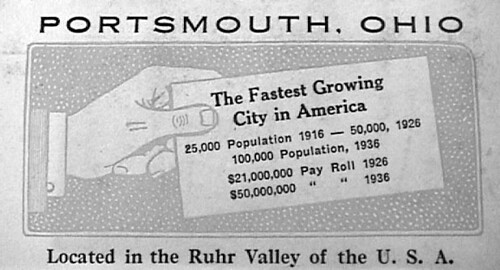
5. It is clear from the 8-28-06 meeting of the City Building Committee that Johnson and Robinson are now on board with Mearan and Kalb when it comes to tearing down the present Municipal Building. The CBC passed a resolution calling for the city to make a feasibility study of the Municipal Building, but even before that feasibility study has been done, Robinson made it clear where he now stands on the Municipal Building. He mocked Emily Gulker, accusing her of wanting to save the building and “turn it into a museum.” He turned around and looked up contemptuously at the leaking corner of the council chambers. That leaking corner is the running sore of the Municipal Building that the city government has been using as an advertisement for years to make the case that the building is falling down and beyond repair and every city office should move out as soon as possible if not sooner. If the Municipal Building is now a hazard, it is because puppet Portsmouth politicians like Kalb have deliberately let it deteriorate. At the 8-28-06 CBC meeting, Kevin Johnson made the ridiculous argument that the Portsmouth of 1934 was like a family with one child, but the Portsmouth of now is like a family with ten children, so how can a family with ten children possibly fit in the same house they were living in when there was only one child. What bullshit! Portsmouth had more than twice the population in 1934 than it does now. (In the flyer below, see how Portsmouth was marketed in 1936.) The U.S. Post Office building on Gay Street was built in 1935, a year after the Municipal building, and of the same material and in the same style. The Post Office is in great shape and is probably handling tons more mail annually and has lots more employees than it did back in 1935. The difference between the two buildings is that Portsmouth politicians have control of and have deliberately neglected the Municipal Building while federal officials have over the years taken care of the Post Office.

ptowngrowth
The Portsmouth the Municipal Building was
serving two years after it was erected.

6. At the 8-28-06 City Building Committee meeting, Kevin Johnson spoke patronizingly of those who claim that some developer wants the land on which the Municipal Building rests. He said he’s been in Portsmouth for four years, but he never heard anyone say such a thing. Four years! As long as that? If Kevin Johnson never heard it, then it must never have been said. Is that what we are supposed to believe? Johnson’s learning curve must be similar to Howard Baughman’s, and his powers of perception about on a par with Mr. Magoo’s. In the last four years, Mayor Kalb has said publicly, at least twice, that the land under the Municipal Building is worth much more if it is developed commercially than if it is used for public purposes, and he has said publicly that there was a developer who was interested in that land. The Portsmouth Daily Times (8-12-98) reported the same thing: “Portsmouth City Council voted 4-2 Monday night to authorize the preparation of legislation to demolish the Municipal Building. The vote was taken in connection with a prospective buyer’s interest in the Second Street property where the building stands (emphasis added). The Daily Times reported (1-29-97) “Some city planners have suggested that the best use of the property where the city buildings are now located would be for a hotel and conference center” (emphasis added). Because Johnson was a strong supporter of Kalb in the last mayoral race, he should know what Kalb stands for and wants to do. Kalb is trying to reserve the site of the Municipal Building, right next to the bridge and near the river, for a developer in the event that gambling comes to Portsmouth. Kevin Johnson has already made public his support of legalized gambling in Portsmouth. His pro-gambling position was front-page news in the Portsmouth Daily Times (6-28-05). Are there some dots that need to be connected? Read my earlier blog “Slots and Sluts,” in which I responded to Johnson’s endorsement of legalized gambling.

7. The City Building Committee has already decided the Adelphia building will be the new police station. Mearan has seen to that. The only thing the CBC has not already made up its mind about is whether the Marting or the Fifth/Third building is going to be the new city building. Who will win that checker match, Kalb or Mearan? That’s the only important thing we don’t know: Is the CBC going to recommend the Marting building or the Fifth/Third building? The rest is a charade that will go on for many months.

8. Baughman said at the 8-28-06 Portsmouth Council meeting that the City Building Committee was doing a heck of a job. Based on their performance so far on the CBC, Kevin Johnson and James Robinson have a future as Portsmouth puppet politicians. Just as soon as there’s another appointment to be made to the City Council or an opening in the mayor’s office, they’ll be available.

9. As an older generation of Portsmouth politicians retreats, replacements need to be found, including ones who will devote themselves to tearing down the Municipal Building. More than any other Portsmouth politician, City Councilman John Thatcher dedicated himself to tearing down the Municipal Building, both figuratively and literally. It was Thatcher who made the motion at the City Council meeting on 8-10-98 to raze the Municipal Building.
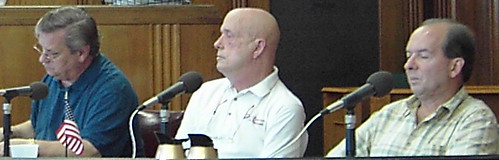
CBC3
CBC members Robinson, Johnson, Kalb

10. Remember that what is at the bottom of all this B.S. from the CBC, is the Portsmouth Commandment that says “No public money will be wasted on a new public building when there is an influential party or parties who own a building that can’t be sold and needs to be unloaded on the public.” If you are not aware of that Commandment, your learning curve is not much better than Baughman’s or Kevin Johnson’s. John Thatcher unloaded his empty unmarketable house on Franklin Boulevard on the state (SSU), which took a $50,000 loss on the deal. That’s nothing compared to the loss taxpayers are probably going to take before Thatcher’s successors, on the City Building Committee, finish their dirty work on behalf of those who pull the strings.

Monday, July 25, 2005

Slots and Sluts


To a drought stricken region, dark clouds on the horizon offer the promise of rain. But dark clouds can be accompanied by destructive forces, by winds, lightning and torrential rains that do much more harm than good.
Like great dark clouds to the west, gambling is on Portsmouth’s horizon – again. Those clouds were there before, in 1988 and 1996, when gambling was on the ballot, but Ohio voters decided on those occasions that the potential harm was greater than any financial gain gambling might bring. But the dark clouds are back. Pro-gambling forces are trying to amend Ohio’s constitution to allow qualified cities to legalize land-based casino gambling. Because it has a home rule charter and has one of the other requirements a city must meet (being a county seat), Portsmouth is one of three cities in southeastern Ohio that would qualify. Ironton and Gallipolis are the other two.
The ruling elite in Portsmouth were aware of these dark clouds before they were on the public’s radar. I found it hard to believe than any informed person could believe the Front Street murals could attract enough visitors to justify expending millions of dollars of public funds on the “Kenrick’s” tourist center. But if the ruling clique is right in betting that gambling will come to Portsmouth, then that visitor center will no doubt be a busy place. But it will be serving people who came to Portsmouth not so much to see the murals as to play the slots.
I was astonished by what a piece of private Front Street property near the Municipal Building sold for last year. It made absolutely no sense unless someone was betting that gambling would come to downtown Portsmouth. If gambling does come, then all downtown properties, particularly in the area of the Municipal Building, the Ramada Inn, and the new bridge can be expected to skyrocket in value.
The determination of the ruling clique and their local political prostitutes to tear down the Municipal Building can best be understood when put in the gambling context. Acting Mayor Kalb said in a public forum that Portsmouth’s riverfront property is potentially valuable and that he knew of a developer who was interested in the Municipal Building site. Since when is riverfront property in Portsmouth valuable? Only since legalized gambling became a distinct possibility.
The Ramada Inn has struggled for years and would not have been able to survive without the kind of pork that has kept others in business in Portsmouth, which has been like a Third World city for a long time. When I came for an interview at the university in 1989, I was put up at the Ramada, as all university visitors are. I traveled in the Third World in the 1970s, and when I stayed at the Ramada I felt I was back in a Third World hotel. Without university business, which is ultimately public money, and without serving as a dormitory for the university, would the Ramada still be in business? It is certainly not the Ramada that made downtown property valuable. It is the prospect of slots that make the Ramada and other downtown properties look like a potential goldmine. We already have the sluts. (For a libertarian read on the sluttishness of slots, look at http://tzaddik.us/lilpoh/archives/001116.html)
The Portsmouth Daily Times recently (28 June 2005) ran a front-page story by Mark Shaffer with the headline “Gambling Draws Local Support.” Who is the local support? The only supporter quoted is a local businessman, someone identified in the story as “Kevin Johnson, the co-owner of the Emporium at Portsmouth . . .” The PDT reports that Kevin Johnson is in favor of legalized land-based gambling in Portsmouth. Kevin Johnson pointed to unspecified cities in Colorado and South Dakota as places where legalized gambling have been a good thing, and what’s good for cities in Colorado and South Dakota, he implies, will be good for Portsmouth. “He [Kevin Johnson] said casinos could mean turning around the local economy.”

“Gambling Draws Local Support” is the kind of slanted and inaccurate reporting that has made the PDT the prostitute of the local ruling clique for at least a quarter of a century and probably much longer. A story on a local antique dealer’s enthusiasm for legalized gambling is published without checking on the nature of the purported success of legalized gambling in Colorado and South Dakota. In a twenty-minute search on the Internet PDT reporter Mark Shaffer could have found enough documented criticism of gambling in South Dakota and Colorado to balance Kevin Johnson’s rosy scenario for legalized gambling in Portsmouth. When if ever will the PDT point out the potential environmental, social, and moral costs of “revitalizing” Portsmouth through gambling dollars?
Perennial Political Pawn David Malone at Work
We can expect more coverage like "Gambling Draws Local Support" by the PDT in the months and years ahead. Expect the forces pushing for legalized gambling to spend big bucks in promotional campaigns. Expect the PDT to be the recipient of many of those promotional dollars. Expect local businessmen and politicians to cite unspecified studies, as Kevin Johnson does, that imply legalized gambling will be the answer to Portsmouth’s economic woes, as “the mall” was supposed to be back in 1980.
In a cursory look on the internet, I found many websites promoting legalizing gambling in Colorado and South Dakota. These websites are sponsored by the gambling interests in those states. They obviously have a vested interest in convincing the public legalized gambling is a good thing. If your research extends no further than these patently biased sources, you will be impressed, as Kevin Johnson is, by the possibilities of legalized gambling in Portsmouth. A final word about Kevin Johnson. According to the County Auditor’s records, Paul E. Johnson and Kevin Warren are co-owners of the Emporium, a new antique store on Chillicothe St., so Mark Shaffer may have mixed up their names. If so, that was not the only thing he did not get right in the story.

After PBS showed a Frontline program on legalized gambling in the USA, a Colorado viewer wrote a letter to PBS saying, “I want to thank you for the excellent story about gambling. A few years ago when I lived in Colorado I voted for legalized gambling in the town of Blackhawk just west of Boulder and Denver. Today I would never vote for something like that again. I saw the slow decay of that beautiful mountain town and what that type of business can do! It basically destroyed the spirit of the town. The locals were driven out by big money, and fast life style in the name of progress. Closer to home a co-worker of mine hits the Native American casinos on a regular basis, and has in my opinion nearly bankrupted his family. I realize as Americans we control our own destiny, but what kind of future are we creating for ourselves? I get very scared when I hear of all the problems of this country, but I think this problem needs immediate attention! At the rate we are spending money on the ‘Gaming’ industry what is going to happen to us when the well runs dry, all this investment could have been more wisely spent on perhaps educating children against the evils of gaming.”

Another viewer wrote PBS from Colorado to say, “Your program regarding gambling was very interesting. I live in Colorado and we have legalized gambling in three small mountain towns and the State of Colorado lottery. I have seen my in-laws who are in their 70's spend their time and money on the pursuit of ‘easy money.’ It amazes me because they worked very hard all their lives to be able to retire with a modest income. They use to camp and ride their dirt bikes in our beautiful Rocky Mountains. Now, they take bus trips to gambling towns in and outside our State. I personally do not enjoy gambling or understand the pleasure in it. I have not expressed to them my opinion of gambling because it is after all, their right. Four years ago, I met a man who moved to Colorado from Las Vegas. Originally, he told me he moved because he was tired of the rat race and his now ex-wife was transferred here by her company. He lived here over a year before discovering legalized gambling just 30 minutes away from Denver. He became a frequent visitor to the gambling casinos. His whole personality changed. He began losing large sums of money he did not have. He would take out cash advances on credit cards in order to try and 'win it back.' To make a long story short, he never did 'win it back' and eventually hit bottom when he lost his job and had to file bankruptcy for the second time in his life. I learned later on that he had a terrible gambling problem and that was one of the reasons for the move to Colorado. I do not agree with the widespread of legalized gambling. I am concerned for the children who sit in lobbies with very little to do while their parents are gambling. I think gambling is one of the factors contributing to the demoralization of American society.”

And what about South Dakota, the other state Kevin W. Johnson mentioned? “Since South Dakota voted to make Deadwood a casino town in 1989, South Dakota politics have been hijacked by the massive political spending of gambling interests,” according to Mother Jones Magazine. A citizens' group on the internet (http://laplaza.org/~totem/gam.html) wrote, "Deadwood (South Dakota) is a prime example of what happened to a small self-sufficient community after the opening of casinos in its town. The town was lured by the promise of a much larger tax base, a larger tourist industry, and all the other lures that an industry will use to force the passing of ordinances to allow the business to locate in a community that otherwise would not allow it." The same citizens' group provided the following report, the information in which they attributed to U.S. News & World Report (14 Mar. 1994):

"Shortly after the advent of legalized casino gambling [Nov. 1989], the Deadwood [South Dakota] casino economy lurched forward. The state attorney's office in Deadwood indicated that within approximately two years:

1. Child abuse cases had increased 42% to 43% (from 350 to 500 cases);

2. Police costs had increased 80% to 100% with a virtual doubling of the number of police officers;

3. Although national statistics had increased only slightly, crime in the Deadwood area had increased overall by 10% (although prior to 1989 the crime rate had been declining) with a 50% increase in felonies. Furthermore, there were 614 Class One misdemeanors or felonies in 1988, and 1,070 in 1992, a 75% increase in four years;

4. Domestic violence and assaults had risen 80%; and

5. Burglaries and writing of bad checks had increased . . .

One of the saddest impacts of gambling and casinos in a community are the costs in people. The property and money loss are nothing compared to what people have to do to obtain the money to support their habits. And the saddest of these is when teen age girls have to turn to prostitution to get the money they need. It becomes epidemic as casinos and gambling have always lured girls and women into prostitution.

Teenage girls are forced into prostitution when they can't pay their gambling debt to the loan shark. In 1976 Atlantic City had no prostitution problem - today it is a public health problem.”


It is also possible that the lure of gambling, like the lure of the 1980 mall, by promising prosperity, will take in the hopefully gullible but amount in the end to nothing, and there will be further recriminations against those who challenged gambling for having prevented progress and prosperity. If gambling does come to Portsmouth, the Marting building might finally be recycled appropriately, in view of its recent notoriety, either as a casino or, in the unlikely event prostitution might be legalized, as the biggest bordello east of the Rockies.
Biggest bordello east of the Rockies?