Saturday, July 16, 2005

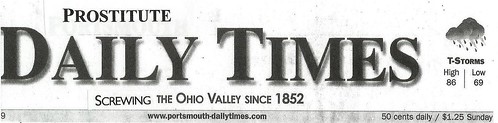
Prostitute Times

prostituteatwork
Hooker at work

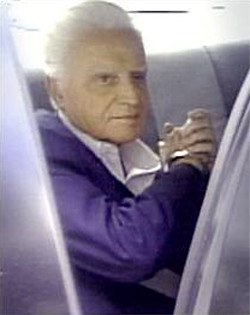
Julie Stout recently pointed out in Moe’s Forum that the 56-year-old James M. McGinnis, until last February the president and CEO of Heartland Publications, the parent company of the Portsmouth Daily Times, or PDT, was found guilty last June of having purloined $1.7 plus from company coffers. Shades of Adelphia! McGinnis claimed that he was just borrowing the money, but the judge ruled the former owner of the PDT “committed theft, as that term is defined in 812.014, Fla. Stat. (2004) by taking $1,713,342 from Heartland's accounts for his own personal use and benefit." The judge fined McGinnis $5.1 million or triple damages. According to officials, McGinnis will probably not be able to pay the fine, because his wife divorced him, took possession of their house, which left him with only one asset – his XJ8 gold Jaguar, which will be sold at auction.

McGinnis has long been in the business, over the course of 30 years, of managing, owning. and milking roughly 80 small- and medium-town newspapers in 22 states in what he called the American heartland. Contrary to the prevailing view that American newspapers are liberal, most small-town newspapers, of which there are very many, are politically conservative. Small-town newspapers are conservative partly because they are dependent upon local conservative business people for their survival. If local businesses don’t advertise, there is not much to be milked by the small-town newspaper’s corporate parent. The pressure that the Portsmouth Chamber of Commerce puts on the PDT to toe the SOGP line is no secret. If you believe the PDT’s current opposition to a second round of recalls was based on an honest, independent judgment on the editor’s part, then you might also believe Madonna is a virgin.

As for the PDT’s circulation, the other source of its income, it has been about as robust as a fossilized pterodactyl’s. That is why small town newspapers often function as the handmaidens of local Chambers of Commerce and do everything they can to promote local economic development, even if the development has an unethical or criminal character and has a detrimental effect on the community, as legalized gambling has. (I’ll deal with legalized gambling in my next blog.) In the case of our river city, the PDT is not so much the handmaiden as it is the prostitute of the Portsmouth Chamber of Commerce and the Southern Ohio Growth Partnership, which is the arm of the Chamber that launders government money.

As for the notion that a small town newspaper might do the kind of investigative reporting that could put local business and political bigwigs in a bad light, forget it. Did the PDT report the conviction of its owner James M. McGinnis? Did it put a reporter on the anthrax evacuation at Shawnee State? Has it ever reported that for a decade or more Shawnee State has been ranked as one of the worst universities of its kind in the U.S., in spite of many millions of dollars of state support and special subsidies? Not that I am aware. But it did recently put a reporter on a front-page story of a duck that was reportedly trapped in a storm drain. The Shawnee Sentinel came into existence and became Portsmouth’s most popular source of local news not by reporting on alleged ducks in drains but because it does investigative journalism and is the generator of lively opinion. The PDT does not cover the news that the Chamber of Commerce and the two other large institutions in Portsmouth, the hospital and the university, do not want it to cover. There is a local news vacuum, which readers abhor. That is why the Sentinel, which reports it had 10,000,000 hits in the last year, finds so many readers. Even my infrequent and somewhat professorial blog, River Vices, as it approaches its first anniversary, has had over 10,000 visitors.

The FBI was reportedly involved in the investigation of McGinnis. I have heard rumors that the FBI is involved in an on-going investigation of criminal activities and corruption among the higher-ups of Portsmouth, but that’s all they are at this point, rumors, born of wishes. But of one thing I am fairly sure: the kind of newspapers McGinnis owned, such as the PDT, are about as likely to be investigating corruption or criminal activities among the higher-ups in the towns of the American heartland, and in Portsmouth in particular, as the Portsmouth Spartans are of playing in the Super Bowl next winter. Rather than investigating the well-heeled of Portsmouth, the drain-duck lame-duck PDT is in bed with them, trying to denigrate the use of the recall of public officials and promote legalized gambling, all the while piously pretending to occupy a moral high ground where it scolds the “troublemakers” on the internet, the same internet that broke its monopoly on local news. What the PDT is really doing is working both sides of the street, like a five-dollar John St. whore waiting for a John, or another Jim McGinnis, in a gold-colored Jaguar.

prosttimes

Saturday, July 09, 2005

Adelphia: O, Brother!

RIGAS
Adelphia founder in handcuffs

To better understand the Marting mess and the swindle Clayton Johnson has nearly completed with the complicity of the Portsmouth City Council, it helps to look at the so-called Adelphia building, at 807 Washington St., which Johnson made part of the package he told the city it must accept if it hopes to get back any part of the $2 million he illegally obtained from the city for the Marting building.

A little background. Adelphia is a Greek word meaning “brother,” but Adelphia’s history of corruption is enough to make anyone say “O, brother!”

A year ago this week, a federal jury found former Adelphia chairman and founder 80-year-old John Rigas (in photograph above) and his son Timothy guilty of conspiracy and massive securities and bank fraud. Rigas and Timothy were convicted of deceiving investors and hiding more than $2.3 billion in debt while using company funds to finance a lavish life style for themselves and their relatives. The father received a 15- and Timothy a 20-year sentence. The Rigas family was required to pay huge fines and to give up any stake in Adelphia, which was operating under Chapter 11 bankruptcy protection. The elder Rigas is reportedly down to his last $76 million.

adelphia
Former Adelphia building on Washington St.

Now, what about Adelphia and Portsmouth? O, brother! In 1984, a Dr. Herbert I. Singer, of Los Angeles, bought what became known as the Adelphia building, on Washington Avenue, from Michael H. Mearan, a local lawyer who specializes in auto accidents and bankruptcy. Dr. Singer leased the building to Adelphia for twenty years, but Adelphia reportedly abrogated that lease in its last year, presumably because Adelphia was in bankruptcy and could get away with abrogating leases and not paying its bills.

About that time, Adelphia moved from Washington St. to its new location, not far from the 15th Street viaduct development. Given the 15th St. viaduct’s shady history and shady tenants, it should be called “Shady Plaza.” The Adelphia building on Washington Street was convenient to customers and far better suited than its current building, which looks and feels like a fur trading outpost in the wilds of Alaska. When I asked an Adelphia representative why the company had moved from Washington St., she said it was because the rent on Washington St. was too high – $2,200 a month.

Did Adelphia try to renegotiate the lease? I don’t know, but Adelphia was in an excellent position to do so, because commercial and retail property in downtown Portsmouth is notoriously hard to rent and even harder to sell. For example, according to figures in the auditor’s office, in the Scioto County Courthouse, in 2001 the true cash value of Adelphia’s Washington St. property – actually Dr. Singer’s property – was listed at $958,970; three years later that figure had been reduced 66% to $319,920.

It is hard to believe, with the value of the Washington St. property plummeting 66%, that Adelphia could not have gotten its rent reduced or even bought the property at a distressed price from Dr. Singer. If the city was sincerely interested in reviving downtown, they should have done everything to encourage Adelphia to stay on Washington St. That would have made sense, at least for Adelphia’s customers, but Adelphia does not think first of its customers, not when it has a cable monopoly and a city council that cares about its constituents about as much as Adelphia does for its cable customers.

By moving to “Shady Plaza,” Adelphia not only did a disservice to its customers, but it apparently dealt a karate chop to Dr. Singer, who filed for bankruptcy. In speaking before the city council, Dr. Singer’s lawyer denied his client had declared bankruptcy, but records in the Scioto County Courthouse at the time and still today prove otherwise. Why did Mr. Singer’s lawyer deny he was in bankruptcy? It is possible that Singer is trying to use bankruptcy in the way Adelphia used it, to avoid meeting his financial obligations. The suspicion that Dr. Singer is yet another shady character in this Adelphia corruption saga is heightened by the fact that he is in default for about $18,000 in city taxes on his Washington St. property, taxes which his filing for bankruptcy puts in abeyance.

One of the refreshing things about Dr. Singer and his lawyer, Mr. Mearan, is how candid they are about the underlying reason Dr. Singer is offering the property to the city. There is no moonshine about saving downtown Portsmouth and no Herbert I. Singer Foundation façade has been established to provide a front of civic-mindedness for Singer’s pecuniary motives. According to Portsmouth City Council minutes (14 March 2005), “Mr. Mearan said that in order for Dr. Singer to take advantage of certain IRS regulations the City could not sell or lease the building because that would set a value on the property and would restrict the amount Mr. Singer can claim as a donation to the City. Mr. Mearan stated that with the understanding that the City would accept the property and use it for City purposes [italics added], with a restriction of ten years[,] after which if the City wants to get rid of the building or do whatever they want with the building they could do so.” After ten years, Dr. Singer doesn’t care what the city does with the Washington St. property; they can flush it down the toilet for all he cares. What he wants is for the city to use the property for some public purpose for a minimum of ten years or otherwise he will be greatly restricted in what he can claim as a tax write for a charitable donation.

We need to understand that this is also the motive behind the Marting Foundation’s offer to give the city the Marting building that it had previously fraudulently tried and failed to sell to it: in order for Singer and for Johnson to qualify for maximum tax write-offs the property they donate must by IRS regulations be used for government purposes, in the case of the Adelphia building as a police station and in the case of the Marting building as a city hall.

Public policy in Portsmouth is being dictated not by what is best for the city and its citizens but by what is best for privileged property-owners who want to unload their virtually worthless buildings off on the public for the purposes of tax write-offs. And it is not just the Marting and Adelphia buildings that are being foisted off on the public. The practice of getting the public to pay for property that is no longer of use to it owners and of very little value in the local real estate market is long-standing and widespread in Porksmouth.

Instead of using millions of dollars of public monies to build structures designed for the purposes to which they will be put, the city government receives old and architecturally embarrassing hand-me-downs that require ridiculous outlays to try to transform them into the public buildings they were so obviously never intended to be. In the meanwhile public buildings of architectural importance and practical value are derided and torn down, while for at least ten years, these other old buildings, such as the Marting and Adelphia buildings, with new phony facades, will have to be renovated and maintained, at large public expense, just so that the tax breaks to the privileged few can not be challenged by the IRS. After ten years the buildings can be flushed down the toilet, which is probably what should have been done in the first place. Or to repeat the startlingly candid language of the minutes of the March 14th city council meeting: “Mr. Mearan stated that with the understanding that the City would accept the property and use if for City purposes, with a restriction of ten years[,] after which if the City wants to get rid of the building or do whatever they want with the building they could do so.” O, brother!

singer2
From minutes of the 3/14/05 Portsmouth City Council Meeting

Monday, July 04, 2005

ROYAL SCREWING

GEOIII

“The history of the present King is a history of repeated injuries and usurpations, all having in direct object the establishment of an absolute tyranny over Portsmouth. To prove this, let facts be submitted to a candid world.” Or so say I.

On this July 4th weekend I am thinking not only of the Declaration of Independence but of May 24th, 2005, and of another document that was signed on that day here in Portsmouth, Ohio. I hold a Ph.D. in American Civilization, and as a student and teacher, and as the coordinator of a Yale-based committee that organized a series of conferences around the world prior to the celebration of the American Bicentennial, in 1976, I have in my time seen a lot of American documents. But I have never seen one that mocks the Declaration of Independence and the ideal of American democracy as blatantly and cynically as the one that was signed on May 24th, 2005, by Portsmouth’s acting mayor James Kalb and city solicitor David Kuhn, representing the city of Portsmouth, and by Julia Wisniewski, representing the Richard D. Marting Foundation. That infuriating document, which the city solicitor gave the innocuous name “Marting’s Foundation Grant Agreement and Release,” deserves to be studied for the revealing light it throws on the tyranny that exists in Portsmouth as a result of the unholy alliance between crooked politicians and crooked lawyers.

The depth and pervasiveness of that tyranny cannot be appreciated unless we note that there appeared to be a sort of political revolution last year in Portsmouth. Following the revelation that the city had purchased a former department store at a wildly inflated price of $2,000,000 from the Richard D. Marting Foundation, Mayor Greg Bauer and two members of the Portsmouth City Council, Ann Sydnor and Carol Caudill, were recalled from office as a direct result of that scandalous sale. In spite of the support he received financially from well-heeled backers and editorially from the Portsmouth Daily Times and from the weekly Community Common, Mayor Bauer was recalled by a 2 to 1 margin. The recall movement was bi-partisan, for crooked/honest, not Republican/Democratic was what mattered. June 22nd, 2004, the day Mayor Bauer and the others were recalled, had some of the feel of July 4th, 1776, as I showed in Recall, the video that is now available at the Shawnee State Clark Memorial Library and the Portsmouth Public Library.

The political victory was followed by a stunning legal victory when a suit brought by community activists Bob and Teresa Mollette against the Marting Foundation led to a ruling by Judge Marshall that invalidated the sale of the Marting’s building to the city. Mollette’s attorney had argued that Clayton Johnson had conducted secret illegal negotiations with members of the city council, and Judge Marshall agreed. Johnson is playing the role of King George III in Portsmouth’s contemporary history, but fortunately there are some patriotic people in the city not intimidated by him.

But the political and legal victories of the reform movement did not end the tyrannical rule of crooked politicians and crooked lawyers, as the “Marting’s Foundation Grant Agreement and Release” sadly reveals. What that agreement does is not only put the Foundation and everyone associated with it, including Clayton Johnson, beyond the reach of the courts, it also stipulates a number of conditions that the city would have to meet in order to get back any part of the $2,000,000 the Foundation had previously illegally acquired from the city.

To quote the language of the May 24th agreement, which protects Johnson and the Foundation from any legal action: “the City hereby releases and discharges the Foundation and Marting Brothers from any and all claims or causes of action, from the beginning of the world to the date of this Agreement, arising out of the Dispute and the Purchase Agreement, including any and all claims asserted or which could be asserted which the City has or may have against the Foundation and/or Marting Brothers, whether such claims are legal or equitable, known or unknown, contingent or matured, or joint, several or individual. The release by the City is also intended to and does release and discharge the agents, affiliates, subsidiaries, related business entities, insurers, successors, attorneys, officers, directors, board members, assigns, and all and every other person who has worked for or on behalf of the Foundation and/or Marting Brothers.” With this agreement Johnson not only covers his own ass from the beginning of the world to all eternity, but he also covers the asses of every party however remotely related to the Foundation and the crooked sale of the Marting building.

In the agreement the Foundation on its part agrees to give the city the Marting building, but the Marting Foundation never wanted this worthless property in the first place; the Marting building is like the Old Maid in the card game: whoever gets stuck with it loses. I think the Foundation may have been created primarily to unload the Marting building, preferably by selling it to some foolish buyer or, failing that, by giving it away, which ended up being the only way the Foundation could get rid of it.

Councilman Marty Mohr was right about one thing when he told a Columbus Dispatch reporter last year that he had made a study of retail property and decided the Marting building “ain’t worth anything.” (After being courted by King George and after real estate developer Neal Hatcher named an SSU dormitory in Hatcheville in honor of the Mohr family, Marty Mohr changed his mind about the value of the Marting building.) As long as the Marting Foundation owned the building, it presumably would have had to pay taxes indefinitely, assuming the Foundation had not finessed those, too; there was little chance that any retailer would buy it. Giving the building away, provided someone would take it, might at least make a tax-write off possible, as had been the case when Johnson arranged to have the very dubious assets of the defunct Travel World agency donated to Ohio University, at Ironton.

What makes the May 24th agreement one of the most infamous documents in Portsmouth’s history is, first, that the Foundation, after Judge Marshall’s invalidation of the sale, did not agree to return the $2,000,000 it had received from the city but only $1,405,000, because the Foundation had lost nearly $600,000 on risky investments.


"Honey, I shrank the $2,000,000!"

AGREEMENT
Section of Marting's Agreement with city of Portsmouth showing how, through poor investments, the Marting Foundation shrank the city's $2 million to $1.4 million

Even though Judge Marshall had ruled that Johnson had violated the law in the underhanded way he had conducted negotiations for the sale of the building, the Foundation would not agree to return all the money it had received but only whatever portion of it that remained at such time that it might return it. The high-handed attitude of our King George can be explained by the unwritten rule that possession is ninth-tenths of the law, even if what you possess you acquired illegally.

But Johnson and the Foundation did not stop there: he also set conditions that the city would have to meet before the Foundation would turn over what ever remained of the $2,000,000, for there was no guarantee that the $1,405,000, with fluctuations in the market, would not shrink some more. Here is the relevant passage from the agreement:

“The Foundation agrees to deliver the Foundations Assets” [that is, the money the Foundation obtained illegally from the city], if “The City agrees that the Foundation Assets shall be used exclusively for one (1) or more of the following purposes: City Police Station, Portsmouth City Offices, or a national or regional retail establishment . . . The City agrees that the Foundation Assets may be used for rehabilitation and renovation of 807 Washington Street, commonly known as the Adelphia Building, for a Permitted Use; and/or (ii) the balance, including any sums which the City shall decide not to allocate to the use and purpose described in Clause (i) herein, to rehabilitate and renovate, or to tear down and rebuild at the main Marting Building, 515 Chillicothe Street, and any other of the Marting Properties, for a Permitted Use."

Imagine a con artist being arrested for illegally selling a worthless painting for $2,000,000, and then agreeing to return only part of the $2,000,000 but only if the defrauded party agrees to keep the painting and spend a specified amount of the returned money on restoring the worthless painting. Oh, and in addition, the con artist insists that any money left over should be spent on restoring another painting of dubious value (the Adelphia building).

We mustn’t lose sight of the fact that con artist King George is not asking for the Marting building back. If you miss that point, you miss everything. Hell, that Old Maid is the last thing he wants back in his hands. No one in his right business mind wants a square foot of that property. As a former employee of Marting's says in Recall, "I know every stinking inch of that building." Johnson's got the city’s money, and he doesn’t want to spend another nickel on that 100-year-old worthless old maid.

But King George the con artist is not done dictating conditions in the Agreement, for the city has to submit a specific plan for a Permitted Use (that is, plans for the Marting and possibly the Adelphia building) within 36 calendar months or lose all claims to the Foundation’s assets (i.e., the city money it holds). "Do exactly what I tell you to do in the time I have told you to do it or you will not get a cent of your money back!" Our spineless and corrupt city government is reduced to being a pawn of this small town dictator.

In his memo to the city officers, accompanying the “Marting’s Foundation Grant Agreement and Release,” solicitor Kuhn wrote, “Please review the agreement carefully, so that the time constraints are met in order for the City to take full advantage of the Agreement.” The city take full advantage of the Agreement? Anyone who reads the agreement carefully should conclude that it is the city that is being taken full advantage of. What the solicitor is really saying is let’s push this crooked deal through as fast as we can, for what the “Marting’s Foundation Grant Agreement and Release” really is, I say on this 4th of July weekend, is a royal screwing.

Sunday, June 26, 2005

Prayer

malonepreach
Rev. Malone praying on steps of Municipal Building

Religion played an important part in the recall of mayor Greg Bauer. In the months leading up to the special recall election, on June 22, 2004, the Rev. David Malone denounced the wickedness in Portsmouth. With leaders of the recall movement standing next to him, with their heads bowed, Malone preached a sermon on the steps of the Municipal Building. In that sermon, “Protection and Deliverance of a City,” part of which is reproduced below, he said, “In the name of Jesus, we stand victorious over the principalities, powers, rulers of the darkness of this world, and spiritual wickedness in high places over Portsmouth, Ohio.” Austin Leedom later said Malone’s prayers on the steps were the turning point for the recall movement.

But while he was praying with leaders of the recall movement, Rev. Malone at the same time was disassociating himself from that movement. In a recorded interview with me, in his church office, not long after his sermon on the steps, Malone characterized the recall movement as mistaken and “divisive.” His prayers, he told me, had not been intended to help the recall movement. But if there was wickedness in high places, wasn’t using a special election to remove it not only totally constitutional but also morally obligatory? Apparently not, at least not in the mind of Rev. Malone. In his relationship to the “rulers of darkness” and to the followers of the prince of air who hovers satanically over Portsmouth, he appeared to be, if not hypocritical, at least contradictory.

There were those who believed Malone, in appearing to sit on the fence, was maneuvering for the upcoming mayoral primary. He was willing to denounce Evil, in general, but no crooked politician, in particular: “Holy Spirit, we ask you to visit our city and open the eyes of the people, that they may turn from the power of Satan to God,” he preached. But who in Portsmouth is Satan working with? Malone was not willing to be more specific. He was apparently trying to have it both ways, to please both his potential supporters in the recall movement but also powerful people in high places. If that was his strategy, his poor showing in the mayoral primary showed how politically ineffective fence-sitting can be.

The suspicion is growing that Malone’s political priorities take precedence over his moral and spiritual obligations, and as a result he is losing the trust not only of those recall advocates who prayed with him on the steps of the Municipal Building, but also of a number of others as well. Judging from his poor showing in the primary, he has forfeited much of the moral high ground he once occupied. The voters expect a man of God to be at least a cut above a politician, especially above a Portsmouth politician.

At the last city council meeting the ever solicitous city solicitor asked if any of those members of council who regularly meet in the office of the city clerk’s office prior to council meetings believed they were participating in a non-public and therefore illegal meeting of the council. When Malone blurted out “No!” to the solicitor’s question, many of the visitors in the chamber laughed. How did Malone interpret the laughter? Does he realize that in allowing himself to be used by solicitor Kuhn, acting mayor Kalb, and city council president Baughman that he is not only losing the respect of the populace but that he is also becoming something of a joke? Councilman Tim Loper was applauded at the last council meeting for saying he had been played for a dummie long enough. Loper was applauded for declaring his independence; Malone was laughed at for claiming he had done nothing illegal. Shouldn't that tell him something?

Judge Marshall had already pointed out, in ruling on the Marting sale, that whenever four council members get together there is a potential quorum; and if those council members discuss anything remotely related to city business that gathering constitutes a meeting, an illegal meeting since the public is not given the opportunity to attend. Clayton Johnson’s arranging to meet with members of the council in three’s in negotiating the sale of Marting’s was an obvious, crooked scheme to get around the “four’s a meeting” rule.

Pre-council meeting get-togethers in the city clerk’s office are another obvious way for illegal meetings to take place, and Malone should not give even the appearance that he is part of illegal meetings. He should follow the example of council members Bob Mollette and Tim Loper and not join with other members behind closed doors. And, as important, he should not join with those members of city council and mayor Kalb, who are attempting to deliver to Clayton Johnson a half of the whole loaf that Judge Marshall’s decision denied to Johnson when he ruled that the sale of the Marting building to the city had been illegal.

If ever the expression “the devil is in the details” could be said to apply, it applies to the sale of the Marting building, as well as to the machinations mayor Kalb and several on the city council are conducting to get around Judge Marshall’s ruling that the sale of the Marting building was illegal. The sale of the Marting building to the city was not only illegal, it was, from a religious point of view, illicit – a bastard project conceived in a law office in Portsmouth’s red light district. A minister of the gospel should not vote in favor of any ordinance that lends legitimacy to that illicit sale.

The mayor and two council members have been recalled as a direct result of the Marting scandal, which outraged voters, and for Malone to continue to add his support to a proposal that he knows will deliver a half loaf to Johnson will only add to the perception that he is still playing politics rather than following his religious principles.

Malonesermon
Part of Sermon Malone delivered on steps of Municipal Building

I hope that those who believe in the power of prayer will pray for the Rev. Malone. When Baughman calls for a moment of silence at the beginning of council meetings, I hope that those who laughed at Malone will follow a more Christian path and pray for him, with all their might, for he was and still is a potential leader of obvious ability, and could yet be a key figure in the crusade against the forces of darkness and for the moral rejuvenation of our river city.

Wednesday, June 22, 2005

Anniversary of Bauer Recall


Front Page of Daily Times, 06/23/04

One year ago today, on June 22nd, 2004, the voters of Portsmouth recalled Mayor Greg Bauer from office by a 2 to 1 margin.

Several months earlier, around April 2004, I began using my new DV video camera to make a record of the recall process. I worked on editing the video as my teaching schedule permitted in the fall and winter of 2004. On March 16th, 2005, I showed Recall to the public in Flohr Hall at the Shawnee State Clark Memorial Library. Prior to that showing, the Communications Office of SSU put out the following publicity release based upon answers I had provided to their questions:

FOR IMMEDIATE RELEASE
March 11, 2005

Robert Forrey’s video essay Recall to premier at SSU

Shawnee State University’s (SSU) Robert Forrey, Ph.D., professor of English, has created a video essay, entitled Recall, regarding last June’s recall of Portsmouth Mayor Greg Bauer. A showing of the 60-minute documentary will take place on Wednesday, March 16, at 7 p.m. in the Flohr Lecture Hall, located on the first floor of the Clark Memorial Library on the SSU campus.

According to Forrey, the recall movement apparently began when Bauer summarily rejected Lee Scott’s attempt to get city assistance for the restoration of the old Columbia Theater, located on Gallia Street in downtown Portsmouth.

“Scott began an intensive investigation of city government and concluded it was rife with favoritism and corruption,” said Forrey. “However, the seismic event of the recall movement was the controversial sale of the Marting’s department store building to the city, for which Mayor Bauer was responsible.”

Forrey said he had audited a course on videography taught by Michael Barnhart, senior instructor of music at SSU, in order to learn the basics of making videos.


“Though I still have much to learn about the technology, and remain a novice about the art, I proceeded on my own, contacting those involved in the recall movement and members of the city government,” he said.

Incidentally, the key figure, Bauer, declined to be interviewed, in addition to his assistant, Jamie Tuggle, who is an SSU graduate, according to Forrey.

“I am embarrassed at how little I knew about local politics after living in Portsmouth for 15 years,” he said. “I suspect that many at the university know very little about the problems and politics of Portsmouth. One senior professor in business [Larry Essman] told me that until I learned about Portsmouth, its history, and its politics, I could not really understand the university. I now appreciate the wisdom of his observation.”

Forrey has spoken to representatives of Adelphia cable about showing the video essay on cable access, but no date has been set. [Adelphia is not going to air the video.]

“I have been reluctant to call what I created a documentary,” he said. Most of what are called documentaries are not, if by documentary is meant an objective record of something. What I have created and what most so-called documentary makers create is a video essay. Essays have a thesis, a point. I didn’t start out with a thesis; I thought I was just going to record on videotape what others said and felt and what the facts were about the recall. I was being naïve. There is no overall truthful objective record about anything, especially about something as heated and contentious as politics. There are just various people, parties, and points of view, competing with each other for a share of the truth.”

The showing will be followed by an open forum on the issues that led to the recall. [Most of that forum was later added to Recall.]

“Dr. Forrey’s video essay is an interesting look into the politics of Portsmouth,” said Jennifer Phillips, president of the Shawnee Liberals Association, the student group that is sponsoring the event. “People who live and work in the area should be interested in seeing it, and SSU students wishing to learn more about the city they live in will find it worth watching. The discussion that is to take place after the video is shown should be interesting and informative as well.”

DVD copies of the final cut of Recall (approximately 80 min.) are now available for circulation at the Shawnee State Library and the Portsmouth Public Library. A limited number are also available free through The Sentinel, the editor of which can be reached at aleedom@adelphia.net.

Thursday, June 16, 2005

Gutter Politics


Blog Slut from Mike DeWines Office
As I was driving down to Portsmouth from Columbus late Sunday afternoon, June 12th, I noticed a slew of DeWine for Congress signs along Route 23, in Scioto County. That would be Pat DeWine, son of Ohio Senator Mike DeWine. Once I reached Portsmouth, the DeWine signs were all over the place, especially on the properties of real estate developer Neal Hatcher and lawyer Clayton Johnson. As I was driving by the corner of Washington and Sixth Streets, in Portsmouth’s red light district, I thought I recognized the short senator, briefcase in hand, standing in the gutter in front of Portsmouth’s most prestigious house of ill repute, namely the law offices of Johnson & Oliver, Esq. Partially obscuring a DeWine for Congress sign, the senator was talking to a young man and a younger woman. With a digital camera, through a dusty windshield (through a glass darkly), I took a picture.
Mike DeWine in gutter outside Clayton Johnsons Office
Where Senator DeWine happened to be standing was appropriate, for the political gutter is where the DeWine name has been dragged in the last couple of years. The twenty-five-year-old Jessica Cutler, who worked in DeWine’s Washington office, created a blog to keep a few of her friends apprised of her promiscuous sex life, which she carried on primarily with family-values espousing Republicans. But her blog leaked all over Washington, and the petite Korean-American, who became known as the “blog slut,” lost her job and got a six-figure book contract, in that order. DeWine’s 35-year-old son Pat may have moved in some of the same gutters as Ms. Cutler. The younger DeWine left his pregnant wife and two children for a Republican lobbyist whom he had been having an affair with and whom he had the chutzpah subsequently to campaign with. “Pat and Girlfriend on the Campaign Trail.” Not only that, DeWine was accused by a political rival of having changed his vote on tax breaks for a company that had hired his girlfriend. 
Pat DeWine has shown about as much loyalty to those who elected him as he did to the woman who married him. First, he was elected to the City Council, where he served his constituents without distinction. “Then,” according to Michael Altman in the online Queen City Forum Magazine (queencityforum.com), “DeWine jumps ship and runs for County Commission, where he wins and—after being sworn in six months ago—jumps to the next level again to run for Congress in the special election . . .” His political rise from City Council to County Commission to Congressional candidate was accomplished with the help of financial contributions from friends of his father, the senator. “There is a boatload of money fronting a guy who has never done anything to merit a seat in Congress,” the Queen City Forum blogger observed. “Republican PAC’s across the country contributed big bucks to Pat DeWine’s campaign for the Hamilton County Commission, knowing of course that it was just a stepping stone for higher office, and it was a way to stay in the good graces of Senator DeWine.” 
Peter Bronson in the Cincinnati Enquirer wondered aloud whether DeWine and his far-flung Republican PAC supporters had the inside scoop that Rob "Porkman" was going to resign his congressional seat, creating an electoral opportunity for the junior DeWine. Bronson asked rhetorically, “Did Washington PACs know DeWine was already planning to run for Congress, before Rep. Rob Portman was nominated as U.S. trade representative, opening the Second District slot?” The answer is fairly obvious. In the stock market, this is called insider trading and is against the law. In politics it is called helping the son of an influential senator and is apparently legal. The distinction seems slight, like the difference between slot and slut.
According to the Enquirer, Pat DeWine raised far more money than his rivals in his campaign for the congressional seat to be vacated by Porkman. But just last Tuesday, in the June 14th special election, DeWine finished a dismal 4th. That was no surprise, for neither Mike DeWine nor his son Pat are currently popular among conservative Republicans in the recently gerrymandered Second Congressional District. To loosely paraphrase a Second District Republican who wanted no part of father or son, the DeWinesap didn't fall far from the tree.
So Clayton Johnson, Neal Hatcher, and the other pork merchants of Portsmouth have backed another politician of questionable morals and ethics, only to lose badly at the polls again, just as they did when they backed Portsmouth Mayor Greg Bauer, who was recalled last June, by a margin of two to one, in spite of the big bucks spent to keep him in office. Portsmouth’s pork merchants did not back Bauer and Pat DeWine because of that hapless pair's penchant for the gutter, but because they expected them to continue the tawdry tradition of funneling public funds into the Portsmouth area, funds ostensibly appropriated for the economically disadvantaged but that end up in the pockets of those who make up the Portsmouth Chamber of Commerce and the Southern Ohio Growth Partnership.
The defeat of Bauer and now Pat DeWine may reflect the inability of big bucks, in this age of blogging and Googling, to control the news and buy elections. The Portsmouth Daily Times continues to launder the news, the way drug dealers do money, but gutter politics and the corruption of local government are being reported on by people with candid cameras and computers, even if they are not by uncrusading reporters, and that should give us hope.


Saturday, June 04, 2005

Feldman Followup

feldparticulars
Why City Council Fired Feldman

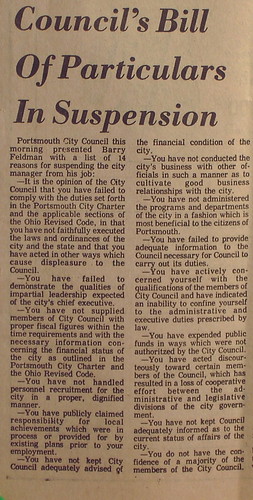
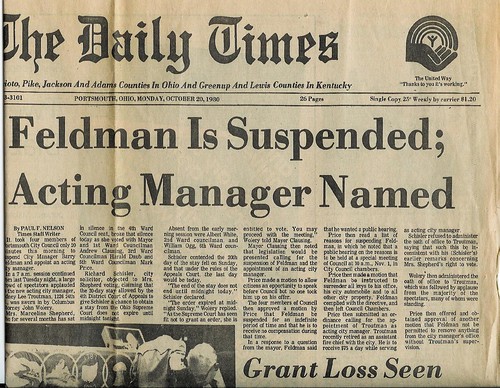
On March 18th I published a blog on Barry Feldman, who was fired as Portsmouth's City Manager back in 1980. Since then I have received several emails from people in the Hartford, Connecticut, area, who say the events in Portsmouth twenty-five years ago are eerily similar to those that are taking place today. Feldman is once again involved in a mall controversy and is being accused of many of the same underhanded things he was in 1980. The folks in Hartford have asked me to provide them with more particulars, which I will now try to do. What follows are the 14 reasons the Portsmouth City Council gave for removing Feldman from office. They were reported on the front page of the October 20, 1980, Portsmouth Daily Times, with the headline, "Council's Bill of Particulars in Suspension."

- It is the opinion of the City Council that you have failed to comply with the duties set forth in the Portsmouth City Charter and the applicable sections of the Ohio Revised Code, in that you have not faithfully executed the laws and ordinances of the city and state and that you have acted in other ways which cause displeasure to the Council.

- You have failed to demonstrate the qualities of impartial leadership expected of the city's chief executive.

- You have not supplied members of the City Council with proper fiscal figures within the time requirements and with the necessary information concerning the financial status of the city as outlined in the Portsmouth City Charter and the Ohio Revised Code.

- You have not handled personnel recruitment for the city in a proper, dignified manner.

- You have publicly claimed responsibility for local achievements which were in process or provided for by existing plans prior to your employment.

- You have not kept City Council adequately advised of the financial condition of the city.

- You have not conducted the city's business with other officials in such a manner as to cultivate good business relationships with the city.

- You have not administered the programs and departments of the city in a fashion which is most beneficial to the citizens of Portsmouth.

- You have failed to provide adequate information to the Council necessary for Council to carry out its duties.

- You have actively concerned yourself with the qualifications of the members of City Council
and have indicated an inability to confine yourself to the administrative and executive duties prescribed by law.

- You have expended public funds in ways which were not authorized by the City Council.

- You have acted discourteously toward certain members of the Council, which has resulted in a loss of cooperative effort between the administrative and legislative divisions of the city government.

- You have not kept Council adequately informed as to the current status of the affairs of the city.

- You do not have the confidence of a majority of the members of the City Council.

Feldman suspended2

Headline announcing Feldman's firing

Monday, May 30, 2005

Spats and Anthrax

anthrax molecule
a lethal anthrax molecule

Two events last week, and the way they were covered in the Portsmouth Daily Times, may be examples of the way in which that newspaper occasionally reverts to its previous practice of manipulating the news and controlling the way its readers perceive local events. The Daily Times was not quite the official organ of the Portsmouth Chamber of Commerce and the SOGP porkers, but it was close to it. Without their advertising revenue, the steadily shrinking newspaper could not survive. If a Daily Times reporter dared to try to do the kind of investigative reporting that led the Toledo Blade to expose the scheme by which a prominent political fundraiser and rare coin collector allegedly swindled the Ohio Bureau of Workers’ Compensation of millions,* that reporter would soon be looking for another job. Instead of uncovering corruption or incompetence in Scioto County, the Daily Times is more likely to gloss it over, if not cover it up.

Which gets me back to the Daily Times reporting on two events last week, at both of which I was present and therefore know something about firsthand. The first was the Portsmouth City Council meeting, last Monday evening. In recent weeks, councilman Marty Mohr has attempted to change the existing format of council meetings so that citizens cannot speak on items not on the agenda. Instead of focusing on this unusual and even extraordinary effort to restrict free speech, and on Mohr’s earlier dissing of citizens in the council chamber as “crap,” the Daily Times has focused on the protests that Mohr’s insult and his attempt to restrict free speech has prompted. In other words, the Daily Times has made the protests, and not what provoked them, the story.

The May 25th front-page story on the May 23rd council meeting was headlined, “Spats Disrupt Council.” The opening paragraph reads, “Even though it’s hard to find common ground for City Council members and some vocal citizens, they agree that recent disturbances during meetings are not conducive to business.” Jeff Barron closes his report by quoting Mohr and Baughman. Mohr said, “We have an extremely small group of people who enjoy bashing people at meetings, on the Internet and in their newspaper (Shawnee Sentinel).” Barron gives Baughman the last word in the story. “I think the atmosphere discourages outside investment,” Baughman said, “because there has to be an atmosphere of trust.”

Baughman repeats one of the favorite Chamber of Commerce myths of the last quarter of a century, which is that a few people “discourage outside investment [in Portsmouth],” to use his phrase. Twenty-five years ago, according to this myth, three malicious councilmen condemned Portsmouth to another quarter century of economic stagnation by opposing the building of a downtown mall. Two of those councilmen are no longer alive to defend themselves, but one of them, Harold Daub is, and not coincidentally Daub is being cast as the chief culprit of the city council disturbances that are allegedly discouraging outside investment. Daub is being cast as the Darth Vader of Spat Wars. Daub’s behavior at the May 23rd council meeting was not disruptive. I was there. I saw and heard. Daub spoke to the council at the appropriate time, and calmly, but he dared to mention a council member by name, which has become an ejectionable offense according to the imperious standards of deportment set by the dictatorial Baughman and Mohr. Daub was commanded to leave the Municipal Building, and I’ve heard of people who were not there circulating stories he was out of control. The Mauling of Harold Daub continues.

The other event that may have been slanted by the Daily Times occurred on March 24th, the night after the council meeting. It occurred on the Shawnee State campus.

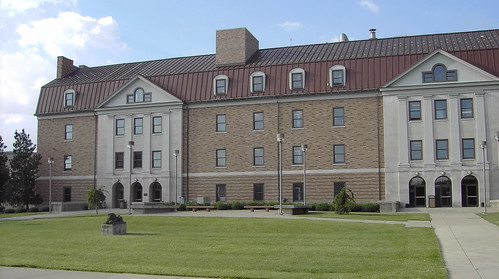
Massie Hall
SSU's Massie Hall: Scene of the "Anthrax" Evacuation

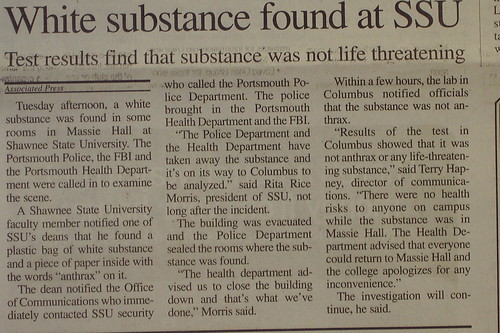
Unlike the “spat” at the council meeting, at which there were a Daily Times reporter and an editor, and about thirty-five citizens, there was no one from the newspaper at what I will call the "Anthrax" Evacuation, judging by the way the Daily Times reported the story. Having been part of it, I thought that the Anthrax Evacuation was the biggest local story of the day, if not the week, and maybe the month, but the Daily Times put the story on page 3 of the same May 25th paper that had the “Spats Disrupt Council” story on the front page. The small story on page 3 is an Associated Press, not a Daily Times story, and the unrevealing and possibly obfuscating headline for it was “White Substance Found at SSU.” White substance? Snow? Cocaine? Why the reluctance to mention in the headline the "A" word, which is what the whole panic was about?

white substance
Associated Press story on page 3 of Daily Times (5/25/05)

Well, of course, how can finding a white substance on campus possibly compete for front-page coverage with a spat at city council? That headline – “White Substance Found at SSU” – may speak volumes for what the Daily Times, and possibly SSU, did not want to publicize about the Anthrax Evacuation, which involved hundreds of students and faculty, as well as more police and police cruisers than I have ever seen at one Portsmouth scene. The potentially tragic Anthrax Evacuation has such possibly revealing and important elements, as well as curious and embarrassing sidelights, that most reporters at most newspapers (certainly those at the Toledo Blade) would love to be assigned to it. But I think no Daily Times reporter has yet written one word on the Anthrax Evacuation. Why not? Writing about council spats apparently has a higher priority.

But I don't think the Anthrax Evacuation story will be buried. Somebody, either because of negligence or misplaced public relations priorities, may have risked the lives of hundreds of people. However, rather than speculate further, I will wait until SSU or public authorities release more facts, facts that Daily Times reporters should be digging up. But in order to do that they need at least temporarily to devote less time to perpetuating the myth that a very small number of citizens, by speaking out at council meetings and writing in the Shawnee Sentinel, are maliciously preventing the economic revival of Portsmouth, and more time to exposing the incompetence and corruption that give Portsmouth a bad name and impede its economic recovery.

*For more on the Toledo Blade story, click on:
http://www.toledoblade.com/apps/pbcs.dll/frontpage

Tuesday, May 24, 2005

Automaniac

mohrmug
Marty Mohr Mugging for Moe

City Council meetings are turning into the Marty Mohr Show. Is this how Jerry Springer, former mayor of Cincinnati, got his start in show business? Mohr’s mugging for the camera when "Moe" Ferguson caught him red-handed at the illegal pre-meeting meeting in the city clerk’s office shows how much contempt and defiance Mohr has for a free press and the public it serves.

Mohr is Ward 6 councilman and owner of Automania, the car radio business. If nothing else, last night’s May 23rd meeting of the Portsmouth City Council showed that there are some citizens who are not going to take any Mohr crap sitting down. Objecting to his attempts to stifle free speech at the council meetings, the same citizens whom the crapulous (i.e., intemperate) Mohr at an earlier meeting had called “crap” dared to stand up at last night’s meeting and say they objected to his motion to eliminate free speech, which got them ejected from the meeting.

Probably infuriated by the rumors of his adultery circulating on local chat rooms, Mohr seems determined to deny citizens the right to say anything at council meetings. If citizens attending last night’s meeting so much as mentioned the name of a councilman in their remarks to council, in any context, Mohr called them out of order and instructed police to eject them from the Municipal Building. His response seems as irrational as it is ineffective, because his attempt to change council rules and eliminate the part of the meeting allowing citizens to speak on items not on the agenda failed by a vote of 4 to 2.

Judging by how he conducted himself in the rest of last night’s meeting, Mohr must have been incensed by the 4 to 2 vote. He had succeeded in instigating a disorder that he could then use to justify stifling free speech, but four other councilmen did not buy his argument. Councilman Malone wisely declined to be defended by the undemocratic duo of Baughman and Mohr, saying he was quite capable of defending himself, and he did not need to stifle free speech to do it.

While citizens speak during the non-item segment of city council meetings, Mohr, unlike other council members, avoids looking at them, in a studied show of disrespect. As a political ally, the smarmy Baughman has indulged Mohr’s dictatorial tendencies, and excused his crapulousness, but Baughman is clearly eager to move on to other business. Mohr is out of order. By turning meetings into the Marty Mohr Show, he is interfering with the council’s normal business of mulcting the public. How does he expect the fraudulent Marting’s deal to be completed if he continues to incite disorder?

Monday, May 16, 2005

Little Reichstag Fires

Freedom of Speech_1
Freedom of Speech (1943) by Norman Rockwell

“Lies.” That's the only word I can apply to the case that councilmen Howard Baughman and Marty Mohr have made to justify their attempt to deny citizens the opportunity to address the Portsmouth City Council on items not on the agenda, which citizens have been able to do for many years. Baughman and Mohr are trying their hardest to suppress the views of the informed citizens who attend council meetings and occasionally criticize council members, especially Baughman and Mohr themselves. Just how far the two councilmen are willing to go to suppress freedom of speech was evident at the May 9th council meeting, which I attended and which I have also viewed a tape of.

One of the well-informed citizens who addresses the council and occasionally criticizes them is Teresa Mollette. The specific justification that Baughman and Mohr gave for suppressing free speech was her criticism at the April 25th council meeting of councilman David Malone. In comments on the council's inability to handle budgets, Teresa Mollette pointed out that Malone, a councilman who was running for mayor, was not good with budgets. Councilman Malone has some admirable qualities as a public servant, but he is not good with budgets. That is no secret. Like everybody else, he is not perfect. But Mollette's criticism of Malone was not an attack on, or a harassment and an intimidation of, him, as Baughman charged. Nor did Mollette administer a "thrashing" to Malone, as Baughman also alleged.

I was at the April 25th meeting and heard Teresa Mollette address the council. I have since viewed a tape of her comments. She did not attack, harass, intimidate, or thrash Malone, as Baughman claimed. To say that she did is so gross a misrepresentation of what she said and how she said it as to constitute a lie. She was speaking on the failures of the council as a whole in handling budgets. She made a passing reference to councilman Malone because the Daily Times had written that he claimed to be working on balancing the budget. She wasn't singling out Malone; she made it clear she was criticizing the council per se for being penny-wise and pound-foolish in refusing to pay claims by former long-time city employees against the city. She spoke about 3 minutes on the council's budgetary shortcomings; less than half a minute was on Malone.

Baughman and Mohr seem oblivious to the fact that not only is what they and others say at council meetings recorded in the minutes but they are also recorded on tape, by Joe Ferguson, for all to hear and see on his website, Moe's Forum, including body language and facial expressions.

John Welton wrote recently that, “It is becoming more apparent that Sixth Ward City Councilman Marty Mohr is trying his best to cause another political firestorm between the residents of Portsmouth and the City Council.” In a similar vein, Austin Leedom wrote that the Baughman-Mohr attempt to restrict free speech smacked of facism. Firestorm? Fascism? That may strike some as wildly exaggerated. But after sitting through the April 25th and May 9th meetings, as well as earlier ones, I can understand why Leedom and Welton would make these charges.

Let me remind you of a historical parallel. On Feb. 27, 1933, a fire of suspicious origin destroyed the Reichstag, or parliament building, in Berlin. Many historians believe the Reichstag fire was started by the Nazis, who used it as a justification for cracking down on their political opponents and seizing unlimited powers. Remember the city council meeting at which citizens were searched at the door for hidden weapons after a threat was allegedly made against Baughman by someone in a local bar? A reliable source told me that the alleged threat was relayed to authorities by the son of the city clerk. Jo Ann Aeh, the city clerk, has been associated with the Portsmouth City Council since 1980, not long after she and her husband were reportedly welcomed into the Ku Klux Klan by the white supremacist David Duke. The tactics used by supporters of city manager Barry Feldman in 1980 to remove from office three councilmen who were his political opponents resembled the infamous tactics used by the Ku Klux Klan and the Nazis to intimidate their opponents.

What we are currently witnessing in Portsmouth is a series of little Reichstag fires to justify a crackdown on free speech and free assembly. Baughman’s characterization of Teresa Mollette’s April 25th remarks to the city council as an attempt to “inflame the environment,” to quote him again, is an example of an effort to light a little Reichstag fire. It is Baughman and Mohr, not Teresa Mollette, who are trying to "inflame the environment."

For example, at one council meeting, Marty Mohr abused his authority as acting president of the city council to angrily denounce "People on the Internet - and I think you all know who you are -- " for spreading rumors in an online chatroom about his having an adulterous affair with a young woman whose name been mentioned in the chatroom. Mohr apparently thought he recognized some of these "People on the Internet" in the front row of the council chambers and he denounced these "gentlemen," as he sarcastically called them, as "crap"; and he said anybody who associated with them were also crap. Since some of these "gentlemen" had wives who were present, the wives naturally took strong exception to his remarks, and pandemonium followed.

No citizen had ever used a council meeting to accuse Mohr of adultery, so why should Mohr use a council meeting to raise such a personal issue and then denounce citizens in the front row as crap? To quote further from Mohr's outburst, he said "Anybody, ANYBODY who'll say anything detrimental to my family, my wife, I will not stand for it!" As I understand it, nobody in the online chatroom had said anything detrimental about Mohr's wife or his family. It was Mohr who was accused of adultery, not his wife or his family, and if he was going to defend anybody at a city council meeting it should not have been his wife or his family but himself. Perhaps it was just an oversight, but he did not deny the adultery charge. Following his outburst, Mohr was reportedly escorted to his car by police. (I listened to Mohr's outburst and the pandemonium that followed it on an audioclip.)

The meeting at which Mohr provoked pandemonium is now being cited as justification for suppressing the right of free speech in public meetings in Portsmouth. Daily Times reporter Jeff Barron recently referred to the disturbances at council meetings as “outbursts,” without pointing out who created the “outbursts.” What those who are attempting to suppress freedom of speech are doing is creating the outbursts that are then used to justify a crackdown on free speech. Baughman characterized Teresa Mollette's mild 26-second criticism of the only African-American council member as a "thrashing." The definition of "thrashing" is to beat with a stick or whip. But it is the erratic Mohr, not Teresa Mollette, who has the reputation of carrying a chip on his shoulder and whip in his hand.

Baughman and Mohr’s ostensible defense of councilman Malone from criticism should be seen for what it is: a cynical attempt to pose as his protectors when it is themselves they are trying to protect. Disappointed as he probably is in his fourth place showing in the mayoral primary, Malone may mistakenly believe Baughman and Mohr are acting on his behalf in making an issue of Teresa Mollette's comments. I believe they are using him for their own political purposes. Baughman and Mohr are the objects of the citizens’ wrath, not Malone, and Malone would be making a serious error if he allows them to use him as an excuse for suppressing free speech.

Baughman and Mohr are laboring under the same illusion those who wield the real power in Portsmouth are laboring under. They think this is twenty-five years ago when the elite had the city manager Barry Feldman in their pocket and controlled the media. They believe they are above criticism and they treat anyone who criticizes them as disturbers of the peace, if not anarchists. Greg Bauer, who was recalled from office last June, had predicted that if he was not retained as mayor Portsmouth would fall into anarchy. Baughman, Mohr and the SOGP crowd they represent are trying by lighting little Reichstag fires to create the impression that Bauer's prophecy is coming true. Because they controlled the news the citizens of Portsmouth got for so long, the elite and their pawns on the council cannot countenance public challenges to their authority. In particular, they cannot stand the freedom of expression and information that the Internet makes possible. They cannot control the Internet, but they continue to try to control public meetings in Portsmouth, setting the conditions and terms under which those meetings take place, in contravention of the spirit of Ohio's Sunshine laws. The attempt to eliminate the opportunity of citizens to address and, yes, to criticize the city council on issues not on the agenda is just part of a wider effort to stifle freedom of speech. Whether they succeed may be decided at the next council meeting, on May 23rd, when another vote is expected on Mohr's motion.

Saturday, May 07, 2005

Write-in

I voted button

In the weeks prior to the mayoral election, I spoke to acquaintances about the slate of candidates. And the prevailing opinion was there was no candidate on the slate worth voting for. “It’s very discouraging,” was one complaint. “I’m sitting this one out,” was another.

My circle of acquaintances is not large, but it is diverse, including some fairly conservative individuals. But liberal or conservative, they said they were disgusted by Portsmouth politics and frustrated by the slim mayoral pickings, so they decided to stay away from the polls on May 3.

What surprised me was not how many decided not to vote but how many expressed regret that Frank Gerlach was not a candidate. Even some Republicans expressed this view, and they said they knew other Republicans who felt the same way. They had not felt that way in the past, but after seven years of Bauer, Gerlach began to look petty good. I don’t claim to know if such feelings are widespread since I am reporting on a fairly small sample. I haven’t seen any “Bring Back Gerlach” bumper stickers.

But I know I felt most of the serious candidates were compromised by their involvement in the corruption of the Bauer years, in particular by the Marting scandal, and they have not done or said anything to lead me to believe they have turned over a new leaf. None of those on the ballot publicly stated they were against making the Marting building the new city hall, but Gerlach has. None of those on the ballot said publicly the current form of city government is inefficient and should be changed, but Gerlach has. None of those on the ballot has said the Municipal Building is worth saving, but Gerlach has. None of those on the ballot has served as the elected mayor of Portsmouth, but Gerlach has.

Unfortunately, Gerlach did not choose to run. Perhaps he believes he has paid his dues and can live without the hassles of public office. Still, I decided I would rather vote for somebody who was qualified but not on the ballot than for any of the unqualified who were. I decided it was a waste of time trying to figure out who was the lesser of several evils. Instead of staying away from the polls, I decided to go and vote for someone I wish had been a candidate.

I was warned that writing in a candidate is complicated. It isn’t. On the inside of the sleeve that holds ballot, there is column for writing in a candidate. All it takes is a pencil. I did my civic duty. I voted, even if it was for someone not on the ballot.

Friday, April 29, 2005

Scioto Cesspool


The now infamous Marting building

As infamous as it deservedly is, the city’s purchase of the Marting building was not unique. It is part of a pattern in which members of Portsmouth’s heavily abated privileged clique unload distressed property on the public. The public continues to pay long afterwards because the property the elite unloads typically is unsuited for public use because of its condition and its location. Like the Marting and the Kendrick buildings, such properties usually have to be extensively repaired or renovated. The hidden long-range costs of such repairs and renovations are rarely acknowledged at the time the property is unloaded because that would show the folly of purchasing old but architecturally insignificant structures when new ones, designed for the specific uses to which they would be put, would be cheaper and far more efficient in the long run. Count on it – the 100-year-old Marting building will end up costing the public an arm and a leg.

But that is nothing new. It goes on all the time. As an example, let’s review a couple of house purchases by Shawnee State U. On 9 April 2001 SSU agreed to purchase 3060 Camelot Drive, which now houses Shawnee State’s president. As was the case with the Marting building, the public paid far too much for 3060 Camelot ($412,000), which, because of its location and condition and lack of parking space, never should have been bought in the first place, at any price.

 
3060 Camelot. Note truck, materials, and crack in driveway

Since it was not his own but the public’s money he was spending, there was little motivation for George Clayton, the Shawnee State trustee who brokered the deal for 3060 Camelot, to bargain with the doctor who owned it. Clayton could afford to be generous to a neighbor on the Hill, and he was. In a flat real estate market and for a prematurely old house that the departing doctor was having trouble selling, Clayton agreed to pay a whopping purchase price. And that was just the beginning.

In 2001, the Portsmouth architectural firm of Tanner Stone made an inspection of 3060 Camelot for the trustees and declared it sound. The Tanner Stone report concluded, “it must be said this is a truly fine house. It appears that it was well built and, possibly more importantly, has been well maintained.” The Tanner Stone conclusion was, to put it mildly, misleading. But Clayton got what he wanted, an endorsement of his decision to purchase 3060 Camelot, just as the Marting Foundation got from Ken Rase the high appraisal it wanted to unload the Marting building at an inflated price.

From top to bottom and in between, 3060 Camelot was a lemon. Let’s start at the top, with the cedar-shingled roof. The contractor who had previously done sealing work on the roof claimed, according to the Tanner Stone report, that if the roof continued to be resealed every three years, it could last for ten or more years. At such time in the future when the roof might need to be replaced, it could be done for as little as $10,000 the same contractor claimed, according to the Tanner Stone report.

Let us now fast forward, not fifteen, not ten, but to just a couple of years, and what we discover is that the roof on 3060 Camelot had to be replaced. The cost was not $10,000, not $15,000, but $30,000! And there were additional costs connected with the roof. There were drains, which cost $2,618, and gutters:, which cost $466.

How about the middle of the house, the living area? According to the Tanner Stone report the house had been well maintained, but I was at a trustees’ meeting at which it was reported that newly appointed president Rita Rice Morris on her first tour of the house had found the main living area in sore need of repainting and re-papering. The cost was $7,590. And of course the house had to be furnished. The cost for the furniture was $15,000. The university had previously purchased furniture for a temporary presidential house, but that furniture was reportedly not the right style for 3060 Camelot. I will get back to that temporary president’s house later.

In SSU files that I viewed under Ohio’s open records law, I found a long list of items that needed to be repaired or replaced at 3060 Camelot. Just repairing the shower, for example, cost $1,659. There is a hot tub on the rear porch, and keeping that up is no small expense. Servicing it cost $803 and a new cover for it $463. There was $2,406 for leaks around fans, etc. There were thousands of dollars in other costs to add to the $412,000. The point is there are immediate expenses with an older house that would not have been the case with a new one.

Now let’s look at the foundation of 3060 Camelot, which is located on a hill. The ground on which 3060 Camelot is located has proved somewhat unstable. In building 3060 Camelot in 1980, the contractor had apparently used fill to provide an even foundation for the house, which was also the case in 1990, when another garage was added. What struck me when I first drove several miles up to 3060 Camelot about five years ago were the large cracks in the asphalt in front of the house. Those cracks may or may not have any relationship to a potential problem that Tanner Stone acknowledged in their report: the garage that had been added and an adjoining retaining wall needed to be shored up to prevent them sliding down the hill. The approximate cost for securing the garage and wall was $15,000 - $20,000, according to Tanner Stone. The doctor claimed that work could be done for a fraction of that figure, which he promised to do before the sale. But is it only the garage and wall that are unstable? Will 3060 ever settle down?

The most surprising thing I saw in the files I obtained were the costs connected with maintaining and improving the grounds around 3060. One item in the file revealed the cost of tree and stump removal: $9,250. And there are many thousands of dollars more listed, including $3,150 for (presumably) another tree removal and $1,645 for landscaping. Perhaps the house and grounds had been well maintained, as Tanner Stone reported. But if that is the case then even well-maintained houses only 20 years old can be money pits.

What makes this all the more hard to take is that the trustees had previously committed to building a new presidential house on or near the campus. The trustees had authorized the creation of a President’s House Committee, of which I was a member and of which George Clayton was chairman, to plan for that house. Two things that the committee agreed upon early on was that “the house must be in close proximity to SSU’s campus” (7 Jan. 1999), and that it should not be a “Shawnee brick” square box house. Susan Warsaw, a member of the committee, urged us to “think outside box.” Instead of hiring the usual architectural suspect, Tanner Stone, the committee selected a young Columbus architect, Michael Hasara, and the committee encouraged him to be creative. He came up with an original design that the committee approved, but George Clayton and William McKinley, another member of the committee, early on began criticizing the design and undermining the architect. (For a view of Hasara’s extraordinary work, in both traditional and modern styles, explore his website at www.hasara.com) And to see what might have been, look at the proposed design for SSU. It was to be built on the southeast corner of Waller and Second St., where a parking lot was built instead.


The SSU president's house that never was

After the committee had chosen a site on campus and was preparing for the groundbreaking, and the university had already paid Hasara about $10,000 of his fee, George Clayton picked a fight with the young architect and accused him of refusing to make changes in the design that he Clayton had asked for. I don’t know what these changes were, because Clayton was using the House Committee as a front and rubber stamp for himself and the trustees. Hasara told others at SSU via email that Clayton was misrepresenting the situation. When he learned about Hasara’s email, Clayton did his Don Corleone imitation. Loyalty is what Clayton expects above all from others, even though he seems congenitally incapable of it himself. I knew Hasara only slightly, but I got to know Clayton well enough to know whose word I would believe.

Hasara was fired and the commitment to build a house in close proximity to the SSU campus was scuttled. And what better place was there for a new president to live than on the Hill, not far from George Clayton and other trustees? And why waste money building a new house anywhere when there was a deserving doctor on the Hill with a house on his hands?

I now suspect that one of the reasons Hasara was terminated and the plans for the presidential house on campus were scuttled was that several influential trustees had concluded that in hiring James P. Chapman as president they had made a mistake. Chapman was too close to the faculty, among whom he had tremendous support – the most popular president the university had ever had, the Daily Times reported editorially. The trustees had never been able to get along with the faculty, and would be suspicious of any president who did. The trustees preferred a president like Clive Veri, however incompetent and unpopular with the faculty he may have been, because Veri knew how the game was played. For one thing, he lived in a home up on the Hill. The trustees decided to locate the president’s house and the new president that they would get to replace Chapman a good distance – physically and symbolically – from the campus, even though such a decision went in the face of what the trustees had publicly committed themselves to.

According to the minutes of t the trustees’ meeting at which they approved the purchase of former trustee Jo Ann Thatcher’s 1828 Franklin Boulevard house, the chairman of the trustees, Frank Waller “stated that this [Thatcher’s house] was an interim home and that sometime in the future, a presidential home would be built close to or on campus. Mr. [George L.] Davis voiced his approval of the resolution even though he had no vote at this meeting, stating that it shows a commitment to build a presidential home on campus.” Actually all that this palaver about building a presidential house on campus showed was how far some trustees would go to create a smokescreen to cover up the obvious conflict of interest they had in buying a former trustee’s house as an interim house at an inflated price of $230,000. When the university tried to sell the Thatcher house, it had no takers at this fraudulent figure. After being on the market for an embarrassingly long time, 1828 Franklin was sold not for $230,000 but for $180,000, the tax-payers taking a $50,000 loss, along with the thousands of dollars spent on it in the interim.


Taxpayers took $50,000 loss on Thatcher house

There is a possibility that in purchasing 1828 Franklin and 3060 Camelot SSU may have violated state law, which forbids the state paying more than 10% above the appraised value of property. I’ve been told the Thatcher house was appraised at $200,000 (and that may have been one of those suspiciously high appraisals that take place when a property of the clique goes on the market), so in paying 15% more for it, SSU appears to have gone over the 10% limit. The Thatchers reportedly got a twelfth hour offer that led trustee chairman Frank Waller to increase SSU’s offer. That incidentally, also is what happened at 3060 Camelot. At the twelfth hour the selling price was jacked up because the doctor claimed he had a higher offer from another party. Even if that offer was made, should it change the appraised value of a house? Does all this sound fishier than something cooked up in Johnson’s Restaurant? Surely, if there was anything illegal or unethical, SSU counsel Stephen P. Donohue, who is rumored to be an Ohio Assistant Attorney General and who has gone on to become a part-time judge, would have been on it like Gangbusters.

If 1828 Franklin and 3060 Camelot were money pits, Martings could turn out to be Scioto's great cesspool. Estimates for Marting’s renovation have ranged from 2 to 10 million dollars. Most tax-payers in Portsmouth could tell you which of those two figures will be closer to the eventual cost. Through public feeding tubes and other means, public monies will pour into the hundred year-old building for the next quarter of a century. “I know every stinking inch of that building,” a former employee of Marting’s said recently at a public meeting. What is the source of that stink? If the physical foundation of 3060 Camelot is somewhat mushy, the moral foundation of the Marting building is even more so. Located as it is in the heart of Portsmouth’s downtown red light district, the illegitimate offspring of a phony Foundation and a corrupt city council, Marting’s is just up the street and around the corner from the law offices of George Clayton’s cousin.

Saturday, April 16, 2005

SSU Turmoil

worstcoll

In the 1990s, when Shawnee State University was warned by the North Central Association of Colleges and Schools that it had to improve its governance problems or risk its accreditation, the administration gave the appearance of allowing the faculty a voice in governance. But once the accreditation was granted, the administration resorted to its familiar underhanded methods, methods that have alienated many faculty in the past and continue to create turmoil today.

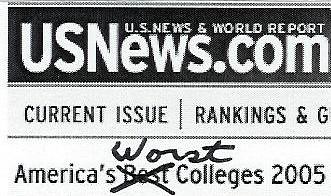
Shawnee State is one of the 217 small liberal arts colleges that US News ranked for 2005. The 217 colleges are divided, by quality, into four tiers, the best in the top tier, the worst at the bottom. Shawnee State is one of 53 colleges in Tier 4, the bottom group. Not only that, it is near the bottom of the bottom group, and it has been ranked near the bottom of the bottom for at least a decade. By reputation (on a scale of 1 to 5) SSU is currently ranked at 1.6. There are only 4 colleges among the 217 that have a worse reputation. Here is US News' bottom tier: Note the arrow next to SSU, near the bottom:

usnews
SSU near the bottom of US News bottom tier

From the time it was founded in 1986, SSU has been the beneficiary of many extra millions of dollars in state aid. While Speaker of the House Vern Riffe was alive, SSU occupied a privileged position among Ohio’s state universities. As a result of its most-favored-university status, SSU increased in campus size and in academic quality, though not so much in quality as in size. But in spite of these improvements, SSU has one of the worst reputations not only among the small colleges in Ohio but among all the small colleges in the nation. Why?

Why does SSU continue to have such a terrible reputation? Why does it continue to be ranked by US News near the bottom of the bottom? One of the reasons is that the business and professional clique that controls Portsmouth also controls SSU. They control Portsmouth through the mayor and the city council, and, though none of them are educators, they control SSU through the university lawyer and the board of trustees. While they are willing to pay lip service to the idea, most trustees have never really accepted, indeed some are not even aware of, the principle of shared governance that is supposed to be in place at every accredited institution of higher education.

The special role of the university in modern American society is different from the business model. To accomplish its unique mission, to succeed as an institution of higher learning, a university requires unusually close cooperation between administration and faculty. But the trustees and the administration at SSU, acting on behalf of those who control Portsmouth, have traditionally treated the faculty like spoiled children, or at best as ungrateful employees who do not do what they are told. In the past, a North Central Association accrediting team acknowledged the faculty’s feeling that a politicized board of trustees exerted undue influence over the university.

SSU is currently experiencing turmoil over the trustees’ decision to switch from a quarter to a semester calendar. Even some of those who prefer semesters are protesting the way in which the trustees and the administration went about making and implementing the decision. SSU cannot possibly make the difficult transition to a new calendar without the faculty’s cooperation, because it requires an enormous effort by the faculty, apart from their heavy teaching responsibilities, to change to semesters. The trustees have the statutory authority to declare a change from quarters to semesters, but there is nothing in the faculty’s contract that says they must serve on the many committees that are necessary to do the thousands of things required to make the change. Faculty are a volunteer army, but before they fight a war declared by the trustees they need to be convinced the war is worth fighting. The administration has never convinced enough faculty that the semester war is worth fighting. The administration’s line now is that no matter what some faculty might feel about semesters, the decision to switch has been made and, to quote the administration's line, “the train has left the station.” The train may have left the station, but are there any passengers on it?

Just as Portsmouth has been controlled by a privileged clique of business and professional people who have more dollars than sense, SSU has been controlled by the same privileged group through the board of trustees and through the privileged clique's point man, university lawyer Stephen P. Donohue.

No matter how corrupt or incompetent a mayor may be, the privileged clique will try to keep him in office just as long as he serves the interests of that clique. That was the case with Mayor Bauer, who was recalled last year, in spite of the clique's campaign to keep him in office, and that was the case with Clive Veri, who resigned in 1998 under pressure and rumors of scandal after serving as the controversial president for nine years. Unequal to the challenges of the present, let alone the future, the desperate Veri came up with a nostalgic 1950s solution for SSU in the 1990s – football, fraternities, and semesters. Even though he had been unable to convince the faculty in nine years of lobbying and even though the major state universities in the area – Ohio State, Ohio University, and the University of Cincinnati – remain on the quarter system, Veri in his final months as president convinced the trustees to mandate conversion to semesters.

verimural
See "Veri's Revenge" in the archives

James P. Chapman, Veri’s successor, was denied reappointment in large part because he had concluded switching to semesters did not make sense. Chapman was replaced by Provost Michael Field, who was appointed Interim President by the trustees, in spite of the documented views of the faculty that Field was a failure as provost. However, with support from some trustees, Field threw his hat in the ring for the presidency, but the presidential search committee kicked his hat out. Even though influential trustees wanted the obliging Field as president and would have appointed him over faculty objections, the presidential search committee wisely withheld that opportunity from them by declining to include Field among the finalists the trustees would select from. Rejected by the search committee, Field resumed his job as provost, in spite of the highly critical evaluations he had earlier received from the faculty. What does someone who had failed as provost and then failed in his bid for the presidency do? Elsewhere he might have to find a job at another university. At SSU he resumed being provost and was appointed to oversee the most momentous and controversial change in the history of the university – the conversion to semesters.

freepress1
2002 article in student alternative newspaper

Field is the engineer of the train that left the station without the passengers. Is this any way to run a railroad? Is this any way to end the turmoil? Are semesters a way to help improve SSU’s terrible reputation? I don’t think so and neither did any of the accrediting teams who have visited it in the last twenty years. SSU has some very serious problems, but being a quarter institution is not one of them.