Sunday, November 28, 2004

On Native Ground

shawnee_village

I suggested in a previous blog that whites in their relationships with Indians were like those South American tribes who first killed their foes and then ate their hearts to acquire the warrior virtues those foes possessed.

In North America, the warrior virtues were only the first useful thing whites took from the Indians. Once the Indians had been decimated by war, disease, and alcohol, once they had been removed as impediments to the exploitation of the continent, it was then possible to transform them, at least in the national imagination, into “Native Americans.”

The renaming, the recasting, of the Indian as Native American was part of the process of cultural cannibalization by whites. As Native Americans, Indians possessed other virtues worth appropriating, besides being warriors. Indians were cruel, uncivilized killers, which is how they are described in the Declaration of Independence: Native Americans, by contrast, are in harmony with themselves, with the environment, and with the Great Spirit. In the most extreme transformation of the Indian into Native American, he is turned by the media into a redeeming spiritual figure. He walks these polluted hills.

In a famous ad sponsored by the American Ad Council, which first televised it more than thirty years ago, a Native American sheds tears over the pollution of the environment, by people, of course, not by corporations. That particular ad, incidentally, first appeared on Earth Day, 1971, but the “Native American,” who became famous as “the crying Indian,” was bogus: he was Espera DiCorti, a Hollywood actor who was born in Louisiana of Italian immigrant parents but made a career in Hollywood and TV by claiming to be an Indian from Oklahoma. He made an early film appearance as an Indian in the 1919 silent, “Back to God’s Country.”

Indian captivity narratives were a favorite literary genre in the colonial period of American history, back when Native Americans were still Indians. Tales of white women held prisoner by savages were best sellers. The Indians of Lower Shawnee Town, located roughly where Portsmouth now is, held a white woman captive back in 1775. A stirring mural of that piece of local history would make tourists stop their cars, but it would be out of keeping with the politically correct, Portsmouth-Chamber-of-Commerce view of Portsmouth’s past that is depicted on the Floodwall. Better to commemorate Jim Thorpe playing the white man’s game than redskins menacing a white woman.

The natives of Lower Shawnee Town, in the mural above, are shown in peaceful pursuits, in the period prior to the arrival of the whites. Absent is any suggestion they valued freedom enough to die for it. Possibly because they were among the most nomadic of the native peoples, the Shawnee refused to be confined to one place, especially to a reservation. You would not guess from the Shawnee Floodwall mural that such people would produce such a defiant leader as Tecumseh, who said the following in 1810 to the Osage tribe of the Ohio River Valley: “Brothers: Who are the white people that we should fear them? They cannot run fast, and are good marks to shoot at; they are only men; our fathers have killed many of them; we are not squaws, and we will stain the earth red with their blood.” The Shawnee were among the most defiant of the native peoples, and they made their last stand in Ohio. That heroic resistance is no where commemorated on the Portsmouth Floodwall.

On land that they took in the vicinity of Lower Shawnee Town, the whites eventually built a university, which they named, along with a nearby state forest, Shawnee. What white Americans did on the North American continent they are now doing half way around the world. Through the military and the mass media, the most effective weapon of cultural transformation, we are imposing our political, cultural, and religious values on darker-skinned people, whether they like it or not. Who knows whether in a hundred years, in an another ironic convolution of history, after we have killed the Tecumsehs and subdued the rest, we might not idolize and name universities and forests after those who fought suicidally rather than submit to us.

Tuesday, November 23, 2004

Jim Thorpe: Return of the Native

thorpemural

To understand the ambivalent relationship between Native Americans and white Americans, it is instructive to recall the practice of some South American tribes who, in an attempt to acquire the strength, bravery, and other martial virtues of their slain foes, ate their hearts.

“The only good Indian is a dead Indian” was a proverbial American slogan in the 1800s. For hundreds of years, white Americans had deprived native Americans of their land, their culture, and in many cases their lives, herding those who survived onto reservations. Then, at the beginning of the last century, after native Americans had been virtually vanquished, the whites began to rehabilitate the reputation of the red man. The same qualities for which Indians were formerly feared and loathed, their unflinching fierceness, gradually became a virtue. As sports began to be a major national industry in the first half of the last century, amateur, college, and professional teams proudly adopted Indian names – the Indians, the Braves, the Redskins, the Chiefs, the Warriors, the Fighting Illini, the Seminoles, etc. The image of the Indian as unregenerate savage was gradually replaced by the Indian as outstanding athlete. Having practiced a form of genocide, the whites then in an act of expiation glorified, if not deified, their vanquished foe. They ate their hearts out.

Jim Thorpe was living embodiment of the transformation of the young Indian brave from savage to star athlete. If Thorpe had not existed, he would have had to be invented, because he filled an important cultural need. From Oklahoma, where his ancestors had been driven on to reservations, which were the concentration camps of the 1800s, Thorpe came East to play for the Carlisle School for Indians, in Pennsylvania. Thorpe may have been the first minority athlete to be recruited to play collegiate sports. But Carlisle was not a college. It was a trade school founded for the purpose of not only taking the Indian off the reservation but also of taking the Indian out of the Indian. Parents on the reservation had no choice: the law forced them to give up their children to a school a thousand miles away whose aim was, in the words of its white military founder, who was speaking figuratively, of course, to “kill the Indian, save the man.” Carlisle students were forbidden to talk, to dress, to act, to sing, to dance, like Indians. At Carlisle, Thorpe excelled in football and ballroom dancing, but there is no evidence that he learned any trade, other than being an athlete.

Portsmouth, Ohio, was one of the more undistinguished stops in his career as a professional athlete, and there is irony in his coming to southern Ohio, for his Shawnee ancestors had been forced out of the area in an earlier period of American history. Thorpe was an underpaid player and manager of the Portsmouth Steel-Shoes for a season, and on the basis of that tenuous connection to the river city, he is memorialized in a Floodwall mural.

When his youth was gone and his athletic skills deteriorated, Thorpe drifted during the Great Depression into manual labor and alcoholism, although he did have a bit part as a native in the 1933 movie “King Kong.” He died broke in 1953, just a few years after the appearance of the film “Jim Thorpe: All American,” which was a Hollywood contribution to the process of cultural cannibalization of Native Americans, of which the Thorpe Floodwall mural, is a more modest and more recent example.

Friday, November 19, 2004

Changing Names

jimthorpe2

For Jim Thorpe, 1888-1953

He had an Irish name and an Indian face,
a half-breed, born on an Oklahoma reservation –
strength of steel tempered by balletic grace.
A bear of a man, he became the pride of a nation

that reveres the athleticism of inferior races.
In a collegiate dance contest, he first showed his stuff.
Light on his feet, he threw off the traces
until the judges conceded: “Enough is enough.”

The Carlisle Indians were real redskins.
In one game the score was Thorpe 18, Harvard 13.
They finished that season with eleven wins.
He was the best anyone had seen.

In 1912, thousands of miles from home,
his athleticism, like the Olympic flag, unfurled
before the blonds, agog, in Stockholm.
The king called him “the greatest athlete in the world.”

Fast-forward to 1953 and a poor drunk
dying in a trailer park in Lomita, CA.
His third wife sold his corpse to Mauch Chunk,
which changed its name to Jim Thorpe, PA,

a petered out mining town where
they buried him in a sure-fire tourist site.
An Indian name, Mauch Chunk means “Sleeping Bear.”
Thorpe’s, “ Wa-Tho-Huk,” means “Path of Light.”

Robert Forrey

Thursday, November 11, 2004

The Culture of Dependency

Riffe mural
In spite of being dominated by conservative Republicans, who advocate the classic Horatio Alger virtues of strive-and-succeed, south central Ohio has a pervasive culture of dependence on government – city, county, state and federal. This dependency is obvious, even notorious, in those at the bottom of the social ladder – the uneducated, the unskilled, the unemployed. For them government aid takes the form of food stamps, Aid for Dependent Children, Medicare, welfare, etc. For those at the top, the business and professional classes of south central Ohio, governmental assistance is less obvious, but it’s there too. Want to start a business? Can’t do it by pulling yourself up by your bootstraps? There’s the Southern Ohio Growth Partnership to loan you government money, or the city government to sell you public land cheap for your new business, or tax breaks, write-offs, abatements, or other sweetheart deals. Are you going out of business and have a big empty department store to unload? Look to the city or county government to take it off your hands. Got a house that you are having trouble selling in Portsmouth’s flat real estate market? Look to the state university to buy it for more than you could ever sell it to a private party. Got a friend or relative who needs a job? Look to the city and country government, to the prison or the new jail; to the hospital or the university, but only if you know someone who knows someone. And being a Democrat doesn’t disqualify you. The incestuous nepotism and feeding at the public trough in south central Ohio is bipartisan. The godfather and the dispenser of much of the governmental largesse to south central Ohio, Verne Riffe, was a Democrat. He is enshrined on the Floodwall Murals. He walks these hills.

How did this pervasive dependence of people in Southern Ohio on government come about? Once a bustling manufacturing and transportation hub, where employment was high and commercial competition presumably was intense, the Portsmouth area, as a result of regional, national and global changes that were beyond the control of any individual, class, or political party, began a steady economic decline about a half century ago. The Midwest generally and Ohio in particular, with its large industrial base, was especially vulnerable. Ohio found itself a rustbelt state and Portsmouth a terminal city in a downsizing digitalizing world. Rather than competing for the few jobs and scarce customers in the private sector, collaborating with public officials to tap into public monies became a way of life in south central Ohio. The $300,000 check delivered by Representative Portman for Portsmouth Murals, Inc. just prior to the elections last week is pure political pork.

In south central Ohio there may have been cultural baggage that exacerbated the problem of dependency on government. David Hackett Fischer in Seed of Albion pointed out that the wave of immigrants who settled in the Appalachia region brought with them from the border regions of Britain a shiftlessness, incontinence, and orneriness that was impervious to the American creed of strive-and-succeed. In the politically incorrect classic Taps for Private Tussie, Jesse Stuart, more in sorrow than anger, mocked the dependency of hill people on government handouts, but he said nothing of the dependency, mooching, and hypocrisy of those at the top. There is, for example, the Portsmouth real estate developer who received over 3.7 million dollars in abatements as he first ran down and then razed neighborhoods, in one of which he built dormitories for students but only after the university agreed to reimburse him if the occupancy rate ever fell below a certain percentage. He owns the dormitories, and pockets the profits, but the university, that is the government, takes the risks. That is the way business is done in south central Ohio.

Saturday, November 06, 2004

Angel in Sydnor's Corner

angels
What was very surprising about the results of the recent attempt to recall Ann Sydnor as Ward 1 representative on the Portsmouth City Council was the narrow margin of her victory. It could not have been narrower – a single vote. Out of the 1345 votes cast, 672 were for and 673 against her recall. The percentage by which she avoided recall (assuming the numbers don't change in a recount) was a remarkably narrow .03%. But that was not the only surprising thing, because her margin of victory was about as narrow as her political and financial advantages over her challenger, Tim Loper, were wide.

Sydnor has many years of experience as a council member; Loper has none. She waged an active campaign; if Loper waged anything more than a token campaign, I saw no sign of it. Speaking of signs, hers appeared throughout the ward, and they were commercially produced; Loper’s very few homemade signs (I saw three) were limited to the Front Street area. Sydnor had the support of most of the local political establishment, everyone from former Mayor Bauer and the Republican lawyer John Thatcher, to Lee Scott, a leader of the movement to recall Mayor Bauer. When the campaign expenditures of Sydnor and Loper are made public, I expect they will show that the disparity in dollars were as great as the disparity in signs. And yet her margin of victory was only 3/100ths of one percent.

In my few contacts with Ann Sydnor, who is my council representative, I have found her savvy and helpful. When Timothy Angel was running against her for the Ward 1 council seat and spoke to me about the need of new blood on the City Council, I was not persuaded to vote against her. Then in this recall election. Angel himself emerged as her strong supporter and treasurer of the Keep Sydnor Committee. So even her opponent in the last several council races was on her side in this one, and yet her margin of victory was only one vote out of 1345 cast.

In her campaign, Sydnor argued experience is her strong suit. But the issue to Sydnor’s critics is not her experience but her integrity, which they claim she lacks. They say her role on the City Council in general and her part in the Marting’s purchase in particular show that she is not to be trusted. In a campaign letter to Ward 1 residents, Angel implicitly defended Sydnor’s votes on the City Council, including her vote in favor of the Marting’s purchase, by saying, “She has made decisions based on the information she had at the time and voted how she felt was in the best interest of Portsmouth.” According to Angel, Sydnor, at worst, had been misled on the Marting’s purchase. But given her experience and savvy, shouldn’t she have been the one person on the Council who should not have been misled? Shouldn’t she have known the Marting’s deal smelled to heaven? Wouldn’t her nose alone have told her that?

One of the positive things about Portsmouth politics is that party affiliation, gender, and sexual orientation are not all that important. The people who get in bed with each other politically don’t let things like that get in their way. The alliance between Sydnor and Angel strikes me as a marriage of political convenience. Sydnor has said that she does not plan to run for City Council again when her term is up next year. It would not surprise me if Angel did run, with Sydnor’s blessing. After all, if he had not voted for her, she would not have achieved her razor-thin margin of victory. He literally was the Angel in her corner.

Semesters: Veri's Revenge

verimural
In addition to giving a Shawnee State trustee the chance to tap into public monies, as I pointed out in my previous blog, the Portsmouth Floodwall murals also provided the artist an opportunity of showing a troubling period in the history of Shawnee State U. in an idyllically academic light.

The mural “SSU Expansion” stresses academics, not expansion, showing President Clive Veri (in the detail above) in his robes standing in front of Massie Hall talking to several graduating students. The mural does not show the dozens of homes in the area around Massie that were eminently domained and subsequently pilfered by a Shawnee State administrator on behalf of the overprivileged of Portsmouth, who coveted the doors, chandeliers, mirrors and other valuable accoutrements of these historic homes. The bulldozing of Portsmouth’s architectural heritage was part of SSU’s “expansion.” And as for academics, there is no way of telling from the mural that during Veri’s troubled nine years as president, from 1989 to 1998, SSU was annually consistently ranked by U.S. News as one of the worst liberal arts universities in the nation, near the very bottom of the fourth and bottom tier of small liberal arts institutions.

In spite of his poor performance as president, Veri regularly received commendations and merit raises from the trustees. If he was an abysmal failure with faculty (in the year prior to his resignation only 5% of the polled faculty gave him a vote of confidence), Veri was the darling of the trustees and the overprivileged of Portsmouth, whose obliging servant he became. As long as he did nothing to upset the corrupt status quo or upset the trustees, his incompetence was no bar to his remaining president of SSU. If a trustee, like Frank Waller, wanted to start a travel business that would eventually become the preferred agency for the university; and if another former trustee sold her white elephant house on Franklin Boulevard to SSU for much more than it was worth, Veri would have been the last to question whether there might be a conflict of interest.

Veri didn’t have a clue how to lead a small new state university in Ohio or how to operate in the shadow of SSU’s political godfather in Columbus, Vern Riffe. A heavy drinker and smoker, instead of dealing with difficult realities, Veri resorted to 1950 fantasies. As his model of what SSU might become, as I learned from a conversation with him, he took as his ideal a picturesque New England college, Middlebury, in Vermont, which he had not attended but which he looked enviously at when he was president of déclassé Lyndon State College, in a more remote part of the state. From a blue-collar ethnic background, Veri may never have recovered from the disappointment of not attending a picture-postcard New England college. He became SSU’s Great Gatsby, and an upper-class New England college, with its football, fraternities, and semesters, was his East Egg.

With no-confidence votes and rumors of scandals swirling around him, Veri resigned in 1998, possibly because he was pressured to. But as a reward for his servility, the trustees in his last months in office gave him a degree of satisfaction by endorsing one of his Gatsby dreams. Though they made no sense for the type of institution SSU was and is, semesters were mandated by the trustees, but they would not be imposed until after Veri had left. If semesters was originally a dream of Veri’s, what semesters became in his final embittered months as president was an act of revenge. What Veri dared not have the trustees do during his nine years – mandate semesters – they did in his last months in office, leaving the dirty work for some future president to deal with.

Politics, not academics, have always been the priority at SSU, and politicians not educators continue to call the shots, and as long as they do SSU will continue to have one of the worst reputations among small liberal arts colleges in the United States, as it has again this year. Among 217 small liberal arts universities, there are only four ranked lower than SSU by U.S. News, and those four survive not on the public treasury but on a wing and a prayer. It is a scandal that after eighteen years and many millions of dollars of state support and subsidies, SSU still has one of the worst academic reputations in the nation. And what is the best solution the trustees can come up with to improve SSU? To switch to semesters! Once it does make the switch, after several years of herculean fruitless efforts, SSU will have one more thing in common with Arkansas Baptist College, Barber Scotia College (NC), Christendom College (Va), and Christian Heritage College (Ca): they will all be on the semester calendar.

Saturday, October 23, 2004

A Tale of Two Cities:2

PORTSMOUTH MURALS


In Revere, Massachusetts, where I grew up, the Mafia was the group you had to worry about. In Portsmouth it’s the Chamber-of-Commerce and Southern-Ohio-Growth-Partnership types, the over-privileged people, a number of whom live on the Hill. Yes, there was more crime and corruption in my hometown than in Portsmouth, but Portsmouth has more of one thing than any town I’ve lived in – what could be called legal, or country-club, corruption. In Portsmouth, the over-privileged don’t have to bilk the public; they simply have to bill them, and some foundation or “non-profit” organization, will tap in into local, state, or/and federal sources to find the money to pay the bill. One local “non-profit” corporation that has apparently tapped into public funds for real-estate payoffs is Portsmouth Murals, Inc.

In addition to attracting a steady trickle of tourists and funneling a few scarce dollars into Portsmouth’s depressed downtown neighborhood, Portsmouth Murals, Inc. also provided an influential member of Portsmouth’s ruling clique, George Clayton, with the opportunity of unloading five parcels of property in the same depressed downtown neighborhood, including the empty store of his failed Kenrick’s business. Just as Mayor Bauer and the Portsmouth city council used public funds to bail out the Marting’s Foundation by buying the empty Marting’s department store for $2,000,000, Portsmouth Murals, Inc. bailed out Clayton by buying the Kenrick building and adjoining properties for $350,000. These properties have very little commercial value, and the empty store was likely to stand idle for years, so public funds had to somehow be tapped into to take these distressed properties off his hands. Historic structures like the Norfolk & Western terminal and a number of elegant older homes near the university have been demolished, while buildings like Marting’s and Kenrick’s, which have even less historic and architectural worth than they do commercial value, are re-cycled with public monies to bail out the over-privileged who own them. Was it just a coincidence that George Clayton was bailed out by a publicly funded, not-for-profit corporation, Portsmouth Murals, Inc., that he himself was one of the founders of? Wasn’t George Clayton involved in a similar conflict of interest similar to that of his relative Clayton Johnson in connection with the Marting’s purchase?


In an article I published in 2002, “House Shenanigans,” I wrote about several sweetheart real-estate deals for and by the over-privileged people on the Hill, and of a particular deal that George Clayton was directly responsible for when he was chairman of the board of trustees of Shawnee State. A doctor who lived just a golf putt away from Clayton’s home on the Hill was leaving town and reportedly having trouble selling his house. Sounds like a situation in which the doctor might have to sell at a loss, right? Wrong. Just as the city came to the rescue of the Marting’s Foundation, just as Portsmouth Murals, Inc. came to the rescue of George Clayton, Shawnee State University with George Clayton in the negotiating seat came to the rescue of the doctor on the Hill, paying him $412,000, for his house on Camelot Drive, a house that had been appraised for $365,140 in 2001, and he would have been lucky to find a buyer at the figure. Isn’t there a pattern here in which the over-privileged of Portsmouth, in danger of taking a loss on real estate, are bailed out by publicly funded institutions and organizations?

According to the Portsmouth Daily Times, Representative Rob Portman recently deposited a check for $300,000 in federal money into the account of Portsmouth Murals, Inc., bringing to a total of $1.2 million the public money that has been allocated for the renovation of the former Clayton property. It is ironic that businesses that go bust in downown Portsmouth manage to unload upon the public property that no other business would want. If you are a member of Portsmouth’s over-privileged and have a white elephant house or vacant store, be patient. The city, state, or federal government will bail you out. It remains to be seen how much Portsmouth Murals, Inc. is going to cost the public in the years ahead, and it will probably all be legal.

Friday, October 15, 2004

A Tale of Two Cities:I

Paul Revere
"The Midnight Ride of Paul Revere," by Grant Wood

Like a ball through space, the past does not move through time without spin. Throughout history, individuals and groups, tribes and races, religions and political parties, nations and, yes, even cities, put their spin on the past, re-spin their history, in order to improve their image. The saying that you can’t change the past is wrong. The past is constantly being changed. The past is not what it used to be, and it never will be.

I grew up in Revere, Massachusetts, a city whose past was steeped first in poverty and sin, and then, in the twentieth century, in crime and corruption. Like the nation of which it became a part, the history of my hometown was in sore need of re-spinning. The easiest thing to change about anything is its name. In 1871, the town, then called North Chelsea, renamed itself after the legendary hero of the American Revolution, Paul Revere, even though he had no connection with the town. Not only was there no connection, the real Paul Revere was no hero. That was just a legend. The real Paul Revere had fled cowardly in the only Revolutionary war battle he was ever in. No matter. Longfellow re-spun who Revere was in his famous 1861 poem “The Ride of Paul Revere,” and the rest is history, or rather myth, which is enchantingly rendered in the painting by Grant Wood.

I am now living in another American town with a shady past and a tarnished present. Like Revere, Massachusetts, Portsmouth, Ohio, has re-spun its history. It did not change its name: it changed its past. Portsmouth’s town fathers have tried to make the past of their river city look respectable through one of the oldest forms of propaganda: murals. I will say more about that in “Tale of Two Cities: II.”

Robert Forrey

Friday, October 08, 2004

TRAVEL WORLD: GONE BUT NOT FORGOTTEN

Example

In the last couple of years, several shady real estate deals have taken place in Portsmouth, such as the sale of the Marting’s building to the city and the sale of Kenrick’s store to Portmouth Murals, Inc. Elsewhere, when a business fails it goes out of business: in Portsmouth, when a business fails it unloads its liabilities and otherwise depreciated assets off on the public in the guise of philanthropy and foundations while getting tax breaks in the process. The Marting’s and Kenrick’s deals were too big to escape public notice, but how many smaller shady deals are hardly noticed? What follows is the history of one of these failed but not completely forgotten smaller businesses, Travel World.

In 1993, Frank Waller, of Waller Bros. Stone Co., and Michael Warsaw, of Lewis Furniture, joined with dentist Gregory Gillen to establish Travel World. Starting a business in the chronically depressed economy of Portsmouth in any year takes nerve; starting a travel agency in Portsmouth in 1993 took more than nerve, because Portsmouth already had a major travel agency, Triple AAA, which had been serving the community for seventy years, and several smaller travel agencies as well. The Travel World partners apparently had no previous experience in the travel business. Waller’s business was rocks, Warsaw’s furniture, and Gillen’s teeth. But they had something more valuable than experience, namely connections. The most important of these was Waller’s connection to Shawnee State University, where he was a member of the Board of Trustees, which he also chaired. It did not hurt Travel World’s prospects that Warsaw was the husband of SSU Director of Development Susan Warsaw, because among the potential customers Travel World aimed at were state-funded travelers at SSU, including the Board of Trustees themselves. While Waller was sitting on the SSU Board of Trustees, Travel World became the preferred travel agency for the university. A former Travel World employee told me Waller was sometimes kidded about his apparent conflict of interest, but he could shrug it off, as Clayton Johnson was able to shrug off his apparent conflict of interest in the Marting’s deal. In the country club atmosphere that prevails among the small circle of Portsmouth elite, what may appear to be conflicts of interest to outsiders is to them just Chamber of Commerce camaraderie. By 1996, Travel World’s net total sales had reached $853,083. By December 31, 2000, net total sales had increased to $1,052,582.

But 2001 turned out to be a disastrous year for Travel World. For one thing, on-line internet travel sites began cutting deeply into its business. In fiscal year 2000-2001, according to university financial records, SSU was directly billed for only about $15,000 by Travel World for official travel, but that was a third more business with SSU than Triple AAA did. But the fatal blow to Travel World came on 9/11/ 01 when the travel industry nationally was paralyzed following the attack on the twin towers. After 9/11, Travel World was close to being grounded permanently. Its assets were negligible. It did not even own the land and building in which it was doing business; that building was rented, and has since been razed. But help was on the way. Travel World retained attorney Clayton Johnson and hired Portsmouth CPA Michael L. Gampp, whose business connection at the time was with Reynolds & Co., a CPA firm that had been founded by the late Thomas B. Reynolds. Mr. Reynolds was a member of the SSU Board of Trustees and his widow Kay Reynolds continues with Reynolds & Co. She also served on the Board of Trustees.

Travel World supplied accountant Gampp with unaudited figures on which to make an estimate of what Travel World was worth, which he calculated to be $100,942. That may not sound like much for a company that had been doing an annual million dollar business a few years earlier, but it was more than the business would be worth in bankruptcy. Perhaps with the fate of auditors such as Arthur Andersen in mind, Gampp disclaimed any responsibility for the unaudited figures he used to make his estimate. He stated twice in official documents, “I take no responsibility for the underlying data presented in this report.” Gampp also denied his fee was influenced by the figure he came up with in his valuation.

In estimating what Travel World was worth, Gampp took as his base period the five-years from January 1, 1996, to December 31, 2000, which was the most prosperous period of Travel World’s history. He excluded the catastrophic year, 2001, in his calculations. To use an analogy, imagine a doctor evaluating the health of a patient for a life insurance policy. The doctor reviews the patient’s health beginning six years earlier but excludes in his evaluation the most recent year, when the patient suffered a stroke that left him paralyzed . I know nothing to suggest Mr. Gampp is an ethically challenged CPA. But it is curious that his valuation included the following stipulation: “This report is not to be copied or made available to any persons without the express written consent of Michael L. Gampp, CPA.” Perhaps that is a boilerplate CPA stipulation, but it certainly sounds suspicious in light of the accounting scandals of a few years past. In any case, I obtained his valuation from Ohio University, Ironton, under Ohio’s open public records law, which overrides his preference for secrecy.

Waller and his partners donated the sinking travel agency and its assets, such as they were, to Ohio University, Ironton, to be used for instructional purposes in its travel program. That move may have been philanthropic or it may have been a way to get Ohio taxpayers to defray their losses, for the donation had tax advantages: Waller and his partners, based on Gampp’s valuation, became eligible for a $100,942 tax credit. I do not claim to know whether legal boundaries were crossed in Travel World’s relationship with SSU, but those boundaries were obviously blurred by possible conflicts-of-interest. Not all the people who serve on boards of trustees and boards of directors do so for altruistic reasons. The country club corruption of our river city makes it possible for people with connections to unload their white elephant houses, failed businesses, and empty department stores off on the public, all in the name of philanthropy and public service.

Saturday, October 02, 2004

Tangled Web

city_council picture

Portsmouth City Council c. 2000
From left to right rear are Solicitor Kuhn, Mayor Bauer and City Clerk Aeh.


“O, what a tangled web we weave when first we get involved in real estate deals.”

A hearing on the now notorious purchase by the city of Portsmouth of the Marting’s department store building was held last Thursday, September 30th, 2004, in the Court of Common Pleas on the third floor of the Scioto County Courthouse. The hearing was held in connection with a suit brought by Robert Mollette against the Portsmouth City Council. The chief witness was City Clerk Jo Ann Aeh, who was questioned by City Solicitor David Kuhn and cross-examined by the attorney for Mollette. Ms. Aeh’s testimony in the dimly lit, acoustically challenged, drafty chamber of the Common Pleas court will be little noted nor long remembered, but it is a classic example of the denial, deception, and double-talk that those who defend the Marting purchase have to engage in.

At the outset, Ms. Aeh appeared to be a self-assured, even haughty witness. She prided herself on her efficiency and accuracy as City Clerk, and she was obviously impatient with the whole procedure; at times she could not hide her contempt for the line of questioning that Mollette’s attorney was following, especially when he made a few missteps. Her general position was that nothing improper had occurred in city government prior to the purchase of the Marting’s building. She was absolutely confident of her record keeping in regard to the number of meetings that had been held to discuss the purchase of the building. When her testimony regarding the number of meetings related to Marting’s was shown by Mollette’s attorney to be at variance with the testimony of five city council members who had been deposed in the previous week – depositions Ms. Aeh had not seen – she said the council members’ memories were obviously faulty. It was then the turn of Mollette’s attorney to be contemptuous.

Ms. Aeh may be as well-organized and efficient as she implies she is, but she is caught in a web of deceit woven by more clever and less scrupulous hands than her own. The more accurate, reliable, and upright she tried to be, the more hopelessly she got ensnared in the tangled web, and the more morally compromised she became. At one point, while she was quibbling about the meetings, the judge said to her (I had trouble believing what I was hearing) that the reason council members were meeting with attorney Clayton Johnson in groups of threes was obviously an attempt by those involved to get around provisions of Ohio’s Sunshine laws, since the presence of four council members would have made it an official meeting and open to the public. Why did those meeting in the offices of Johnson and Oliver not want the public to know what they were doing? Could it be because they were about to rip off the public?

On Portsmouth's John Street there’s a lot of trafficking in sex and drugs by those without the education and connections that would allow them to make a killing in the professions or in real estate. Every real estate deal in Portsmouth is an opportunity for someone – often more than one party – to make a dishonest dollar – dishonest though not necessarily illegal. From the shenanigans at Shawnee State in connection with the purchase of a home for the university president, I learned how these shady real estate deals are pulled off, how these webs get woven and tangled. The Marting’s deal is different only quantitatively; it was just too big and crooked a deal, too wide a web, however clever the weaver, not to entangle and compromise others. It remains to be seen whether anybody besides Mayor Bauer, who was recalled by the voters, will be made to pay for the Marting’s purchase.

Robert Forrey

Saturday, September 25, 2004

A DIRTY BUSINESS

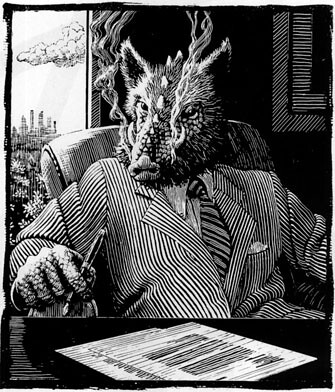
pigguy

The recent recall of mayor Bauer and the visit of George Bush and John Edwards to River City set me to reflecting about Portsmouth’s politics and history.

The dirtiness of politics is proverbial. How can anyone participate in, without being contaminated by, politics? The butcher is going to have a bloody apron and the plumber a gucky snake, but we never stop being indignant when a politician has sticky fingers, deep pockets, deserving friends, and enough skeletons in the closet to supply every anatomy class in the nation.

Politicians as a class are despised and distrusted even more than lawyers, and they are often of course one and the same. The very worst of them belong to the opposing political party. There is a name for politicians who are not lawyers: fools and amateurs.

Politicians, like lawyers, do our dirty business, as we used to have washerwomen do our laundry. Politics does not attract the sensitive or morally squeamish. Politicians are usually ambitious and shrewd but seldom honest. A lack of principles is not a requirement for public office, but it is harder to succeed with principles than without them. Count on it: anyone who speaks reverently of “the American people” or “the people of Portsmouth” is probably trying to screw them.

Lawyers and politicians know how sausages are made. The sausage eaters, the electorate, don’t want to know about it. Who cares how many porkers get slaughtered. Just keep those sausages coming.

Politicians are men not of steel but of pig iron. The first mayor of Portsmouth, a gent name Tomlin, “kept a hotel on Pig Iron Corner,” as Evans wrote disapprovingly in his History of Scioto County. Did Tomlin rent rooms by the hour as well as the day? Evans does not say. When he came to Portsmouth in 1831, Tomlin married the daughter of a local saloonkeeper and made his living supplying whiskey and pork to the people of Portsmouth. Booze? Pigs? Inevitably, he got into politics. A Democrat, he was appointed Associate Judge of Scioto County. (“The devil is an Irish judge,” an old Irish proverb says.) Tomlin was also elected to the Portsmouth town council. In March 1837, he was elected first mayor of Portsmouth and subsequently was reelected. He was reelected again in 1844, defeating the Whig candidate with the help of what Evans calls “defamatory circulars” distributed just before the election by the Swift Boat Veterans for” . . . no, wait I am getting things mixed up. It was the Committee to Re-Elect Mayor Bauer, no, that’s not it, either.

They did not have Recall back then; they apparently didn’t need it. After several terms as mayor, during which time he continued as Associate Judge, Tomlin ran afoul of the town council, which voted to remove him from office claiming he was sick, deaf, and incompetent. They appointed another man to fill out his term. Tomlin was a candidate in the next mayoral election, but he got only one vote, presumably his own.

There is no mural on the flood wall for the first mayor of Portsmouth, nor is there one for the infamous “Black Friday,” January 21, 1830, when the eighty or so African-Americans of Portsmouth were driven out of town in accordance with the “Black Laws” of Ohio.

The floodwall is where Portsmouth’s history gets laundered. The Flood of 1937 and the drowning of a black woman, the flood’s only fatality, washed away all our sins, or most of them anyway.

Sunday, September 12, 2004

FOLLOWING A PRECEDENT

“It was a great day for the City of Portsmouth,” Richard Bussa began his article in the Community Common following the recent visit of President Bush to our river city. I disagree strongly. I believe September 10, 2004, in Portsmouth, Ohio, was a poor excuse for democracy. September 10, was, as far as democracy goes “a miserable failure” – to borrow Representative Dick Gephardt’s characterization of the president himself.

The Bush campaign chose Shawnee State University because it was, like Bible colleges and military institutions, a safe venue. When Bush’s twin daughters were graduating from Yale and the University of Texas last spring, he did not go to either of those graduations because his mere presence was likely to provoke massive protests over the Iraq War.

At Shawnee State University , the Bush campaign, with the cooperation of local Republicans, were able to stage one of those surreal Republican fantasies in which Bush and his most enthusiastic and carefully screened supporters were insulated not only from his miserable record on the economy, Iraq, and the environment, but also from the unpleasant realities of Portsmouth – from poverty, unemployment, prostitution, drug dealing, and political corruption, problems that prompted local voters recently to throw out a corrupt and inept Republican mayor by a 2 to 1 margin in a special recall election.

I joined those protesters who gathered in a small median set aside for protestors at the edge of the university. If there was one place Bush and his entourage could be guaranteed not to drive by it was that small reservation in which the white leaders of Portsmouth succeeded in penning dissenters, who were warned not to move from the site, certainly not in the direction of the insulated incumbent and his followers. The protestors had to satisfy themselves with exchanging chants (“Four more years!” versus “Three more months!”) with a group of young Bush supporters who were allowed to mix with and taunt the protesters. One anti-Bush protestor was arrested. A few people who witnessed the incident said he was not doing anything to warrant an arrest. The biggest (literally and figuratively) trouble-maker and loud-mouth among the Bushies, who said he was a student from Rio Grande, was sought out by a reporter for the Portsmouth Times. “Instead of being out here protesting,” the Rio Grande student said very angrily (I was standing right beside him), “why don’t they go look for a job?”

I am sure most of the millions of unemployed and underemployed in America and Appalachia would gladly get fulltime jobs if they could, but the Rio Grande student and president Bush refuse to acknowledge that during his administration there has been the greatest loss of jobs since Herbert Hoover, the last Republican president to visit Portsmouth. Hoover gained a kind of infamy for his refusal to face the reality of unemployment, poverty, and social unrest in America. Hoover kept on insisting that we had turned the corner, that new jobs and prosperity were just up the road, even as millions of desperate Americans took to the road in a futile search for jobs. When they got mad enough, they joined in protests against a Republican presidents’ bankrupt policies and elected a Democrat president. We hope to follow that precedent.


Wednesday, August 25, 2004

TERMINAL: A POEM


(On the demolition of the Norfolk & Western terminal)

After our candlelight vigil, we returned the next day
for an unauthorized tour of the Art Deco terminal
that will be razed to make way for a jail.
We could not find a room with a window
overlooking the past that we knew.
Like prisoners of the twentieth-first century,
we went from office to office, from floor to floor,
looking for memories undusted by asbestos,
stepping over wires ripped from walls and ceilings,
stubbing toes on clunky beige telephones
that were once the last word in style.
Faded green files lay on the floor like salmon
that had spawned obsolete data and died
of irrelevance, shamed by change.
Schedules beneath our feet lay at the bottom
of a tributary that had run dry
when America, captivated by cloverleafs,
sold its soul to the infernal combustion engine,
and trains stopped carrying passengers
in love with rail, and salesmen, servicemen,
fathers and mothers, uncles and aunts –
when Americans of every kind –
with faith in the future, reverence for the past,
with destinations as close as the town up the line,
or as remote as places existing only in the mind,
departed for the last time from the terminal.
Departing is such sweet sorrow.

Robert Forrey

Saturday, August 14, 2004

Straight Talk and Gay Bashing

What a week!

In an interview in Playboy Terrell Owens, a former teammate of Jeff Garcia, implied that the former quarterback of the San Francisco Forty-Niners was a homosexual. “Like my boy tells me,” Owens said about Garcia, “if it looks like a rat and smells like a rat, by golly, it is a rat.” Ricky Williams, the record-setting running back of the Miami Dolphins, is rumored to have retired prematurely because he is a homosexual who wants to do other things with the rest of his life than knock heads with Mike Ditka-like linebackers. And then New Jersey Governor James E. McGreevey, the highest ranking elected official ever to do so, publicly admitted to being a homosexual. Actually, with a wife and children, McGreevey could qualify as bisexual, but just as 1/32 of Negro blood during the slave era made one legally a Negro, one homosexual grain of sand is enough to convince homophobes the whole beach is gay. And now John Welton has discovered that back in 1981 the Daily Times reported that Lee Scott, among other things, had allegedly been involved in a homosexual relationship.

I had not heard that before, but during the Recall Bauer campaign I heard more than once that the mayor was a homosexual. I wouldn’t mention this rumor if someone who is in a position to know, and who is not a political enemy of the mayor, had not confirmed that the rumors were true.

In the interest of full disclosure I’ll admit that I’m faculty advisor to the Gay and Straight Student Alliance at Shawnee State. I know the Bible condemns homosexuality, but that is one of the issues I don’t agree with the Bible on. I think the world would be a less hate-filled place without homophobia, but I’m not suggesting we should be tolerant of drug-dealing and political corruption, two of Portsmouth’s prevailing vices. What I am suggesting is that we should not think homosexuality has some inherent link with drug trafficking and political corruption. The vast majority of drug-dealers and corrupt politicians are heterosexual, but that does not make heterosexuality a vice.

It is to the credit of Welton and Scott that, in spite of their being the victims of a sleazy “ex-con” flyer in the Community Common, they did not sink to making Bauer’s sexuality an issue during the recall campaign. During that bitter campaign, I asked Scott about the Bauer rumors, and he said the sex life of the mayor, though no secret in Portsmouth, was not a relevant recall issue.

A homosexual relationship Scott allegedly had almost twenty-five years ago is even less relevant than his drug conviction almost twenty-five years ago. He readily admits he was guilty of trafficking, for which he expresses contrition. He may have to answer for being a Benedict Arnold and a sell-out, just as Bauer may have to answer for being a pawn of the corrupt Portsmouth powers-that-be, but Scott does not have to answer for his sex life any more than the ex-mayor does.

Sunday, August 08, 2004

Legal Corruption

State investigators found nothing illegal in the city’s purchase of the Marting’s Building. That may be the case. Just because something is corrupt or unethical or unwise does not mean it’s illegal. The mayor may not have done anything illegal, but that does not mean he hasn’t facilitated the legal corruption that flourishes in Portsmouth. Because someone is un-indicted does not mean he is honest. Because someone is un-indicted does not mean he should not be recalled from office. Even in Portsmouth, we need to hold people who occupy public office to a higher standard than whether or not they are indictable.

Thursday, July 29, 2004

Digital Revolution

Recent events in Portsmouth, Ohio, and the recall of the mayor in particular, may reflect the remarkable revolution that electronics has brought about in communication in general and politics in particular.

Several days before the recall vote, I was talking to a solid citizen, Bob Mollette, who was very active in the recall movement. He probably was in a better position than I was to say how the vote was likely to go, but he was curious about what others thought. I told him that I had interviewed a number of people for my video documentary on the recall, and my sense was that dissatisfaction with the mayor was both deep and widespread, as a PORTSMOUTH DAILY TIMES survey had recently indicated.

But the campaign to keep the mayor in office had spent a lot of money in the two weeks prior to the election, and the two local newspapers, the DAILY TIMES and the weekly COMMUNITY COMMON, as well as local radio stations, had carried paid advertisements focusing on the criminal records of several leaders of the recall movement. The COMMUNITY COMMON carried as an insert a flyer that was designed to look like a WANTED poster, with mug shots of the ex-convicts. It was an attempt to smear the widely-based recall movement by identifying it with criminality, in spite of the fact -- or perhaps because of the fact -- that the ex-convicts John Walton and Lee Scott had long since done their time and were now actively crusading against political corruption. The advertising blitz did not mention Austin Leedom, the founder and editor of THE SENTINEL, who is an Air Force veteran and a deeply religious person, nor did they say anything about the Mollettes, a very impressive couple. The blitz was a crude smear job, but I thought it might succeed. In addition, the local media though they did not use smear tactics, editorially advised readers and listeners to vote against the recall. I thought the editorials and the blitz could possibly turn the tide against the recall movement.

However, I added an important qualification. I told Bob Mollette that one of the most striking things I had noticed in talking to people was how many of them were electronically literate. Even if some of them were pretty shaky when it came to using the English language, they knew how to operate a computer and go on-line to read publications like THE SENTINEL and THE SCIOTO COUNTY NEWS and to participate in lively electronic discussions, like DANNY'S FORUM, and read blogs and see digitalized documentaries that cover controversial subjects from an unconventional point of view.

As recently as fifteen years ago, when I moved here, TV, radio and newspapers had enormous almost exclusive power to shape public opinion, especially in a company town like Portsmouth. The proliferation of technology and the internet especially has democratized -- the elite might say bastardized -- political discourse. Once confined to the Letters to the Editor section of the DAILY TIMES, if they were lucky, unempowered people in our river city can now criticize those in power as well as each other, sometimes bitterly, whenever they want to. The people of Portsmouth were communicating with each other during the recall movement not only the old-fashioned way -- by word of mouth -- but electronically and digitally. That is one of the reasons the smear campaign did not work. The people of Portsmouth were not letting the media do their thinking for them.

The privileged class of Portsmouth may have been confounded when their money not only could not keep the mayor in office, it could not stop him from being swept away by a 2 to 1 margin. The voters of Portsmouth had more faith in ex-convicts than some of the con-artists who control this city. Those in the recall movement utilized the new technology to achieve a stunning victory. The digitalized genie is out of the bottle. In Portsmouth, things may never never be the same.

Thursday, July 15, 2004

Welcome to River Vices

Portsmouth, 1903. Floodwall Murals


I have started this blog (or online journal) to add my voice electronically to those that are protesting the political corruption in Portsmouth and Scioto County. In the weeks, months and hopefully years ahead, I will share some of my observations on and analyses of Portsmouth's "river vices."

I am an English professor at Shawnee State University (SSU), in Portsmouth, Ohio, a city of about 24,000 located in south central Ohio, on the Ohio River, where I have lived for the past fifteen years. I hold a B.A. and M.A. in English from Wesleyan University, in Connecticut, and hold a Ph.D. in American Studies from Yale. I have been very active in the Shawnee Education Association (SEA), the faculty union, which I served as president for four terms. I have also served as president of the Concerned Citizens Group and I have written for the Shawnee Sentinel, an alternative newspaper that was created by students at SSU, and which was instrumental in the recall of the mayor of Portsmouth from office on June 22, 2004, by a 2 to 1 margin. Until a few months ago,  I did not follow city politics closely. I had no opinion on the recall effort and knew very little about Portsmouth politics, but when I began making a documentary video  The Recall of Mayor Bauer (which is available at the Clark Memorial Library at Shawnee State and at the Portsmouth Public Library), I came to understand that the politics of Portsmouth were much like those at Shawnee State. The privileged class of the Portsmouth area tried to control the city the way the Board of Trustees (with a few notable exceptions) controls SSU: mainly for the benefit of the privileged classes. The mayor of Portsmouth and the city council, like the president of the university and the board of trustees, is expected to serve the interest of the privileged class of the area. Mayor Bauer and his chief assistant, a former student of mine, might have dissuaded me from forming this negative opinion, but they declined to be interviewed for the video.

I might not have begun this blog and definitely would not have named it River Vices if it were not for River Voices, the documentary created by my colleague Professor John Lorenz and his son Nathan. After watching River Voices, I felt strongly that in addition to hearing the voices of Portsmouth,  the people of Portsmouth needed to read also about the vices of Portsmouth, which are biblical in character. In beginning River Vices, I had in mind the magazine column "The Prophet," which Theodore Dreiser, author of An American Tragedy,  had written very early in his career, when he adopted the voice of the prophets of the Old Testament, denouncing the corruption of the privileged classes and the neglect of the slum dwellers in cities like Chicago, Pittsburgh, and New York. Later in his career, however, Dreiser tried to repress his identification  with the poor and with failures,  and identify instead with the rich and powerful, with the unscrupulous and the  successful in the person of the Robber Baron Charles Tyson Yerkes. I dealt with Dreiser's conflicting values in my Yale dissertation, "The Flesh and the Spirit" (1971). Though not a believer myself, I have adopted the prophetic voice in River Vices. 

                                                                                                                   Robert Forrey