Thursday, June 25, 2009

Ten Commandments of City Council Etiquette

Moses

I am told by those who do their civic duty and attend Portsmouth City Council meetings that His Honor Our Lapdog Mayor recently reprimanded a Local Capped Citizen for trying to address that august body through the non-functioning microphone without first taking his John Deere cap off, which is one of the Ten Commandments of City Council Etiquette. His Honor Our Lapdog Mayor is particularly sensitive to displays of disrespect since he is the most disrespected public figure in Scioto County, and particularly at Kroger’s Supermarket where he has been calling in sick and otherwise making a liability of himself for thirty years or more. The Drug-Dealing Pimp who sits to the right of His Honor Our Lapdog Mayor on city council reportedly audibly gasped when he saw the Local Capped Citizen approaching the non-functioning microphone with his cap on. The Drug-Dealing Pimp nudged Sleepy, the councilman to his right, to call his attention to the insult that was about to be perpetrated. The Adulterous Minister who sits on the other side of the council table scowled when he saw the Local Capped Citizen approaching the non-functioning microphone. The Adulterous Minister at an earlier council meeting had publicly reprimanded local citizens for not addressing him as “Reverend,” so he was very sensitive to slights and insults from the capped as well as the uncapped of whatever religion or political party they might belong to.

Of course, Council rules forbid local citizens who speak before Council from mentioning any city official by name. Hebrews of Old Testament times were forbidden to utter the name of God or writing it without leaving out the vowels, as in Y*W*H. So too are citizens addressing the Council forbidden to speak the names of those members of Council, or even allude to them euphemistically as His Honor Our Lapdog Mayor, Drug-Dealing Pimp, Sleepy, Adulterous Minister, etc. If they do mention names, they are ejected by the Chief of Police Chief, known as “Inspector Cluzot,” which nickname he earned in part for his Campaign Against Domestic Bloggers Over Sixty, and in part for his history of Botched Drug Busts of Christian Couples Over Seventy.

As a public service, I have done research on the Ten Commandments of City Council Etiquette and I will present them here with the hope that local fast food restaurants, and the slow ones too, will print them on menus, and that the opening of City Council meetings will include, along with the salute to the flag and the silent prayer, a reading of the Ten Commandments of City Council Etiquette:

1. Thou shalt not wear a hat, cap, or head covering unless it is a requirement of your religious faith, as it is for orthodox Jews, devout Muslims, Catholic women over the age of fifty, and loyal Buckeye fans of all ages and denominations.

2. Thou shalt not in addressing Council mention the name of any city official, nor use any euphemism for same, such as Lapdog Mayor, Drug-Dealing Pimp, etc.

3. Thou shalt not think that His Honor the Lapdog Mayor thinks he has the best job in the world just because he does not have to punch a time clock, can come and go as he pleases, as he often does, and has no one to tell him what to do or when to do it.

4. Thou shalt not take photos or otherwise take notice of His Honor the Lapdog Mayor if you should happen to see him driving over to Kentucky in a city vehicle to buy gas, cigarettes, or lottery tickets.

5. Thou shalt not think, just because several Council members sometimes shut their eyes and have trouble keeping their heads up, that they have dozed off or are otherwise not closely following the important business at hand.

6. Thou shalt not be shocked when a Council member appears to be mathematically challenged, and to not know two and two equal four, or to not remember whether he was instructed to vote yes or no on the particular ordinance on the agenda.

7. Thou shalt not, even if you recently had colon surgery, release any gas during Council meetings, particularly audibly, not when the air-conditioning is on the fritz, and particularly not if you are sitting near His Honor Our Lapdog Mayor’s wife, who is honorary chair of the Journey Within Chapter of the Fart-Free Portsmouth Committee.

8. Thou shalt not think that when a Council member is busy texting during a meeting that he is contacting one of his prostitutes rather than closely following the important business at hand.

9. Thou shalt not think that when a member of Council who is about to be recalled by angry voters but resigns instead is resigning so that Council can immediately appoint a replacement who is every bit as obliging and crooked as he or she was, and possibly even more so.

10. Thou shalt not think that the concerned citizens who come to Council meetings each week, and not the crooked and incompetent members of city government themselves, are the ones who, like the Statue of Liberty, are keeping the promise of democracy alive and the flame of freedom lit.

Thursday, June 18, 2009

Wired World


In the last quarter-century or so, and particularly in the last ten years, computer technology has transformed politics tremendously at the international, national, and local levels. The past few months have demonstrated what computer technology is doing on the international level. In today’s (17-06-09) New York Times, columnist Nicholas Kristof wrote, “The unrest unfolding in Iran is the quintessential 21st century conflict,” by which he meant that computer technology is at the heart of the conflict. Every website in Iran became a potential pocket of resistance to the authoritarian government, as did every “twitter” that was sent over the internet, so the government of Iran started blocking websites used by dissidents. Not to be outsmarted, or out-interneted, the dissidents resorted to a free software program developed for dissidents in China, called Freegate, which is small enough to be carried on a flash drive. “Have flash drive, will surf!” could be the motto of these pesky Paladins. With Freegate, a dissident can connect to a server outside China that changes the I.P. address constantly, so the government can’t block it. Messages sent on Freegate can be encrypted and the message easily deleted from the computer on which it was sent.

Guns are a much older form of technology, and in the streets guns trump computers. But streets are not where the conflict between dissidents and governments are ultimately decided, not any more at least. Conflicts are decided one way or another in the hearts and minds of people, and governments and the news media no longer have a monopoly on deciding what constitutes news. Bloggers have helped break that monopoly, and any one of the millions of Americans who own a cell phone camera can scoop the main stream media and the professional journalist. A decisive moment in the Virginia contest for governor occurred when candidate George Allen at a small gathering in a rural setting referred to someone filming the event by a racial slur, calling him a “macaca,” meaning a person of Indian or Pakistani descent. Allen made other serious mistakes, but that one recorded blunder quickly circulated in the blogosphere and was considered to have been the straw that broke the back of his campaign. The internet was crucial to Obama’s campaign for the presidency, making it possible for him to come from far behind to overtake Hillary Clinton and other frontrunners, and then go on to defeat McCain in the general election. The internet, like sex, favors the young, and in no one area did McCain show his age to more disadvantage than in his computer illiteracy. When he admitted he was computer illiterate and that he did not use email, he reinforced the impression, especially among the young, that he was out of touch with the times, lagging behind even most ten-year-olds and perhaps some dogs. In a New Yorker cartoon, one dog, at a computer, says to another dog, “The nice thing about a computer is that no one knows you’re a dog.” Though McCain reportedly owned fourteen dogs, it is unlikely any of them were computer literate. You can’t teach an old dog new technology.

1980

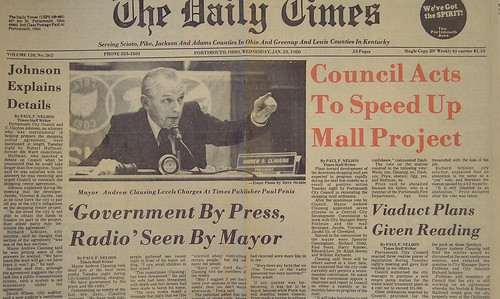
As I pointed out in one of my very first River Vices blogs, back in 2004, and I have repeated in other postings since, local politics have been transformed profoundly by the internet and the blogosphere. Back in 1980, the small clique who controlled Portsmouth politically and economically were able to drive three councilmen from office through a concerted media campaign that involved local radio stations, the Portsmouth Daily Times and local clergy, no less. If the small clique who now control Portsmouth ever look back nostalgically, it would be to that 1980 campaign, with its parades, speeches, and vilification of the councilmen for maliciously standing in the way of progress, by which was meant a new downtown mall. There were concerned citizens in Portsmouth back then, but what did they have to fight back were pathetically few: mimeographed flyers, telephones, and letters to the editor, which may or may not have been printed, and if they were printed probably would be censored, because no criticism of prominent people by name was allowed. That policy still prevails at the Portsmouth Daily Times, but fortunately computer technology and cell phones make it possible for concerned citizens to communicate instantly with hundreds and thousands of people in the local area.

As president of the Shawnee Education Association (SEA), at Shawnee State University, I revived SEA-VIEW, the faculty union newsletter, and, with Jim Flavin, made it available on hard copy and online at the university. But it was the students at SSU who inaugurated a new era in Portsmouth journalism when they published the first paper edition of the Shawnee Sentinel, in 1994; and when they expanded news coverage beyond the university and put the Sentinel online its readership and its influence multiplied exponentially. When Dr. Clive Veri was president and attorney Steve Donohue was Vice President of Practically Everything at SSU they tried to prevent the students from circulating the Shawnee Sentinel on campus, just as the government in Iran and China are trying to clamp down on bloggers and tweeters, but when the Sentinel went online the genie was out of the bottle.

Stifling Bloggers

Still, attempts were made in city government to stifle bloggers and the Shawnee Sentinel in particular. I heard that at one time city employees were told they should not read the Sentinel on city computers, and Portsmouth Police Chief Charles Horner publicly denounced local websites, labeling those who write for them “domestic terrorists,” and he did what he could to restrict what councilman Bob Mollette could post on his website. Along with Bob’s wife Teresa, who has a public information website, the Mollettes used their technological knowhow to clean up the corruption and cronyism. I would not be surprised to learn someday someone is writing a dissertation on the influence of the computer technology on local governments focusing on the the Mollettes as an example of the best of American citizens, a couple willing to spend many thousands of hours and dollars to make local government more responsive to the people.

The semi-official line of the small clique who control Portsmouth, a line parroted by their hirelings in the media, is that there is a small clique of intractable individuals who are making it impossible for the city to move forward with such projects as the renovation of the Marting building. Since it takes a majority to win any election, and since the Marting building has been turned down decisively several times by voters, and since other proposals have been passed that the clique disapproves of and campaigned against how can a small clique be responsible for impeding progress, unless it is the small clique of lawyers and developers who have a stranglehold on the city? It is a majority of the voters of Portsmouth who are opposed to the corrupt clique, a majority who are computer literate and who know better than to believe everything they read on the editorial pages of the Portsmouth Daily Times or hear from Steve Hayes on WXNT. There was a time when the people of Portsmouth had no other source for local news, when they could be manipulated and brainwashed by those who controlled the media, but those days have come to an end in our city, just as we hope they will in Iran and China. Internationally, nationally, and locally, technology has liberated people from ignorance, rescued them from isolation, and united them in the cause of truth and justice. Through wireless communications, the whole world is wired.

I will stop now. My cell phone with a megapixel camera is ringing and my computer is tweeting.


.

Friday, June 05, 2009

No Justice in Portsmouth

317 Front Street

I've heard a number of times in the last twenty years that one of the things that has accelerated the economic decline of Portsmouth has been the practice of excluding outside businesses from getting a foothold. The Chamber of Commerce and civic leaders would strongly deny this accusation. Undoubtedly, the Chamber of Commerce and public officials are all for new businesses, in principle. However, what an individual is strongly for in principle, and in general, will not necessarily be what he is for in practice, not when it is his particular business that would face more competition. "Not in my backyard!"

A current possible example of this "Not in my backyard!" attitude might be the obstacles the city is placing in the way of J. & P. Caulking, Inc., a Columbus-based construction and renovation business that has bought several old buildings in downtown Portsmouth and begun to restore them. In November 2008, the owners of J. & P. Caulking, Paul Adkins and his family, bought a three-story brick building on 317 Front St. for $12,900. I was told that 317 Front St. had previously been condemned by the city. Built in 1900, according records in the County Auditor's office, the tall narrow building was in danger of collapsing, but the Adkinses  thought it could be stabilized and renovated. Their plan was to create apartments on the two top floors and an ice cream parlor on the ground floor. The city granted the new owners a building permit, but it wasn't long before Larry Justice began bugging the Adkinses about one thing and another. If anybody should be hauled in to court because of rundown property, it is Justice himself, for the building in which he once had a manufacturing business, on Spring Lane, is an embarrassment to the city, as I pointed out in a previous blog

People who live in glass houses should not throw stones. Since he is the Residential Building Inspector, the Sidewalk Inspector, the Code Enforcement Officer, and the Land Reutilization point man, Justice is in position to do a lot of mischief. Most recently, he had warned the Adkinses that the color they are painting the side of the building is not a color the Architectural Review Board would approve, and the large display windows that have been installed on the ground floor are not acceptable either. Why not? The windows are manufactured by Peachtree Doors and Windows, a solid Wisconsin company that has been in business for over forty years, so the Adkinses cannot be accused of using shoddy materials. Instead of harassing and impeding the Adkinses, the city should be doing everything it can to help and encourage them to restore 317 Front St.

Stop Work Order

I think a review board is a good thing for any community to have, but it is not a good thing to use as a political tool to harass outside contractors trying to do business in the city, especially when that outside contractor is investing many thousands of dollars to renovate a building that has some architectural value but a building that constitutes a public hazard as long as it stands as it is, looking like it could be blown over in a good wind storm. If the city is not going to seize the building as a hazard to the public, and go through the expense of tearing it down; if the city is going to grant the Adkinses a permit to renovate the building, then it shouldn't harass them and order all work on the building stopped because of the color the east side of the building is being painted and because the design of the windows on the front are not up to the Architectural Review Board standards. Give us a break, please! This is Portsmouth where so many of Neal Hatcher's properties were for years allowed to become an eyesore and the neighborhoods they are in become hangouts for drug dealers and prostitutes. This is Portsmouth where there are still neighborhoods that look like rattraps and breeding grounds for poverty, drugs and prostitution. And yet Larry Justice has ordered all work on 317 Front St. stopped because the color of the paint on the side and the design of the new windows allegedly do not conform to the design  standards of the Review Board.

The city appears to be harassing the Adkinses about another building they are in the process of restoring, at 1511 3rd St., on the east side of the city, a neighborhood that needs more than a face lift: it needs major surgery. But the city and Larry Justice ordered work on 1511 3rd stopped because of the equipment parked outside the building. There is a crying need for parking space, don't you know? Ordering the Adkinses to stop working on 1511 3rd St. because their equipment is taking up parking space is like towing away a doctor's car while he is inside treating a patient.

Why is the city and Larry Justice doing this? Is it just random stupidity and incompetence? Or is there a jealous contractor who had hoped to pick up 317 Front St. for a pittance but was surprised when the Adkinses came along and paid $12,900 for a building that had been condemned and would require many thousands of dollars to renovate? When I say jealous developer I don't mean Neal Hatcher but rather a minor league developer. But it is not the minor league developer but Justice who may be in the best position to impede outsiders, who are not close to the ruling clique that the Building Inspector and Mayor Kalb obligingly serve. One of the ironies is that Justice complains about the  color of paint and the design of windows at 317 Front St. do not conform to Portsmouth's high architectural standards while the building in which  Justice once conducted a business (Quality Sheathing Co.) on Spring Lane, is a sight to behold and has been for many years. When Justice  failed to pay Workmen's Compensation taxes, the state put a a lien on his property and got a judgment against him for $7,053.76. Justice has been officially reprimanded in writing at least twice, once for lying to his immediate superior about an important zoning matter, and again for his contacts with a state official, in which he claimed authority and a job title that he did not possess. Not only has the state got him for not paying taxes, SOMC has had to take him to court to pay a hospital bill. Is it too much to hope that, next year, in addition to a new mayor, Portsmouth may also have a new building inspector? That would be a situation in which no Justice would be welcomed.


817 Spring Lane, site of deadbeat Justice's failed business.

Tuesday, May 26, 2009

Apple Falls


Apple  Falls

Everyone's a  relative.
They  couldn't be nicer to you.
Kinship's a great palliative
If you're not drunk and feeling blue.

He hears, downstream, rushing water,
The turbulence of Apple  Falls,
Like Susanna, his stepdaughter,
Twisting the heads off of her dolls.

Leaning over in the canoe,
He plucks a solitary straw,
Takes another swig of brew,
Gaping in the collateral maw

Of kinship, looking for some clues
To what the patriarch Paw-Paw,
What the brothers,  uncles, nephews,
Might  do to his damned  son-in-law.

After the  last  drop of liquor,
He  stops paddling, begins to nod,
Drifting, drifting, down  Red River,
Like a straw in the hand of God.

Robert Forrey

[I maintain a poetry blog at http://xpalidosis.blogspot.com ]


Tuesday, May 19, 2009

Gaming the System


America’s favorite pastime is no longer baseball; it is gaming the system, whatever the particular system may happen to be. And no state may be quite as good as Ohio, or any city in Ohio as good as Portsmouth, at gaming the system.

What is meant by “gaming the system” is when the players in any system, by breaking or at least manipulating the rules, subvert the system for their individual advancement or enrichment. Two large systems currently being gamed to death are Wall Street and major league baseball. The recent international financial meltdown was the result of financial players making enormous profits by bending and breaking the rules, that is by gaming the unregulated sector of the financial system. Banks had to play by rules that were instituted after the the Crash of 1929, but players in hedge funds and derivatives did not. Hedge funds and derivatives did not have to report their holdings and activities; did not have to maintain a minimum balance; did not have to make an accounting to federal or state agencies; did not, generally, have to do anything that would interfere with their freedom to game the system and fleece investors of billions.

A corresponding kind of deregulation and gaming took place in major league baseball. Because of lax oversight by the office of the baseball commissioner and the collusion of the union, cheating players were able to use performance enhancing drugs and supplements to bulk up like the Hulk and break records with banal frequency. When he appeared to testify before a committee in Washington, the retired slugger Mark McGwire, no longer on steroids, looked like the incredible shrunken man. Not just McGwire’s, but many of the records set in the major leagues in the last twenty years have become suspect, and the integrity of the game, and the huge profits tied to it, are in jeopardy.

Shadow Government

In Portsmouth, unscrupulous lawyers and developers have been gaming the system for almost half a century. They are able to do it in part because a form of deregulation took place in the early 1960s with the creation of a so-called “community improvement corporation,” which morphed into the Southern Ohio Growth Partnership. The SOGP is a private corporation, but, in conjunction with its acronymic cronies, the GPEC, CAOSC, SOPA, etc., it has become a shadow government with much more money and power at its disposal than the pathetic city government that operates out of the Municipal Building. In 1964, the Portsmouth City Council declared that the predecessor of the SOGP, the Portsmouth Area Community Improvement Corporation, had a mandate To promote the health, safety, morals [sic!] and general welfare of the inhabitants of the community . . .” “General welfare,” is a broad category that can and apparently has meant anything and everything having to do with the citizens of Portsmouth, including high school athletics.

What safeguards and rules did the City Council establish to insure the SOGP was not going to abuse its mandate and pull any fast ones? None whatsoever. The City Council provided the SOGP with a blank check, allowing the unelected and unregulated members of the SOGP, and their colluding allies, to fill in the blanks and do what they wanted, and what they wanted, not surprisingly, was usually to promote their own interests. Unlike public officials, the SOGP does not need to rely on or seek approval from voters. The SOGP does not need to placate the most vocal group in any community, the taxpaying property owners. The SOGP relies instead on rebates, dowager dollars, and, in particular, pork, a financial steroid provided by the government. Rebates, dowager dollars and pork provide the SOGP and its surrogates with the money to finance “community improvements,” which include everything from new offices for the SOGP (the Welcome Center) to a new high school athletic complex, a complex as impressive, according to original designs, as the televangelist Robert Schuller’s Crystal Cathedral, in California. In the worst recession since the Great Depression, in one of the most chronically depressed crime- and drug-ridden cities in Ohio, a multi- million dollar high school athletic complex is being built in the center of the city. In any other chronically depressed city, a multi-million dollar high school athletic complex might not rank near the top of municipal priorities, especially since the city already owns a historic municipal football stadium (built for the forerunners of the Detroit Lions) and a baseball field that has served high school athletes and a minor league base team well enough until now.

Shell Games within Shell Games

It’s one thing when children or adolescents play games; it’s another when dishonest adults do. The game the adults are playing is, in effect, pin the tail on the donkey, the donkey in this case being the hard-pressed property owners of Portsmouth, and the tail that is pinned on them being the property taxes that will be used to help pay for the long term maintenance of the athletic complex. Shell games are being played within shell games, a shell game being a swindle in which something of value (millions of dollars) is paid to Hatcher for something of little or no value (the blighted property he acquired to build a mall that did not materialize). Will the athletic complex bring new revenues into the city? Not likely. The tax base of the downtown area, further depleted by the new non-taxpaying public university will be further eroded by removing hundreds of additional acres of property permanently from the city’s tax base.

If we can’t have a mall, or a gambling casino, let’s have a high school athletic complex that is one part Woody Hayes and three parts Donald Trump. How did Portsmouth, without debate or the approval of voters, get a multi-million-dollar high school athletic complex? The athletic complex is the result not of a pressing need or of long-range careful planning but rather of the need to bail out the local developer, Neal Hatcher, who had acquired hundreds of pieces of property in the center of the city with the aim of building a mall. He ended up owning at least twenty-three pieces of property on John Street, once the la Rue Saint-Denis of Portsmouth’s prostitutes. Hatcher’s mall never materialized, just as the mall back in 1980 never materialized. If insanity is doing the same thing over and over again and expecting a different result, Portsmouth’s dream of a mall is insane. The craziness resulted in Hatcher having on his hands hundreds of pieces of property he helped blight, acquired through means both underhanded and heavy handed, such as eminent domain, means that have made him infamous locally.

Go Bucks!

With the cooperation of our corrupt city government, money laundering foundations, and the Portsmouth City School system, he unloaded his mall-apropism off on the public, just as the Marting Foundation did the Marting building, just as the Thatchers did their house on Franklin Boulevard, just as Dr. Rooney did his house on Camelot Drive, just as George Clayton did his Kenrick’s building on Second Street, and just as Dr. Singer did his festering eyesore on Washington Street. But when it comes to gaming the system, none of these crooks can compare to Hatcher, who is the Woody Hayes of Portsmouth and whose war cry should be (what else?) “Go Bucks!”

I love football and played it in high school and would not have gone on to college if I hadn't. But think of the pressure on high school athletes who will have to prove worthy of this Roman- or Trojan-like high school complex. Think of what will happen if the team ever ends a season with a 1 and 9 record, as Woody Hayes did in 1940, at New Philadelphia High School. Think of the scandals we have to look forward to when high school coaches and athletes cut the ethical corners that have historically been cut at Ohio State to meet the expectations of rabid Buckeye fans like Mike Mearan shouting, “We’re number one! We’re number one!” In a state where being number one in anything else appeared out or reach, being number one in college football was all that was left. If having “Road Rage” Hayes stomping the sidelines, punching reporters, officials, and even players; if having a notorious sore loser like him as coach and playing a schedule that somehow managed to avoid Notre Dame, the perennial powerhouse; if that was the price Ohio had to pay to be number one in something, well so be it.

Let’s hope Portsmouth can avoid similar shenanigans, but don’t bet on it. If you believe winning isn’t everything, it’s the only thing; if you say you believe in competition but fix games and that you believe in democracy but “fix” city officials the way dowagers do lapdogs; if you say you believe in God but worship money, then you can’t help cheating, you can’t help gaming the system, because that’s the only way you can win. The current recession has resulted in the postponement of half of the athletic complex, but of course not the half that includes the football stadium. What we have to look forward to, however grim the next couple of years may be, is not bread and circuses, but Crispie Cream donuts and high school football games. Let the gaming begin!

Monday, May 11, 2009

Incredible Shrinking DAILY TIMES

AOCpointing
AOCpointing
AOCpointing
AOCpointing
AOCpointing
AOCpointing
AOCpointing

Our anorexic local newspaper, the Portsmouth Daily Times, recently announced that because of shrinking revenues from advertisers it will no longer publish on Mondays. It will shrink from a seven-day to a six-day newspaper. Though it was not mentioned in the public statement, shrinking circulation probably factored into the equation. The paper claims a circulation of about 12,000, but someone who worked at the paper said PDT routinely inflates circulation. Truth, whether in regard to circulation or local politics, is not the PDT’s strong suit.

Over the last half century, because of shrinking circulation, the PDT has been decreasing in pages and increasing in price. On January 1, 1960, the paper contained 34 pages and sold for 7 cents. On January 1, 1970, it contained 38 pages and sold for 10 cents. On January 1, 1980, it contained 18 pages and sold for 20 cents. On January 1, 1990, it contained 16 pages and sold for 30 cents. On January 1, 2000, it contained 16 pages and sold for 50 cents. As of January 1, 2009, it contained 16 pages and sold for 50 cents. Even allowing for inflation, the cost per page to the reader has gone upward steadily with the passing years. A single page of the paper now costs the reader who gets it from a machine about fifteen times as much (ouch!) as in 1960.

The shrinkage in the number of pages and the cost per capita per reader reflects, in part, the shrinkage in Portsmouth’s population over the last century. In 1907, the city’s population was approximately 50,000; in 1950, it was approximately 35,000; in 2000, it was 20,909. In 2005, it had slipped, in one estimate, to 19,072. The 2010 census will probably show a further decrease. . The decline in Portsmouth’s population reflected the decline of heavy industry in the U.S. and in the Midwest in particular. The decline was what could be expected in an American Rust Belt city, and then some.

Shrinking in Influence and Moral Stature

Though it is not as easy to measure, there are some statistics to suggest that the Portsmouth Times has shrunk in terms of influence and moral stature in the community since it was founded in 1861 by twenty-one-year-old James W, Newman. According to Nelson Evan’s A History of Scioto County (1903), the Portsmouth Times, with Newman as owner and editor, “early became prosperous and attained a wide influence and prosperity.” Under a new ownership, it became a daily in 1894. “So far as circulation was concerned,” according to Evans, “the Daily Times bounded into almost instantaneous popularity.” Its success was all the more impressive because the paper was Democratic in its political sympathies though Portsmouth was staunchly Republican. That changed in the twentieth century, of course, with the paper becoming rabidly right wing.

With the formation in 1962 of what later became the Southern Ohio Growth Partnership, the instrument was created by which a handful of men, largely Republicans, were able to control the shrinking and decaying city economically and politically. Through pork and government monies, and Foundation finagling, they learned how to make poverty pay. A culture of dependency replaced a culture of enterprise and competition. City government was corrupted and city officials became puppets. Portsmouth became a a company town but without the company. Because the PDT became the mouthpiece of the Southern Ohio Growth Partnership, and the lawyers and developers who dominated it, the PDT’s name became mud with many citizens. Most newspapers are now experiencing extreme financial problems and a number are on the verge or already have folded, but the PDT has an additional problem. It has earned the enmity of a number of Portsmouth citizens who believe it is biased in its reporting and subservient editorially to the lawyers and developers who control the economic and political life of the city. Some of those critics of the PDT had this to say when I asked them for their reaction to the Monday cutback. “Given the nature of that rag, will it really matter?” “Maybe they should take some lessons from the Cleveland or Akron newspapers and do some real investigative reporting, but then they would lose all their crony advertisers!“Maybe they should just make it a weekend paper, that way it will at least have more than 6 pages.” “I do not waste my fifty cents on it, so I won’t miss it anyway!” “Speak the truth and the truth will set you free.”

The First Rule

In the first forty years of its existence, the Times, as a weekly and daily, had only three editors. The turnover among editors and reporters has been high in the twenty years I’ve been in Portsmouth. Maybe I’m being naïve, but I thought the high turnover was not just because of the low pay but because anybody with any self-respect, not to mention journalistic ethics, would get out as soon as they could, because if they stayed around for very long, they would end up getting fired, as two veteran reporters, Mike Deaterla and Jeff Barron, were last year. Not given to investigative reporting or liberal opinions. Barron was fired for making the mistake of mentioning that somebody arrested for dealing drugs was employed as a mechanic at Glockner Motors. A PDT reporter must never ever report anything that might embarrass a bigwig or a business that advertises in the PDT. That is a rule that should be hanging on the wall of the press room on 5th St. I didn’t think an editor could have been any more obliging to the SOGP than Arthur Kuhn was, but after he was fired not too long ago he was replaced by Jason Lovins, who has shown there were depths of casuistry and deceit that Kuhn apparently would or could not sink to.

It Pays Not to Advertise

Speaking of shrinking influence, it may pay to advertise, but not in the PDT. Look at what Jim Kalb’s ludicrous thousands-of-tiny words full-page ad in the May 3 PDT got him in the May 5 primary election. He lost by more than a 2 to 1 margin to a newcomer, Jane Murray, who ran no ad in the PDT, not even a teensy-weensy one. Kalb came out first in only one of the city’s twenty-four precincts; she won in twenty-two of them. Kalb had learned nothing from city solicitor David Kuhn who in 2007 spent thousands of dollars in PDT ads, including a quarter-page ad in which he boasted that he had the support of such local luminaries as Mike Mearan and Clay Johnson! Kuhn was clobbered in the election.

In influencing voters and swaying public opinion, an ad in the PDT is about as effective as an editorial in the PDT. Whatever position the PDT takes, the public opposes in the voting booth. I hope before much more time goes by that the shrinking PDT will completely disappear. The disappearance of the shrinking PDT will represent a step forward, not a step back for the city. I call it the Prostitute Daily Times. I look forward to the day when there are no prostitutes or PDT dispensers on the street corners of Portsmouth.

Wednesday, May 06, 2009

Dope Box Derby


Now that he has finished behind Jane Murray by a 2 to 1 vote in the May 5 primary, winning only one precinct to her twenty-two, expect Mayor Kalb and his disturbed wife to grow increasingly desperate and disruptive in the run up to the November general election. The Kalbs’ favorite trick is to crash other people’s meetings and try to turn them into Kalb campaign rallies. Why go through the trouble of organizing a meeting of your own, to which very few people probably would come, when you can like the cuckoo bird, lay your political eggs in somebody else’s nest?

Mooching every opportunity he can for public exposure during this election season, Kalb is currently appearing on Channel 25, enthusiastically endorsing the Soap Box Derby. Don’t be surprised to see a Soap Box Derby display in a Marting window, along with the Easter Bunny, Mothers (on Mother’s Day), the Girl Scouts, and other sanctified groups, which is the equivalent of putting statues of the Virgin Mary in the window of a cat house.

What we have in the current city government is a Dope Box Derby, with the Mayor, the Auditor, the City Solicitor, and members of City Council competing to see who is the dopiest, in more than one sense, and the most subservient to the rich white trash who run the city. As president of the City Council, Howard Baughman would have had the number 2 position in the Dope Box Derby if the voters in his ward hadn’t begun a campaign to recall him, which almost certainly would have removed him from office by the same kind of wide margin by which Murray clobbered Kalb in the primary. Rather than allowing himself to be recalled, Baughman resigned, enabling the city council to appoint his replacement, thus preventing the voters in his ward from making the decision of who would replace him. Resigning rather than being recalled so that another crook can be appointed in your place is a dirty trick that has been pulled before and will be pulled again.

Instead of competing in an honest race, Portsmouth politicians do what some unscrupulous entrants at the Soap Box Derby have done: they cheat. In 1973 the 14-year-old Derby winner had an illegal electro-magnetic device in his racer that gave him an advantage over his competitors. The electro-magnet pulled his racer forward toward the steel paddle that started the race. The mastermind behind the magnetic device was the boy’s wealthy uncle, whose own son had won the derby the year before in what was possibly another electro-magnetic powered racer. It took observers a second time around to figure out what was going on. The boys were only tools, as Kalb and other Portsmouth politicians like him are. The masterminds behind Portsmouth’s Dope Box Derby are a couple of wealthy individuals who do everything they can to eliminate competition in Portsmouth’s economic and political life. Why leave anything up to chance when a lapdog mayor can be installed in office the way an electro-magnet can be installed in a Soap Box racing car?

Kalb has complained that the 1999 Ford the city provides him does not reflect well on the dignity of the city. The truth is he reflects far worse on the dignity of the city than the 1999 Ford he is driving. If Kalb got the vehicle that a public servant of his limited ethical and intellectual development deserved, it would be a Dope Box Derby racer, of the kind shown above, which is powered only by gravity, and therefore needs a hill to run. When a visiting dignitary is in town, Kalb’s racer could be towed to the top of the reservoir via Sunshine Ave., and the mayor and the visiting dignitary could take turns whizzing down the hill like kids on a sled. Instead of traveling hundreds of miles to compete in motorcycle rallies for senior citizens, on geezercycles, as they are sometimes called by the younger crowd, he only has to spend an hour out of the Municipal Building, or at the most a morning, as he currently does on Thursdays to punch a cash register at Kroger’s.

When it began in 1934, the Soap Box Derby was for boys only. That form of discrimination eventually ended, and in 1975 a girl won the Derby. Up to the present time, Portsmouth has never had a female mayor. It is probable, but not a certainty, that next November we will elect our first female mayor. Not a certainty because six months is plenty of time for mischief, plenty of time for Kalb’s rich uncles and the lawyers they can hire to install electro-magnets. Or they may have already decided Kalb is hopeless, as many voters have decided, in which case they might reconsider their options. One thing is sure: they will not give up trying to stick the taxpayers with the Marting Building. That is the 125-year-old booby prize of the Dope Box Derby.


Monday, April 27, 2009

The Pimp and the Lapdog


Posted by Picasa


The Pimp and the Lapdog

Let me say in this last blog,
Let every citizen hear:
The pimp and the lapdog
Must face the voters this year!

VOTE NO to the little blimp!
VOTE NO to the smirk and sneer!
VOTE NO to the pimping imp!
VOTE NO to the lapdog mayor!

From Grandview to Forest Heights,
From Wayne Hills to Farley Square,
Stand up for your inalienable rights:
VOTE NO to the insufferable pair!


_______________

Saturday, March 28, 2009

From Dollars to Donuts


When Mike Jones accepted an invitation from the Concerned Citizens Group and met with them on 20 January 2007 to discuss his candidacy for city solicitor, one of the questions he was asked was about the Marting building. Since 2002, the most contentious issue by far in Portsmouth has been the city’s purchase of the worthless Marting building from the Marting Foundation at an inflated price. The city intended to convert the 125-year-old leaking department store into a new home for city offices. Former mayor Greg Bauer and members of city council had involved themselves in the fraudulent sale of the building. The persistence with which our current doofus mayor, Jim Kalb, and a couple of crooked city council members have tried to waste from $7-10 millions of public dollars to make the building habitable has mobilized many citizens and particularly property owners. Because they were the victims chosen to pay for the fraudulent project through property taxes, property owners were outraged.
Marting Building

There is no single issue that more accurately reflects the judgment and the integrity of a candidate than the position that he or she takes on the Marting building. Beware of candidates who avoid or even hedge on that issue, because they are probably either dumb or dishonest, or both, and we’ve got enough of those types in public office already. So eager were they to get David Kuhn out of office that CCG members did not pay enough attention to what Jones’s position was on the Marting building. They have lived to regret it, deeply. Jones’s answer in January 2007 to the question on the Marting building was that he didn’t have a position, or at least didn’t have one that he was willing to admit to in public. Once in office Jones quickly showed his true colors, not only on the Marting building but on other issues as well. He has turned out to be, in my opinion, a politician of the worst stripe, lacking not only in competency but integrity. We may be able better understand the reasons candidate Jones would not say what his position was on the Marting building when we examine his financial situation at the time he was running for city solicitor.

On 8 June 2007, five months after not answering the question on the Marting building and five months before being elected to office, Jones and his partner completed the purchase of the Crispie Creme Donut Shop, at 1202 Gallia Street. The value the County Auditor put on the donut shop was $107,990, but Jones and his partner paid an eye-popping $325,000 for the property. Did Jones confuse Crispie Creme with the national chain Krispy Kreme? What was he thinking? I suspected there might be an error in the $325,000 figure, so I checked with the County Auditor’s Office to make sure that figure was correct. I was told it was. Granted the valuation put on property for purposes of taxation is usually less than the putative market value, but a nearly 300 percent increase can hardly be accounted for on those grounds. The $325,000 for Crispie Creme sounds as inflated as the $2 million dollars the city paid for the Marting building.

I have walked or driven by Crispie Creme at least a thousand times over the last twenty years and the question that often occurred to me was how in the world it managed to stay in business. In driving past the small building, it’s hard to tell whether it’s open or closed, because open or closed, the dimly lit interior is often empty. I’ve been told that it was a popular business in an earlier time. Customers loved the coffee and especially Mrs. Renison’s 1929-recipe donuts. But time and tastes change. Duncan Donuts and later Starbucks helped do-in old-fashioned donut shops like Crispy Creme, but concerns about diet were what really nixed donuts.

Why did Jones and his partner pay $325,000 for a walking-dead donut shop? I don’t know, but from public records I know who his enablers were, I know who made it possible for him to pay that eye-popping price. The financial institutions that granted Jones mortgages on Crispie Creme were, not surprisingly, the American Savings Bank (ASB) and the Southern Ohio Growth Partnership (SOGP). When I hear ASB and SOGP, what do I think? I think financial hanky-panky and political shenanigans. Records in the County Auditor’s office and the County Records office show that the ASB obliged Jones with a $182,000 mortgage and that the SOGP, to cover the rest of the purchase price, provided him one for $147,000.

Is it possible that the ASB and SOGP were in Jones’s corner in the city solicitor race? Of the SOGP’s involvement in local politics we have plenty of evidence, not just the Marting building; and the ASB, it is now clear, is up to its eyeballs in local politics. Robert M. Smith is the most politicized bank president in Portsmouth, and ASB Vice President Michael L. Gampp was the point man on the Progress Portsmouth Political Action Committee, which lobbied hard for the passage of the Marting ballot measure in November 2008. In spite of the fact that Clayton Johnson, Neal Hatcher, et al, made sizeable financial contributions to Progress Portsmouth, that ballot measure was soundly rejected by the voters.

One way Johnson and Smith could help Jones, in addition to providing him with $329,000 in mortgage money, would be to patronize Crispie Creme, which is in sore need of customers. Rumors currently circulating about Jones being in dire financial difficulties are just that—rumors, but with the financial meltdown and business recession that have occurred since he acquired Crispie Creme in the summer of 2007, it would not be surprising if Jones was in a financial deep fry, and that he soon may be toast. Even the national chain Krispy Kreme, according to Yahoo! Finance, may be out of business before 2009 is over.
House Money

Who knows why the SOGP makes loans or provides mortgages to the people it does? Someone wrote in an email, “Jones was bought and paid for from the beginning.” I don’t know about that, but like the AIG and other free-wheeling financial entities, the SOGP has pretty much had Portsmouth public officials in its pocket for quite a spell. The SOGP, with its offices in the pork barrel Welcome Center, has been able to do as it pleases in River City. It has no accountability to voters and little to regulators. The SOGP is Portsmouth’s shadow government, wheeling and dealing while playing with house money, doling out millions of dollars without much oversight. The ASB is not much better. In 2005, to avoid the paper work and scrutiny that goes with being a publicly held company, ASB went private, buying out its shareholders. Since then, as a private company, its financial operations have become somewhat inscrutable, like they were at AIG, Bear Stearns, and Lehman Brothers.

Why, for example, would ASB grant a $187,000 mortgage to a business that appears to have nothing going for it but donut nostalgia and a return to those filling days of yesteryear, before our deep-fry diets caught up with us in the form of artery-clogging cholesterol and ass-over-the-stool obesity? It’s not just assets that can be toxic. The SixWise.com website claims that donuts are among the six unhealthiest foods in America. When it comes to diet, according to a nutritionist at the New York Obesity Research Center, the only healthy thing about a donut is the hole.
Is it too much to hope that the SOGP and ASB might in the future be held more accountable not only for their financial but also their political activities? Can we be assured that they are not making the equivalent of sub-prime loans to customers whose failing businesses they are subsidizing and whose political support they are currying? Can the citizens of Portsmouth be assured that the chief legal officer in city government is not being held hostage by his indebtedness, that he does what is best for the city, and not just for the influential and wealthy individuals to whom he might be beholden for $329,000 in mortgages and his $60,000 a year part-time job?

Closer to Home


Unfortunately, Jones’s indebtedness is not confined to his business. He appears to have financial problems closer to home. In April 2005, two years before taking out the two mortgages on the donut shop, he bought a home in Portsmouth, on “the Hill,” at 2828Willow Way, for $192,000. Yes, Jones lives on the Hill, but can he afford to, not only financially but ethically? Were the decisions he has so far made as city solicitor influenced by his being mortgaged to the hilt? Would he have favored renovating the Marting building if he was not obligated to the SOGP and Clayton Johnson? Would he have brought Harold Daub to trial on trumped up charges if Daub wasn’t enemy number one to the rich white trash who control Portsmouth economically and politically? And would Jones have tried to fire Police Chief Charles Horner in the rush-to-judgment, undocumented way he did if Horner had not been disloyal to his bosses, first to Mayor Bauer and then to Mayor Kalb, accusing them of illegal actions in connection with the purchase of the 15th Street Viaduct property and the Marting building?

Is there a more highly leveraged office holder in city government than the City Solicitor? If the City Solicitor is no better at handling the city’s legal problems than he is at handling his own finances, his term in office may seem even longer to the citizens of Portsmouth than it will to him. The prayer of Alcoholics Anonymous goes, “God grant us the serenity to accept the things we cannot change, courage to change the things we can, and wisdom to know the difference.” Is Portsmouth one of those things that cannot be changed? Should the Concerned Citizens Group change its name to the Serene Citizens Group? Should they wear a toga and do yoga? Should they, like Alfred E. Newman, stop worrying? Questions and more questions! When a Greg Bauer is replaced as mayor by a Jim Kalb, and a David Kuhn is replaced as city solicitor by a Mike Jones, when we go from the deep fryer into the fire, it is enough to drive a teetotaler to drink or, even worse, to donuts.


Saturday, March 21, 2009

The Trial of Harald Daub


On March 19, 2009, at the end of a long day’s trial in the courtroom at the Portsmouth Municipal Building, Harald Daub was found by a jury of his peers not guilty of the misdemeanor of shoplifting. I want to focus on one aspect of the trial, an aspect which is embodied in the unusual phrase “magnitude of existence,” which Portsmouth police officer Jon Peters used to describe Daub. In his testimony, Officer Peters was asked by Daub’s attorney Richard M. Nash, if he knew who Daub was when he began the shoplifting investigation. Officer Peters admitted he did. When he was pressed by Nash to explain what it was he knew about Daub, Officer Peters replied he knew of Daub’s “magnitude of existence.” As original as it is cleverly imprecise and evasive, Peters’ bureaucratic phrase may be a key to understanding Daub’s trial. Peters resorted to bureaucratese, or the language of evasion, because he wanted to avoid saying, clearly, that Daub was a controversial public figure. If he had said that, Peters might then have been asked by Nash to explain why Daub was a controversial public figure. That could have opened up a can of worms, or a shopping bag of snakes, and the jurors would have learned not just about Daub’s alleged shoplifting but also about his long crusade against political corruption in Portsmouth. Hearing that, the jurors might have suspected the reason Daub was being prosecuted was not for shoplifting but for being a burr under the saddle of those who ride roughshod over citizens’ rights. Daub’s shoplifting trial should be seen, in part, as punishment for his criticism of city government and in particular of Mayor Kalb and of City Solicitor Jones.

The city wasted a great deal of time and taxpayer money in this trial in a futile effort to prove Daub a shoplifter. Although he has worked for thirty years at the A-Plant and testified he has never in his fifty-nine years had any run-ins with the law, Daub was charged with one of the pettiest of crimes. Petty crime or not, Jones made a federal case of it, bussing jurors over to Aldi’s, the alleged scene of the crime, as if this was trial over a murder or a million dollar heist. I have suggested in the past Portsmouth is ripe for reality television series. It rocks! The characters! The plot twists! A First Family worthy of Saturday Night Live!

Jones handled the trial with an ineptness that we are unfortunately getting accustomed to, showing legal skills that were at best rudimentary. Whatever he may have learned as a military lawyer does not seem to have carried over into civilian life. Like an earnest high school debater, he seemed to argue with the greatest conviction precisely at those moments in the trial when his argument was weakest. When the case was clearly slipping away from him, Jones became desperate, accusing Daub of calling Aldi employee Anita Sexton and Officer Peters, the prosecution’s only two witnesses, liars. Daub had not called them liars; he had disagreed with crucial parts of their testimony. But as Judge Kegley pointed out at the beginning and repeated at end of the trial in his instructions to the jury, people of good will can differ in their accounts of events without one or the other being a liar. Experiments prove that people who witness the same event can differ wildly in what they claim they have seen. Jones presumption that there are truth tellers and there are liars, and that’s all, greatly oversimplifies human psychology and seriously limits his effectiveness as a trial lawyer.

The Shopping Bag

Mayor Kalb and his wife have been chortling for months, as if Daub’s guilt was undeniable. Kalb even reportedly showed up at a recent City Council meeting carrying an Aldi’s shopping bag, apparently to call attention to Daub’s alleged shoplifting. An Aldi’s shopping bag became the chief exhibit at the trial, with both the prosecution and the defense debating how many stolen items it could hold and who was carrying it any given second. An Aldi’s shopping bag may live on in infamy, as the Marting building has, as an icon of Portsmouth’s corrupt political history. The bag has the slogan, “It’s all about saving green.” On the basis of Daub’s trial, it could read, “It’s all about screwing Harald Daub.” The testimony of Aldi’s employee Anita Sexton, which Daub’s attorney, effectively demolished, did not reflect well on her or Aldi’s. The possibility that she and her employer were in cahoots with the city is one of the conclusions that could be drawn from the trial of Harald Daub. The prosecution’s case was essentially over by the time Nash was done cross-examining Sexton. She has reportedly been courted by the city government ever since the alleged shoplifting at Aldi’s on December 20, 2008. She was treated like a celebrity by the Kalbs in the hours leading up to the trial, but attorney Nash argued during the trial that she is biased against Daub, whom she admitted she knew as a longtime customer at Aldi’s.

The Nephew

Daub’s drug-addicted nephew has a long criminal record. I saw a notarized statement he had made, confessing to the shoplifting but swearing that his uncle had not been a party to it. If having a drug-addicted nephew is a crime, how many uncles would escape hanging? If having a drug-addicted, drug-dealing son is a crime, Mayor Kalb and Police Chief Horner would be in a lot of trouble. There is no doubt Daub’s nephew was the only shoplifter at Aldi’s on December 20, 2008. The nephew has admitted as much and has already served a short sentence for the misdemeanor in the County Jail. But the crooked arm of the law was not after the nephew; it was after the uncle. Daub is the most hated and feared critic of the corrupt city government, of the Southern Ohio Growth Partnership, and of the rich white trash who control Portsmouth economically and politically. He has been a marked man ever since 1980, when he and several other city councilmen refused to go along with a shopping mall scam. (See my earlier posting, “The Mauling of Harold Daub.”)

The First Family

According to what I heard in the hallway before Daub’s trial, Allison Kalb, the Mayor’s wife, had previously got herself excused medically from serving on any jury because of her phobias, but her phobias did not prevent her on the day of the trial from hanging around the Municipal Building and sitting through the long trial, like a ghost in the attic. Before the trial began, she talked for long stretches with the Anita Sexton, the prosecution’s star witness, in the stairwell in the hallway outside courtroom and also in the mayor’s office, after Hizzoner returned from his Thursday morning gig punching a cash register at Kroger’s. In the weeks before and especially on the morning before the trial, Ms. Sexton was being lionized, from what I could see, by the Kalbs like a contestant on American Idol. I was not there when the “Not guilty” verdict was finally delivered, in the evening, but I was told before either of them could be asked their opinion on the verdict, Hizzoner and the First Lady bolted out of the courtroom like bats out of hell, with Jones not far behind. In my opinion, Jones is proving to be about as successful at winning cases as city solicitor as he is at selling donuts. There is about him a certain magnitude of incompetence, to coin a phrase.


Mayor Kalb parading across council chambers with an Aldi bag to hand something out of it to Solicitor Jones, who turned out to be the one left holding the bag in this farce.


The Videos

The six videos dominated the trial and were played and referred to by Jones over and over again, but the videos were of such poor quality that they set the reputation of surveillance video back about a half century. I can remember seeing a neighbor’s home movies back in the 1940s that were technologically light years ahead of this stuff. The only thing the videos showed with any certainty was a shopping bag being taken from Aldi’s, but the video also shows that the bag was taken not by Daub but his nephew. Daub was charged with being an accessory to the nephew’s theft of the shopping bag! The theft of a shopping bag was all that was actually proved by the investigation and trial. Instead of being the smoking gun, or money shot, that Jones treated them as, the misnamed surveillance videos were a fusillade of fuzzy through-a-pool-of-water-home-video of events. The laser that Jones used to point to the screen on which the video was projected was like a scene from a Get Smart episode. “See here, Mr. Daub.” “See there, Mr. Daub.” “Is that you now appearing in the produce aisle, Mr. Daub?” I can recall in high school looking through a microscope at amoeba. That’s about how clear the shoppers at Aldi’s looked in the videos, like amoeba. Not only his mishandling of the trial itself but his decision to go ahead with the trial on the basis of such flimsy evidence seems terribly bad judgment on Jones’s part. Only a desperate desire to nail Daub, the city government’s enemy number one, can explain why the city solicitor showed such terrible judgment. Is this a lesson on what happens when the city government attempts to take down the man with the most “magnitude of existence” in Portsmouth?

Final Arguments

In his closing argument, Jones urged the jurors to (a) review the surveillance videos during their deliberations and (b) to use their common sense. Given this particular case, he could not have used two worse arguments. What were the jurors going to see in the videos that he had not all already failed to find during the trial? And as for common sense, that was the defense’s, not the prosecution’s, best argument. Why would Daub, with a good job and close to retirement, with a loving wife and son, risk everything—his job, his reputation, his pension-- to shoplift a bag of whatever it was the prosecution had failed to prove was in the bag the nephew had left the store with? Daub testified that his nephew had put in the bag only a toaster, a six-pack of imported beer, and some miscellaneous candy and snacks. The prosecution claimed Daub and his nephew had shoplifted some hardware. What was the basis of this hardware charge? Aldi’s did an inventory some days after the alleged theft and had found those hardware items unaccounted for: they concluded, therefore, that’s what Daub and his nephew had shoplifted! On such flimsy circumstantial evidence, such harebrained logic, Jones dared to rest his case, saying that even if those pieces of hardware had not been stolen, the videos showed the bag had definitely been stolen and Daub was an accessory to that theft. Even if only a $1.99 dollar Aldi’s bag had been shoplifted, Jones solemnly told the jury, that was enough for them to find Daub guilty as an accessory. Even as I write this blog, I cannot believe the travesty of justice Jones attempted to perpetrate at the trial. Is this the result of his consorting with the likes of Jim Kalb and Mike Mearan? I actually feel sorry for Jones, because he is the one who is going to have to live with the humiliation of this trial for the rest of his life. At the end of the trial of Harald Daub, Jones was the one who was left holding the bag.

During his campaign for city solicitor, Jones had promised he would handle cases himself, and not hire outside lawyers, thus saving the city money. Jones is handling cases himself, as he promised. He mishandled the hearing about Chief Horner’s firing, and now he has mishandled the Daub case. As a result he is not saving but costing the city even more money. The money the city has blown on the Daub case may prove chump change compared to what Daub could sue the city for. If Daub does sue, I don’t think Jones will be handling that case. That would be sending good money after bad.