
What tips, if any, about Portsmouth's problems can be derived from Jesse Stuart's Taps for Private Tussie, a novel about Kentucky hill people published over sixty years ago? Sixty years is a long time in the lifetime of an individual but not in the history of a region or a nation; and the area of Kentucky Stuart fictionalized in Taps is not far from Portsmouth, across the Ohio River. Parts of south-central Appalachian Ohio were and still are Tussie country.
Taps for Private Tussie (1943), which I wrote about in a previous blog, is a great American novel, told in the first person by Private Tussie’s teenage nephew, Sid, who doesn’t know exactly how old he is (somewhere between twelve or fifteen, he figures) or who his father or mother are either. Taps is a coming-of-age novel in which the narrator tries to figure out who he is, both familially and existentially, and what he’s going to do with his life, whether he’s going to be shiftless and ignorant, like most of his male kin, or whether he’s going to get an education, stand on his own feet, and make something of himself.
The underlying conflict in Taps is between the American ideals of hard work, self-reliance, and success, on the one side, and the Appalachian realities of indolence, poverty, and dependency on the other. With satirical irony, Taps for Private Tussie shows how deeply dependent many Appalachians are on the “govinment” that they profess to distrust and even despise.
Taps takes place in the mid-1940s, at the end of the Second World War. The economic boom that accompanied the war had not made much difference to the hill people, the poor whites of the region. Many of them are uneducated and unemployed, and some are still receiving weekly government food allotments, or “relief,” which had begun during the Great Depression of the 1930s. When the novel begins, the family to which Sid belongs, part of the large Tussie clan, had been on government relief for about a decade. The colorful, unambitious, and shiftless Tussies are good at making music, making moonshine, and making love, especially to their relatives, but they are not much good at making a living.
Grandpa “Works” the System
As a result of political changes that had taken place between 1933 and 1945, the Tussies have split into two camps. The “relief” Tussies, led by the wily patriarch Grandpa “Press” Tussie, had made political compromises with the Democrats, who were in control in Washington and in the county. The pragmatic Grandpa Tussie adjusted his politics and voted accordingly.
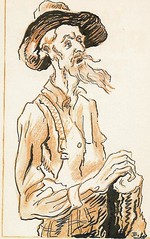 “‘B-gad, I’s allus a Republican until this relief thing come along,’” he said. “‘It looked like too good a thing to pass us up.’” The other camp was made up of those Tussies who remained at least nominally Republicans. If they had received relief in the 1930s, they were no longer receiving it in 1945.
It should not be assumed that the Republican Tussies had more integrity than the turncoat “relief” Tussies. On the contrary, the argument could be made that they were worse, because their principles and their Republican heritage did not stop them from sponging shamelessly off the “relief” Tussies when the latter came into some money as a result of the death of Private Kim Tussie. When Kim Tussie’s young widow, Aunt Vittie, collected ten thousand dollars from his insurance policy, Grandpa Tussie rented a sixteen-room mansion and soon their Republican kin came knocking. “‘You know the nature of the Tussies,’ Grandma said. ‘When one family has plenty, the kinfolks come to live with ‘em until everything’s gone.’” The Biblical metaphor that Grandma uses to describe the Republican Tussies is appropriate: “locusts.”
None of the Tussies, on relief or not, subscribe to the American ideal of “strive and succeed.” Though the male Tussies tend to be strong as an ox, they would never bear the yoke. There was, for example, “Bert Tussie who could kill a beef with his fist but had never done a day’s work in his life . . .” Though able-bodied, Mott Tussie, Sid’s alcoholic uncle, never worked. Sid says of him, “He’d send me to the woods to find sticks for kindling to start the fire in the coal stove while he lay under the shade of the hickory trees and picked his banjer. Uncle Mott was a good banjer player, so everybody said when he played at the square dances. But everybody said he ought to be a good banjer picker since he hadn’t done a day’s work in his life.”
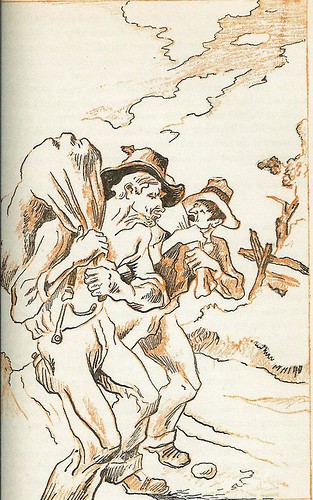 Though he was strong as a mule, Sid’s grandfather is not much better than his uncle Mott when it comes to work. Except for a period of his youth when he lived in Michigan, where he claimed to have been industrious, Grandpa Tussie viewed work as worse than hoof-and-mouth-disease. Sid says of his grandfather, “I’d seen people come and ask Grandpa to work; but he’d always tell them he was down in his back. He’d tell them that he’d never be able to work. And Grandpa wouldn’t work for anybody. Soon, people quit askin Grandpa to work.” Tobacco picking was one way to earn money, but Grandpa refused. He said he loved to smoke, snuff, and especially chew tobacco, but he refused to pick it. His so-called bad back did not stop him from square dancing all night like a man half his age. He loved to dance, but he hated work and thought anyone who stooped to it was a fool. Sid noticed that when Grandpa and Uncle Mott went to town with their relief sacks to pick up the government grub, they joked about other people working.
The Relief Industry
At the same time that they milk the government, the Tussies are a fiercely independent lot who refuse to be tied down by convention or routine. They are the decayed descendents of a hunting culture where a rifle is a man’s most prized possession. But “strive-and-succeed” America is a land of farming and selling, of learning and earning, of slaving and saving, of getting up and going, but the Tussies stay put like bumps on a log. The only growth industry is government assistance. Even though the Depression was over and the economy had boomed elsewhere in America during the war, the “relief industry” just kept growing in Stuart’s fictional Kentucky county. As Grandpa said, “‘It’s one industry that keeps a-growin right through good times!’”
The Tussie’s independence is a myth of their own creation. They are as independent as parasites. They are willing to live off the larder of those who work and pay taxes. Their only callouses are from carrying their “relief” sacks. While basking in their sense of independence, they make a career of mooching off the government. The only thing they work is the system, and nobody more cynically than Grandpa Tussie. Even after his daughter-in-law shares her insurance money with him, Grandpa Tussie does not want to give up the weekly government food handout. “‘B’gad, the relief grub is free and we’ll get it . . . I wouldn’t feel at home unless I got it. Been a-gettin it ten years and I’ll get it ten more if I can. That’s the way I feel.’”
T.S. Eliot’s “The Waste Land,” which deeply influenced several generations of American writers, including Stuart's, presents a dispiriting picture of contemporary life as a dry barren landscape, without faith or hope. Eliot's poem is famous for despairing lines like, “I think we are in rats' alley / Where the dead men lost their bones.” Though it is easy to miss it because of the Swiftean irony in which it is wrapped, the opening chapter of Taps presents Stuart’s version of an Appalachian wasteland. Withered is the key word in the chapter, including Grandpa’s withered cornsilk hair and tobacco-stained beard, the withered grass through which little lizards scamper like lice, and the spiritually withered people, hoping to cash in on Private Tussie's death, who carry what they think are his remains up the hill to the graveyard.
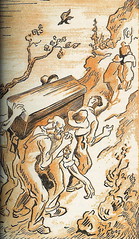 In Kentucky, July, not April, is the cruelest month, as the stench of the remains in Private Tussie's coffin remind Uncle Mott when he steps in to the coal shed just before the funeral. “‘That scent will knock you down,’” he warns Grandpa. What makes T.S. Eliot’s world a wasteland is the lack of religious faith; what makes Stuart’s Appalachia a wasteland is the lack of faith in the American Dream, the refusal of the lazy and intractable Tussies to lift a finger to achieve that dream.
There is another reason in addition to the satire that makes it difficult to see that Stuart’s Appalachia is a wasteland: Stuart is a bit ambivalent about the American dream of strive-and-succeed, just as he is ambivalent about the Tussies. For example, Stuart seems uncertain whether Grandpa’s longing for a piece of land of his own represents the best or the worst side of his character, whether being a landowner is the first stop to independence or the first step to the kind of servitude Thoreau warned against in Walden. Stuart begrudgingly admires the Tussies, he even begrudgingly loves them, perhaps because of their refusal to be emasculated and branded, to be regimented and repressed, or to be pussy-whipped by the American bitch-goddess Success. But at the same time Stuart cannot help being embarrassed and appalled, as only an intelligent, educated, and ambitious native of Appalachia could be, by the Tussies’ anti-social behavior, by their slovenly lack of ambition, by their failure to even begin to measure up to their primary obligation, the obligation that every red-blooded Americans is supposed to feel – the obligation to succeed.
Hail the Unconquering Hero
There is not a shred of patriotism in Taps, which is remarkable considering it was written and published while the war was still going on. The flag on the pole outside the county courthouse is neutralized by the soiled flag that shrouds Private Tussie’s coffin, a flag that Sid thinks of as dead, as dead as the corpse inside the coffin. Kim Tussie was no hero, even though he was given a hero’s funeral. Before he went off to war, he was just another ignorant, no-good Tussie. Sid says, “I remembered Uncle Kim how he used to come home drunk and throw the few pieces of furniture out of the house, break the dishes and winders, break the chairs over the stove and drive Aunt Vittie off. . . . I remember how the Law used to threaten Uncle Kim because he wouldn’t pay his debts and how he’d take to the woods with his pistols when the sheriff would come to get ‘im.”
Though it is a great novel, Taps lacks a resolution to the conflict at the heart of it, the conflict between self-reliance and dependency. After the laziness, incestuous lust, and violence of the first twenty-two chapters of the novel, the last two chapters resort to what was called in Greek drama a deus ex machina, or god from the machine. By some mechanical means, a god descended from the skies to the Greek stage to straighten everything out. The god-from-the-machine in Taps is Private Tussie himself who returns home very much alive and reformed to explain that it wasn’t him they had buried but some other unfortunate solider. We are supposed to believe that the war has civilized him, made him sober, sensitive, and kind – taken the Tussie out of him. It is a kind of miraculous rebirth.
Stuart ends his wasteland novel as a Shakespearean comedy, like All’s Well that Ends Well, with Kim and his wife Vittie on the final page snuggling up before a fire and presumably living happily ever after, with Kim serving as the father Sid had never had. Kim’s wife Vittie, whom Sid previously had been told was his aunt, was really his mother. She had given birth to Sid out of wedlock before she married Kim. So on both his mother’s and his father’s side (his biological father was middle-class), Sid is not a Tussie, which may be the equivalent of those fantasies children have who wish their parents were not really their parents, as Stuart may have wished at times he was not Appalachian. The ending of Taps is a happy one, but it is more or less stuck on the rest of the novel.
With a combination of nerve and naïvete, Stuart wrote a culturally subversive, politically incorrect novel in the middle of a war. Industriousness, self-reliance, virtue, and godliness – these were the ideological cornerstones of the American nation, and no one better suggest otherwise, especially when a war is being waged. Everyone was supposed to pull together to defeat the evil enemy. No ethnic or racial group was supposed to be portrayed as anything but virtuous and patriotic. In creating the Tussies, Stuart was revealing the dark side of the American dream, if not of human nature; he was showing his own Appalachian kinfolk in as unflattering a light as they had ever been portrayed prior to the war on the radio and in comic strips and movies. But at the end of Taps, Stuart backed away from his satirical, unpatriotic vision.
Welcomed Relief
Many readers appreciated the novel, which sold well and won prestigious awards, probably because it was such a relief from the propaganda of that period. But the conservative guardians of America’s image, and war-time Hollywood in particular, wanted no part of Private Tussie; it wanted Sergeant York, a Kentuckian who had allegedly used his sharp-shooting skills to kill and capture scads of Huns in the First World War. We now have learned that Alvin York had not been quite the hero Gary Cooper had portrayed him as in the Academy Award-winning 1941 movie Sergeant York, but when nations, races, religions and civilizations war with each other for control of the world, in a survival of the holiest struggle, myth is usually a more useful weapon than the truth. Truth is the first casualty of every war, the adage says, and since undeclared wars often simmer between declared ones, many people go through their lives uncritically and usually unconsciously immersed in the myths they have been programmed by their culture to believe in.
Later in his career, as he moved further right politically, Stuart came up with an ideological rather than an artistic resolution of the conflict he had left hanging in Taps. He fell back on an Appalachian prejudice and blamed the government for having corrupted the poor hill people of Kentucky. Stuart dramatized that thesis in his novel The Land Beyond the River (1973), in which Ohio and Portsmouth are fictionalized as the places where salt-of-the-earth Kentuckians go to be corrupted by the welfare state. The Land Beyond the River is not anywhere near the artistic achievement Taps was, perhaps because there is no ambivalence in it: the love hate relationship with Appalachia and its people that Stuart creatively wrestled with in Taps is replaced by a monomaniacal right-wing Cold War conviction that government is the source of all that is bad in America.
Though a work of fiction set in the Buckeye, not the Bluegrass State, The Land Beyond the River offers insights into the history and character of Appalachian Ohio and Portsmouth, where Stuart lived and taught school for a time. What I understood after reading Taps is that the Tussies are still with us, if by Tussies we mean those who milk the government at the same time they sing the praises of free enterprise and individual initiative. Grandpa Tussie, that clever and incorrigible old sponge, now has a law degree and a real estate license; he and his clan control the Chamber of Commerce and the Southern Ohio Growth Partnership. Our contemporary Tussies, all gussied up and with more “schoolin” than their predecessors, have managed to keep Portsmouth poor and crime-ridden so that they can keep financial assistance rolling in from the state and federal government and pork from the U.S. Dept. of Agriculture in particular.
The dishonesty of the Tussies who control Portsmouth is equaled only by their clannishness. Those outsiders who dare to question the way things are done locally – even though those ways have fostered a culture of corruption and incompetence – run the risk of being harassed, arrested, and denounced as “domestic terrorists.”
Chamber of Commerce's Stuart
One of the Dept. of Agriculture pork projects in Portsmouth is the Floodwall Murals. That Jesse Stuart has found a niche on that Chamber-of-Commerce version of Portsmouth’s history is an irony that he
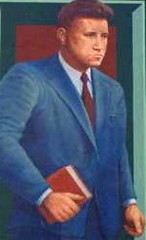 would have been able to appreciate better than anybody. Labor and learning, sacrifice and curing, community and caring are celebrated in the murals, but where are Stuart’s Tussies and the unpleasant truths they represent? The scalawag Uncle Mott had boasted, “‘[A] Tussie can stand anything when he has to,’” to which Grandma shrewdly replies, “‘He can stand anything before he’ll work to make it better . . .’” That can also be said of the Tussies who now control Portsmouth, and who try to get us to believe otherwise through the myths depicted on the trompe d'oeil (“deceive the eye”) pork-barrel murals.
Note: Taps for Private Tussie quotations are from the 1943 first edition published by E. P. Dutton, with illustrations by Thomas Benton.


