Tuesday, March 19, 2013

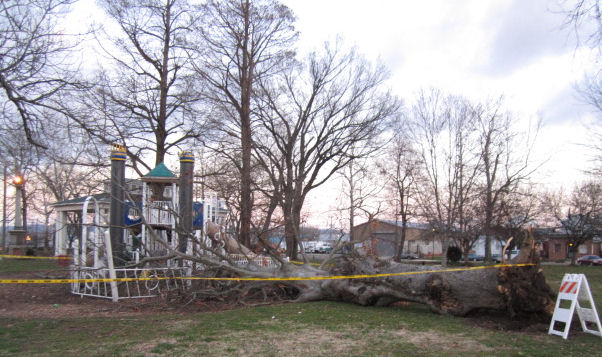
Kiwanis Playground: Deathtrap for Tots?


The huge Copper Beech hardwood tree that crashed upon the Kiwanis playground


     Frank Lewis has outdone himself in shamelessness in his report in today’s  online Portsmouth Daily Times on the huge tree falling on the Kiwanis playground (click here). Because he is so skillful in covering up the crookedness of Portsmouth, Lewis could work for a hundred years for the PDT and he would never be fired or made to feel unwelcome as editors and reporters have in the past. He spends a good part of his story providing John Johnson, the president of the Portsmouth Kiwanis Club, and Kiwanis Ohio District Governor Donald Parker, with the opportunity for taking bows for the Kiwanians for the wonderful work they did in building “this wonderful playground,” “this world renowned playground.” What chutzpah! What a crock! The truth is the playground was and is a potential deathtrap for tots, not only because of falling trees but also because of the heavy vehicular traffic that swirls around it. 
     The city and the Kiwanis Club were warned about the potential consequences of how and where the playground was built, and they can thank whatever gods may be, or their lucky stars, that one or more children was not killed or badly injured when the tree fell. Surveying a bench the tree had obliterated, Jack Tackett of the Portsmouth City Service Department is quoted by Lewis as saying, euphemistically, “If somebody had been sitting on that bench they would have been in trouble.” Would have been in trouble? They probably would have been dead. If only one child had been killed or injured, the city and Kiwanis could have been sued. Kiwanis’s claim that they now have no legal responsibility for the playground overlooks their culpability in this project from the start.  
     The real heroes in this mess is the couple who called everybody’s attention, including my own, to the problem of the rootless trees. Naturally, they were viewed as trouble makers, as what Steve Hayes of WNXT calls CAVE people, that is, Citizens Against Virtually Everything, including apparently deathtraps for tots. That’s how critics of the city are treated by the local media, as cave people.
     For my side of the story, read my 2009 post, “The Kiwanis Playground: The Hole Truth” (click here). Also read “Burning the Midnight Oil,” my 2009 post on Mayor Kalb’s email answer to my open records request for official documents related to the playground agreement between the city and the Kiwanis Club (click here). That was the email in which Kalb called me “a worthless piece of shit” and worse, the email that went viral. My blog crashed when the number of hits to “Burning the Midnight Oil” approached 450,000 in 48 hours. For the  country and the world, Kalb may have confirmed the worst stereotype of  the ugly American, if not the ignorant redneck. The world was astonished:  “What kind of a city would have such a crude ignoramus as mayor?” 
Kalb supplied me with an undated document that I suspected had been produced after the fact. I strongly suspected that the playground had been built without proper authorization, which would have made the whole project  a violation of Ohio law. I challenged both the city and Kiwanis to say that the written agreement was drawn up and signed before the project was begun. I got no answer from Kalb.  I visited the then president of the Portsmouth Kiwanis Club. I went with someone who knew Dr. Hamm-LaValley, who assured me the doctor of dentistry was an honorable woman. I was prepared to drop the whole matter if Dr. LaValley had an explanation of why the letter she signed was not dated, but she declined to talk to me. Immediately below also is a previous letter of intent, signed and dated 18 December, 2008, under the official Kiwanis letterhead. Below that is a copy of the undated agreement letter, signed by Dr. LaValley, which I suspect is undated because it was written after, perhaps well after construction of the playground began. That may be why it has a faux letterhead and is not written on either city of Portsmouth or on official Kiwanis stationary:

Dated playground letter of intent with Kiwanis letterhead
Undated Kiwanis letter of agreement with stark letterhead.


Finally, when the playground was dedicated, I wrote an open letter to the children of Portsmouth about the playground, trying to explain the controversy (click here).


Saturday, March 16, 2013

GOP: Gay Old Party?

rivervices.blogspot.com

Yesterday, Ohio Senator Rob Portman surprised almost  everybody, but especially conservative Republicans, by announcing his support of same-sex marriage. He changed his mind after his twenty-year-old son  told him a few years back that he was gay. Some Ohio Republicans were a little uneasy about Portman’s sexuality when he was mentioned as a possible vice president candidate, which of course was before he announced his support of same sex unions. Portman was perceived to be too low-key and  deferential, and he was an Ivy League graduate (Dartmouth). Among his incriminating activities? He likes to go hiking and he kept a kayak in his office in Washington.  His gay son is an undergraduate at Yale. Not your NASCAR type. More your Log Cabin Republican type. But who can be sure there aren’t gays at the Indianapolis 500, and that there won’t be a Nellies for NASCAR someday.
 There are deep divisions within the Republican Party, divisions that are growing wider each news cycle. Since he has already caved on Obamacare, who knows what liberal new  proposal Ohio’s Republican governor John Kasich is going to come up with in an attempt to prove he’s not a  Stone Age Republican. There is now a segment of the GOP that is getting so liberal that some liberal Democrats worry they are being outflanked on the left. It would be even less surprising  than Portman’s switch if  Ohio Attorney General Mike DeWine, hoping to get back his Senate seat, drops his tough guy Jimmy Cagney impersonation (yes, that’s what that is), announces he is gay,  and  supports same sex marriage. 

Bi-political Homosexual

The Portsmouth politician that may benefit most from the growing acceptance of gays is  city council member Kevin W. Johnson, whose Democratic affiliation presents little problem since he is bi-political, just the kind of bipartisanship that can help reduce  the paralyzing polarity of American politics. He has the strong backing of not only Democratic but also some Republican power brokers in Portsmouth. When a putatively pro-Johnson flyer was widely distributed during the last race for the First Ward seat on the city council, I assumed it was the work of the drug-dealing pimp who was the First Ward incumbent on the city council, or some of his supporters. I  assumed it was a homophobic hoax perpetrated by the pimp, who was as notoriously heterosexual as Johnson was openly homosexual. But because public opinion has shifted so much it  is possible, though still very unlikely, that the flyer was genuine. But in the seismic political and sexual shifts that are taking place, you can’t be sure about anything.

Not long after taking his seat on the city council, Johnson strengthened his political position in Portsmouth by pushing a  primary ballot proposal to change the city charter from the mayoral to the city manager form of government. The proposal passed, but I think it would have failed in a general election because Portsmouth had already tried the city manager form of government and concluded it was even worse than the mayoral form, which it voted to return to. Why did Johnson want to get rid of the mayoral form of government? In part possibly because he wanted to get rid of the African-American mayor, David Malone, who is a hypocritical philandering evangelical preacher who denounced Johnson’s effort to get the city council to pass a resolution endorsing same sex unions. Malone believes homosexuality is the abomination that the Bible insists it is. Malone was appointed mayor when the first female mayor, Jane Murray, who challenged the monkey-business-as-usual tradition in Portsmouth, was recalled in a campaign that was led by the former Portsmouth police chief, the heavy-drinking Tom Bihl,  who had been convicted of  misusing public money.  Bihl hasn’t announced what his position on same sex marriage is,  but I would guess he’s “agin’ it.”
 Johnson may have a bright political future, not only  because he is gay,  but because he is bi-political, working both sides of the street, as he is on the Third Street controversy, and it doesn’t hurt that he is strongly in favor of gambling, which many locals believe will be the salvation of the city. 
       And what about “Governor” Johnson? Does that sound impossible? Well, so did “Governor” Strickland sound impossible twenty years ago, when he was teaching part-time evenings at Shawnee State University, and when a Republican member of the Cornerstone Church accused him of being sexually  involved with teen-age boys, without a shred of evidence, as I recall. I've heard Johnson was in Washington for Obama’s inauguration. He might even end up being the Republican candidate for governor. That day may arrive sooner than anyone can imagine. As Rob Portman’s conversion suggests, in spite of the  Tea Party, GOP could come to  stand not for the Grand Old Party but the Gay Old Party, which might be a big improvement.


From Kevin Johnson’s Facebook pages


For  past posts related to the above post, click here   for “From Moses to David Malone,” and here for “Snow White and the Seven Dwarfs.”


Monday, March 11, 2013

Third Street: Thick as Thieves


Third Street: Hatcherville


Third Street


      Shawnee State University doesn’t have a master plan as much as a master plot. By plot I mean not “a measured area of land,” but rather “a secret plan, a scheme.” The plot was to enrich a local lawyer, Clayton Johnson, and his partner in crime, a local developer, Neal Hatcher, by giving them sweetheart deals: for example,  taking  the worthless Marting Building off Johnson’s hands, for almost two million dollars, and allowing Hatcher  to build SSU student dormitories in a can’t-lose arrangement. Hatcher  built dormitories on the  northern side of Third Street, a major thoroughfare running through the heart of the university. The dormitories were on one side of Third Street, the classrooms, the administration buildings, the athletic center, the student center, etc., on the other. A hazardous arrangement. 
       Every student who lives in Hatcher’s dormitories plays Jeopardy. They have to to cross heavily trafficked Third Street day and  night, much of the traffic coming from or going to the Grant Bridge. Just the other day a young man from Portsmouth, on a moped,  was killed on the Kentucky side of the bridge, apparently by a driver who reportedly ran a red light. Like most streets in Portsmouth, Third Street speed limits are frequently violated, putting the lives and limbs of students in jeopardy. Now, the university wants to close Third Street and put grade school, middle school, and high school students, just north of Third Street, in jeopardy, making a bad situation even worse.
      Those who might be opposed to the project are dismissed, in a recent PDT editorial, (9 March 2013) as “people who are opposed to anything that brings progress.” Sound familiar? Steve Hayes has been peddling that line at WNXT for years. Where is Steve’s buddy, WSAZ’s Randy Yohe, now that the ruling clique could use Yohe’s support for closing Third Street? But the Can-Can Man was canned after being arrested for drunken driving. Of course, Yohe or no Yohe, the collection of bankrupts and political pawns who make up the Portsmouth City Council will pass the measure to close Third and probably quickly, as the PDT urges in the same editorial, as the council previously acted quickly to unload the Marting building on the taxpayers of Portsmouth. 
      If the most recent editor at the PDT did not support the closing of  Third Street,  it would not be long before he would join the long line of editors and reporters who have  quit or been fired when they failed to please the rich crooks who control the no-longer daily Daily Times  and the city. Now,  the politics are even thicker than they used to be. The Felix of the Odd Couple, Clayton Johnson, has retired, leaving Oscar, Neal Hatcher, holding the money bags alone, prompting Jeff Albrecht, Portsmouth’s preeminent snake oil salesman, to make his move for the Municipal Building, backed by the American Savings Bank in the person of Michael Gampp. Thick as thieves, they are all for closing Third Street, as quickly as possible, whatever the consequences. 


Click below for previous posts related to above post:


Thursday, February 28, 2013

Jesse Jackson, Jr.: Black or African-American?

Jesse Jackson, Jr., as I recollect him in Massie Hall. 


African-Americans may be  making a serious mistake in calling themselves black rather than African-American because in doing so they are opting for polarity rather than solidarity, for disparity rather than parity, for denigration rather than elevation. In the next census, the U.S. Census Bureau will be offering African-Americans the choice of identifying themselves as either African-Americans or blacks. (See the ABC news report at the end of this post.) I believe “black: is a mistake  because African-Americans cannot win the black-and-white name game. It is like a game of Scrabble in which they always get screwed. The Black is Beautiful slogan was an attempt to rebrand Negro. While it may have increased self-esteem on an conscious level, on an unconscious level, where the waters run very deep, Black is Beautiful  intensified the association between  blacks and badness.
Blacks are not really black and whites are not really white. We are all to some degree colored and will become increasingly so as racial barriers are further erased in America. By calling themselves black, African-Americans are burdening themselves with blame they don’t deserve. They are helping perpetuate the myth they are the white man’s burden, which too many so-called white Americans, continuing the South’s racist traditions, continue to think is the case.  In the minds of racists, in the North as well as the South, the West as well as the East, and also here in the Midwest, America’s so-called heartland, “blacks” are  associated with indolence, thriftlessness, and chitlins, with illegitimacy, crime, and dependency—dependency on both illegal drugs and the so-called welfare state.
Sometime in the mid-1990’s, in a February Black History Month conference at Shawnee State University, Jesse Jackson spoke to  a small gathering in a Massie Hall classroom. Jackson was in the front of the class, conservatively dressed in suit and tie,  sitting at a desk facing the audience. When he finished with his prepared remarks,  an  African-American  girl, who looked to be of high school age,  asked  him what he thought the appropriate name for people of their race should be.  She didn’t list them, but the options were colored, African-American, black, and, though it had fallen into disfavor,  Negro. The reason the word Negro had fallen into  disfavor was because the racist epithet “nigger” was probably derived from it. Negro  was pronounced “Niggra”  in the slave South and that evolved into  ‘nigger,” with all its hostile, racist connotations. Jackson  answered the  girl’s question without hesitation or qualification. He said he was certain of one thing: he didn’t want to be called black. “Look black up in the dictionary,” I recall him saying.  “Just see what it says—most of it’s bad and negative.”

Blackguards and Blacks

      We are heir to the Judaic-Christian tradition in which darkness is the primary metaphor for  what is undesirable, if not evil.  In Genesis we are told that “darkness was on the face of the deep,” so God said, “Let there be light: and there was light.” And since light was good, “God divided the light from the darkness.” God created a segregated world in which light and darkness were separate and opposite: God and the devil, good and evil, light and darkness.  Calvinists, among the most pessimistic of Christians,  had a frightening sense of what Herman Melville called “the power of blackness,” meaning the  power of evil. For Calvinists, as well as other Christians, the devil was a black. Merriam-Webster includes, among other definitions of black, the following: “dirty, soiled; characterized by the absence of light; thoroughly sinister or evil: wicked; very sad, gloomy or calamitous; marked by the occurrence of disaster; characterized by hostility or angry discontent: sullen; indicative of condemnation or discredit; connected with or invoking the supernatural and especially the devil.”  Could any name they might have chosen for their race be worse than the word black? Invariably, black is bad, either alone or combined with another word. Take the word  blackguard for example. Originally, a blackguard was  lower-class employee in an upper-class  British household who worked “downstairs,” in the kitchen, and guarded, figuratively if not literally,  the blackened instruments—the pots, pans, and ironware of the household. Blackguards were the bottom dwellers, doing the dirty work  in an upstairs-downstairs, class-rigid world. But, though bottom dwellers, they were nevertheless white and of the same race as their masters. But  just as the neutral word Negro evolved into nigger,  blackguard, i.e., a kitchen helper, because of its association with blackness, came to mean a “bad person.” The online dictionary Wordnik, defines blackguard as  “black in color of the skin or dress, or in character.” So, blackguard, which started out as a word reflecting class antagonism became a word reflecting racial antagonism.

Denigration as Defamation

      The word denigrate is also instructive. The Merriam-Webster definition of it is, literally, to blacken and, more figuratively, to defame or belittle. To create a neologism, denigrate means  “to negrify,” though those who use it are rarely aware of this meaning. African-Americans are more likely than whites to be aware of its racist connotations. In responding to a posting by a someone in a thread on Firedoglake, an African-American, objected to someone else’s use of denigration in a thread: “if you’re  black, can you please stop using the term ‘denigrate’ in this discussion?” he wrote. “i’m black too, friend. i say ‘ouch’ every time i read it . . .” The unintended irony in the following examples of the use of the word denigrate, compiled by Wordnik, speak for themselves: “We do not intend to denigrate southern values,” someone claimed. Denigrate  southern values? Negrify southern values? That is not what the user intended but given the racist etymology of the word, that is the absurd meaning of the statement. Here is another example Wordnik provides of the use of denigrate, which is even more absurd than the previous one:  “Some Rousseauean anthropologists protest that reports of cannibalism represent a racist desire to denigrate other cultures . . .” If instead of “to denigrate” the statement had read to defame, degrade, or impugn, then there would be no contradiction.  But to speak of denigrating  dark-skinned cultures by calling them cannibalistic is nonsense. It is like the pot calling the kettle black. These examples suggest that African-Americans cannot escape the stigma of blackness that is built into the English language.
Even a word that has nothing to do with black, such as  “niggardly,” which means parsimonious or stingy, should be avoided,  as the white aide to the  black mayor of the District of Columbia  discovered in 1999 when he characterized a stringent  D.C. budget as “niggardly.” Unlike the word Negro, niggardly has no etymological connection to nigger, but niggardly, a nearly obsolete word, sounds too much like it. There was a protest from blacks (as opposed, say,  from  African-Americans), and the white  aide, who was gay,  was fired but then rehired when the gay community protested on his behalf. The aide took it in stride, saying he had learned an important lesson. “I used to think it would be great if we could all be colorblind,” he said. “That’s naïve, especially for a white person, because a white person can afford to be colorblind. They don’t have to think about race every day. An African American does.”  In using the term African-American rather than black to refer to people of color, was the gay aide aware  that “black” was the racist equivalent of such sexist words as “queer,” “faggot,” and “fairy ” for the male homosexual?
Unfortunately, Jesse Jackson, Jr., did not practice what he preached in the classroom in Massie Hall. In the end he personified some of  the  negative meanings of the word black. If he didn’t turn out to be “thoroughly sinister or evil,” he did  prove to be deserving  of “condemnation or discredit.” He showed himself to be corrupt, selfish, dishonest, unprincipled, adulterous, hypocritical, conniving, spoiled, and materialistic. Though he didn’t want to be called black, he blackened the reputation of the race he was identified with, reinforcing racist stereotypes.

Blacks and African-Americans 

      But what  Jackson’s career really reflects poorly  on is not any particular race but on politicians in general. Politicians to a large extent are an embarrassment, not just to our nation,  but to our species, as is depressingly evident not only in Chicago and Washington but also in Portsmouth.  In some respects, specifically the degree of audacity, Portsmouth may be worse than Chicago and Washington, in part because the major papers in those cities, The Chicago Tribune and The Washington Post, occasionally do investigative journalism, while The Portsmouth Daily Times has almost always been under the thumb of the crooks who control the city. Not even in Chicago or Washington would  a notorious blackguard, a white  drug-dealing pimp be brazenly appointed to fill a vacated elective office without a peep from anybody, especially not from local law enforcement and  the local media.  At least in Chicago and Washington the crooks occasionally get publicized, arrested, and jailed. In Portsmouth they get away with everything but murder.  In Portsmouth we had not only a drug dealing pimp being appointed to city  council we have a philandering, hypocritical, homophobic unelected mayor who just coincidentally  happens to be black.
Bill Clinton is jokingly said to have been the first black president. There is some truth to the joke, but it is not a flattering truth. Americans should be grateful that in 2008 they elected and in 2012 reelected not the first black—as Jesse Jackson Sr., was grooming Jesse Jackson,Jr., to be—but the  first  African-American president. Jesse Jackson, Jr.’s, father  was speaking not as an African-American but as a black when he was overheard saying  about Obama, on a mike he didn’t realize was on, “I’d like to cut his nuts off.”  Jackson, Sr., was reportedly angry at Obama for speaking down to blacks. But what the president was actually doing was speaking up for African-Americans. 


The form that was used in the last US census.


Wednesday, February 20, 2013

The Illustrated Ballad of Dr. Lundeen


Now that the Tenth Appellate District Court has upheld the revocation of Dr. James Lundeen's medical license, I call the attention of those have not read it to my post "The Illustrated Ballad of Dr. Lundeen." (Click on  the link below.)


http://rivervices.blogspot.com/2011/12/illustrated-ballad-of-dr-lundeen.html


Wednesday, February 13, 2013

OH EPA: Death by Chocolate, Death by Power Point

Jane Murray addressing panel at EPA meeting following stultifying
 Power Point presentation by Richard Duncan, on stage left


In Flohr Hall of Clark Memorial Library at Shawnee State University, on  the evening of  February 12, 2013, the Ohio EPA sponsored an Information Session and a Public Hearing regarding the draft agreement  reached between the Ohio EPA and the city of Portsmouth. In a display of bureaucratese,  somebody in government had named this kind of  agreement “Administrative Order of Content.” One of the aims of bureaucratese, as this name illustrates, is to keep the public in the dark about what is going on. The AOC in question, to use its acronym, has to do with water. When it comes to two extremely important  resources, namely water and money, Portsmouth city government has played fast and loose with state and federal laws and ordinances that are supposed to  regulate them. 
The Information part of the EPA evening, which took up the first hour, consisted almost entirely of a deadly dull Power Point presentation by Richard Duncan, the city’s man in charge of sewers. Duncan’s Power Point presentation had as one of its results, intended or not, the paralysis of most of the forty or so members of the public and city government in attendance.  Just as spiders paralyze the  insects that fall into their webs, preserving them for future consumption, Duncan with his mumbling delivery, faded slides, and hypnotic red laser pointer, rendered the audience stultified for the second hour of the meeting, the so-called Public Hearing half of the evening, during which the audience was allowed to  ask questions about the “information” that Duncan had provided in his Power Point presentation. However, when Duncan finished and the  moderator asked for questions,  there were none.  Tick, tick, tick. She waited and she waited. How embarrassing. It was like asking the paralyzed insects trapped in a spider web if they had any questions about the spider’s slide show. Finally, to  everyone’s relief, somebody finally came forward and asked a question.
Emboldened by that hearty soul, I volunteered to ask a question,  but as I approached  the microphone at the front of the hall  my foot was asleep and so was my cobwebby  brain.  I asked the panel about  subhead sections F and G on page 4 of  the draft agreement. The “Respondent” referred to at the beginning of F is the city of Portsmouth or its chief officer, the mayor. However, although Portsmouth Mayor Unelect   David Malone was in the audience he took no part in the proceedings and asked no questions, leaving Duncan to twist in the wind. The question I asked the panel on stage was how come there was no mention during the Information hour  of  the important statement in the agreement that charged the  Respondent (the city)  with repeated violations of the Sciotoville and Portsmouth  permits governing the city’s handling of  sewage water and storm water, and the violation by the city of  the  requirements of Section 301 of the Clean Water Act, the federal law governing polluted water throughout the United States. What follows is a  photocopy of the section of the agreement I am alluding to:

From the draft agreement between OH EPA and city of Portsmouth


           It was Duncan who answered my question why the charges against the city (and him principally) had not been mentioned. He said the part of the draft agreement I referred to was “boilerplate” language and didn’t really mean much. His answer like his Power Point presentation was an effort to deceive and obfuscate. The Respondent referred in F of page 4 of the draft agreement is not just anybody or any city; it applies specifically to Portsmouth, which a number of times, during storms, had discharged raw sewage into the Ohio River. I asked the panel if they agreed with Duncan that it was boilerplate language and didn’t really mean much. The EPA representative, Barbara VanTil,  sitting immediately to Duncan’s left on the panel nodded her head in agreement with him and murmured “Yes.” Her response was a revelation to me. I have always assumed the acronym EPA stood for Environment Protection Agency. I did not know it also meant Egregious Protection of Assholes. What Ms. VanTil’s response and the meeting itself revealed to me was the  likelihood that the city’s chronic sewer crisis is the result not just of the incompetence and dishonesty of politicians of Portsmouth but of the enabling of the good folks at the EPA at both the state and federal levels. They are, knowledgeable, polite, and even sweet, like chocolate, but they are also the kiss of death, like Duncan’s toxic Power Point presentation. Just today PBS released a report by the Center for Public Integrity, with the title “EPA Contaminated by Conflict of Interest” (click here.) That appeared to be the case at the meeting OH EPA hosted last evening in Portsmouth.
It must be very difficult to work for an agency like the EPA in a swing state like Ohio. In very red or very blue state, you would know where you stand. But in a swing state like Ohio, half blue and half red, the politics of environmental protection are as polluted as the sewers of Portsmouth.  I suspect that OH EPA is constantly trying to avoid getting caught in the middle, to avoid controversy and, consequently, by not taking a stand, they become enablers. The water controversy has drug on for years, as they say in southern Ohio, and will probably drag on, unresolved,  for many years more, as the OH EPA enables  as it waffles.
It’s the same with money. While the state auditor in Ohio dilly dallies the crooked politicians in Portsmouth channel money that is supposed to be used for road, bridges, and sewers to increase their own salaries and the salaries and benefits of the public employees who strongly support them. It’s the same with water. Instead of taking decisive action, the EPA treads water, enabling incompetent city employees like Duncan to discharge raw sewage into the Ohio and paralyze attendees at EPA public meetings with stultifying  Power Point presentations.  It is no wonder city politicians privately express contempt for the toothless state regulatory agencies. If former mayor Jane Murray and councilman Steve Sturgill had not been at the meeting, challenging the bureaucratese and the raw sewage,  the rest of us might still be sitting in Flohr Hall, paralyzed by  Duncan’s Power Point presentation.


. . . the rest of us might still be sitting in Flohr Hall, paralyzed by  Duncan’s Power Point presentation.


Thursday, January 31, 2013

Marting Brick


“. . . the Albrecht-Gampp combination appear to be clowns by comparison.”


                                                            Marting Brick is falling down,
                                                            Falling down, falling down,
                                                           Marting Brick is falling down,
                                                           My fair lady.

On January 26, 2013, a report appeared in the Portsmouth  Daily (except Monday) Times on bricks falling from the Marting building onto the property of the American Savings Bank (ASB). The anthropologist and linguist Levi Strauss   hypothesized that one of the reasons humans developed language was to deceive.  Deception is important  in human activities, especially politics and business.  The  Portsmouth Daily Times (PDT) is a business and practices deception, especially since it is a failing business whose days are numbered.
“Portsmouth boy” reporter  Frank Lewis has spun quite a deceptive tale about Marting bricks. It is deceptive, at least in regard to intentions, as much in  what he  left out as  what he put in. The following sentence appears near the end of Lewis’s tale:  “The city purchased the building in May of 2002, and has done nothing with the building, allowing it to fall into deep disrepair.” This clearly makes it sound as if the city is the culprit where the Marting building is concerned.   The city is not guiltless but is far less guilty than the Marting Foundation and the mastermind behind the Foundation, Clayton Johnson.
What Lewis left out of his tale was that the “purchase”  of the Marting building was a swindle made possible by the conniving of two willing tools—then-mayor Greg Bauer and then-city council president Jim Kalb. But the perpetrator and the orchestrator  of the Marting swindle was Clayton Johnson,  the brains of the Marting Foundation. Having wrung every dollar it could from the crumbling bricks of the Marting building, the Marting Foundation  then foisted the building  off on the taxpayers of Portsmouth who paid about five times more for the bricks than they were worth. In fact, the bricks were not worth anything. They were worst than worthless: they were a tax liability  and a potentially large expense since the leaking asbestos building would need to be torn down at the Foundation’s expense.  
Is Clayton Johnson  mentioned even once by Lewis? No. Not one PDT reporter or editor has ever  criticized Johnson, and if anyone  had he or she would have been out of a job pronto. But the Johnson era is definitely now over. He’s retired and spending most of his time in the scalawag heaven of Hilton Head. And now that  Hatcher has turned into a public benefactor, with a public athletic complex named after him, could his rapacious career as a developer be drawing to a close?
What  Lewis reveals in his Falling Bricks tale is that  we are now living in  the beginning of the Gampp-Albrecht  era. Gampp is portrayed in Lewis’s tale as the good guy, concerned not only about the well-being of  bank property  but also of  the good citizens of Portsmouth who might  he clobbered by a falling brick. “Yes I know it’s a once in a million chance that someone could be walking down the alley and a brick could fall and hit them in the head,” Gampp told Lewis, “but it is there.”  He explained further, “So we want to make sure that we don’t have damage caused to our structure, and we want to be appropriately compensated if something does happen. But, beyond that, our concern was then, and still is, we don’t want to risk the safety or health of anyone, and our concern is, that as bricks start falling out of that building, we don’t want to see anyone get hurt.” Is it possible that Gampp, a banker, is more concerned about  people than profits? Or is Lewis’s tale confirmation of Levi Strauss’s suspicion that language evolved to deceive?
Lewis’s tale is not really about  bricks. You have been deceived if you think it is. His tale is not about the Marting building, either, not really. It is about the Municipal Building, or more specifically the land on which the Municipal Building rests. The last paragraph of Lewis’s tale drags in the the Municipal Building by the eaves. “Meanwhile, the city remains in a building on property considered by some as the most valuable piece of property in downtown Portsmouth with no solid plans for where they will house government offices in the future. All the while, bricks continue to fall from the Marting’s Fifth Street building, a brick at a time, with still no remedy in sight.”
  The developer Jeff Albrecht has been lusting for  the land under the Municipal Building for at least fifteen years. What  Albrecht wants to do is tear down the Municipal Building, and Gampp is abetting him by hyping the danger of falling Marting bricks,  suggesting by analogy that the Municipal Building is falling down and should be bulldozed as soon as possible, if not sooner. Intelligent people will not be fooled by the stupid deception. If Marting brick is falling down,  so is the IQ of the crooks in  control of the city.  I could never have imagined I would one day look back nostalgically on the Johnson-Hatcher era, but  the Albrecht-Gampp combination appear to be clowns by comparison.


Monday, January 14, 2013

J. Scott Douthat: The Specter of SSU's Anemic Academic Reputation


“What Professor Douthat and his students did at the Celebration of Scholarship, 
as the photo of him speaking at the Celebration suggests to me,  was to revive
 the Bela Lagosi-like  specter of SSU’s anemic academic reputation.” 


In 2012, a sociology professor at Shawnee State University, J. Scott Douthat, conducted a class whose ambitious aim was to address the many social and economic problems of Portsmouth. Such a daunting task would seem to require a multidisciplinary approach. Anyone addressing Portsmouth’s many problems—the poverty, unemployment, drug addiction, prostitution, political corruption, etc.—would need to understand not just sociology but also economics, political science, history, and other disciplines. Is Douthat multidisciplinary? What was the upshot of his class’s work? What conclusions did they reach? As the story on the front page of the SSU student newspaper The Chronicle put it in April 2012, the conclusion Professor J. Scott Douthat and his student researchers presented at the annual Celebration of Scholarship was that Portsmouth needs to be revitalized to become “the ‘All American [sic] City’ it once was 33 years ago . . .” As a former faculty member I’m embarrassed by such nonsense. The ignorance implied in the statement reflects poorly on us all. That Douthat conducts a real estate business in Portsmouth, rents to students, and has a private consulting practice, in addition to his full-time faculty position at SSU, may help explain why his students are not better prepared.

      One of the disciplines Professor Douthat and his students showed a poor grasp of at SSU’s 2012 Celebration of Scholarship is history, and in particular Portsmouth’s history. Contrary to what Douthat and his students mistakenly assumed, “33 years ago” was not the Golden Age of Portsmouth. On the contrary, In 1979-1980 Portsmouth was at perhaps its lowest point, at least politically, in the twentieth century, which was not surprising since the city had begun going downhill economically, socially, and politically after the Second World War. By 1979, when Barry Feldman (click here) was Portsmouth’s controversial city manager, the city was in desperate need of public relations. But Douthat and his students naively assumed, because Portsmouth had been designated an All-America City by the National Civic Association in 1979, that that period was Portsmouth’s finest hour. The promoter of All America City is the National Civic League (NCL), which was, and still is, primarily in the public relations business, which it is very good at. Cities looking to improve their image and reputation enter NCL’s annual All America City contest. One of the aims of public relations is to spin the news so that the public is too confused to know which side, or which city, is up. The essence of public relations is to use words and images to make anything, no matter how bad, look good or at least better. The historian Daniel Boorstin wrote wryly, “Some are born great, some achieve greatness, and some hire public relations officers.” What some cities wanting to improve their reputations do is enter the National Civic League’s All-America City contest, as Portsmouth did in 1979. As an employee of NCL candidly admitted, the All-America City award is often used by the winners “for signs, for civic pride [and] to sell their city to corporations.” 

    Unfortunately, Portsmouth found no takers. Corporations continued their exit from our river city after 1979. What the city is left with now is little civic pride, no large corporations, and a big peeling icon of the All-America City on the river side of the flood wall. Peeling or not, it apparently still can fool some people, including Douthat and his students, into thinking Portsmouth’s past was so much better than its awful present. This is the stuff that myths, the ultimate in public relations, are made of.

      Mistakes or inaccuracies of any kind at SSU’s Celebration of Scholarship are unfortunate because the university from its founding in 1986 had gained a reputation as a  fourth-rate academic institution. U.S. News annually ranked SSU near the bottom of the lowest (fourth) tier of American colleges and universities. I wrote about those anemic rankings in April 2005:

Shawnee State is one of the 217 small liberal arts colleges that US News ranked for 2005. The 217 colleges are divided, by quality, into four tiers, the best in the top tier, the worst at the bottom. Shawnee State is one of 53 colleges in Tier 4, the bottom group. Not only that, it is near the bottom of the bottom group, and it has been ranked near the bottom of the bottom for at least a decade. By reputation (on a scale of 1 to 5) SSU is currently ranked at 1.6. There are only 4 colleges among the 217 that have a worse ranking.

What Professor Douthat and his students did at the Celebration of Scholarship, as the photo of him speaking on that occasion suggests to me, was to revive the Bela Lagosi-like  specter of SSU’s anemic academic reputation. Lagosi became famous playing  Dracula in the movies.


Bela Lagosi as the specter of SSU's anemic academic reputation
     Aside from looking the part, how did Douthat manage to raise the specter of academic anemia? Let me count the ways. Although he is a professor of sociology at SSU, Douthat’s B.A. and  Ph.D. degrees are both in psychology, not sociology, with the doctorate being specifically in forensic psychology. Yet he is, an associate professor of sociology at SSU and the coordinator of the department’s sociology major. The ideal venue for a forensic psychologist is the courtroom, not the classroom. Be that as it may, Union Institute and University, a primarily online institution where Douthat received his Ph.D. in 2005, is not, or at least was not, the best place to have a Ph.D. from in any field. In a useful consumer protection website, Ripoff Report, a frustrated Ph.D. candidate in religious studies wrote a long, detailed complaint in 2004 of his unhappy experiences with Union. “Now, as usual,” the candidate wrote, “further attempts to get the administration to update and correct my records and my program, have met with silence and inaction. This is only one string in this very long and complicated series of problems in which all attempts to get things cleaned up have met with, at most, a momentary flutter of activity that has resulted in no significant change except for often creating more problems.” One dissatisfied student, or perhaps he should be called customer, is one thing, but a complaint from an agency of the state of Ohio and another from the federal government is something else. In 2002, the Ohio Board of Regents (OBR) issued a report critical of Union’s Ph.D. program, finding that “expectations for student scholarship at the doctoral level were not as rigorous as is common for doctoral work . . .” As was reported in the Cincinnati Inquirer, the OBR called for a major overhaul of Union’s Ph.D. programs. Not long afterward the U.S. Department of Education (USDE) became concerned that the millions of federal dollars that were going to subsidize Union graduate students were not being distributed according to federal guidelines. The USDE  insisted on more accountability before it would release more funds. Shouldn’t somebody at SSU insist on more accountability from students and especially from professors participating in the Celebration of Scholarship?


Portsmouth's unelected mayor, David Malone, trying to balance city budget
      Who if  anybody benefited from Professor Douthat’s  class? A chief public relations beneficiary of the 2012 Celebration of Scholarship was Portsmouth’s unelected mayor David Malone, who embodies to an egregious degree the incompetency, dishonesty, and financial and moral  bankruptcy of  Portsmouth’s politicians.  “Several of the solutions proposed by students  to mayor Malone have been implemented,” The Chronicle reported. “Mayor Malone recently implemented the students’ suggestion that inmates could perform public services and clean up the city.” Oh?  My recollection is that inmates have been doing clean up for a long time. I checked with former mayor Murray, who, unlike the out-to-lunch, philandering Malone, was elected mayor and did not come in through a trap door. She informed me that utilizing inmates did not start with Malone. They were already being utilized when she became mayor, but she, along with the probation director and Health Dept. staff expanded it to include “litter control, mowing, cleaning the city buildings, etc.” Another proposal that one of  Douthat’s students came up with was increasing the city’s property taxes. This proposal is so misguided as to be insulting to the property owners of the city. No one who knew anything about the recent history of property taxes and other taxes in Portsmouth would seriously propose it.

    An earlier generation of students, twenty years ago,  on their own initiative, made a big impact on SSU and later on the city. Because The Chronicle lacked true editorial independence, these crusading students started their own newspaper The Shawnee Sentinel. SSU did everything it could to suppress these students and prevent their newspaper from being distributed on campus. This is part of the hidden history of SSU that Douthat’s students and perhaps Douthat himself are oblivious to. One of those former students, Austin Leedom, has an archive that includes copies of The Shawnee Sentinel and thousands of other documents that bring to light SSU’s hidden history. If only his collection could be made part of the archives at the Clark Library, SSU students would not have to rely on unqualified professors and back copies of  the politically correct  Chronicle for their research. It is time that a stake be driven though the heart of the anemic corpse that is SSU’s reputation as a fourth-class institution.


The peeling All-America icon on the Portsmouth flood wall


Thursday, January 03, 2013

"Portsmouth Boy": James R. Saddler, II [reposted]

[In January 13, 2011, I posted the following opinion piece on Richard R. Saddler, II, following his appointment as the council member for Ward Two. The doubts I expressed about Saddler’s appointment then have been confirmed in the two years since. Austin Leedom tells me that our “Portsmouth Boy” outdid himself in assininity at tonight’s council meeting. The record of those who first got on the council by being appointed is a sorry one, but what else can we expect when drug-dealing pimps, drunken drivers, deadbeat dads, and bankrupt failures are shown preference as appointees?]
. . . . . . . . . .


 “There are some issues with some of our local roads and infrastructure, things like that that might be easily fixed.” Richard R. Saddler, II, Portsmouth’s new city councilman (shown above taking oath of office), as quoted in the 11 January 2011 Portsmouth Daily Times story headed “Council gives Saddler 2nd Ward seat.”

“Give” is the right verb to describe the city council’s action in regard to Richard R. Saddler, II. When a member vacates a seat on the city council for any reason, the other members give the seat to the applicant of their choice. One of the last persons to be given a council seat, prior to Saddler,  was the notorious Mike Mearan. The list of of council members who were first given rather than elected to council seats is long and reflects a serious problem in Portsmouth’s city charter. The four-year terms for all elected officials invites recalls and political shenanigans.
Like Mearan before him, Saddler has never run for city council or attended city council meetings or shown much interest in city government. This is often the case with those who are given seats on city council. Unwilling or too lazy or too chicken to run for a seat,  they are only too happy to be given it, usually with the blessing of the unelected crooks who control the city.  Having been given the seat, they have an advantage in future elections because they are  the incumbent, which helps them remain in office, though in Mearan’s case incumbency was not enough to get him elected. Portsmouth has sunk very low but not that low.
When Saddler told the Daily Times, “There are some issues with some of our local roads,” what was he referring to? Was he referring to the issues of traffic lights and vehicular safety, which Mayor Murray had given a high priority to but which Police Chief Horner had spitefully opposed. (Horner’s ideal would be a Portsmouth that is completely free of traffic lights and farting.) Traffic lights were probably not one of the issues Saddler referred to when he spoke of “local roads,” because the traffic lights issue will not be  “easily fixed,” to quote his words. You don’t have to be a member of the traffic committee to know that. In mentioning “local roads,” Saddler might have been referring to  potholes, or something like that. [I feel fairly sure one of the issues he is not concerned with is drunken drivers.]

The Son of Hell-on-Wheels Bihl

But since he mentioned roads,  rather than the deficits, drugs, or traffic safety,  I would say that if Saddler  is no better as a councilman than he is as a driver, then we’re in for a hell of a ride. From 1992 to 2008, Saddler  had twenty-one traffic violations, many of them  for  speeding and not using a seat-belt. (See his rap sheet below.)  In not wearing a seatbelt, he was not only breaking the law; he was  endangering his own life. In  speeding, he was not only breaking the law, he was also endangering the lives of others. If Saddler had  twenty-one moving violations in sixteen years, how many times was he not caught speeding and driving without a seat belt? Is Saddler “The Son of Hell-on-Wheels Bihl”? Saddler is just the kind of driver who is all the more dangerous the fewer traffic lights there are in the city. And he would be even more dangerous if he was driving while under the influence. But in  none of Saddler’s  twenty-one traffic violations is there any mention of alcohol. It’s hard  to believe that someone would  drive above the speed limit without a seatbelt as many times as Saddler has, and in every one of those instances be cold sober. It’s possible he never drinks and drives, and it’s possible he doesn’t drink at all. It’s possible, also,  that former Police Chief Tom Bihl, when he totaled  two parked cars on Offnere Street back in 1998  was cold sober,  as he later claimed he was. But how  can we be sure since he was  not given a breathalyzer test, which Saddler apparently wasn’t given either in   any  one of his  twenty-one moving violations.
I have been driving for twenty two years in Portsmouth and have never received so much as parking  ticket, but that’s probably because I  drive much less than Saddler. The only driving I do is the couple of miles of day on round trips to the Life Center.  But you don’t need to drive much to be at risk on “local roads,” especially since the number of traffic lights has been reduced. On my way to the Life Center one day  several years ago I was slammed into by a young woman racing through a stop sign at an otherwise  quiet intersection on Findlay Street, not far from the notorious pain clinic.
Since city  traffic lights were unwisely covered up during Kalb’s incompetent and corrupt administration, driving has become even more nerve wracking. Crossing Route 52 in particular has became a heart stopper, and about six months ago I saw a very serious accident at a Route 52 intersection where the light was covered.  One night just several months ago driving south on Chillicothe Street I was sideswiped by a car going over the speed limit. I tried following  the compact white sports car to get the  license plate, but the young male driver sped away. I had to replace the driver’s side rear view mirror. Since I didn’t get the license number, I  didn’t report it to the police.  I also didn’t report to the police another time when my car was broken into and some personal belongings were stolen. I am told that Horner’s officers discourage those involved in  traffic accidents or a petty theft reporting, unless they file a claim with their  insurance company. I am told that is how Horner is reducing Portsmouth crime and accident rate is being reduced: by discouraging victims from formally reporting them unless they are filing a claim with their insurance company. As long as Horner is chief, the real crime and accident rate may not see the light of day.

Troubling Questions

I will conclude with some  troubling questions about Saddler and offer some troubling answers. What will happen when and if Saddler gets another moving violation? Will he go to court to appeal it, now that as a councilman he has more political influence? And suppose, if he appeals the violation, that Steve Mowery is the judge presiding at the municipal court. Prior to being elected municipal judge, Mowery was the lawyer who represented Saddler in his divorce,  and Mowery is also one of the “friends” on Saddler’s Facebook site. There is even a photo of Mowery in shades (shown at left). Mowery is the one who when campaigning for municipal judge said that the Municipal Building should be torn down and the city government, including the municipal court, should be moved to a renovated Marting building. Mowery’s opponent in the contest for municipal judge correctly pointed out that whether the Municipal Building should be torn down and whether the city government should move to the Marting building is something the voters, not a municipal judge,  should decide. The  decision not to renovate the Marting building has already been rendered, twice, by the voters of Portsmouth. But the recall of Mayor Murray and the installation of David Malone as her replacement, and the “giving” of the Ward Two council seat to Saddler is probably the prelude to completing the Marting Scam, and the voters be damned. Malone, the Uncle Tom of Portsmouth, has already indicated he is in favor of spending the millions of dollars that the city doesn’t have to renovate the Marting building, and there is  no question how Hassle’em and  Bash’em will vote. In Saddler we already know we have one for the road, and it may not be long before we have another for the Marting building. 


Just the good ol’ boys,
Never meanin’ no harm.
Beats all you ever saw,
Getting in trouble with the law
Since the day they was born.


* * *

Traffic Violations of James R. Saddler, II

1
Concerning: Saddler, James R II
D.B.A./A.K.A.:
Filed: 02/24/1992
Arr. Agency: OSP
Case #: 9201332
Docket Entry: Click
Charge: SEAT BELT-DRIV
Case Type: Traffic

2
Concerning: Saddler, James R II
D.B.A./A.K.A.:
Filed: 01/06/1997
Arr. Agency: OSP
Case #: 9700112
Docket Entry: Click
Charge: 64/45 SPEED
Case Type: Traffic
           
3
Concerning: Saddler, James R II
D.B.A./A.K.A.:
Filed: 09/19/1997
Arr. Agency: OSP
Case #: 9705887
Docket Entry: Click
Charge: 67/55 SPEED
Case Type: Traffic

4
Concerning: Saddler, James R II
D.B.A./A.K.A.:
Filed: 06/15/2000
Arr. Agency: OSP
Case #: 0004500
Docket Entry: Click
Charge: 70/55 SPEED
Case Type: Traffic

5
Concerning: Saddler, James R II
D.B.A./A.K.A.:
Filed: 06/15/2000
Arr. Agency: OSP
Case #: 0004500
Docket Entry: Click
Charge: SEAT BELT-DRIV
Case Type: Traffic

6
Concerning: Saddler, James R II
D.B.A./A.K.A.:
Filed: 04/17/2001
Arr. Agency: OSP
Case #: 0102442
Docket Entry: Click
Charge: FOLLOW TOO CLOS
Case Type: Traffic

7
Concerning: Saddler, James R II
D.B.A./A.K.A.:
Filed: 04/17/2001
Arr. Agency: OSP
Case #: 0102442
Docket Entry: Click
Charge: SEAT BELT-DRIV
Case Type: Traffic

8
Concerning: Saddler, James R II
D.B.A./A.K.A.:
Filed: 10/12/2001
Arr. Agency: OSP
Case #: 0107630
Docket Entry: Click
Charge: 66/55 SPEED
Case Type: Traffic

9
Concerning: Saddler, James R II
D.B.A./A.K.A.:
Filed: 10/12/2001
Arr. Agency: OSP
Case #: 0107630
Docket Entry: Click
Charge: SEAT BELT-DRIV
Case Type: Traffic

10
Concerning: Saddler, James R II
D.B.A./A.K.A.:
Filed: 05/17/2002
Arr. Agency: OSP
Case #: 0202903
Docket Entry: Click
Charge: 65/55 SPEED
Case Type: Traffic

11
Concerning: Saddler, James R II
D.B.A./A.K.A.:
Filed: 05/17/2002
Arr. Agency: OSP
Case #: 0202903
Docket Entry: Click
Charge: SEAT BELT-DRIV
Case Type: Traffic

12
Concerning: Saddler, James R II
D.B.A./A.K.A.:
Case #: 9705887
Docket Entry: Click
Filed: 09/19/1997
Arr. Agency: OSP
Charge: SEAT BELT-DRIV
Case Type: Traffic

13
Concerning: Saddler, James R II
D.B.A./A.K.A.:
Filed: 09/19/1997
Arr. Agency: OSP
Case #: 9705900
Docket Entry: Click
Charge: 67/55 SPEED
Case Type: Traffic

14
Concerning: Saddler, James R II
D.B.A./A.K.A.:
Filed: 07/09/2002
Arr. Agency: OSP
Case #: 0204754
Docket Entry: Click
Charge: 50/40 SPEED
Case Type: Traffic

15
Concerning: Saddler, James R II
D.B.A./A.K.A.:
Filed: 07/09/2002
Arr. Agency: OSP
Case #: 0204754
Docket Entry: Click
Charge: SEAT BELT-DRIV
Case Type: Traffic

16
Concerning: Saddler, James R II
D.B.A./A.K.A.:
Filed: 10/18/2006
Arr. Agency: OSP
Case #: 0606781
Docket Entry: Click
Charge: 75/55 SPEED
Case Type: Traffic

17
Concerning: Saddler, James R II
D.B.A./A.K.A.:
Filed: 05/08/2007
Arr. Agency: OSP
Case #: 0702581
Docket Entry: Click
Charge: 58/35 SPEED
Case Type: Traffic

18
Concerning: Saddler, James R II
D.B.A./A.K.A.:
Filed: 05/08/2007
Arr. Agency: OSP
Case #: 0702581
Docket Entry: Click
Charge: SEAT BELT-DRIV
Case Type: Traffic

19
Concerning: Saddler, James R II
D.B.A./A.K.A.:
Filed: 01/04/2008
Arr. Agency: OSP
Case #: 0800067
Docket Entry: Click
Charge: 70/55 SPEED
Case Type: Traffic

20
Concerning: Saddler, James R II
D.B.A./A.K.A.:
Filed: 12/01/2008
Arr. Agency: OSP
Case #: 0808118
Docket Entry: Click
Charge: PHYSICAL CONTRO
Case Type: Traffic

21
Concerning: Saddler, James R II
D.B.A./A.K.A.:
Filed: 12/01/2008
Arr. Agency: OSP
Case #: 0808118
Docket Entry: Click
Charge: MARKED LANES
Case Type: Traffic