Monday, October 23, 2006

Bridge to the Past

Grant Bridge


Portsmouth has a beautiful expensive new bridge, but the celebrating is over, and now it’s time to come to terms with reality and face the costs of that project, and not just in terms of dollars. On October 15th, the Community Common published a pathetic Sunday supplement called “Bridging the Past to the Future.” Contrary to the claim of the Common’s headline, the U.S. Grant Bridge is not a link to Portsmouth’s future, only to its past. The Grant Bridge is a 38 million dollar pork project, which cost millions more than it was projected to cost and experienced so many delays that it ended up taking longer to construct than the Golden Gate Bridge. The C.J. Mahan Company – which has been in trouble with the EPA, with its sub-contractors, with its endangered workers, and with the widow of one of its original partners – should not do any bragging about the Grant Bridge, for the sad irony is Mahan appears to be better at making excuses than building bridges.

Death of a Salesman

I heard somebody recently express disappointment that the bridge did not have a walkway for pedestrians, but there are advantages to excluding pedestrians. No homeless soul or depressed drug-addicted prostitute or destitute gambler (should the casinos come) are going to be able to walk out on the bridge and jump off, adding to Portsmouth’s “image problem.” People have been persistently jumping off the Golden Gate Bridge from the time it was built, but San Francisco is large enough and has enough going for it that millions of tourists have left their hearts there without thinking about Golden Gate suicides. But picture some clinically depressed traveling salesman calling up for reservations at Portsmouth’s downtown Ramada Inn, dubbed by one critical traveler the “Queen of the Rust Belt,” and asking, “Are you within jumping – I mean walking– distance of the Grant Bridge?” It would be bad for business, and there is little enough of that as it is. Instead of claiming to be “The Gateway to Southern Hospitality,” Portsmouth,with a walkway on the bridge, might have become known as “The Jumping off Spot for World Weary Travelers.”

Speaking of death, those who work with and for Mahan run financial and personal risks, including death itself. The bridge Mahan built across the Big Sandy River, the Perry and Gentry Memorial Bridge, is named after two workers who lost their lives building it. The barge that sank and the crane that went with it on the Grant project slowed things down, but fortunately no lives were lost. While the Grant Bridge was falling further and further behind schedule, partly as a result of serious design faults, Mahan was being sued by the wife of his original partner, who died unexpectedly. The widow claimed Mahan had cheated her out of her fair share of the company while awarding himself a super-sized salary and expense account. Court records show his annual salary in the mid-90s was $580,000 and his draw account alone was $355,000. In reviewing the judgment on the widow’s case, the courts decided that “there is competent, credible evidence to support the jury’s finding that Mahan received excessive compensation for the years 1996 and 1997.” If that’s what he was paying himself ten years ago, what must he be taking home now? The $900,000 in bonuses he has allegedly been awarded by Ohio Department of Transportation to get him to finally finish the Grant Bridge have understandably outraged taxpayers. Since when are huge bonuses awarded for being two years behind schedule? Instead of giving bonuses, the ODOT could have done what others who have grievances against him have done: sue him.

Considering what Ohio taxpayers will get for their money, the Grant Bridge is pork not just because of Mahan’s poor performance but because the 38 million dollars of public dollars that have been expended on it could have been better spent. If it is not as questionable as Alaska’s infamous “Bridge to Nowhere,” the Grant Bridge is a luxury, not a necessity. What justification was there in the first place for building the new Grant Bridge when the Carl D. Perkins bridge is about a mile down the road and has served as Portsmouth’s link to Kentucky in the five years that the Grant Bridge has been under construction? Trucks have used the Perkins Bridge since it was built in 1980 to avoid downtown Portsmouth, and during the five years (2001-2006) Portsmouth was without the Grant Bridge, motorists driving on Route 23 could use the Perkins bridge as a detour. For those motorists who had no reason to stop in Portsmouth, using the Perkins Bridge was no inconvenience. They drove a few more miles than if they had driven through Portsmouth, but they lost little time since they did not have to deal with all those traffic lights on Chillicothe Street. (Chillicothe St. is that quarter mile stretch of Rte. 23 that runs through downtown Portsmouth and has seven traffic lights.)
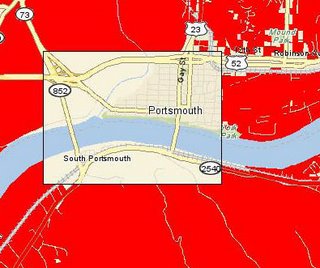
Map showing one mile distance between Perkins and Grant Bridges.

If the 38 million was not spent to save motorists a couple of minutes and a couple of miles driving on Rte. 23, then who or what was it spent for? The answer is the 38 million was spent to help revive Portsmouth’s depressed downtown district. That’s in addition to the millions that had already been spent for that purpose. The unfortunate truth is downtown Portsmouth died about a quarter of a century ago, and misguided politicians and Portsmouth con artists posing as community leaders have been claiming to have a plan to revive it ever since. The advocates of downtown Portsmouth are like those operators who were still milking the Missing in Action movement twenty years after the Vietnam War. The Marting scam would not have been possible without the Save the Downtown mentality, as if the downtown and the downtown alone was the key to the city’s salvation. When the industrial base of the Portsmouth area began disappearing a half century ago, many of the retail and commercial businesses in downtown Portsmouth that served and prospered from that industrial base, began to close shop. Even before the old Grant Bridge closed in 2001, downtown Portsmouth was in bad shape. Yes, the closing of the old Grant Bridge made a bad situation worse, but the spending of 38 million dollars to return to 2001 hardly seems a wise investment. “I would like to see all the buildings up and down Chillicothe Street occupied like they used to be when I came to Portsmouth in 1947,” an elderly Portsmouth resident told the Portsmouth Daily Times on the Bridge Day celebration. It ain’t going to happen, lady.

Insulting Consulting

According to the Oct. 18 Daily Times, we have yet another publicly funded study being done on how best to revive downtown Portsmouth. “Oh, my god!” a longtime resident of Portsmouth exclaimed on hearing about the study. “Not another one!” Having established that it is incapable of coming up with any solutions to the downtown Portsmouth problem on its own, the city government regularly insults the intelligence of the taxpayers by bringing in these so-called experts to do a study. The latest study is being conducted by a Cincinnati consulting firm, Edwards and Kelcey, whose fee is being paid in part by the city government, which is providing $23,000. More pork! If all the money spent on all the studies of downtown done in the last half century were put in a pot, the city would have enough to put a new roof on the leaking Municipal Building and have enough left over to provide Mayor Kalb with the luxury SUV he feels a man in his position should have. How can we take seriously any out-of-town consulting firm that knows so little about Portsmouth as to hold its initial public meeting in what is known unaffectionately locally as the UnWelcome Center. The UnWelcome Center is just another Portsmouth pork project that houses the offices of the Chamber of Commerce and the SOGP, Portsmouth's axis of evil, which has a stranglehold on the city. Not that the consulting firm had much choice. Folks at the the SOGP are probably behind this “study,” just as they were behind the Marting scam. And how can we take seriously a consulting firm that comes up with a gimmick of audience participation.

Those who attended the charade at the UnWelcome Center were encouraged to play the equivalent of pin-the-tail-on-the donkey, which would be more appropriate in a grade school than at a meeting of adults. The Edwards and Kelcey people put up a list of possible solutions to downtown Portsmouth on the wall, and those in the audience were invited to put red stickers on solutions they liked best. This is democracy at work, you see. But absent from the list of solutions was the most important one of all: Get Rid of the Goddamn SOGP! We ended up paying 38 million bucks for a bridge to revive downtown Portsmouth, and now we have to pay thousands of more public dollars to yet another consulting firm for yet another study on how to revive downtown Portsmouth. Why do we have so much faith in outside consultants anway? Do we assume they’re smarter than us because they don’t live and work in Portsmouth? What is an outside consultant after all if not somebody you pay to pick your pocket to tell you how much money you don't have?

Downtown Portsmouth is the Terri Schiavo of South Central Ohio. It has been on life-support for so long that not even Senator Frist would deny that it is in a persistent vegetative state. And when you consider the level of intelligence of the politicians in the Municipal Building, you could also say downtown Portsmouth is brain-dead. Any community planners with sense would see that any attempt to revive downtown Portsmouth as a retail and commercial center, as it was in the 1940s, is suffering from pernicious nostalgia. All the pork projects in the world, including a 38 million dollar bridge, or an 8 million scam project like the Marting building, is not going to bring back downtown Portsmouth. Not bring it back to anywhere near what it was anyway. A few years ago, Adelphia Cable (since absorbed by Time-Warner) moved its offices from downtown to the uptown Viaduct area, which is where Verizon later moved its downtown offices. And the Fifth/Third Bank is reportedly going to move out of its present downtown offices on Chillicothe St. If the few remaining corporate businesses are moving out of downtown, what do you think of our chances of getting others to move in? The overseers of these businesses are not brain dead. They know that downtown Portsmouth is a graveyard and buildings left behind, like the Marting building, are tombstones testifying to that fact. They know that building a 38 million dollar bridge to a graveyard doesn’t raise the dead. They know that downtowns are no longer the place to do business, at least not business as we know it. They know you don't make fire by rubbing two wet noodles together.

Not just downtown but all of Portsmouth is going to have to reinvent itself. Massive changes in industries, cities, and roads and transportation have taken place in the last half century. Portsmouth, along with the rest of America, is drastically different from what it was back then. American know-how was been replaced by American no-how, American enterprise by American porkbarreling. Those antique cars that were part of the Bridge Day parade could be accommodated in the old downtown Portsmouth. But vehicles are bigger and there are millions more of them. Half of downtown Portsmouth would have to be razed to accommodate the cars that a large shopping might attract, and I emphasize might. A shopping mall has been Portsmouth’s pipedream for a quarter of a century.

Gambling on the Future

What a few wheeling and dealing developers, lawyers and politicians are counting on is casino gambling coming to Ohio and Portsmouth. As long as we are fed and continue to swallow the line that downtown Portsmouth can be revived like it was in the 1940s, that we can go forward to the past, the more likely is it that gambling is in our future. That’s the future they’re counting on. If you build casinos, they will come. Millions of dollars would be pumped into the local economy. But at what cost? The human hazardous waste gambling generates gets buried in the local community in the form of increased crime, corruption, drug abuse, divorce, and suicide rates. Already one of the most corrupt and crime-ridden cities in Ohio, Portsmouth would become Sodom-on-the-Ohio, utterly degraded by gambling dollars, which there will not be as many of as promoters promise but enough to create more serious social problems. Considering what a problem drugs and prostitution now are in Portsmouth, what will they be like with gambling money flowing like crack through the veins of the local economy? Gambling addicts, whose numbers are estimated by pro-gambling sources at 1% and by gambling opponents at 5%, will be a problem far beyond the 1 to 5%, because families, relatives, and employers are affected. It is called the ripple effect.

I grew up in Revere, Massachusetts, when it was known as “The Gambling Capital of New England,” so I am not basing what I say on some outside consultant’s study of the effects of gambling on Portsmouth, although we are going to get those studies, rest assured, studies probably paid for by gambling interests, studies that will say yes, there may be problems, but the overall effects of gambling are positive. The toxic effects of gambling are not limited to the casinos and the gamblers. Gambling is like mercury poisoning and PCB’s. Gambling contaminates whole communities – the political, social, and spiritual environment. The American dream of succeeding through hard work and honesty is replaced by the dream of instantly striking it rich. Life becomes a lottery. People dream about lucky numbers or combinations to play. If gambling comes, our current mayor will no longer have to drive across the river to gamble in the economy model city car he’s ashamed of. He can do his gambling in Portsmouth.

The indirect influence of gambling has been observable in Portsmouth for the last fifteen years. The deliberate neglect of the Municipal Building and the calls to tear it down are indirectly related to gambling. A developer has wanted that land for gambling-related purposes for a number of years. The longer we fall for the “forward to the past” line, the more likely we are going to wind up tearing down the Municipal Building and replacing it with a casino. Then adults will really be playing games, and it won’t be the pin-the-tail-on-the-donkey variety.

Bridge to the Future

One thing that we might do is try to change Portsmouth politically, and see if political changes might help the economy. Lee Scott believes getting rid of the city charter might work wonders. I think what needs improving is the quality of the people who gravitate toward city government. It is too much to expect that the best and the brightest would want to get involved in city government, but do we have to settle for the worst and the dumbest, who become pawns in the hands of the richest and the slickest? Shawnee State University could be one institution to help raise the intellectual and ethical level of local government. Employees at the university and the students and faculty in particular have to care about and get involved more with Portsmouth politically.

Little did the richest and slickest realize when they lobbied for a university what the consequences would be, because along with those millions of pork dollars that were pumped into the community came also students and faculty, who are not as easy to bamboozle as the general public. The Shawnee Sentinel was the creation of Shawnee State students, and since the paper first appeared back in the mid-1990s, news reporting in Portsmouth has not been the same. The appalling level of incompetence and dishonesty in local politics has been the main focus of the Shawnee Sentinel, but that newspaper arose in spite of harassment from the administration and from university lawyer, Stephen P. Donohue in particular.

The sick condition of Portsmouth’s economy and the corruption in government is a scandal that the university, a public institution, is ethically obligated to do something about. It should not be left to outside consultants who have no roots or stake in the city. In Athens, faculty members from Ohio University have actually served on the city council. Imagine having somebody connected with the university be mayor of Portsmouth instead of having men who never amounted to anything, like the present and former mayor? There should be some interdisciplinary program or institute established at SSU that directly relates to the political and economic affairs of Portsmouth. But the university is not likely to make much of a difference in the quality of life in Portsmouth without major changes first taking place there, which is unlikely since it is now controlled, like most things in town, by the SOGP, acting through the Board of Trustees. As long as trustees like George L. Davis III, George Clayton and the current trustee chair Kay Reynolds are in control of the university, and as long as Stephen P. Donohue is the Vice President of Everything and de facto SSU president, no constructive changes are likely to take place at SSU. However, with a former dedicated instructor at SSU in the governor’s office, perhaps something can be done about SSU, if only through the trustees he will have the opportunity to appoint.

SSU developed a terrible reputation over the last twenty years, when it was treated locally as another publicly funded pork project, another public feeding trough. The number of land scams and housing shenanigans that took place as the university expanded should be the study of a dissertation someday. We saw what happened to the one president of SSU, James P. Chapman, who was not a tool of the SOGP and who began to make a difference. People with a little more education, vision, and ethics, who are not lapdogs for local multimillionaires, could help build our bridge to the future. And is it too much to hope that that education bridge will not continue to be a pork project, costing hundreds of millions of dollars without taking the city anywhere? Is it too much to hope that someday somebody who is not the equivalent of C.J. Mahan will be in charge of building our bridge to the future, and that somebody other than a consulting firm of Edwards and Kelcey’s ilk will be offering us advice on how to proceed instead of inviting us to pin-the-tail-on-the-donkey, as if we were all, like those politicians in the Municipal Building, jackasses?

Dramatic political changes may take place after November 7 at both the state and national levels. Kevin Tillman, brother of former pro football player Pat Tillman, has published an extraordinary indictment of American politicians and policies, titled “After Pat’s Birthday.” “Somehow,” Kevin Tillman wrote, “the same incompetent, narcissistic, virtueless, vacuous, malicious criminals are still in charge of this country.” But is it too much to hope that on November 7 some important political changes might begin to take place not only at the national and state but at the local level as well? The same old virtueless, vacuous, malicious crooks are still in control of Portsmouth, but could their days be numbered?

Friday, October 06, 2006

From Alger to Foley

flagjohns


To compare Mark Foley with Horatio Alger, Jr. is to be reminded that the more things change, the more they stay the same.

If very few people any longer know who Horatio Alger (1832-1899) was, almost everyone now knows who Mark Foley is. Son of an ex-Marine, a Catholic with Boy Scout connections, the Republican congressman from Florida resigned recently after it was revealed he had sent lewd emails to congressional pages. He reportedly engaged in mutual masturbation online with a page while waiting to vote on an authorization funding bill for Operation Iraqi Freedom. His case illustrates not only how sleazy politicians can be but also how hypocritical, because he was the point man in the Republican family values oriented campaign to stop perverts from preying on children on the internet. And he almost got away with it. The parents of the first boy whose case had come to light wanted the matter dropped to save the boy from embarrassment.

After Foley was exposed as a sexual predator, some wag ridiculed the Republican campaign he spearheaded with the slogan “No child’s behind left behind.” But in most of the news reports and in all the public emails that I have read no distinction is made between pedophiles and pederasts. You would think a nation alarmed about sexual abuse and determined to stop it would know a little more about the subject.

Foley has often incorrectly been called a pedophile, but he is a pederast or an adult male who is sexually attracted to adolescent males. An adolescent is someone who has reached puberty, someone who has acquired secondary sexual characteristics and is capable of sexual reproduction. A child is someone who has not acquired secondary sexual characteristics and has not reached puberty and adolescence. Adult males who are sexually attracted to children are pedophiles. Foley is a pederast, not a pedophile. The sixteen-year-old pages he pursued on-line were adolescents, not yet men but no longer children. Some states recognize sixteen-year-olds as having reached the age of consent, so sexual relations with them, however reprehensible, is not always illegal. Making contact with them and soliciting sex from them on the internet could be, however, and that may be what Foley gets nailed on. Ironically, Foley was the politician who made a name for himself in Republican politics by proclaiming that the law should show no mercy to such predators.

The failure to understand the difference between pedophilia and pederasty is a failure to understand why some men are a menace when they around children and others, like Foley, are a menace when they are around adolescents. Foley loved being around adolescent males, and a corps of sixteen-year-old male pages apparently sent him over the edge. Nobody in the last ten years paid more attention to congressional male pages than Foley and nobody showered them with more praise. As each class of pages graduated, he was heartbroken. Footage of him getting choked up at a graduation exercise is part of the stock footage being shown over and over on television. But his love of pages was anything but fatherly or platonic. His tears were not necessarily a crock, but he gives a whole new meaning to wanting to take the measure of boys before they are men.

Horatio Alger, Jr. was the son of a preacher. He was born in 1832 in what was then known as Chelsea but is now known as Revere, Massachusetts. This is the city I grew up in and am now writing a history of. Alger, Jr. went to Harvard, as his father had done. (The likeness I have included here is his Harvard graduation photo.) Again, like his father, Alger became a Unitarian minister. The first pulpit he occupied was in the town of Brewster, Massachusetts, on Cape Cod. A young bachelor, Alger, Jr. spent lots of time with the boys of his parish. It was not quality time, though, for before long very disturbing rumors circulated about his relationships with a few of the boys. It was whispered that the new young pastor had committed unspeakable sexual acts with them. Called before an ad hoc church committee, which questioned him about these rumors, the tight-lipped Alger neither admitted nor denied the rumors were true. He confessed only to having been “imprudent.” Not long afterwards, he slipped out of town. The church complained bitterly to the Unitarian headquarters, in Boston. A deal was struck whereby Alger would not be exposed or prosecuted if he promised never again to serve as a minister. So, to protect the abused boys from further trauma, which prosecuting Alger would have entailed, the whole sordid business was hushed up.

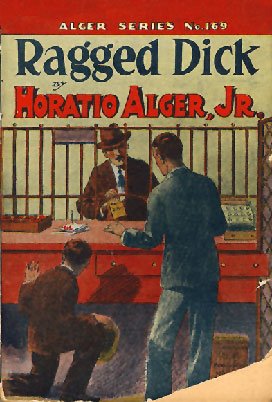
Unofficially defrocked, Alger moved to Manhattan and began a career writing uplifting dime novels about boys who work themselves up from poverty to success, novels with names like Strive and Succeed and Sink or Swim. Alger became one of the most popular authors in the U.S., and his name became synonymous with the rags-to-riches version of the American dream. His name became synonymous with capitalism, which is preumably why Michael Moore has a chapter in Where’s My County Dude? called “Horatio Alger Must Die.” In Ragged Dick, the novel that brought Alger recognition, he editorialized, “Now, in the boot-blacking business, as in the higher avocations, the same rule prevails, that energy and industry are rewarded, and indolence suffers.” Since Alger’s pederasty had been kept secret, when he began befriending newsboys and bootblacks of Manhattan, nobody suspected anything. He was viewed as a saintly faith-based benefactor of homeless and orphaned boys. Because of the self-help message his novels presented, he became after his death, in 1899, kind of saintly icon of laissez-faire capitalism. After the Second World War, the Horatio Alger Association was founded in New York City, to promote the conservative Republican values Alger’s young heroes were believed to have exemplified. Alger Awards, or “Horatios,” were given annually to Americans who had overcome adversity to achieve success through perseverance and hard work.

In 1971, Richard Huber published a book, The American Idea of Success, in which he revealed publicly for the first time the charges against Alger in Brewster. After Huber outed Alger, a right-wing Republican columnist Medford Evans, writing in the John Birch magazine Public Opinion, denounced the revelation as a liberal slander, as “totally unproven allegations against a man of blameless life.” The Horatio Alger Association of Distinguished Americans, as it now calls itself, ignored Huber’s embarrassing revelation, and as far as I know has never acknowledged that Alger was a pederast. Many famous Americans, most of them Republicans, have been recipients of Alger Awards. Before he became an infamous figure in the Enron scandal, Ken Lay won an Alger Award in 1998. The Alger Association even had the chutzpah to establish an award for those who achieved success in spite of having been sexually molested in their youth! If I recall correctly, Oprah was the recipient of this award.

Another group, the Horatio Alger Society, was formed in the Midwest in 1961. I wrote an article in Bootblack Magazine (July-Aug 1989) about this group, which was founded by a religious mailman from Kalamazoo, Michigan. The Horatio Alger Society had many of the characteristics of a religious cult, of which Alger was the prophet. The mailman knew of Alger’s molestation of boys, but he was in denial and kept that knowledge from members of the society, some of whom idolized Alger, but others of whom, aware of the pederastic elements in Alger’s novels, collected them and figurines of bootblacks and newsboys as erotic art objects. I also published, again in Bootblack (Nov-Dec. 1991), copies of which are in the Shawnee State library, an article “Horatio Alger: the Art of Pederasty,” showing how Alger’s sexual interest in boys found expression in novels like Cast Upon the Breakers, especially in the relations among boys and between boys and older males, and indirectly through symbols and symbolic action. The pederastic pleasure Foley found explicitly in emailing Congressional pages Alger perhaps got more prudently in writing some hundred so-called “wholesome” novels about boys.

Liberal Democrats can be pederasts. There was the creepy Massachusetts Congressman Gerry Studds, who was involved sexually with a 17-year-old page. But the tradition of conservative Republican sexual predation runs deep, if silently, and in terms of hypocrisy and cynicism, has no parallel. Gerry Studds did not wrap himself in Family Values. From Horatio Alger to Mark Foley, the Republicans have been the hypocritical party of Grand Old Perverts. The more things change, the more they stay the same.

I recommend the following article, “Republican Hypocrisy Revealed,” in the following blog: http://www.armchairsubversive.com/

Saturday, September 23, 2006

Portsmouth and Chillicothe: Twin Cities?


     Portsmouth and Chillicothe have a number of similarities. Both are medium-sized cities with about the same populations (in 2000, Portsmouth had 20,909, Chillicothe 21,796 residents). Both cities are county seats, Portsmouth of Scioto County and Chillicothe of Ross County. Both cities are located in a so-called rust belt state and both have seen better days. A manufacturing city and railroad hub, Portsmouth boasted of having the biggest shoe factories and largest railroad yards in the country. Portsmouth also touted a population of some 60,000, and at about that same time, seventy-five years ago, it had an NFL team, the Portsmouth Spartans. The center of an agricultural region, Chillicothe has a rich political heritage, and was twice the capital of Ohio, and before that the capital of the eastern part of the Northwest Territories. Both Portsmouth and Chillicothe have Mexican sister cities. Both have a mayor-council form of government, and both have tried and abandoned the city manager form of government. Both cities are trying to figure out how best to deal with the problems of the twenty-first century.
     One of the problems both cities are trying to deal with is what to do with the older buildings that house their city governments. The decision both city governments have to make is whether to renovate their present city building, convert another building, or build a new building from scratch. Because this issue is so timely and so important, I will devote a whole article to it in my next posting.
Differences
     If these are some of the similarities between Portsmouth and Chillicothe, what are some of the differences? To start with, in 2000, the median income for households in Portsmouth was $23,004, and the median income for households in Chillicothe $33,991. The household income in Portsmouth is more than a third less than it is in Chillicothe. That is a whopping discrepancy. As of July 2006, Scioto County, with a 7.3 percent unemployment rate, ranked 6th highest among Ohio’s 88 counties, and Ross County, with a 5.9 rate, ranked 30th. Ohio’s unemployment rate in July 2006 was 5.8 percent, so Ross County was about at the state average, while Scioto was about 1.5 above average. Studies have shown how crime, spousal abuse, divorce, and suicide rates rise alarmingly with each percentage point increase in the unemployment rate, which may explain why the social fabric in Portsmouth has become so frayed in the last half century as the economy of the river city has steadily gotten worse. Yes, Portsmouth once had a professional football team, but the Spartans have long since migrated to Detroit, where they were renamed the Lions. Portsmouth’s entry into a bush league, the Portsmouth Explorers, folded after a couple of seasons while the Chillicothe Paints are still going strong.
Call it architectural consciousness, call it respect for tradition, call it whatever you want. Chillicothe has it, Portsmouth doesn’t. Chillicothe has saved its old city hall, built in 1874 and restored in 1957; the county courthouse (see inset) in historic downtown Chillicothe is currently conscientiously being restored. Downtown Chillicothe is an architectural treasure. Many of the most historic and beautiful buildings in Portsmouth have been torn down, while millions of dollars of public money has been poured into saving worthless ugly old department stores and former car dealerships (the Adelphia building) simply because they are owned by people with pull who have come to expect the government to bail them out. Every day I drive by the new county jail, smack in the middle of Portsmouth, with glistening razor barb wire, and I think of the magnificent railroad terminal that had been torn down to make way for the jail. As if there wasn’t empty land in the county for a new jail. If only Clayton Johnson or Neal Hatcher had had some financial interest in the terminal, then it probably would have been saved.
Comparing Crime in Portsmouth and Chillicothe
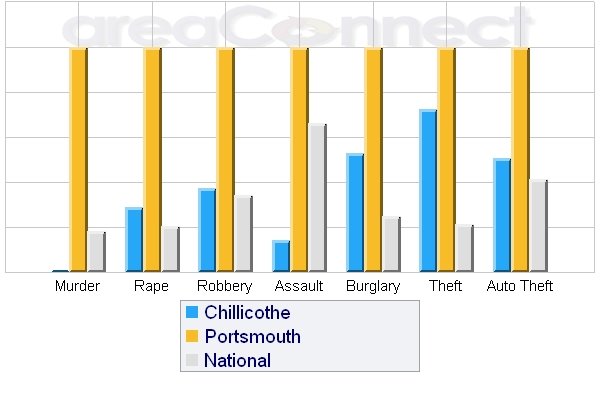
     Even more than family income and unemployment statistics, even more than minor league baseball, even more than architecture, the contrasting crime rates in the two cities show that though they are only an hour’s drive from each other, Portsmouth and Chillicothe are otherwise worlds apart. The following chart shows how they compare with each other and with the nation in terms of crime:
     Not surprisingly, given Portsmouth’s high crime rate, political corruption has been a problem for at least the last half century. A sentence in the online Wikipedia Encyclopedia says, “Portsmouth has not been immune to political corruption.” What an understatement. Not only has Portsmouth not been immune to political corruption, it has been plagued by it. Mainly through an agency called the Southern Ohio Growth Partnership (SOGP), a small clique controls Portsmouth. Though they have never held public office, two individuals in the clique, working as a team, the lawyer Clayton Johnson and the realtor-developer Neal Hatcher, dominate the politics of Portsmouth. They are a bipartisan team. Johnson is a Republican and Hatcher works both sides of the political street.
Tripping Out
    Several months ago, on a beautiful summer day, Thursday July 6th to be exact, three senior citizens from Portsmouth drove up to Chillicothe, which is about an hour to the north. Route 23, the highway they drove up on, is the road that the Columbus Dispatch called the drug pipeline between the state capital and Portsmouth, the road on which not too long ago the young “stenographer” of Portsmouth City Councilman Mike Mearan was busted for possessing drugs while driving in a car rented by Mearan. Portsmouth is a city plagued by drugs, prostitution, unemployment, and political corruption, and so is a good place to get away from, if only for a day. The three seniors were Austin Leedom, who had worked as a deputy sheriff in Chillicothe some years ago; Richard Noel, who had been to Chillicothe a number of times for various reasons, including on business for the State of Ohio; and yours truly, a retired college professor who had been to Chillicothe at most a half dozen times in fifteen years but only to shop in the mall or on the outskirts of the city. 
     We were going to Chillicothe because all three of us are active in the political reform movement in Portsmouth and are members of the Concerned Citizens Group. We wanted to get a first-hand view of Chillicothe, what condition it was in and how its government operated. Before I visited Chillicothe, I had no impressions or preconceived notions about it. I knew little about Chillicothe’s past, except that it had been the state capital in the old days. I knew even less about its present condition. It was just the city with the curious name that I had driven by many times on my way to and from Columbus.
     We hadn’t arranged any meetings in Chillicothe. We wanted to see how three strangers seeking information would be dealt with. We wanted to see what the spontaneous answers of people in the city government would be to our questions. But we began with the Chamber of Commerce. Because of my experiences with the Portsmouth Chamber of Commerce, which I now think of as the equivalent of a Mafia “social club,” I would not have made Chillicothe’s chamber of commerce our first stop, but Austin Leedom led us straight to the Ross County-Chillicothe Visitors Center, which shares space with the Chamber of Commerce on East Main St. We got direct answers to a number of questions. There was none of the narrow-eyed suspicion I was familiar with at the Portsmouth Chamber of Commerce.
     From the Chamber of Commerce, we went to the Chillicothe Administration Building, on Paint St. The building looked very inadequate for a city its size. It doesn’t look like a city hall. It looks makeshift and temporary. When you enter, it seems cramped. But in contrast to the Portsmouth Municipal Building, everybody we talked to seemed alert and helpful. We were not in the Administration Building a few minutes before we all three had the sense we were not only in another city – we were on another planet. We couldn’t believe it. Were we dreaming? All three of us were used to the gloomy atmosphere and paranoia of those in Portsmouth’s Municipal Building, where because of a tradition of political corruption and a bad press, a bunker mentality seems to prevail. By contrast, in Chillicothe’s Administration Building, everybody seemed open and helpful.
Chillicothe Mayor
     The openness about budget matters was a big surprise. We were used to the budget being considered a secret, like the formula for Coke or for a Masonic ritual. A copy of the Chillicothe budget was always available on a table outside the auditor’s office. You didn’t even have to ask for it, and get the runaround, as you do in Portsmouth. We talked to the city auditor, William Morrissey, a Republican, and also to Mayor Joseph Sulzer (shown here), a Democrat, both of whom have the education and experience, not to mention intelligence and articulateness, to justify the important positions they held. In Portsmouth, unfortunately, it seems that it is mainly the unsuccessful, the unscrupulous, and the un-indicted who gravitate toward city government.
     Austin returned to Chillicothe on July 10th, just four days after our July 6th visit, to attend a Chillicothe city council meeting. He told me that while there was debate and differences of opinions expressed at the council meeting, it was much more businesslike and non-confrontational than Portsmouth’s council meetings. It was all very professional, he told me, and so were the members of the Chillicothe City Council, including council President Robert Shoultz. Austin told me he talked afterwards to Shoultz about the two-year terms for council members. Chillicothe council members have two-year terms, Portsmouth city council members four-year terms. Portsmouth Council President Howard Baughman thought anything less that four years would create chaos, because, he said, it takes at least four years for council members to learn the ropes. Shoultz thought two-year terms made more sense, because voters could get rid of a council member by going to the polls every two years. They didn’t have to resort to the costly and troublesome recall process that is the alternative under the four-year system.
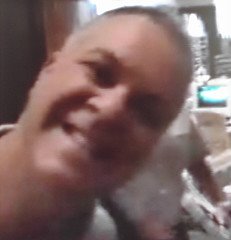
     I figured I would see the Chillicothe City Council in action for myself, so I drove up for the Monday September 25th meeting. Austin was right. For anyone used to city council meetings in Portsmouth, it was hard to believe. I got there early, almost a half hour before the meeting, but most members of the city government were already in the chamber, some in their seats. In Portsmouth, prior to the city council meeting, members usually meet for a half hour behind closed doors in the adjoining office of City Clerk Jo Ann Aeh, who was once officially found guilty by the state of mutilating recall petitions. The little get-togethers in her office beforehand are the real meetings, where deals are struck and strategies devised. Only councilman Bob Mollette will not take part in these closed-door shenanigans. When videographer Joe Ferguson opened the closed door and tried to take footage of one of these rump meetings, councilman Marty Mohr defiantly mugged for Joe’s camera (see insert), with Council President Howard Baughman smirking in the background, providing us with a candid, unscripted example of the real attitude of most Portsmouth politicians toward the voters. Incidentally, Mohr is the same councilman who nearly caused a riot at one meeting when he angrily denounced people in the audience as being “crap” for spreading rumors on the internet about his alleged adulterous behavior.
“Take Me to Your Leader”
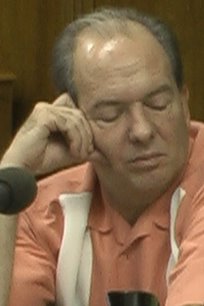
     I asked Austin Leedom recently if he had to sum up his overall impression of Chillicothe in one word, what would it be. He said, “Openness!” When I compare the secretiveness and skullduggery of Portsmouth’s city government with the openness of Chillicothe’s, I am embarrassed for our city. To compare just the mayors of the two cities is to see why, as I said earlier, we felt not just that we were in another city but that we were on another planet. If a spaceship landed in Portsmouth and aliens told me, “Take us to your leader,” I might have to tell them, “I’m sorry. He isn’t here. He just drove over to Kentucky in his city car to buy lottery tickets.” I couldn’t possibly begin to make the aliens understand how uncomfortable Portsmouth's mayor Jim Kalb (shown here) felt driving to Kentucky in his little economy city car because what a public official of his importance should be driving is a new S.U.V. That's what he said at a council meeting.
     What my recent visits to Chillicothe did for me was serve as a reminder that what is going on in Portsmouth and Washington D.C. is not what’s going on everywhere else in the country. That Chillicothe is not perfect goes without saying. I know there are citizens who disagree with some policies and actions of their city government. But corruption, incompetence, and pork barreling have not become the norm in Chillicothe, as they have in Portsmouth. The two cities are alike in many ways, like twins, municipally speaking, but Portsmouth is the evil twin. City government in Chillicothe is of, by, and for the people, but in Portsmouth city government is of, by, and for a clique of crooks. By following Chillicothe’s example, Portsmouth could begin to climb out of the pit that it has dug itself into in the last half century, but not as long as it is controlled by crooks.


Tuesday, August 29, 2006

Political Puppets of Portsmouth

feldpuppet

Portsmouth Political Puppets, 1980:
Not much has changed.


Though I am still involved with another web project, I want to take a break and report on the shenanigans of the recently appointed City Building Committee.

I will summarize my report in ten points.

1. The citizens of Portsmouth have got problems, many problems in the city government. The latest is the City Building Committee (CBC). The first problem is that CBC thinks it’s the Portsmouth City Council. Imagine a gerbil that thinks it can fly, or a Chevrolet Aveo that thinks it’s a Cadillac Escalade. Maybe that’s what happens when two aspiring politicians, who wanted to be appointed to replace Tim Loper on the city council – Kevin Johnson, an antiques dealer, and James Robinson, a pawn broker – end up getting appointed instead to the City Building Committee. Instead of focusing on making a recommendation on a city building, the CBC is spinning its wheels all over the place. It is out of control, like a Chevrolet Avio with a driver high on Oxycontin. Too much time has been spent at CBC meetings on “marketing.” Marketing is not what the CBC should concern itself with, but antiques dealer Johnson considers himself a marketing guru, and he has turned the CBC into a marketing committee. The marketing of downtown Portsmouth and the marketing of the Marting’s building may be something that should be done, but the CBC is not the committee to be doing it. The CBC is definitely not the City Council and it is definitely not a marketing committee. IT IS A BUILDING COMMITTEE. But if the committee is confused, is it any wonder? Consider that in the charge that the not-too-bright president of City Council Howard Baughman gave to the CBC, he included the recommendation that they “look at and review any and all things . . .” ANY AND ALL THINGS! And that’s just what marketing guru Johnson is leading the CBC to do. At the 8-7-06 meeting of the CBC, Johnson presented a plan for the “Marketing of Marting’s Building.” That plan included the proposal to “Establish a business and community involved committee or sub-committee to develop a marketing plan which is to include finance options for encouraging a national or regional retail establishment to utilize the Marting’s Building.” So right off the bat Johnson proposed the CBC create a sub-committee to market the Marting building. The problem with Johnson’s proposal was that Mayor Kalb is still trying to make the Marting building the new city building. Just because the voters of Portsmouth recalled former mayor Bauer and two other members of city council because they tried to foist the Marting building on the city, and just because the voters as recently as last May soundly rejected a referendum to convert the Marting building into a new city building, Mayor Kalb has not given up trying to pull Clayton Johnson’s old chestnut of a building out the fire. All the voters in the world could not deter Kalb from his appointed task, which is to arrange a shot-gun wedding of the city to the old-maid Marting building. Kevin Johnson apparently didn't understand that, even though he was a strong supporter of Kalb in the mayoral race and even though he probably would not have been appointed to the CBC without Kalb’s support.

2. So Kevin Johnson, having unwittingly stepped on the toes of the gent who brought him to the dance, went back to his marketing drawing board. At the 8-28-06 meeting, Johnson proposed the CBC pass a resolution to the effect that the city should try to market not the Marting building but the Marting’s Annex. Now, that’s more like it. That’s all right with Kalb. It’s the Marting building itself that Kalb does not want anybody to market, because he still has hopes of sticking it to the citizens and taxpayers again. Back on Oct. 25, 2005, Jeff Barron wrote a Daily Times front-page story titled, “Marting’s Fate in Voter’s Hands.” Barron was wrong again. The fate of the Marting’s building is not in the voters’ hands. It is in the hands of the City Council and Mayor Kalb, and they have shown their customary contempt for that strong majority of voters who decided the city should not convert the Marting building into a city building. The CBC is a puppet committee created by the City Council to get around the voters.

3. The City Building Committee at the 8-28-06 meeting also passed a resolution on the Adelphia building. Members of the CBC have already made a visit to the Adelphia building, and Kevin Johnson gave a strong endorsement on converting the building to a new police station. The CBC should not be passing resolutions or making a decision on the Adelphia building until it considers all possible sites for the new city building. Why should it tie its hands on a possible site for a new city building by making a commitment on where the police station is going to be? Maybe there’s a site or plan where the police and city offices could be together. At the present time, the Adelphia building is the tail wagging the dog, just as Clayton Johnson is the tail wagging the city.

4. The reason the City Building Committee is making the Adelphia building a high priority is because the chairman of the CBC, Mike Mearan, in 2005 negotiated a deal whereby his client Dr. Singer, the absentee tax-defaulting Los Angeles landlord, unloaded that building on the city, just as Clayton Johnson unloaded the Marting building on the city. Unless the Adelphia building is used by the city for some public purpose, such as a police station, Singer will lose out on his tax write-off scheme. According to Portsmouth City Council minutes (3-14-05), “Mr. Mearan said that in order for Dr. Singer to take advantage of certain IRS regulations the City could not sell or lease the building because that would set a value on the property and would restrict the amount Mr. Singer can claim as a donation to the City. Mr. Mearan stated that with the understanding that the City would accept the property and use it for City purposes [emphasis added], with a restriction of ten years, after which if the City wants to get rid of the building or do whatever they want with the building they could do so.” After ten years, the city can shove the Adelphia building, as far as Singer is concerned, because by then he would have gotten his full write-off from the I.R.S. One of the reasons Mearan is chairing the CBC is obvious. He is going to make sure that the Adelphia deal with the city is consummated and that the building is used for “City purposes” so that Dr. Singer will be able to get the maximum write-off on the building. Mearan is involved in a conflict of interest in even being on the CBC, never mind chairing it. Mearan declared at the beginning of the 8-7-06 CBC meeting that though he was Singer’s lawyer on the Adelphia building, he was not in a conflict of interest. But then, at the 8-28-06 CBC meeting, Mearan abstained from voting on the Adelphia resolution. Why would he abstain if he is not in a possible conflict of interest? Perhaps he did not remember that he had declared at the 8-7-06 CBC meeting that his being on the committee was not a conflict of interest. Since Mearan’s young stenographer Heather Hren was busted in Waverly in July for the possession of illegal Oxycontin while riding in a Chevrolet Aveo Mearan had rented for her, she is no longer taking notes at CBC meetings. Mearan himself was taking notes at the 8-28-06 meeting, so he may be having trouble keeping things straight.

5. It is clear from the 8-28-06 meeting of the City Building Committee that Johnson and Robinson are now on board with Mearan and Kalb when it comes to tearing down the present Municipal Building. The CBC passed a resolution calling for the city to make a feasibility study of the Municipal Building, but even before that feasibility study has been done, Robinson made it clear where he now stands on the Municipal Building. He mocked Emily Gulker, accusing her of wanting to save the building and “turn it into a museum.” He turned around and looked up contemptuously at the leaking corner of the council chambers. That leaking corner is the running sore of the Municipal Building that the city government has been using as an advertisement for years to make the case that the building is falling down and beyond repair and every city office should move out as soon as possible if not sooner. If the Municipal Building is now a hazard, it is because puppet Portsmouth politicians like Kalb have deliberately let it deteriorate. At the 8-28-06 CBC meeting, Kevin Johnson made the ridiculous argument that the Portsmouth of 1934 was like a family with one child, but the Portsmouth of now is like a family with ten children, so how can a family with ten children possibly fit in the same house they were living in when there was only one child. What bullshit! Portsmouth had more than twice the population in 1934 than it does now. (In the flyer below, see how Portsmouth was marketed in 1936.) The U.S. Post Office building on Gay Street was built in 1935, a year after the Municipal building, and of the same material and in the same style. The Post Office is in great shape and is probably handling tons more mail annually and has lots more employees than it did back in 1935. The difference between the two buildings is that Portsmouth politicians have control of and have deliberately neglected the Municipal Building while federal officials have over the years taken care of the Post Office.

ptowngrowth
The Portsmouth the Municipal Building was
serving two years after it was erected.

6. At the 8-28-06 City Building Committee meeting, Kevin Johnson spoke patronizingly of those who claim that some developer wants the land on which the Municipal Building rests. He said he’s been in Portsmouth for four years, but he never heard anyone say such a thing. Four years! As long as that? If Kevin Johnson never heard it, then it must never have been said. Is that what we are supposed to believe? Johnson’s learning curve must be similar to Howard Baughman’s, and his powers of perception about on a par with Mr. Magoo’s. In the last four years, Mayor Kalb has said publicly, at least twice, that the land under the Municipal Building is worth much more if it is developed commercially than if it is used for public purposes, and he has said publicly that there was a developer who was interested in that land. The Portsmouth Daily Times (8-12-98) reported the same thing: “Portsmouth City Council voted 4-2 Monday night to authorize the preparation of legislation to demolish the Municipal Building. The vote was taken in connection with a prospective buyer’s interest in the Second Street property where the building stands” (emphasis added). The Daily Times reported (1-29-97) “Some city planners have suggested that the best use of the property where the city buildings are now located would be for a hotel and conference center” (emphasis added). Because Johnson was a strong supporter of Kalb in the last mayoral race, he should know what Kalb stands for and wants to do. Kalb is trying to reserve the site of the Municipal Building, right next to the bridge and near the river, for a developer in the event that gambling comes to Portsmouth. Kevin Johnson has already made public his support of legalized gambling in Portsmouth. His pro-gambling position was front-page news in the Portsmouth Daily Times (6-28-05). Are there some dots that need to be connected? Read my earlier blog “Slots and Sluts,” in which I responded to Johnson’s endorsement of legalized gambling.

7. The City Building Committee has already decided the Adelphia building will be the new police station. Mearan has seen to that. The only thing the CBC has not already made up its mind about is whether the Marting or the Fifth/Third building is going to be the new city building. Who will win that checker match, Kalb or Mearan? That’s the only important thing we don’t know: Is the CBC going to recommend the Marting building or the Fifth/Third building? The rest is a charade that will go on for many months.

8. Baughman said at the 8-28-06 Portsmouth Council meeting that the City Building Committee was doing a heck of a job. Based on their performance so far on the CBC, Kevin Johnson and James Robinson have a future as Portsmouth puppet politicians. Just as soon as there’s another appointment to be made to the City Council or an opening in the mayor’s office, they’ll be available.

9. As an older generation of Portsmouth politicians retreats, replacements need to be found, including ones who will devote themselves to tearing down the Municipal Building. More than any other Portsmouth politician, City Councilman John Thatcher dedicated himself to tearing down the Municipal Building, both figuratively and literally. It was Thatcher who made the motion at the City Council meeting on 8-10-98 to raze the Municipal Building.
CBC3
CBC members Robinson, Johnson, Kalb

10. Remember that what is at the bottom of all this B.S. from the CBC, is the Portsmouth Commandment that says “No public money will be wasted on a new public building when there is an influential party or parties who own a building that can’t be sold and needs to be unloaded on the public.” If you are not aware of that Commandment, your learning curve is not much better than Baughman’s or Kevin Johnson’s. John Thatcher unloaded his empty unmarketable house on Franklin Boulevard on the state (SSU), which took a $50,000 loss on the deal. That’s nothing compared to the loss taxpayers are probably going to take before Thatcher’s successors, on the City Building Committee, finish their dirty work on behalf of those who pull the strings.

Saturday, July 29, 2006

Au Revoir, River Vices

blogosphere

July 29th , 2006, marks the second anniversary of River Vices. When I began River Vices, I committed myself to a two-year hitch. Now that I have reached the two-year mark, I am going to take a sabbatical to finish another writing project that I have postponed for far too long. I hope to keep River Vices online for old and new visitors.

Au revoir means not goodbye but “till we meet again.” I will try to resume River Vices as soon as possible. I will occasionally republish news stories and other items that I think will be of interest to readers. In the meanwhile I will be active in the Concerned Citizens Group and writing in other forums on a less regular basis. As the name River Vices was meant to suggest, and contrary to what the Chamber of Commerce and the SOGP want us to believe, Portsmouth has been for some time, is now, and will likely continue to be, a corrupt, crime-ridden, economically distressed river city. But there have always been citizens challenging the corrupt status quo, struggling for a better community. I am proud to be one of those citizens and proud of the political and legal victories they have won in the last several years. Electronic communications and blogs especially are a valuable tool in that struggle for a better community . The almost 48,000 visitors to River Vices and the occasional personal expressions of appreciation from Portsmouth citizens have been heartening, and to them I express my gratitude.

Robert Forrey
Portsmouth, Ohio
July 29, 2006

Saturday, July 22, 2006

Tips for Private Tussie


Taps

What tips, if any, about Portsmouth's problems can be derived from Jesse Stuart's
Taps for Private Tussie, a novel about Kentucky hill people published over sixty years ago? Sixty years is a long time in the lifetime of an individual but not in the history of a region or a nation; and the area of Kentucky Stuart fictionalized in Taps is not far from Portsmouth, across the Ohio River. Parts of south-central Appalachian Ohio were and still are Tussie country.

Taps for Private Tussie (1943), which I wrote about in a previous blog, is a great American novel, told in the first person by Private Tussie’s teenage nephew, Sid, who doesn’t know exactly how old he is (somewhere between twelve or fifteen, he figures) or who his father or mother are either. Taps is a coming-of-age novel in which the narrator tries to figure out who he is, both familially and existentially, and what he’s going to do with his life, whether he’s going to be shiftless and ignorant, like most of his male kin, or whether he’s going to get an education, stand on his own feet, and make something of himself.

The underlying conflict in Taps is between the American ideals of hard work, self-reliance, and success, on the one side, and the Appalachian realities of indolence, poverty, and dependency on the other. With satirical irony, Taps for Private Tussie shows how deeply dependent many Appalachians are on the “govinment” that they profess to distrust and even despise.

Taps takes place in the mid-1940s, at the end of the Second World War. The economic boom that accompanied the war had not made much difference to the hill people, the poor whites of the region. Many of them are uneducated and unemployed, and some are still receiving weekly government food allotments, or
“relief,” which had begun during the Great Depression of the 1930s. When the novel begins, the family to which Sid belongs, part of the large Tussie clan, had been on government relief for about a decade. The colorful, unambitious, and shiftless Tussies are good at making music, making moonshine, and making love, especially to their relatives, but they are not much good at making a living.

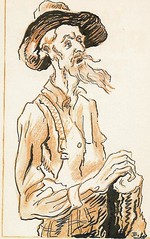
Grandpa
“Works” the System

As a result of political changes that had taken place between 1933 and 1945, the Tussies have split into two camps. The “relief” Tussies, led by the wily patriarch Grandpa “Press” Tussie, had made political compromises with the Democrats, who were in control in Washington and in the county. The pragmatic Grandpa Tussie adjusted his politics and voted accordingly. “‘B-gad, I’s allus a Republican until this relief thing come along,’” he said. “‘It looked like too good a thing to pass us up.’” The other camp was made up of those Tussies who remained at least nominally Republicans. If they had received relief in the 1930s, they were no longer receiving it in 1945.

It should not be assumed that the Republican Tussies had more integrity than the turncoat “relief” Tussies. On the contrary, the argument could be made that they were worse, because their principles and their Republican heritage did not stop them from sponging shamelessly off the “relief” Tussies when the latter came into some money as a result of the death of Private Kim Tussie. When Kim Tussie’s young widow, Aunt Vittie, collected ten thousand dollars from his insurance policy, Grandpa Tussie rented a sixteen-room mansion and soon their Republican kin came knocking. “‘You know the nature of the Tussies,’ Grandma said. ‘When one family has plenty, the kinfolks come to live with ‘em until everything’s gone.’” The Biblical metaphor that Grandma uses to describe the Republican Tussies is appropriate: “locusts.”

None of the Tussies, on relief or not, subscribe to the American ideal of “strive and succeed.” Though the male Tussies tend to be strong as an ox, they would never bear the yoke. There was, for example, “Bert Tussie who could kill a beef with his fist but had never done a day’s work in his life . . .” Though able-bodied, Mott Tussie, Sid’s alcoholic uncle, never worked. Sid says of him, “He’d send me to the woods to find sticks for kindling to start the fire in the coal stove while he lay under the shade of the hickory trees and picked his banjer. Uncle Mott was a good banjer player, so everybody said when he played at the square dances. But everybody said he ought to be a good banjer picker since he hadn’t done a day’s work in his life.”
Though he was strong as a mule, Sid’s grandfather is not much better than his uncle Mott when it comes to work. Except for a period of his youth when he lived in Michigan, where he claimed to have been industrious, Grandpa Tussie viewed work as worse than hoof-and-mouth-disease. Sid says of his grandfather, “I’d seen people come and ask Grandpa to work; but he’d always tell them he was down in his back. He’d tell them that he’d never be able to work. And Grandpa wouldn’t work for anybody. Soon, people quit askin Grandpa to work.” Tobacco picking was one way to earn money, but Grandpa refused. He said he loved to smoke, snuff, and especially chew tobacco, but he refused to pick it. His so-called bad back did not stop him from square dancing all night like a man half his age. He loved to dance, but he hated work and thought anyone who stooped to it was a fool. Sid noticed that when Grandpa and Uncle Mott went to town with their relief sacks to pick up the government grub, they joked about other people working.

The Relief Industry

At the same time that they milk the government, the Tussies are a fiercely independent lot who refuse to be tied down by convention or routine. They are the decayed descendents of a hunting culture where a rifle is a man’s most prized possession. But “strive-and-succeed” America is a land of farming and selling, of learning and earning, of slaving and saving, of getting up and going, but the Tussies stay put like bumps on a log. The only growth industry is government assistance. Even though the Depression was over and the economy had boomed elsewhere in America during the war, the “relief industry” just kept growing in Stuart’s fictional Kentucky county. As Grandpa said, “‘It’s one industry that keeps a-growin right through good times!’”

The Tussie’s independence is a myth of their own creation. They are as independent as parasites. They are willing to live off the larder of those who work and pay taxes. Their only callouses are from carrying their
“relief” sacks. While basking in their sense of independence, they make a career of mooching off the government. The only thing they work is the system, and nobody more cynically than Grandpa Tussie. Even after his daughter-in-law shares her insurance money with him, Grandpa Tussie does not want to give up the weekly government food handout. “‘B’gad, the relief grub is free and we’ll get it . . . I wouldn’t feel at home unless I got it. Been a-gettin it ten years and I’ll get it ten more if I can. That’s the way I feel.’”

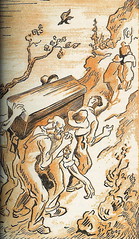
T.S. Eliot’s “The Waste Land,” which deeply influenced several generations of American writers, including Stuart's, presents a dispiriting picture of contemporary life as a dry barren landscape, without faith or hope. Eliot's poem is famous for despairing lines like, “I think we are in rats' alley / Where the dead men lost their bones.” Though it is easy to miss it because of the Swiftean irony in which it is wrapped, the opening chapter of Taps presents Stuart’s version of an Appalachian wasteland. Withered is the key word in the chapter, including Grandpa’s withered cornsilk hair and tobacco-stained beard, the withered grass through which little lizards scamper like lice, and the spiritually withered people, hoping to cash in on Private Tussie's death, who carry what they think are his remains up the hill to the graveyard.

In Kentucky, July, not April, is the cruelest month, as the stench of the remains in Private Tussie's coffin remind Uncle Mott when he steps in to the coal shed just before the funeral. “‘That scent will knock you down,’” he warns Grandpa. What makes T.S. Eliot’s world a wasteland is the lack of religious faith; what makes Stuart’s Appalachia a wasteland is the lack of faith in the American Dream, the refusal of the lazy and intractable Tussies to lift a finger to achieve that dream.

There is another reason in addition to the satire that makes it difficult to see that Stuart’s Appalachia is a wasteland: Stuart is a bit ambivalent about the American dream of strive-and-succeed, just as he is ambivalent about the Tussies. For example, Stuart seems uncertain whether Grandpa’s longing for a piece of land of his own represents the best or the worst side of his character, whether being a landowner is the first stop to independence or the first step to the kind of servitude Thoreau warned against in Walden. Stuart begrudgingly admires the Tussies, he even begrudgingly loves them, perhaps because of their refusal to be emasculated and branded, to be regimented and repressed, or to be pussy-whipped by the American bitch-goddess Success. But at the same time Stuart cannot help being embarrassed and appalled, as only an intelligent, educated, and ambitious native of Appalachia could be, by the Tussies’ anti-social behavior, by their slovenly lack of ambition, by their failure to even begin to measure up to their primary obligation, the obligation that every red-blooded Americans is supposed to feel – the obligation to succeed.

Hail the Unconquering Hero

There is not a shred of patriotism in Taps, which is remarkable considering it was written and published while the war was still going on. The flag on the pole outside the county courthouse is neutralized by the soiled flag that shrouds Private Tussie’s coffin, a flag that Sid thinks of as dead, as dead as the corpse inside the coffin. Kim Tussie was no hero, even though he was given a hero’s funeral. Before he went off to war, he was just another ignorant, no-good Tussie. Sid says, “I remembered Uncle Kim how he used to come home drunk and throw the few pieces of furniture out of the house, break the dishes and winders, break the chairs over the stove and drive Aunt Vittie off. . . . I remember how the Law used to threaten Uncle Kim because he wouldn’t pay his debts and how he’d take to the woods with his pistols when the sheriff would come to get ‘im.”

Though it is a great novel, Taps lacks a resolution to the conflict at the heart of it, the conflict between self-reliance and dependency. After the laziness, incestuous lust, and violence of the first twenty-two chapters of the novel, the last two chapters resort to what was called in Greek drama a deus ex machina, or god from the machine. By some mechanical means, a god descended from the skies to the Greek stage to straighten everything out. The god-from-the-machine in Taps is Private Tussie himself who returns home very much alive and reformed to explain that it wasn’t him they had buried but some other unfortunate solider. We are supposed to believe that the war has civilized him, made him sober, sensitive, and kind – taken the Tussie out of him. It is a kind of miraculous rebirth.

Stuart ends his wasteland novel as a Shakespearean comedy, like All
’s Well that Ends Well, with Kim and his wife Vittie on the final page snuggling up before a fire and presumably living happily ever after, with Kim serving as the father Sid had never had. Kim’s wife Vittie, whom Sid previously had been told was his aunt, was really his mother. She had given birth to Sid out of wedlock before she married Kim. So on both his mother’s and his father’s side (his biological father was middle-class), Sid is not a Tussie, which may be the equivalent of those fantasies children have who wish their parents were not really their parents, as Stuart may have wished at times he was not Appalachian. The ending of Taps is a happy one, but it is more or less stuck on the rest of the novel.

With a combination of nerve and naïvete, Stuart wrote a culturally subversive, politically incorrect novel in the middle of a war. Industriousness, self-reliance, virtue, and godliness – these were the ideological cornerstones of the American nation, and no one better suggest otherwise, especially when a war is being waged. Everyone was supposed to pull together to defeat the evil enemy. No ethnic or racial group was supposed to be portrayed as anything but virtuous and patriotic. In creating the Tussies, Stuart was revealing the dark side of the American dream, if not of human nature; he was showing his own Appalachian kinfolk in as unflattering a light as they had ever been portrayed prior to the war on the radio and in comic strips and movies. But at the end of Taps, Stuart backed away from his satirical, unpatriotic vision.

Welcomed Relief

Many readers appreciated the novel, which sold well and won prestigious awards, probably because it was such a relief from the propaganda of that period. But the conservative guardians of America’s image, and war-time Hollywood in particular, wanted no part of Private Tussie; it wanted Sergeant York, a Kentuckian who had allegedly used his sharp-shooting skills to kill and capture scads of Huns in the First World War. We now have learned that Alvin York had not been quite the hero Gary Cooper had portrayed him as in the Academy Award-winning 1941 movie Sergeant York, but when nations, races, religions and civilizations war with each other for control of the world, in a survival of the holiest struggle, myth is usually a more useful weapon than the truth. Truth is the first casualty of every war, the adage says, and since undeclared wars often simmer between declared ones, many people go through their lives uncritically and usually unconsciously immersed in the myths they have been programmed by their culture to believe in.

Later in his career, as he moved further right politically, Stuart came up with an ideological rather than an artistic resolution of the conflict he had left hanging in Taps. He fell back on an Appalachian prejudice and blamed the government for having corrupted the poor hill people of Kentucky. Stuart dramatized that thesis in his novel The Land Beyond the River (1973), in which Ohio and Portsmouth are fictionalized as the places where salt-of-the-earth Kentuckians go to be corrupted by the welfare state. The Land Beyond the River is not anywhere near the artistic achievement Taps was, perhaps because there is no ambivalence in it: the love hate relationship with Appalachia and its people that Stuart creatively wrestled with in Taps is replaced by a monomaniacal right-wing Cold War conviction that government is the source of all that is bad in America.

Though a work of fiction set in the Buckeye, not the Bluegrass State, The Land Beyond the River  offers insights into the history and character of Appalachian Ohio and Portsmouth, where Stuart lived and taught school for a time. What I understood after reading Taps is that the Tussies are still with us, if by Tussies we mean those who milk the government at the same time they sing the praises of free enterprise and individual initiative. Grandpa Tussie, that clever and incorrigible old sponge, now has a law degree and a real estate license; he and his clan control the Chamber of Commerce and the Southern Ohio Growth Partnership. Our contemporary Tussies, all gussied up and with more
“schoolin” than their predecessors, have managed to keep Portsmouth poor and crime-ridden so that they can keep financial assistance rolling in from the state and federal government and pork from the U.S. Dept. of Agriculture in particular.

The dishonesty of the Tussies who control Portsmouth is equaled only by their clannishness. Those outsiders who dare to question the way things are done locally – even though those ways have fostered a culture of corruption and incompetence – run the risk of being harassed, arrested, and denounced as “domestic terrorists.”

Chamber of Commerce's Stuart

One of the Dept. of Agriculture pork projects in Portsmouth is the Floodwall Murals. That Jesse Stuart has found a niche on that Chamber-of-Commerce version of Portsmouth’s history is an irony that he
would have been able to appreciate better than anybody. Labor and learning, sacrifice and curing, community and caring are celebrated in the murals, but where are Stuart’s Tussies and the unpleasant truths they represent? The scalawag Uncle Mott had boasted, “‘[A] Tussie can stand anything when he has to,’” to which Grandma shrewdly replies, “‘He can stand anything before he’ll work to make it better . . .’” That can also be said of the Tussies who now control Portsmouth, and who try to get us to believe otherwise through the myths depicted on the trompe d'oeil (“deceive the eye”) pork-barrel murals.

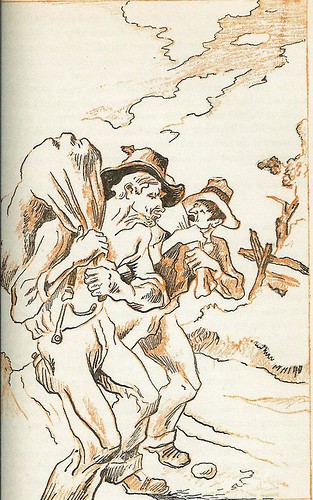
Note: Taps for Private Tussie quotations are from the 1943 first edition published by E. P. Dutton, with illustrations by Thomas Benton.