Showing posts sorted by relevance for query First Commandment. Sort by date Show all posts

Thursday, October 10, 2013

The First Commandment


Because councilmen Kevin W. Johnson and Rich Saddler are reportedly trying to get the city to convert the Marting building into a city hall, I am  reposting "The First Commandment" from 2006 to remind readers that when it comes to unloading property off on taxpayers, some things never change.


Moses


The First Commandment of Portsmouth’s over-privileged is “Local government shall not construct a new public building when a doctor, lawyer or businessman has a worthless old building that can be turned into a public building at great public expense.

Here are five recent examples of the First Commandment at work:

Thatcher House 


Thatcher house

(1) First Ward councilman John Thatcher and his wife, a former trustee of Shawnee State U., owned an unoccupied old house on Franklin Blvd that they had trouble selling in Portsmouth’s sluggish real estate market. The solution? They sold it, for much more than market value, to SSU as a “temporary” house for the SSU president. When the temporary president’s house was later sold, to a doctor, SSU and the tax-payers of Ohio took a $50,000 loss, not counting the furnishings and redecoration and the loss of taxes for the years the house was off the tax rolls.

Camelot Drive


Camelot

(2) A doctor had an unoccupied aging Camelot Drive house, with serious structural problems, which he was having trouble selling in Portsmouth’s chronically sluggish real estate market. The solution? He sold it to Shawnee State U. at an inflated price as the permanent home for the president of SSU, even though the house is far from campus, has inadequate parking space, requires large expenditures for repairs and refurbishing, and is unstably situated on the side of a hill down which it is inclined slowly to slip. The sale was “negotiated” by the chair of the SSU board of trustees, George Clayton.

Adelphia Building


adelphia

(3) Herbert Singer, an absentee landlord, living in Los Angeles, had an unoccupied building on Washington St., the former Adelphia building, on which he owed back taxes. The prospects of any business wanting to rent or buy that property were very remote. The solution? He got the city to accept the worthless Washington St. building as the next headquarters for the Portsmouth Police Dept. That way the absentee landlord in L.A. would not be responsible for real estate taxes, past and future, and he could claim a tax write off. Neil Hatcher, the absentee landlord’s agent, would get his cut. Chief Horner, always willing to play ball in a crooked game, readily agreed to this arrangement.

Welcome Center

Welcomectr

(4) George Clayton’s Kenrick’s catalogue store on Second St. went belly up when the Grant Bridge went down, and he was stuck with an old, empty building that he had no hope of renting or selling but still had to pay taxes on. The solution? With his political connections, he unloaded it on the county, which obtained it with pork provided by Rep. Rob Porkman and the Dept. of Agriculture. The building, on which millions have now been spent, is named The Welcome Center, but tourists complain it is seldom open and when it is it is unwelcoming. What it really is is the headquarters for the Southern Ohio Growth Partnership and the illegitimate and ugly architectural offspring of the marriage of pork and political corruption.

Marting Building

martting

(5) The Marting Foundation, a speciously philanthropic front for Portsmouth’s boss, Clayton Johnson, a cousin of George Clayton, had a large white elephant on its hand: the empty Marting building, a former department store, at the corner of Sixth and Chillicothe St. The problem is a familiar one in Portsmouth: the property is unsellable and unrentable but the taxes on it still have to be paid. “It ain’t worth anything,” as councilman Mohr told a reporter for the Columbus Dispatch. The solution? Get the city to buy it for nearly $2 million and convert the now 124-year-old department store into a municipal building. The city bought it, at the inflated price, but the sale was ruled invalid by the courts. Then the Marting Foundation arranged a fall-back deal whereby the city would keep possession of the building, provided the city met certain conditions laid down by the Foundation. Imagine a con artist dictating the terms under which he will return the money he has fraudulently obtained. Like the Old Maid in the card game, the Marting building is last thing the Foundation wanted to end up in its hands. If it gets approval in a special referendum that will take place on May 2, our corrupt city government plans to go ahead and convert the former department store to a municipal building.

What these five examples demonstrate is how Portsmouth’s over-privileged classes faithfully adhere to the First Commandment: “Local government shall not construct a new public building when a doctor, lawyer or businessman has a worthless old building that can be turned into a public building at great public expense.

Sunday, March 26, 2006

The First Commandment

Moses


The First Commandment of Portsmouth’s over-privileged is “Local government shall not construct a new public building when a doctor, lawyer or businessman has a worthless old building that can be turned into a public building at great public expense.

Here are five recent examples of the First Commandment at work:


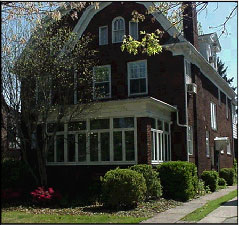
Thatcher House
Thatcher house

(1) First Ward councilman John Thatcher and his wife, a former trustee of Shawnee State U., owned an unoccupied old house on Franklin Blvd that they had trouble selling in Portsmouth’s sluggish real estate market. The solution? They sold it, for much more than market value, to SSU as a “temporary” house for the SSU president. When the temporary president’s house was later sold, to a doctor, SSU and the tax-payers of Ohio took a $50,000 loss, not counting the furnishings and redecoration and the loss of taxes for the years the house was off the tax rolls.

Camelot Drive
Camelot

(2) A doctor had an unoccupied aging Camelot Drive house, with serious structural problems, which he was having trouble selling in Portsmouth’s chronically sluggish real estate market. The solution? He sold it to Shawnee State U. at an inflated price as the permanent home for the president of SSU, even though the house is far from campus, has inadequate parking space, requires large expenditures for repairs and refurbishing, and is unstably situated on the side of a hill down which it is inclined slowly to slip. The sale was “negotiated” by the chair of the SSU board of trustees, George Clayton.

Adelphia Building
adelphia
(3) Herbert Singer, an absentee landlord, living in Los Angeles, had an unoccupied building on Washington St., the former Adelphia building, on which he owed back taxes. The prospects of any business wanting to rent or buy that property were very remote. The solution? He got the city to accept the worthless Washington St. building as the next headquarters for the Portsmouth Police Dept. That way the absentee landlord in L.A. would not be responsible for real estate taxes, past and future, and he could claim a tax write off. Neil Hatcher, the absentee landlord’s agent, would get his cut. Chief Horner, always willing to play ball in a crooked game, readily agreed to this arrangement.

Welcome Center
Welcomectr

(4) George Clayton’s Kenrick’s catalogue store on Second St. went belly up when the Grant Bridge went down, and he was stuck with an old, empty building that he had no hope of renting or selling but still had to pay taxes on. The solution? With his political connections, he unloaded it on the county, which obtained it with pork provided by Rep. Rob Porkman and the Dept. of Agriculture. The building, on which millions have now been spent, is named The Welcome Center, but tourists complain it is seldom open and when it is it is unwelcoming. What it really is is the headquarters for the Southern Ohio Growth Partnership and the illegitimate and ugly architectural offspring of the marriage of pork and political corruption.

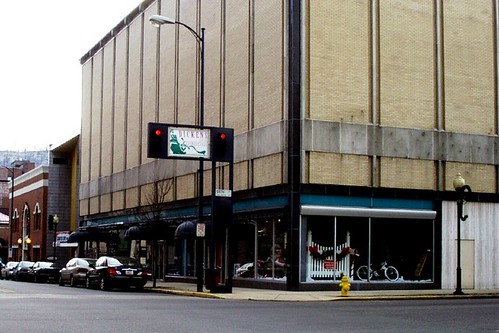
Marting Building
martting
(5) The Marting Foundation, a speciously philanthropic front for Portsmouth’s boss, Clayton Johnson, a cousin of George Clayton, had a large white elephant on its hand: the empty Marting building, a former department store, at the corner of Sixth and Chillicothe St. The problem is a familiar one in Portsmouth: the property is unsellable and unrentable but the taxes on it still have to be paid. “It ain’t worth anything,” as councilman Mohr told a reporter for the Columbus Dispatch. The solution? Get the city to buy it for nearly $2 million and convert the now 124-year-old department store into a municipal building. The city bought it, at the inflated price, but the sale was ruled invalid by the courts. Then the Marting Foundation arranged a fall-back deal whereby the city would keep possession of the building, provided the city met certain conditions laid down by the Foundation. Imagine a con artist dictating the terms under which he will return the money he has fraudulently obtained. Like the Old Maid in the card game, the Marting building is last thing the Foundation wanted to end up in its hands. If it gets approval in a special referendum that will take place on May 2, our corrupt city government plans to go ahead and convert the former department store to a municipal building.

What these five examples demonstrate is how Portsmouth’s over-privileged classes faithfully adhere to the First Commandment: “Local government shall not construct a new public building when a doctor, lawyer or businessman has a worthless old building that can be turned into a public building at great public expense.

Friday, December 26, 2014

Judge Mowery and the First Amendment


The Mowery property at 1327 Kinney's Lane

The First Commandment of Portsmouth real estate is that when a person of influence has a piece of property that is difficult to sell in the chronically depressed Portsmouth real estate market, a public or semi-public entity will take it off his or her hands and, drawing directly or indirectly on public monies, pay appreciably more than the property is worth. (For more on the First Commandment, click here.) The Marting Foundation infamously unloaded the empty, leaking, unmarketable Marting building off on  the city a dozen or so years ago  for almost $2,000,000, and that building has been an albatross around the neck of the city and its taxpayers ever since.

A more recent, smaller scale example of the First Commandment apparently at work is the house at 1327  Kinney's Lane  (shown above) owned by Judge Steven Mowery and his wife Leasa. In a public notice in the classified section of the Portsmouth Daily Times (PDT), it was announced as required by law that Scioto County Counseling Center/Compass Point Housing intended to purchase 1327 Kinney's Lane and another house at 644 4th Street and convert them into  "dormitories" for "residents." In the lexicon of the burgeoning drug addiction treatment industry, addicts with some kind of coverage are "clients" and halfway houses for them are "dormitories," and drug clinics to dispense drugs to them are "counseling centers."

The misleading classified ad that was buried in
 the classifieds of the Portsmouth Daily Times.

Before 1327 Kinney's Lane and 644 4th Street in Boneyfiddle could be sold to SCCC/Compass Point, 4th Street residents learned about the notice buried in the classified section of the PDT and became politically galvanized, appearing at the 16/9/2014 meeting of the City Planning Commission at the Municipal Building to make clear they didn't want  the Counseling Center owning and operating any more property in their neighborhood, which was already saturated with tax-free, socially toxic Counseling Center properties. By protesting, Boneyfiddle residents had made the Mowery house on Kinney's Lane and the 4th Street house political hot potatoes. In my interpretation of what happened, in an attempt to squelch the controversy,  SCCC/Compass Point tried to drop the political hot potatoes as quickly as possible. Toward that end, Craig Gullion, the Executive Director of Compass Point Housing, appeared at the hearing in the Municipal Building to announce his organization was no longer interested in acquiring 1327 Kinney’s Lane because  it was too small for the number of "residents" that Compass Point had wanted to house there. Gullion's  explanation was fishy. Hadn't he, as the Executive Director of Compass Point Housing,  or hadn't someone else in his organization, ever been inside 1327 Kinney's Lane before deciding to buy it?  Isn’t the size of a house one of the first things a prospective buyer, especially the Executive Director of a housing company, would notice? Even if his sense of size was faulty,  wouldn’t the County Auditor’s website have provided the exact square footage for him to determine whether 1327 Kinney’s Lane was big enough to suit Compass Point's purposes?


The size of the house at 1327 Kinney's Lane may not have been the problem. The size may have been a smokescreen Gulllion  raised to cover his tracks.  Since the purchase of 1327 Kinney's Lane by the Counseling Center had become controversial, wouldn't  the fact that Judge Mowery was the potential seller raise eyebrows? It raised more than my eyebrows when I examined the fiscal year 2012-2013 federal form 990 that SCCC/Compass Point was required as a non-profit to file with the U.S. Internal Revenue Service. What form 990  revealed was that Judge Mowery's wife Leasa, the co-owner of 1327 Kinney's Lane, was the president of  SCCC's fifteen-member Board of Trustees. Because of her important position at SCCC and because of her husband's role as municipal judge, their sale of 1327 Kinney's Lane to SCCC would have appeared to be a glaring conflict of interest. But hardly anybody would have known that if the SCCC hadn't been required as a non-profit to publicly reveal who was who and what was what financially in that somewhat secretive corporation. Non-profits are held to a higher standard and can't get away with the unethical hanky-panky private corporations can. Just what the legal and organizational relationship between the SCCC and Compassing Point Housing is cannot be determined by the 2012-2013 990 form. Who is who and what is what financially at Compass Point needs clarification for it looks like the tail that is wagging the SCCC.

In addition to a couple of the usual suspects, such as Julia Wisniewski,  what follows are the names of the fifteen members of the Board of Trustees of SCCC:


Board of Trustees of SCCC 2012-2013
  
Leasa Mowery,  Pres.
Brady Womack, VP
Barbara Burke, Secty-Treas.
Mark Cardosi
Karly Estep
Susan Fitzer
Joan Flowers
Asa Jewett
Wm. McKinley 
Dr. Robert Nelson
Wm. Plettner
Barry Rodbell
Rev. Sallie Schisler
Dr. Ronald Turner
Julia Wisniewski

How much might SCCC/Compass Point have overpaid the Mowerys for the Kinney Lane property if the sale had taken place? That is anybody's guess. But if the First Commandment of Portsmouth real estate was followed, as it was with the Marting building, it might have been well above fair market value. But the petition the residents of 4th Street filed with the City Planning Commission changed the fate not only of 1237 Kinney's Lane but of 644 4th Street as well. Since the controversy broke, SCCC/Compass Point has done nothing about buying 644 4th Street, and now appears to have less than no interest in it. Because of the political blowback, that once red hot potato is colder than an ice cube and may end up on the auction block (click here).


644 4th St.: "the once hot potato is colder than an ice cube."


Sunday, June 18, 2006

The Big Store


BIGSTORE


It’s hard to believe. They are now talking about converting another former big Portsmouth department store into a city hall. The more things change, the more they stay the same.

For the past four years Portsmouth has been rocked by controversy involving another big department store that the city wanted to convert into a city hall.

The scandalous sale of the Marting department store to the city led to the recall of Mayor Bauer and the recall of two council members, Ann Sydnor and Carol Caudill. The Marting sale led to a court case, brought by Teresa and Bob Mollette, in which Judge Marshall ruled the Marting sale invalid. Undeterred, Mayor Kalb and the clownish city council turned right around and worked out another arrangement with the Marting Foundation whereby the city got stuck with the Marting department store again, only this time the Singer building (often inaccurately referred to as the Adelphia building) was thrown in to the mix: the city acquired the Singer building, along with the Marting department store, and committed itself to converting the big one into a huge city hall and the dinky one into a police station. Outraged at the Kalb administration’s contempt for public opinion, the Concerned Citizens of Portsmouth got the proposed conversion of Marting’s placed on the ballot last May 2nd, when it was soundly defeated by the voters.

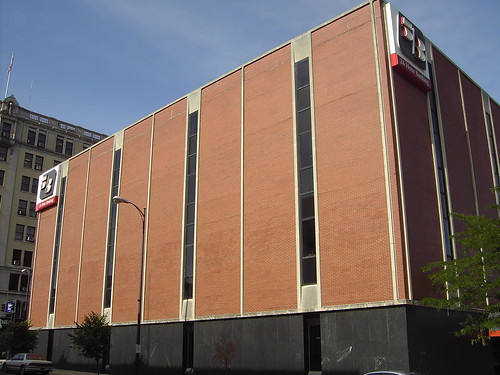
So now what are the clowns doing? With the cooperation of the SOGP’s house organ, the Portsmouth Daily Times, they are beginning a public relations campaign to convince the public that the Fifth Third Bank building, formerly the Montgomery Ward department store, would make a good city hall. How many times does a sucker have to buy the Brooklyn Bridge before he learns his lesson?

FIFTH THIRD
Fifth Third, former Montgomery Ward store


FIRST COMMANDMENT

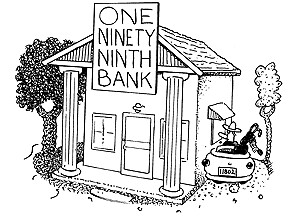
I first proposed back in March and repeat it here, slightly amended, the First Commandment of Portsmouth’s over-privileged: “Local government shall not construct a new building or renovate one it already owns when a doctor, lawyer, businessman, or banker has an old building that can be turned into a public building at great public expense.” The five buildings I offered as examples were lawyer John Thatcher’s house, on Franklin Boulevard; Dr. Rooney’s house, on Camelot Drive.; George Clayton’s Kenrick’s department store; Dr. Singer’s so-called Adelphia building, on Washington St.; and the Marting department store, on Chillicothe St. Now add the possibility of the Fifth Third Bank building to that list.

The Fifth Third Bank is reportedly considering vacating their building, on Chillicothe St., right across from Marting’s. According to the Scioto County auditor’s records, Fifth Third bought the building from Bank One in May 1998. In a press release at that time, Stewart M. Greenlee, president and chief executive officer of Fifth Third Bank of Southern Ohio, said that the purchase of the building “will allow us to greatly expand our Portsmouth banking operations . . .”

Why is Fifth Third Bank, eight years later, moving out of the building? Wouldn’t you think that would be one of the first questions a newspaper reporter writing a story about the Fifth third Bank building might ask? Did its banking operations in Portsmouth fail to expand, as president Greenlee predicted they would? Or is the building itself perhaps something of a headache, particularly in its heating and cooling operations? In an interview in the documentary Recall of Mayor Bauer 2004 (available at SSU and the Portsmouth Public Library), former Portsmouth mayor Frank Gerlach told me that the maintenance problems in the former Montgomery Ward building were no secret and could serve as a warning to those who wanted to convert an even older department store, Marting’s, into a city hall.

Whatever other reasons Fifth Third Bank might have for moving out of the former Montgomery Ward building, the profit it might make by unloading it are potentially large. According to records at the county auditor’s, available online, Fifth Third paid $231,000 for the property in 1998. Those same online records say that in 2005 the property had increased in value to $2,847,020. Leaving aside the question of how or why it happened, that’s a staggering 10-fold increase in value in seven years. If Fifth Third could sell the property at anything approaching $2,847,020, or even half of that, it would still be doing well financially. I learned from a visit to the auditor’s office that just this year the value of the property had been “readjusted,” and dramatically reduced to $1,281,490, or less than half what it was worth last year. Could it have been reduced for a quick sale?

MIKE MEARAN: CONFLICT OF INTEREST?

Now that he has been appointed, not elected, to the city council and is acting like a city manager, the lawyer Mike Mearan may be just the one to serve as the go-between in unloading the former Montgomery Ward building on the city. It was Mearan who worked out the deal that got the city to take the so-called Adelphia building off the hands of absentee landlord Dr. Herbert I. Singer, of Los Angeles. Singer owed about $20,000 in back taxes on his building and other Portsmouth property. The deal Mearan worked out for Singer with the city took Singer off the hook on his delinquent taxes and also qualified him for a tax-write off. But Singer would qualify for that tax write-off only if the city used the building for some public purpose. The public purpose that the city decided on
or that the SOGP decided for it was to convert the Singer building into a police station. The Singer building was the Mini-Me of the Marting deal, so no one seemed to notice.

Incidentally, when Singer bought the building in 1984, Mearan acted as the middle man, just as he may be acting now as the middleman for the Fifth Third building. Mearan appears on the scene like the fourth Marx brother, the unfunny one, who acts smart.

The question arises, since Singer was his client, whether Mearan has a conflict of interest. How can he hope to be objective, as a city councilman, about either the Singer-Adelphia building or the Fifth Third Bank building, with which it has been bundled? Whom is he serving, the citizens of Portsmouth or Singer and others? Isn’t this a question a reporter from the Daily Times should have asked Mearan? Of course it is.

It is one of the vices of our river city that the city’s building plans seem to depend on what unrentable and unsellable properties private individuals and corporations want to unload on the city to escape property taxes and earn a tax credit. City officials are only too eager to accommodate the wheeler dealers of Portsmouth by using public funds to buy their distressed real estate. When property loses all commercial value (“It ain’t worth anything,” as Marty Mohr said of the Marting building) the city or county gets stuck with it. When all the juice is squeezed out of the lemon, the city ends up with the rind. There is an adage that if you get stuck with a lemon, make lemonade. But what do you do with a lemon rind? The Fifth Third building, alias the Bank One building, alias the Montgomery Ward department store, may be about to be squeezed for the last drop, and the taxpayers will be stuck with another rind.

The former Montgomery Ward department store, like the Marting department store, appears much too large for the current needs of the city government. Can somebody help me with the math? How is it that Portsmouth in 2006, when its population is about 20,000, needs a building that is three times the size of the building that was erected at a time when the population was more than twice what it is now? Unless taxpayers want to put the mayor and other city officials in offices large enough for them to play cornhole during lunch hours, converting the Fifth Third Bank building into a city hall makes about as much sense as converting Marting’s did. Mayor Kalb may feel a building as large as Marting’s or Fifth Third is what the taxpayers would want him to occupy, in keeping with the dignity of his office, just as he thought they would want him to be driving a new Ford Expedition SUV. The city has wasted millions of taxpayers' dollars on its dreams and schemes for the Marting building, but the voters thought they had put an end to even bigger expenditures when they defeated the Marting referendum at the polls on May 2nd. If the city acquires the FifthThird building, it may only be getting started. Estimates of converting the Fifth Third will run into many millions, and remember that initial estimates of conversion are usually appreciably less than the final costs, because those who have an interest in promoting the conversion want to minimize the true costs.

If there is a legitimate case for converting the Fifth Third building into a new home for city government, Mayor Kalb is not the one who can make it. After the Marting’s fiasco, he has lost all credibility when it comes to any building. If the Municipal Building cannot be repaired, and even worse if it is a death trap and should be evacuated as soon as possible, as he has claimed for years, then something should have been done about it a long time ago. But there are those who say that the Municipal Building could be fixed, and others who say, for historical and architectural reasons, that it should be fixed. But the issues behind the Municipal Building may not be engineering, architectural heritage, and safety, but land speculation, gambling, and prevarication.

PRIME REAL ESTATE

The city council may be still shopping around for a new home because some unidentified developer is apparently interested in the land on which the Municipal Building is located. Somebody has reportedly been interested for more than ten years in developing that land. Kalb in the past and Mike Mearan more recently have referred to the land under the Municipal Building as prime real estate. Prime real estate? Dubbed “The Queen of the Rust Belt” by one travel writer, downtown Portsmouth’s Ramada Inn has been able to stay in business as long as it has partly by serving as a dormitory for students and as a temporary half-way house for those with DUI problems. Why would land right across the street from the Queen of the Rustbelt be considered prime real estate? Why would anyone want to build another hotel or “a conference center,” to cite another rumor, at that location?

In the zeal of some to tear down the Municipal Building, what we are possibly dealing with is the politics of gambling. The land on which the Municipal Building rests, as well as adjoining real estate in downtown Portsmouth, will increase dramatically in value if gambling comes to Portsmouth. If and when that happens, land prices in downtown Portsmouth will probably skyrocket. Why waste any of that potentially prime land on a municipal building when a docking facility for gambling boats could be built there? And why repair the current Municipal Building when there’s another former department store up on Chillicothe St. that may be empty soon and weighing heavily on the hands of its owner?

At some point in the mid-1990s, I thought I might transfer some of my banking to whatever bank occupied the premises of the former Montgomery Ward building. It might have been Fifth Third, or it might have been Bank One at the time. My recollection was the ground floor had recently undergone major renovations. The setting was plush. The woman behind the desk who interviewed me was dressed to kill. The few employees I dealt with struck me as people who, dressed in new clothes, felt they had come up in the world, though they still had to deal with peasant depositors. Arrivistes is what they reminded me of. An arriviste is someone who has suddenly risen to a higher economic status but lacks the class or confidence to carry it off. Even though I was in pokey Portsmouth, not New York, the renovated former Montgomery Ward building reeked of expenditure and pretentiousness. I decided that any bank that wasted money trying to create an expensive atmosphere was not a bank I wanted to do business with, not permanently anyway. I decided to keep all my banking at my plain Jane bank. At least nobody there was trying to pretend they were in downtown Manhattan or even downtown Columbus, which is to say any place but downtown Portsmouth.

The politicians in the Municipal Building strike me as arrivistes who are embarrassed to be working in a modest building constructed in the face of great financial difficulties during the Great Depression. Since they hold public office, they obviously feel they deserve better from the taxpayers of Portsmouth. Architectural and historical awareness, along with manly competitiveness, seems to have been bred out of most of the pork-fed males in the area, particularly the rich white trash. They are incapable of appreciating the tarnished charm and historical significance of the modest Municipal Building, which may have been systematically neglected and vilified in preparation for the great day when gambling comes to Portsmouth.

The original plans for the Municipal Building were drawn up before the stock market Crash of 1929; those plans called for a larger structure than what the city had to settle for in the Great Depression that followed. Back then, city officials realized they had to scale back and live within their means. Our current officials act as if it is still the Roaring Twenties, and that the sky is the limit when it comes to a new home for the city government.

They want the big official SUV and the big former department store with the phony false façade and offices big enough to play cornhole in, and never mind the millions of taxpayer dollars it will take to finance their illusion of having arrived.

Portsmouth taxpayers can’t afford the dreams of the clownish Marx Brothers in the Municipal Building, not when times are as hard as they are. The city government needs to think smaller, think more economically. They need to get over the Big Store mentality. In considering moving out of the former big store, isn’t that what the Fifth Third Bank might be doing? Perhaps the bank's Portsmouth operations did not “greatly expand,” as its president had predicted they would. And Fifth Third has billions in assets. How much does the city of Portsmouth have? Not enough to waste on more Big Store fantasies.


5th 3rd cartoon

Monday, August 17, 2009

Lovins Leaves Little Shop of Horrors

The Little Shop of Horrors

Public relations is the world’s second oldest profession, and it came into existence to serve the first. The public doesn’t know it, but public relations has been around for thousands of years. The reason the public doesn’t know that public relations has been around a long time is that the name has changed. It used to be called lying, but they made a profession out of it and called it public relations. Presumably, it’s possible to succeed at public relations and not be dishonest, unethical and unscrupulous, and to be a complete liar, cheat and a scoundrel, but it is probably much harder. The same may be said for being a reporter or managing editor for the Portsmouth Daily Times, where reporters and editors are really poorly paid PR people whose job is protect and polish the image of the rich white trash who control the city. Maybe some ex-reporter or managing editor will write a memoir someday, of the hell it was to work for the PDT, for practically nothing, all the while being held in contempt by those who refused to buy the newspaper.
The hardest thing is to change something bad for the better. Changing the name of something bad is the favorite trick of public relations. When something gets a reputation that is so bad that it is not worth defending, public relations doesn’t try to change it, it just renames it. It is much easier to change a product’s, or a service’s, or a person’s name or title than it is to change the product, the service, or the person. It’s much easier to change the way a thing appears than to change what it is. The easiest way to change perceptions is through deceptions. If an institution had to choose between flush toilets and public relations, they would choose public relations because shit may happen but that’s what you have a public relations department for—to turn shit into gold. These days, instead of changing names, public relations specialists are into changing brands; rather than renaming, they are into “rebranding.”
Any produce manager can tell you that what sells fruit is not the way fruit tastes after you buy it but the way it looks before you buy it. If you have the best tasting fruit in the world, it will not sell if it looks bad. The whole fruit business seems geared to growing better looking, not better tasting, fruit. Taking a lesson learned from Hollywood PR, breeding for appearance rather than taste has produced the most voluptuous looking and lousiest tasting hothouse tomatoes under the sunlamp. If the claims sound and the tomatoes look too good to be true, they probably are. That’s because that’s the rule with almost everything, not just fruit. It’s true with teeth whiteners and automobiles. The Volvo station wagon may have been one of the most reliable indestructible clunkers in the world, but nobody wanted to be seen driving one, except maybe Lurch, the butler in the Adams family.
Eventually, the reputation of public relations itself got so bad that it had to change its name. It has come up with a number of euphemisms for itself, usually with the words “communications” and “marketing” somewhere in the new name. Public relations is so pervasive that most organizations are much more devoted to image control than quality control, and because of public relations’ chameleon ability to change not only its name but also its own image, many employees in an organization are not aware that what their job basically amounts to is public relations. Anyone naïve enough to believe that what he or she is suppose to do is make changes for the better constitutes a menace to an organization. Saying the right thing, not doing the right thing, looking the part, not playing the part, is the first commandment in the religion of making it in America, and nobody follows that commandment more faithfully than your public relations specialist. Because of its incestuous culture of dependency and its toleration of incompetence, Portsmouth is particularly in need of and susceptible to public relations.
Lovins' Farewell Address
This peroration on Public Relations was prompted by the recent Farewell Address of the Managing Editor of the Portsmouth Daily Times, the former “Marketing Communication Specialist,” at Southern Ohio Medical Center. Why Jason Lovins left SOMC in the first place is hard to explain, because billboards and ads on radio and TV hail the local hospital as one of best employers in Ohio to work for, as based on a survey of those very same employees. Or is that just more PR malarkey? Why Lovins would voluntarily leave one of the most popular places in Ohio to work to become the low-paid managing editor on the sinking Portsmouth Daily Times is not easy to understand. Did his leaving SOMC have anything to do with that business over the resignation of the Friends of SOMC? That was a public relations mess, which he as SOMC’s Marketeing Communication Specialist must have had some responsibility for.
Anyway, it appears Lovins the PR specialist has either lost or been fired from another PR job. It was Frank Lewis, reporting on the messy resignation of the board of directors of Friends of the SOMC, in 2006, who identified Lovins as the “Marketing Communication Specialist” at SOMC, which may or may not have been his official title. Lewis is not necessarily any more of a fact checker at getting people’s titles straight than he is on quotations by Abraham Lincoln. In his short nine months as Managing Editor of the PDT, Lovins has shamelessly repeated the Chamber of Commerce-SOGP PR line that Portsmouth is a great city and getting better all the time, with a lot of incredibly giving and wonderfully caring people, except for that malicious vocal minority that is always trying to tear the city down. Recently the Times ran a story about a man I don't know but mistakenly used the photo of a gentleman I do know. Of course that is nothing compared to what happens to a patient who goes into a hospital for an appendectomy and comes out of the operating room with the appendix but without a leg. That kind of thing takes a whole lot of public relationing to make up for.
The title of Lovins’ swan song in the PDT is “It Really Has Been a Short Nine Months,” in which he was speaking only for himself of course. It was a very long nine months for some of us. On the basis of the puffery of himself and the Times reporters in which he indulges in his Farewell Address, maybe he should have called it “A Labor of Lovins.” No wonder he was such an unqualified success, since every reporter he worked with at the PDT was so “remarkably talented, hard-working,” etc., and were “experienced journalists providing quality every day.” Well, maybe not every day, because Lovins fails to point out that during his short nine months the incredibly shrinking PDT shrank further, not in size but in frequency, from a seven-day to a six-day-a-week newspaper. Why were those Times reporters so good, according to Lovins? “Largely because they either grew up or have lived a long time here and feel their roots dive very deep into our soil as well as our souls.” This is the kind of PR crap you get from a PR person who is trying his best to put a PR spin on what to outside observers looks like his losing his job. Lovins’ Farewell Address is his PR effort to turn his personal shit into gold. Never mind his reporters digging into our soil and souls. How about their digging into a story? In the story Frank Lewis wrote in July 13, 2006, about the resignation of the Friends of the SOMC, he typically gagged rather than dug. Hardly anybody to this day knows what the hell that was all about. When a major advertiser like the SOMC and bigwigs like Robert Dever are involved, a PDT reporter doesn’t do any digging and finding out things he would not be able to print anyway.
The Miracle Worker
Lovins claims in nine short months to have transformed the PDT, or at least the front page. He was severely limited by what he could print about Portsmouth on the front page because he had to follow the long established PDT policy that if the news wasn’t positive, it wasn’t fit to print. So the front page of the Times became during his short nine months a repository of human interest stories, as if we didn’t get enough human interest stories from Wayne Allen on the front page of the PDT’s sister Community Common. Hold the presses! “Portsmouth woman got her picture taken with Oprah Winfrey!” Rather than “diving very deep into our souls,” why didn’t PDT reporters in the last nine months dive very deep into the corruption, crime, drugs, and prostitution that plagues Portsmouth? Because if they did they would be out of a job pronto. All Jeff Barron had to do was mention that somebody who was arrested for drugs was an employee at Glockner’s and he was history.
Let’s try to find something positive in all this. Maybe there has been some improvement at the PDT. At least Lovins at the end of his short nine months did not suddenly disappear, without a word, becoming a non-person like the previous managing editor. Art Kuhn had done all he could to follow the PDT PR line, and look what it got him. And let’s keep in mind, also, that the Times reporters, in the process of digging into our souls, have not sold theirs forever but are only renting them temporarily, for subsistence wages. They will possibly have an opportunity, when they too are finally fired or the paper shrinks to nothing, to move on to some situation where they might regain their integrity and good name. And it is even possible that the “further education” Lovins cites as one of his reasons for leaving will be in some field other than public relations and that he will find some other way to make a living than lying for others.
In his initial introductory infamous editorial, “Election a Sign of Things to Come,” back on February 5, 2009, Lovins started out, in a disarming PR way, praising democracy but he closed by suggesting there may be too much of it in Portsmouth. “There comes a time,” he closed that editorial, “when the philosophy of Democracy has to give way to the pragmatic reality of fiscal management. This just may be that time.” To speak of ‘the reality of fiscal management’ in a city where Jim Kalb is mayor and Trent Williams auditor, and where current budget projections are for a $1.1 million deficit! What it’s time for is not for democracy to take a back seat to the budget but for Lovins, nine short months later, to leave the Little Shop of Horrors.


.

Tuesday, November 18, 2014

A Brief History of Portsmouth's Psychotropic Addictions


In the last sixty-five years or so, psychotropic (mind altering) drugs  have had a profound  impact on America and on  Portsmouth in particular.  The history of  psychotropic drugs, at least in Portsmouth, can be divided for rhetorical purposes into roughly  five  overlapping stages. Those could be called, based on the psychotropic drug that predominated in each:  (1) the chlorpromazine (2) the meprobamate;  (3) the benzoylmethylecgonine; (4) the paramorphine; and (5) the buprenorphine  stages. Except for the anti-psychotic chlorpromazine, which was marketed in the U.S. as Thorazine, all of these drugs are addictive to varying degrees. However, the withdrawal symptoms associated with Thorazine can be similar to withdrawal from addictive drugs.


The Chlorpromazine (anti-psychotic) Stage


Above: The psychotropic anti-psychotic chlorpromazine in 3D molecular structure

The first important psychotropic drug in America was the powerful anti-psychotic chlorpromazine,  marketed in the United States as Thorazine. First synthesized in 1950, chlorpromazine revolutionized the psychiatric care of psychotics, particularly schizophrenics. According to Wikipedia, “The introduction of chlorpromazine during the 1950s into clinical use has been described as the single greatest advance in the history of psychiatric care, dramatically improving as it did the prognosis of patients in psychiatric hospitals worldwide.”  In the 1950s, I worked as a psychiatric aid in mental hospitals in Massachusetts and Connecticut  and witnessed firsthand the dramatic improvement  in  the treatment of patients brought about in large measure by chlorpromazine.

I began as a psychiatric aid at Boston State Hospital where I  assisted in the use of hydrotherapy and electro-shock to treat psychotic patients. But just several years later I worked as an aid  in a private mental hospital in Hartford delivering chlorpromazine to more tractable patients. In the 1960s and 1970s, because of  the “tranquilizing” effect of chlorpromazine on psychotics, many public mental hospitals closed down, as Boston State Hospital did in 1979 and as the  Receiving Hospital did in in Portsmouth decades later. Because of advances in  anti-psychotic medications  and the subsequent deinstitutionalization of mental patients, today people are walking the streets in  American cities, including Portsmouth, who would  have been institutionalized  in the 1950s. Diversity was not a virtue in the '50s, when there was little tolerance for deviation in sex, politics, or social behavior.

The Meprobamate (tranquilizer) Stage


Above: The 3D molecular structure of the psychotropic diazepam  (Valium) 
The success of Thorazine helped set  the stage for the synthesizing of milder psychotropic drugs for the treatment of patients with emotional rather than mental problems, patients who were classified as neurotic rather than psychotic. The first tranquilizer, meprobamate, was marketed as Miltown in 1955. “Thorazine—which offered the first effective treatment for schizophrenia—had revolutionized the treatment of institutional psychiatry,” Newsweek reported in 2009, “and Miltown seemed to offer a pharmaceutical counterpart to the management of everyday nerves.” People of a certain age will remember what could be called the  Miltowning of America in the late 1950s. To quote Wikipedia again, “Launched in 1955, [Miltown] rapidly became the first blockbuster psychotropic drug in American history, becoming popular in Hollywood and gaining notoriety for its seemingly miraculous effects.” The pharmaceuticals that developed them usually touted the “miraculous effects” of new  drugs, which was the case with meprobamates. The  harmful side effects were downplayed if not denied entirely. Just as the tobacco industry covered up  the carcinogenic risks of tobacco,  the pharmaceuticals downplayed the addictive nature of tranquilizers.

Miltown was followed by Librium and then  Valium (diazepam), which,  after it was introduced in 1963, became the most widely used  tranquilizer in the world.  Valium was prescribed for everything from phobias to depression, and from anxiety to restless leg syndrome. But it became clear over  time that tranquilizers, including  Valium, were addictive, and when used regularly for a long period, became a serious problem. The  withdrawal symptoms that users experienced when they tried to stop taking Valium were  severe. I know a woman  in her nineties who was addicted to Valium for over  a half century, with only her doctors and close relatives knowing that she was. From what I have gathered, the  first prescription drug addicts in Portsmouth were not long-haired youths but respectable, responsible members of the community who were victimized by the pharmaceuticals that synthesized meprobamates and  by the  doctors who overprescribed them.

The Benzoylmethylecgonine  (cocaine) Stage


It was illegal drugs such as heroin and meth, and particularly cocaine (benzoylmethylecgonine), that became the drug of choice in Portsmouth for so-called recreational users. One of the consequences of the  cocaine stage was that the money it illegally generated remained in the underground economy. Drug dealing is a cash only business. That's especially the case with cocaine. The on-line  National Geographic News, of all soures, reported in 2009 that nine out of ten American bills show traces of cocaine. The traces get there when the bills change hands in a drug deal or when addicts use the bills to snort coke.  The coke trade  did little for the chronically depressed economy of Portsmouth. Instead of helping the economy, the money generated by  the cocaine trade  created havoc.  Another problem with cocaine, especially crack cocaine,  was that  too many of  the dealers and  their customers went to jail or died of overdoses. The high incarceration and mortality rate was not good for the coke business. If you have a business that caters to customers who end up behind bars or dead, you do not have customers you can bank on.

As a sign of the extraordinary pervasiveness of the drug problem in Portsmouth’s cocaine stage, the son of the mayor, the son of the police chief, the son of a prominent judge, the son of a prominent lawyer, and the sons and daughters of other prominent fathers became addicted, with some of those sons becoming  dealers themselves. Though more sons than daughters became addicts, the daughters were by no means closeted, for many of the  streetwalkers in Portsmouth were hooked on drugs.  Some years ago I talked to an addicted prostitute on John Street who told me she was related to a bail-bondsman. There was no escape from drugs no matter what family or which social class or which side of the law you were on, or whether your dad was a criminal or a judge. 

 During the crack stage, local, state, and federal governments spent much more money on  than for addicts, much more money arresting, prosecuting and incarcerating than  rehabilitating addicts. There was much more money to build jails to lock addicts up than there was for clinics to treat them.  In 2006,  at the tail end of the crack craze, the $12.5 million dollar Scioto County Jail opened for business with the expectation that if you built it they would come. But with the attrition of crackheads, the new jail had  trouble maintaining full occupancy. That meant the county was losing money while  still having to pay about  $350,000 or so annually to service its debt for the jail.

Jailing addicts for  crimes that were both directly and indirectly related to drugs became  a highly competitive business. The financially strapped Scioto County Jail sought to have prisoners from other counties’ crowded jails transferred to its underutilized facility. Under this arrangement, the other  counties picked up the tab. The Huntington Herald-Dispatch reported in 2014 that ten Lawrence County prisoners had  been incarcerated  at the Scioto County Jail in 2013 at an annual  cost of $230,869 to Lawrence county. When Lawrence county sought to have the empty former youth prison in  Franklin Furnace serve as a less expensive backup to its crowded jail in Ironton, the Scioto County commissioners and sheriff strongly objected, calling the Lawrence County plan not only unfair and in violation of state statutes but also “stupid.”  For competing contiguous counties to be calling each other names is just one of the indirect consequences of the drug epidemic in southern Ohio where addiction, at least for law enforcement agencies, has been  a growth industry. Much of the breaking and entering of homes and automobiles in the Portsmouth area was done by addicts desperate for money to buy drugs. Incidentally, many  drug-related petty crimes were not reported to the police during chief Horner’s stewardship, so Portsmouth’s official crime rate was probably a lot higher than statistics suggested, though those rates were already quite high.

The Paramorphine (oxycodone) Stage

Above: The 3D molecular structure of the psychotropic drug  oxycodone 

The oxycodone stage of addiction in Portsmouth was more profitable than the cocaine stage at least for the pill-mills and those connected to them. Instead of the illegal cocaine, heroin, and meth that fueled the cocaine stage, the oxycodone stage was fueled by a  less potent but  fairly expensive and widely available psychotropic prescription drug. The best selling  brand of oxycodone, Oxycontin helped alleviate pain, including the pain  associated with withdrawal from more potent narcotics, but without producing the high that addicts crave. What made Oxycontin less potent was its timed-release formula. The user did not experience its potency all at once but  gradually, over time. But the timed-release formula was far from foolproof.  An addict was able to easily unleash Oxycontin’s  potency immediately by  chewing, pulverizing, or liquefying it, in which forms it could be swallowed, snorted, or injected.  Even the addition of nalaxone to produce nausea when the drug  was taken in large doses did not stop Oxycontin addiction in the Portsmouth area from  increasing exponentially.

On 9 April 2011, a New York Times reporter wrote of Portsmouth, “This industrial town was once known for its shoes and its steel. But after decades of decline it has made a name for itself for a different reason: it is home to some of the highest rates of prescription drug overdoses in the state . . .” Things got so bad in the Portsmouth area that Governor Kasich said publicly that, when it came to pill-mill prescription drug abuse, “The devil is in control in Scioto County.” One public health official reported one in ten babies born in Scioto County were addicted. The police chief reported that more people had died in Ohio from drug overdoses in 2008 and 2009 than had died in the 9/11 World Trade Center attack. What the police chief, Charles Horner, did not report was that his addicted, drug-dealing son was one of those responsible for the overdose deaths. I was told by someone in a position to know that Horner’s  son brazenly dealt drugs in a restaurant directly across the street from the police station.

Typically, the local  media at first  turned a blind eye to the pill mills as chief Horner had to his son.  In the same downtown office building and on the same floor as the local radio station WNXT, one shady  out-of-town doctor opened a pill-mill office with patients from the tri-state region lining up like customers at  the popular DariCreme on 2nd Street. When a veteran WNXT newscaster learned  a  pill-mill down the hall had been raided,  its existence was news to him.

The doctors who indiscriminately prescribed and the people who owned and operated the pill-mills made  millions of dollars, and in doing so gave a boost to the  local economy, but at  what a cost. Oxycontin became so  widely used and abused that Portsmouth became known as the Oxycontin capital of the nation with one Portsmouth doctor reportedly writing more prescriptions than any other doctor in the country.  The Portsmouth pill-mills became so out of control in their pursuit of profits that they were finally raided by federal, state, and local federal law enforcement agencies. Some of the pill-mill owners and doctors  were arrested and convicted, bringing a reduction, though certainly not an end, to Oxycontin  addiction in Portsmouth.

The Buprenorphine (Suboxone) Stage


Above: The 3D molecular structure of the psychotropic buprenorphine (Suboxone) 


Much more savvy and public-relations oriented, and much better connected politically, the counseling centers in the Portsmouth area, were ready to take up the slack created by the closing of the pill-mills.  While some addicts have been helped by the centers,  profits and politics, not the Hippocratic oath and humanitarianism,  have been dominant in the   buprenorphine stage of Portsmouth’s drug history.  The cost of treating addicts in counseling centers has been paid for primarily  by the government and ultimately by the  taxpayers through Medicaid and since 2014 by the Affordable Care Act, which Republicans have dubbed Obamacare. The cooperation and  collusion between pharmaceutical executives,  U.S. government officials, and unscrupulous professionals,  who were involved in a revolving door arrangement, account in part for the success of counseling centers in the Portsmouth area.

The Counseling Center, Inc. and the Community Counseling and Treatment Services (CCTS), operate clinics and halfway houses in Portsmouth where what they euphemistically call “clients” are treated. A key component of that  treatment of addicts now includes the psychotropic drug buprenorphine,  of which Suboxone became the most  controversial example.  Outselling even Viagra, Suboxone generated $1.5 billion in American  sales in 2010. Suboxone was developed not by an American pharmaceutical but by a British company,  Reckitt and Benckiser (RB), that specialized in health and household products, such as Clearasil and Lysol. The U.S. government spent $89 million to help RB develop and market Suboxone  on the grounds that it was safer than methadone. Safer? A  firefighter  whose son became fatally addicted to Suboxone remarked that  the difference between more potent drugs and Suboxine was like the difference between Budweiser and Bud Lite, meaning an alcoholic who switched to Bud Light was still a drunk and an addict who switched from Oxycontin to Suboxine was still an addict. Reckitt and Benckiser tried to  discourage addicts from abusing Suboxone by adding  nalaxone, an “abuse deterrent,” to it. If addicts crushed and injected Suboxone, the nalaxone was supposed to produce excruciating pain and nausea, but that apparently was  not enough to stop addicts from abusing it. Suboxone  is one of the drugs that has made overdoses rather than car accidents the leading cause of accidental death in the U.S.

The U.S. government tried to control the abuse of Suboxone  by allowing only designated doctors to prescribe it and by limiting those doctors to thirty patients, but that number  was later raised to 100. In spite of these controls, the illegal use of Suboxone proliferated.  In 2011, the number of emergency room visits resulting from the illegal  use of Suboxone were well over 21,000, which was nearly five times what they had been five years earlier.  The doctors who prescribed Suboxone were far from simon-pure and some of  them had even been law-breakers. Rather than the Hippocratic, they appeared to have taken the hypocrite oath. Their primary objective was not to help the addicted but to get rich. As reported in the New York Times  (15 Nov. 2013), Dr. Robert L. DuPont, the first director of the national drug abuse institute, said that at  a recent meeting of the addiction medicine society, “the buprenorphine sessions were all packed with doctors who wanted to get in on the gold rush.” Too many of the doctors who became Suboxone  prescribers did so because they saw it as a bonanza for their faltering practices. Among them were doctors who had been sanctioned for drug addiction; or convicted of Medicaid fraud and of smuggling steroids from Mexico; or of conducting an “excessive number of invasive procedures”; or of failing to report a case of rape of a pediatric patient and of  having intercourse with patients in the office. The government’s screening process was clearly lax. In Ohio, it turned out that nearly 17 percent of the doctors given permission to prescribe  Suboxone had been previously disciplined by authorities whereas only 1.6 percent of Ohio doctors in general had been. If it was 17 statewide, it is easy to believe the percentage was even higher in Portsmouth, one of state’s most addicted cities.

The Treatment Services (CCTS) recently had its clinics in Portsmouth raided by police. According to channel WNXT, CCTS owner Paul Vernier and his employees had been engaged in trafficking in drugs, laundering money, and defrauding insurance companies and the U.S. government by forging prescriptions. In addition to searching for evidence in Vernier’s Portsmouth clinics, the police also used a search warrant to look for incriminating records and papers at his palatial hillside house in West Portsmouth. The other Portsmouth operation, Counseling Center, Inc., which has influential friends in the county government and in the state legislature, continues doing  business as usual in Portsmouth. The raiding of Vernier’s clinics removes Ed Hughes’ chief competition. Business for Counseling Center, Inc., with its motto “We believe in miracles,” is prospering and expanding, especially in the historic Boneyfiddle district.

When I began my blog River Vices in 2004, I said Mark Twain felt river cities had more than their share of vices and I thought that Portsmouth was no exception. I never knew a city that had more religion and less morality than Portsmouth, which calls to mind  Twain’s remark that “religion began when the first con man met the first fool.” The  slogan of Counseling Center, Inc., suggests Hughes might be using the Almighty to cloak his lucrative business in religion, as Vernier seems to have done by naming a real estate business he owns Blessed Realty, L.L.C. Blessed are the realtors in spirit for they shall profit from the First Commandment of Portsmouth politics (click here). That reminds me that Tammy Faye Bakker and her convicted televangelist husband Jim Bakker named their profitable non-profit televangelist racket PTL, short for "Praise the Lord!" That's what she used to exclaim tearfully and often on the Jim and Tammy Show, heavy mascara running down her rouged cheeks.  Incidentally, it may not be coincidental that Tammy Faye turned out to be addicted to Valium. Whether or not  Ed Hughes’s Counseling Center turns out to be a racket, he has become a multi-millionaire, according to Austin Leedom, the dean of Portsmouth's investigative reporters. What I will explore in my next post is the possibility that Hughes may be addicted not to any of the five drugs discussed above  but to the most powerful and pervasive drug in the world. What is that drug? Stay tuned.

Relevant Posts

"From Pill Mills to Counseling Centers" (click here).

Monday, March 11, 2013

Third Street: Thick as Thieves


Third Street: Hatcherville


Third Street


      Shawnee State University doesn’t have a master plan as much as a master plot. By plot I mean not “a measured area of land,” but rather “a secret plan, a scheme.” The plot was to enrich a local lawyer, Clayton Johnson, and his partner in crime, a local developer, Neal Hatcher, by giving them sweetheart deals: for example,  taking  the worthless Marting Building off Johnson’s hands, for almost two million dollars, and allowing Hatcher  to build SSU student dormitories in a can’t-lose arrangement. Hatcher  built dormitories on the  northern side of Third Street, a major thoroughfare running through the heart of the university. The dormitories were on one side of Third Street, the classrooms, the administration buildings, the athletic center, the student center, etc., on the other. A hazardous arrangement. 
       Every student who lives in Hatcher’s dormitories plays Jeopardy. They have to to cross heavily trafficked Third Street day and  night, much of the traffic coming from or going to the Grant Bridge. Just the other day a young man from Portsmouth, on a moped,  was killed on the Kentucky side of the bridge, apparently by a driver who reportedly ran a red light. Like most streets in Portsmouth, Third Street speed limits are frequently violated, putting the lives and limbs of students in jeopardy. Now, the university wants to close Third Street and put grade school, middle school, and high school students, just north of Third Street, in jeopardy, making a bad situation even worse.
      Those who might be opposed to the project are dismissed, in a recent PDT editorial, (9 March 2013) as “people who are opposed to anything that brings progress.” Sound familiar? Steve Hayes has been peddling that line at WNXT for years. Where is Steve’s buddy, WSAZ’s Randy Yohe, now that the ruling clique could use Yohe’s support for closing Third Street? But the Can-Can Man was canned after being arrested for drunken driving. Of course, Yohe or no Yohe, the collection of bankrupts and political pawns who make up the Portsmouth City Council will pass the measure to close Third and probably quickly, as the PDT urges in the same editorial, as the council previously acted quickly to unload the Marting building on the taxpayers of Portsmouth. 
      If the most recent editor at the PDT did not support the closing of  Third Street,  it would not be long before he would join the long line of editors and reporters who have  quit or been fired when they failed to please the rich crooks who control the no-longer daily Daily Times  and the city. Now,  the politics are even thicker than they used to be. The Felix of the Odd Couple, Clayton Johnson, has retired, leaving Oscar, Neal Hatcher, holding the money bags alone, prompting Jeff Albrecht, Portsmouth’s preeminent snake oil salesman, to make his move for the Municipal Building, backed by the American Savings Bank in the person of Michael Gampp. Thick as thieves, they are all for closing Third Street, as quickly as possible, whatever the consequences. 


Click below for previous posts related to above post:


Thursday, June 02, 2011

The Buckeyes: Ohio's State Religion


                                                                          * * *                                                                        

For those that don’t have religion, there is football.” A  line from the 1975 movie Night Moves, in which Gene Hackman plays a former professional football player turned floundering private detective who is going around helplessly in circles in a world devoid of meaning and values.
* * *
“Trust ye not in lying words . . .” Jeremiah 7:4


State Religion

The word fan is short for fanatic, which is a person who idolizes and  blindly worships someone or some thing.  The sports fanatic is second  cousin to the religious fanatic. The religious fanatic worships a god, the sports fanatic worships a star player or  a favorite team. Religious fanatics have holy places and so do sports fanatics. Catholics have the Vatican, Muslims have Mecca, and Buckeye fans have Ohio Stadium, on Woody Hayes Drive. 
     The Buckeye religion depends upon young men, many of them African-Americans, to perform the violent rituals that the fanatically faithful live to watch. A central myth of the Buckeye religion is that these young men are clean living and stalwart amateurs who without remuneration, other than board, room, and tuition,  perform the violent football ritual for the faithful. While OSU makes millions, the players get trophies and medals they trade for tattoos. One player who traded some memorabilia said he and his mother were struggling financially while others were making lots of money from the program. He mentioned no names, but in 2010 the annual revenue from the program was $68 million and Tressel's salary package was $4.1 million. Some players are from single parent families and from impoverished backgrounds where drugs and crime are rife. The single parent is often a poor mother. That is the player’s excuse, but what is Coach Tressel’s?
If Tressel is the minister of the Buckeye  religion, OSU president Gordon Gee is the bishop, but in the Buckeye  religion the minister is much more powerful than the bishop as Gee revealed when he quipped to reporters, “I’m just hoping he,” meaning Tressle, “doesn’t dismiss me.”  Because they are incriminating, if not devastating, important truths can sometimes be revealed only in jest.  In the Buckeye religion, the geek is the lowliest, most pathetic creature in creation, not worthy of washing the feet of a coach who has not only won a national title but beaten Michigan nine  out of the last ten meetings. Not since Wally Cox, TV's Mr. Peepers, roomed with Marlon Brando have we had such an odd couple as Gee and Tressel. For the trustees to have hired the bow-tied Gee for a second go-round was a good way of emphasizing who is really the boss  at OSU—the coach of the football team. But by revealing an inconvenient truth, Gee may have brought  his own retirement that much closer. If the coach has got to go, can the geek be far behind?
If the eighth circle of hell is reserved for those football players who get caught, the ninth circle is reserved for those who get caught and reveal inconvenient truths about “the program,” as the Ohio State system is sometimes called. Running back Maurice Clarett has been consigned to the ninth circle because not only was he caught red-handed but he then blew the whistle on the whole program.

Maurice Clarett consigned to the Ninth Circle of Hell

In our intensely competitive society, being Number One is tantamount to salvation. “Winning isn’t everything; its the only thing,” Vince Lombardi liked to say. That's the first and only commandment of big time college football. Jim Tressel has put a pious spin on “winning is the only thing,”  by saying, in effect,Winning is the godly thing.” Winning is  a goal so worthy of reaching that  cheating to reach it is acceptable provided you don’t get caught. This is as true in football as it is on Wall Street. The hypocritical Tressel got  caught and now the nation is shocked, shocked to learn that he  was forced to resign because he and his recruits have not always played fair and square. It’s a very big  news story not only in Ohio but throughout the country and will be for at least forty-eight hours. This is not just an athletic crisis. This is a spiritual  crisis because OSU football  is the state religion of  Ohio. The state motto, which Tressel highlighted in The Winners Manual,  is “With God all things are possible.” The unwritten corollary is, “Without the Buckeyes, nothing is possible.” There is no other category that Ohio has ranked first in, and thereby been redeemed by, except OSU football. Five times Woody Hayes (blessed be his name!) took the Buckeyes to the Promised Land.  A national title is the state’s salvation. Jim Tressel did it once, but he got caught and now he will be consigned to the Eighth Circle of Hell. Hayes is a saint for having five times filled  up the spiritual emptiness at the heart of it all. Jim Tressel did it only once and now he’s been caught. The fans will turn on him the way they turned on the forty or so players who were caught in his ten years as coach. Along with everyone else, even Brutus Buckeye might turn on him. I can imagine the disgraced coach saying to the Buckeye mascot, “Et tu, Brutus?”          
     “Lasting goals are also from God, and they affect the people around us for good,” it says in The Winners Manual. Well, maybe around Him but not exactly around Tressel. There is Robert Reynolds, to take just one example, who early in Tressel's  tenure  infamously choked the Wisconsin quarterback well after the whistle had blown, knocking him, or choking him, out of the game. Whatever possessed Reynolds to do that? When he was later suspended by the Tennessee Titans for failing a drug test, we have a possible explanation, though the win-at-any-cost-because-God-is-on-our-side spirit of OSU football may have been the only inspiration he needed, though it should be pointed out that the Buckeyes choked and the Badgers came from behind to win the game. For anyone with eyes to see, it was clear whose side God was on that day. 


OSU linebacker Robert Reynolds who gave a whole new meaning to the phrase “an athlete who chokes.