Sunday, November 01, 2009

Letter to the Children of Portsmouth


Kiwanis Playground in Tracy Park


Letter to the Children of Portsmouth on the Eve of the Election of November 3rd, 2009


Being children, none of you is likely to read this letter or understand it fully if you do.

This letter will not be published in the Portsmouth Daily Times nor is it likely to be mentioned on WNXT or referred to in sermons that will be preached today in the many churches in the area.

I am writing this letter to you, the children of Portsmouth, not for now, when it is not likely to make any difference in your lives, but for the future, when you are older and have outgrown the playground that was dedicated yesterday in Tracy Park, in the center of Portsmouth. The playground was the project of the Kiwanis Club, an organization that proclaims itself the champion of boys and girls like you, in this country and all over the world.

This letter is not likely to have any influence on you, but I am hoping that if your parents happen to read it they might consider what I say in it. You should listen to your parents, because they love you more than anyone ever will, they love you as I love my son, and as all parents love their sons and daughters.

Your parents want the best for you, but not all those who tell you they want the best for you are one-hundred percent sincere. For example, the Tracy Park playground may have been conceived by Kiwanis with the best of intentions but it probably became enmeshed in the dirty politics of Portsmouth. Because of the mayor’s failure to do his job properly, the playground may have become mired in deceit and dishonesty. It may have been built in poor faith and possibly illegally. In a public records request, I asked the mayor for a copy of the document that authorized the construction of the playground. I asked for a copy of the document that authorized the construction of the playground because I suspected, based on the controversy that arose over the playground, that there was no document authorizing the construction of the playground.

The mayor responded angrily to my request for the document authorizing the construction of the playground. He answered me late Saturday evening, so late it was already early Sunday morning, using language that children do not need to hear and that I won’t repeat. He said he would provide me with the public records that I asked for, but he could not imagine why I wanted those records. I think the mayor knew why I was asking for those records. I think the mayor knew that I suspected there was no such authorizing public document.

Mayor Kalb is Not a Wise Man

I think the mayor knew that I suspected that the record I was asking for didn’t exist, and that was why he was so angry. I suspected the record didn’t exist because he, with his characteristic negligence and incompetence, had failed to make such a record in the first place. The anger the mayor expressed in his email to me was the anger of an unpopular and controversial mayor who had lost the primary in May by a wide margin, and was now being asked by me , in the middle of the mayoral campaign, to produce something he didn’t have but was supposed to have. He had already received a no-confidence vote from the people in the primary, so he gave vent to his anger at me in the late-night email, not heeding the warning in Proverbs that says, “A fool gives full vent to his anger, but a wise man keeps himself under control.” Mayor Kalb is not a wise man.

I would have been satisfied if someone in Kiwanis could prove to me that the undated public document the mayor had provided me with had been drawn up and signed before I had requested the document, or at least before the construction of the playground had begun. About a week ago, I asked the president of Kiwanis when she had signed the document. She declined to answer me, suggesting I write to the Kiwanis Club with my question. I wrote to the only address I could find for Kiwanis, a P.O. box number. I sent a special delivery letter to the P.O. number, repeating my question, but as of yesterday, October 31, I had received no answer. If the undated document the mayor provided me was bogus, and somebody in Kiwanis had colluded with him in concocting that document, I knew that I probably would not get an answer from Kiwanis, at least not before the November 3rd election, and maybe not even after the election, not if somebody in Kiwanis had conspired with the mayor in a cover-up.

If and when Kiwanis can prove the undated public document the mayor supplied me is not bogus, I will apologize for my suspicions. But until then I will continue to suspect the undated document, signed by the president of Kiwanis and the mayor, was created after the fact, to deceive me and the public, which is why it is not dated. Until an explanation is put forth, I will continue to suspect that a cover-up has taken place, and that you, the children of Portsmouth, are being used as pawns in a cynical political game, the object of which is to return the mayor to office for another four years so he can continue to serve as a puppet for those who control our drug-ridden city.

Overdosing

A recent statistic, cited in the Scioto Voice, shows that the rate for death by drug overdoses in Scioto County is the second highest in the state of Ohio. As you children of Portsmouth enter adolescence, as you leave the playground behind, you will face pressure from peers and from drug-dealers to be cool by getting high. Whether you are from a blue-collar or white-collar family, you will not be able to escape this pressure, not if you live in the Portsmouth area. The sons and daughters of some of the most prominent local families have succumbed to drugs. To support their addiction, some have gone on to become dealers or prostitutes. Not all the prostitutes we see wandering our streets are from out of town. I talked to one drug-addicted prostitute a few years ago who told me her family made their living in connection with the local criminal justice system and I would recognize the family name if she told me, which I didn’t ask her to.

If you are the son or daughter of a prominent Portsmouth family, you must not think that offers protection from getting in trouble with the law over using and dealing drugs. It is a sign of just how bad the drug problem in the Portsmouth area is that the son of the mayor, the son of chief of police, and the son of the man who is likely to be elected the next Portsmouth municipal judge became addicts and compiled public records of a very different sort.

When I moved to Portsmouth in 1989, my son was already of college age. Had he not been, and had I known about Portsmouth what I now do, I never would have moved to this city. As much credit as I would now like to take for my son not becoming an addict, I know I would not risk raising him in Portsmouth – not in a thousand years. I know that there are many drug-free, stable children who grow up in loving Portsmouth families, children who go on to lead productive, happy lives. But I know that luck is involved in which children and which families escape the hell of addiction and which don’t. I would not want to press my luck by raising children in Portsmouth, not with the widespread drug use that has existed here for a long time and will continue to exist until changes are made.

The problem in Portsmouth is not just the drugs. Political corruption is as pernicious as drugs are. It is no secret that a few wealthy people control this town politically and economically, and they are not going to tolerate anyone getting into public office who might try to get them to release the stranglehold they have on the city. Those who control the city would rather have the incompetent and the criminally inclined in public office than have people who want to improve and renew the city.

Moral Quicksand

I hope you, the children of Portsmouth, will grow up to understand that no progress can be made against drugs and all the vices associated with drugs until something is done about the political corruption in Portsmouth. A playground built on moral quicksand, a playground that may have come into existence on the basis of fraud is, in effect, putting the children of Portsmouth in a hole. A city built on moral quicksand is even more dangerous to children, who tend to learn by example. If the children of every community are the most precious group in that community, their civic and moral development is not fostered by perpetuating political corruption, and is not fostered by reelecting a mayor who has the work ethic of a sloth and whose supporters are anonymously and cowardly slandering other candidates for office in a blog that appropriately calls itself “The Underground.” The lowdown types who have produced this blog are truly part of the underground.

If when you grow up and write something in a chatroom or on a blog, as I am doing here, on River Vices, I hope that you will not do it anonymously, that you will sign your name to whatever you write, especially if you are being critical of elected officials or of those who are running for elective office, and that you will take the responsibility for and be prepared to defend publicly, and in a court of law, if necessary, what you write about them. Have the courage of your convictions.

In closing, I want to say to you, the children of Portsmouth, because you represent the future of the city and of America, that true champions of children are not themselves substance abusers. True champions of children do not collude with corrupt politicians. True champions of children do not anonymously slander candidates in underground blogs and flyers that sprout up like poisonous mushrooms in the final days of the campaign. True champions of children must set a good example for them to follow.

When you are old enough to vote, work hard to insure that honest hardworking people get elected to public office, not the kind of lazy puppets and lapdogs we are all too familiar with. The problem with Mayor Kalb is not that he overdoses but that he overdozes.


Overdozing


.

Thursday, October 29, 2009

Kalb's Chickens


Kalb's Chickens Come Home to Roost

1. Writing infamous middle-of-night email and embarrassing city nationally

2. Concocting bogus public record for playground to cover up incompetence

3. Abetting Marting building scam at behest of Marting Foundation

4. Abetting Adelphia building scam at behest of Mike Mearan

5.
Appointing Mike Mearan, of all people, to chair committee for new city building

6. Bungling attempt to fire police chief

7. Driving to Kentucky in a city vehicle to purchase cigarettes and lottery tickets.

8. Helping make Portsmouth laughing stock in his mishandling of Indian Head Rock controversy

9.
Ignoring Grandview Avenue flooding

10. Taking three-hour lunches and three-day weekends

11. Practically giving away Viaduct property to developer

12. Putting substantial raise for himself in city budget during fiscal crisis

13. Presiding over and trying to hide a looming budget deficit until after election


.

Wednesday, October 28, 2009

The Mearan Files

The notorious Mike Mearan (shown above) is an example of those who in other towns might have ended up behind bars but in Portsmouth ends up being appointed to city council. I am republishing two earlier postings and providing links to other posts (in red) to inform those few voters in the First Ward who might not be aware of it that the jolly looking lawyer on the "I Love Mike" signs he has placed all over the ward is by general reputation, and certainly in my humble opinion, a drug dealing pimp. 
      In an undated letter sent to me in June, 2008, Portsmouth attorney Michael Mearan informed me that, in my blog River Vices, “you make numerous false statements referring to me as ‘Shyster Lawyer.’” Later in the letter, he stated, “I have limited my practice to representation of the ‘little guy.’ As a small town lawyer, my reputation is an integral part of my practice. The term ‘shyster’ is defined in Wikipedia as someone who acts in a disreputable, unethical, or unscrupulous way, especially in the practice of law.” At the end of his letter, he wrote, “The River Vices articles previously referred to have held me out to public embarrassment and ridicule. Unless you can furnish me with specific acts that justify your use of the term shyster, I’m asking you to print a ‘sincere’ correction and apology in River Vices on or before July 1, 2008.”
      Instead of apologizing, I provided Mearan with examples of why I believe he is a shyster lawyer in the following River Vices postings: “Mearan’s Conflict of Interest,” on June 19; “Dirty Deeds,” on July 16; “American Dreams, American Nightmares,” on July 10; and “Loan Shark?” on July 31. These postings provide examples of Mearan’s unethical and unscrupulous actions in connection with his chairmanship of the City Building Committee and in his role as the attorney for Mrs. Karol Craft and her son, Timothy Lyons, who lost their home after Mearan arranged a criminally usurious loan for them with Joe Lester. Instead of representing “the little guy,” as Mearan put it, in my opinion he preys upon “the little guy” and “the little gal.”
Before the July 1 deadline Mearan gave me, he filed suit against me, repeating the charges he had made in his undated June letter and asking the court for $25,000 in compensatory damages and $100,000 in punitive damages. My lawyer, D. Joe Griffith of Dagger, Johnston, Miller, et al, in a letter dated June 25, collegially requested Mearan dismiss the complaint and give himself some “cooling down time.” In a letter dated July 1,  Mearan heatedly declined to dismiss the complaint.
On July 7, 2008, a First Set of Interrogatories, a Request for Production of Documents, and Requests for Admission were served to Mearan via U.S. Mail. Those 7 following Requests for Admissions are as follows:
Requests for Admissions
1. “Admit that it is on record with the Scioto County Recorder’s Office that there are liens filed against Michael H. Mearan for unpaid taxes.”
2. “Admit that Attorney Michael H. Mearan has, in Scioto County or the City of Portsmouth, participated in either the purchase and/or sale of illegal drugs.
3. “Admit that Attorney Michael H. Mearan has in the last 10 years illegally solicited the services of prostitutes and/or received compensation for brokering sexual activities.
4. “Admit that within the past 10 years Attorney Michael H. Mearan has participated in illegal gambling activities.”
5. “Admit that Attorney Michael H. Mearan has, within the [last] 10 to 20 years, within the City of Portsmouth and/or Scioto County earned a reputation for engaging the solicitation of prostitution, the use and/or sale of illegal drugs and/or participation in illegal gambling.”
6. “Admit that the River Vices articles written by defendant constitute statements of opinion.”
7. “Admit that Attorney Michael H. Mearan, in July of 2007 and June of 2008, was a Portsmouth City Council Person.”
These Requests for Admissions were accompanied by a set of Interrogatories, which can be found on http://PortsmouthCitizens.info under “Mearan.”
By September 12, 2008, Mr. Mearan had failed to deny the Requests for Admissions in the appropriate time frame allowed by law. Therefore, on September 12, through my attorney, I filed a motion for Summary Judgment, that is for the dismissal of the case.

Motion for Summary Judgment

“Now comes the defendant, Robert J. Forrey, by and through counsel, and pursuant to Civil Rule 36(A) moves the Court for Summary Judgment in the instant case as there are no genuine issues of material fact in dispute and Defendant is entitled to judgment as a matter of law. The reasons which more fully support Defendant’s Motion are contained in the accompanying Memorandum.”
The Memorandum can be found on http://PortsmouthCitizens.info under “Mearan.”
Now it is up to Judge Harcha to rule on the motion for Summary Judgment.
* * *

Mearan and Heather, his drug-addicted "secretary"

Stop "SLAPPing"
I mentioned at the end of my last posting that I wanted to say something more about the suit Portsmouth attorney and city councilman Michael Mearan filed against me in which he claimed I had libeled him by calling him a “shyster.” What he is trying to do is SLAPP me down. The emergence of SLAPPing coincides with and is a response to the Blogosphere, where ordinary citizens can document, publicize, and express their disapproval of the misdeeds of public figures, from the president of the United States to a member of the local city council. Expressing an opinion of public figures is every citizen’s constitutional right.
-->
      I will turn to Wikipedia for the definition of SLAPP, an acronym for Strategic Lawsuit Against Public Participation. These are suits about speech on any public issue, such as those Mearan becomes involved with as a member of city council. To quote Wikipedia, SLAPP “is a lawsuit or a threat of lawsuit that is intended to intimidate and silence critics by burdening them with the costs of a legal defense until they abandon their criticism or opposition. Winning the lawsuit is not necessarily the intent of the person filing the SLAPP. The plaintiff’s goals are accomplished if the defendant succumbs to fear, intimidation, mounting legal costs or simple exhaustion and abandons the criticisms.” 
      Referring to SLAPPs, New York Supreme Court Judge J. Nicholas Colabella wrote, “Short of a gun to the head, a greater threat to the First Amendment expression can scarcely be imagined.” Former New York Times reporter Judith Miller wrote “A SLAPP Against Freedom,” which began, “While authoritarian regimes silence critics by murdering or jailing them, journalists (and other critics) in the United States face gentler, but still effective, intimidation: libel lawsuits.”
Mearan’s suit against me is a glaring example of SLAPP. Anyone who knows him, or of him by reputation, could have figured that out. No way in the world would he go forward with a suit in which he would have to testify under oath, in court, about his reputation for being involved in prostitution and drug trafficking. Nor would he be willing to testify about his role as chairman of the City Building Committee, which recommended that the city “utilize the Adelphia building site to construct a City Hall complex to house all city departments with the exception of the Health Department.” Mearan’s role as chair of the City Building Committee was a direct conflict of interest since a client of his, who owned the Adelphia site, stood to benefit financially if the city utilized the site for public purposes.
Mearan slapped me with a suit to stop me from expressing my opinion about his conflict of interest as chair of the Building Committee and to stop me from expressing my opinion, granted to me under the First Amendment, about his role as the lawyer for Karol Craft and her son Timothy, who were given what a counsel for the Ohio Supreme Court called Mearan’s “disastrous” advice to accept a loan from a “business associate” of Mearan. What the Supreme Court counsel apparently failed to notice was that the loan was not only disastrous for Mrs. Craft, who lost her home as a result of it, but also criminally usurious, which should by law invalidate everything that followed, including Mrs. Craft’s loss of her home. Mrs. Craft’s claims that her signature was forged on the deed by which ownership of her property was passed on to an employee of Mearan. That is another matter Mearan would have to testify to if the suit goes to trial.
But Mearan probably never intended to testify to anything when he SLAPPed his suit against me, and neither do the hundreds of other public officials and public figures across the country who are resorting to SLAPPs to silence and intimidate their critics. SLAPPing has become so widespread that some twenty-five states and one territory, according to Wikipedia, have passed legislation to curb the abuse. California, as far back as 1993, was one of the first states to take action against SLAPPers. California even has a SLAPP-back law that allows victims to recover their legal costs from SLAPPers. Libel suits have since declined in California, presumably as a result of Anti-SLAPP statutes. A public interest group, the California Anti-SLAPP Project, maintains a helpful website. On that site is “A Survival Guide for Slapp Victims.” Another helpful website is the SLAPP Resource Center. Ohio’s neighbors Pennsylvania, West Virginia, Indiana, and Tennessee have anti-SLAPP statutes or case law, but Ohio does not. Perhaps our representative in the Ohio House of Representatives, Assistant House Democratic Leader, Todd Book, can help introduce Anti-SLAPP legislation once he finishes his Indian Head Rock crusade. I would like to see Anti-SLAPP legislation someday listed as an achievement on the Todd Book Wikipedia site.
As dense as he sometimes appears to be, I think Mearan must understand by now that he is not going to get away with SLAPPing. He started to SLAPP Sentinel editor Austin Leedom but has apparently backed off. We Portsmouth bloggers are not going to let ourselves be SLAPPed around by the likes of Mike Mearan. In spite of the adage that a man who serves as his own lawyer has a fool for a client, Mearan is representing himself in his suit against me. Since he does not plan to bring this suit against me to trial, he saves himself the expense of a lawyer. I am not spared that expense, but fortunately that is an expense I can meet. That is not always the case with victims of SLAPP suits, and that is not the case with Mrs. Craft, the seventy-year-old homeless widow, who has been railroaded by Mearan far more cruelly than I have been SLAPPed. Notwithstanding rumors that Mearan’s pandering to the vices of the legal establishment in Portsmouth gains him a peculiar kind of immunity, I will see justice done, sooner or later, or I will die trying.

Mearan at work at the courthouse, as drawn by "Gator," one of his victims. See Loan Shark


.

Tuesday, October 27, 2009

The Mayor, the Mogul, and the Municipal Building


Among the many reasons for those who go to the polls next Tuesday to vote against Mayor Kalb is his long-standing neglect and denigration of Portsmouth’s Municipal Building. Kalb claims the building is in such poor shape because it was built shoddily by the Works Progress Administration, or WPA, during the Great Depression. Ignorant and uneducated as he is, if Kalb had used his computer he could have easily checked on some facts of history and learned that the Works Progress Administration was not created until 1935, a year after the Municipal Building was built. And if he dug deeper into the history of building that houses the mayor’s office that he does his best to avoid (he was not at last night’s city council meeting, for example), he would have learned that the Municipal Building was conceived and designed before the Crash of 1929 and before the Depression, and that it was built not by the government but by a private contractor. It is typical of apologists for unregulated capitalism to denigrate everything associated with government, and the repudiation of the WPA is part of that pattern, but we can be sure that Kalb is incapable of appreciating that the Portsmouth Post Office was the creation of the federal government and that the Clarence Carter murals inside it would not exist if it had not been for the Federal Art Project sponsored by the WPA.

Instead of educating himself about the history and culture of his hometown with the help of his computer, Kalb uses it to write middle-of-the-night emails that embarrass himself and the city, and not just in Ohio but throughout the nation. Judging by the 120,000 hits River Vices got in a couple of days in response to Kalb’s email, I think there will be at least a little curiosity across the country next Tuesday about how the redneck Ohio mayor who wrote the infamous foul-mouthed email fared in his reelection bid.

It is no secret, as Mayor Kalb himself has admitted, that for at least a decade there has been a developer he would not name who wants to acquire the land under the Municipal Building. Kalb would not name the developer, but I would be surprised if Hatcher will not be involved somehow. In Portsmouth, when it comes to developers, no one comes close to owning as much property and having as much political clout as Neal Hatcher, and no developer has as bad a reputation. In addition to being called a worthless piece of shit by the mayor for having criticized his performance as mayor, I have been given the finger by our real estate mogul for the exposés I have posted in River Vices about his real estate rip-offs and sweetheart deals with the city and university. Portsmouth is not a Hooverville but a Hatcherville in which home owners get "Hatchered."


Real estate developer gives me the finger

I find something refreshingly honest in the undisguised contempt Hatcher has for anyone who doesn’t share his obsession with property and money. The matching bookend to our mayor, Hatcher is a redneck Citizen Kane without the sentimentality about a sled. Having been Hatcher’s lapdog for at least a decade, one of Kalb’s goals as president of the city council and as mayor has been to raze the Municipal Building and make the land under it available to a developer.

The land under the Municipal Building is, Kalb has claimed, “prime real estate.” Not only does Kalb not know when the WPA was created, he apparently doesn’t know there is no prime real estate in downtown Portsmouth. Has he failed to notice that the Ramada Inn, right across from the Municipal Building, has been a basket case economically almost from the time it was built? Does Kalb expect anyone to believe that the land right across the street from the Ramada is prime real estate? The Portsmouth Ramada has been dubbed “Queen of the Rust Belt” by one travel writer. Land directly across the street from it could become prime real estate only if and when casino gambling comes to the Portsmouth area. That is what Hatcher or whichever developer acquires that land will be betting on. But making a killing on gambling is now far from being a sure bet. There was a story in the New York Times last week, “Can Atlantic City Raise the Stakes?” about the sorry state of Atlantic City, the first American city, after Las Vegas, to base its economy almost completely on legalized gambling. If Portsmouth manages to get on the gambling bandwagon, it will be doing so just when that bandwagon is driving into a ditch.

To justify razing the Municipal Building, Kalb and his predecessors have deliberately neglected it until it may have reached the point where it is not salvageable, even though it is about the same age and made of similar material and done in a similar style as the Portsmouth U.S. Post Office, which is a municipal architectural treasure, especially with the Clarence Carter murals inside. The Municipal Building is no Taj Mahal, but it is architecturally important, reflecting the Art Nouveau style that had become popular earlier in the twentieth century. But it won’t be long before the building will be demolished by a wrecking ball as so many other architecturally important buildings in Portsmouth were, like the train station, which was the Parthenon of Portsmouth. The city could have bought the station from the railroad for a dollar, but the county bought it instead, razed it, and built a new county jail on the site.

In the New York Times today (27 Oct. 2009) columnist Bob Herbert wrote, "The nation's political leaders and their corporate puppet masters have fouled this nation up to a fare-thee-well. We will not be pulled from the morass without a big effort from an active citizenry, and that means a citizenry fired with a sense of mission and the belief that their actions, in concert with others, can make a profound difference." What Herbert says about our nation's leaders also applies to our local leaders and our local citizenry. Government is too important to be left to the politicians, and to a mayor like Kalb, who is the puppet of the rich and the powerful.

Be sure to go to the polls and vote next Tuesday.


.

Friday, October 23, 2009

Sixteen Years and What Do You Get?


We’ve done our civic duty this past week and have now sat through two long public forums for candidates for mayor, city council, and municipal judge. We came out to listen, or try to listen. In the case of the forum held in the meeting hall of the Welcome Center, a faulty mike stole the show. By faulty mike I don’t mean the shyster “What-you-see-is-what-you-get Mike Mearan” (shown in photo above with Mayor Kalb). I mean the microphone provided by the Welcome Center, i.e., the Southern Ohio Growth Partnership. That microphone was about as dysfunctional as our city government. The acoustics in the Welcome Center are not good to begin with. With that screwy mike, unless you sat up front, you missed a lot of what the candidates were saying, or, in the case of candidate Kalb, what he was mumbling. I was sitting near the back next to a feisty elderly woman who fidgeted and strained to hear what Kalb was saying. Finally, her patience exhausted, she blurted out, “Stop mumbling!”

The League of Women Voters advertised the Welcome Center forum as a one-hour meeting. I knew there was no way nine candidates could be accommodated in an hour, and when the microphone malfunctioned, through no fault of the League of Women Voters, the meeting lasted two hours. It seemed like four.

The day following the League of Women Voters forum, Frank Lewis wrote a column praising the display of civility by the candidates. Civility? Is that what that was? Civility is a commendable virtue, but not when it is a cloak for incompetence, corruption and criminality. Where an editorializing reporter for the Prostitute Daily Times sees civility, I see something else. I see not civility but collusion, collusion in which Republicans and Democrats in a bipartisan spirit work together to deceive the citizens and insure that nothing changes in Portsmouth, that drugs and prostitution prevail, and that a complicit and corrupt city government stays in office.

At the mayoral forum at Shawnee State University on Thursday night, the two candidates who had the ambition and resourcefulness to go on to college, Jane Murray and Jerry Skiver, were articulate and informed. The incumbent Kalb, whose education stopped with vocational school, was an embarrassment, as usual. He is a poor public speaker and a worse public servant. Where Murray and Skiver have records of achievement in education and government, and degrees and resumés to prove it, Kalb displays in the mayor’s office trophies he has won competing in senior citizen motorcycle competitions.

Kalb claims handling irate customers at Kroger's qualifies him to be mayor

In his desperate attempt at finding something in his work experience to qualify him as mayor, Kalb cited handling irate customers at Kroger’s Supermarket, where he worked for thirty years. He continues to work part-time, on Thursday mornings, when he should be in the mayor’s office. He spent some thirty years at Kroger's punching a cash register and stocking shelves. If punching a cash register is a good way to learn how to balance a budget, he’s got the equivalent of a Masters in Business Administration. If stocking shelves is a good way to learn how to allocate resources, he’s got a Ph.D. in Resource Management. But if he is no better as a grocery clerk than he is as mayor of Portsmouth, you can understand why he was never promoted.

When asked in the final round at the university what qualified him to be mayor, the best Kalb could come up with was he’s been in city government for sixteen years. Think of the scandals of those sixteen years: the giveaway of the viaduct property, the Marting swindle, the Adelphia building scam; the recalls of Bauer, Sydnor and Caudill; the resignations of Mohr and Baughman; the backup of sewage on Grandview; the three-hour lunches and the three-day weekends; the driving over to Kentucky for cigarettes and lottery tickets in a city owned vehicle; the bungled attempt to railroad Harold Daub; the bungled attempt to fire Chief Horner; the national embarrassment of the theft of Indian Head rock and the international embarrassment of his infamous middle-of-the-night email; and above all the looming budget deficit. After sixteen years of Kalb in office, Portsmouth is on the verge of bankruptcy in more than one sense.

Sixteen years and what do you get?

Another day older and deeper in debt.

Saint Peter don’t you call me ‘cause I can’t go,

The city of Portsmouth has run out of dough.


.


Wednesday, October 21, 2009

10 Reasons Why Not

prosttimes


Frank Lewis, a Portsmouth Daily Times reporter and a minister of the Gospel, on Saturday, October 10, 2009, offered “Reasons Why You Should Buy the Newspaper.” What follows are 10 Reasons Why You Should NOT Buy “the newspaper.”


1. You should not buy the Portsmouth Daily Times because it has steadily shrunk in size and diminished in quality while steadily increasing in price.

2. You should not buy the PDT because it stands in way of progress, truth, and honest government.

3. You should not buy the PDT because then it will go out of business and stop serving the interests of the Southern Ohio Growth Partnership.

4. You should not buy the PDT because it fires reporters who make the mistake of reporting news that is embarrassing to the SOGP, such as when it fired Jeff Barron for reporting that a man arrested for drug dealing was an employee of an influential member of the SOGP.

5. You should not buy the PDT because at the height of the Marting scandal the SOGP reportedly threatened the PDT with a loss in advertising if it dared to do investigative reports on Marting’s.

6. You should not buy the PDT because when it is faced with the decision of serving its readers or kowtowing to the SOGP, it kowtows to the SOGP.

7. You should not buy the PDT because it tries to operate without a managing editor, without grammatical reporters, and without journalistic integrity.

8. You should not buy the PDT because it allows Frank Lewis to attribute to Abraham Lincoln wingnut fabrications that the sixteenth president would never have said in a million years.

9. You should not buy the PDT because then we will not have Lewis, instead of reporting news, writing editorials about why we should buy the PDT.

10. You should not buy the PDT because then Lewis will be free to find another job where he does not have to jeopardize his chances of going to heaven by continuing in the employ of Beelzebub.


.

Friday, October 16, 2009

Skullduggery?


Less than two weeks ago, it seemed a million people on both sides of the Atlantic read or heard that mayor James Kalb, in response to my public records request, had called me a piece of shit that he wouldn’t piss on if I were burning, and he was just getting started. But he did turn over the public records, and as I suspected they might, those records suggest that he did something worse than call me names. Because he felt cornered and desperate, he may have acted in an underhanded and unscrupulous way; he may have resorted to a devious trick. In addition to lowering the level of public discourse in America to previously unplumbed depths of profanity and coarseness with his post-midnight email, he may have tried to deceive me and the public by providing a bogus public record. There is an old-fashioned word for what he appears to have done: skullduggery.

Agreement in Principle

The public records Kalb provided me include two letters to him from the president of the Portsmouth Kiwanis club, Robin Hamm-LaValley. The first letter (which can be viewed by clicking on the following
link) is a preliminary agreement, or “agreement in principal [sic],” signed by her and Kalb. It is dated December 19, 2008. I believe that first letter is what it purports to be, an agreement in principle, and that the date December 19, 2008, is accurate. The agreement in principle states, and I will bold it for emphasis, that a “subsequent agreement will be required to clarify all issues relating to the plans, specifications, site allocation, site preparation, liability and any other matters that either party deems appropriate.” In regard to site allocation, the agreement in principle stipulates that the City of Portsmouth “will designate ” an area within Tracy Park where the playground would be constructed.

Subsequent Agreement

I believe that the second letter, the subsequent agreement, is bogus. (To see a copy, click this
link.) I believe it was concocted after the fact, ex post facto, in an attempt to deceive the public. The evidence that has accumulated strongly suggests there was no written subsequent agreement when the construction of the playground began. I believe the written subsequent agreement that Mayor Kalb provided me was written sometime after construction began and possibly after I had asked in a public meeting at Tracy Park on September 18, 2009, whether a written agreement existed between the city and Kiwanis regarding the construction of a playground. I had asked at that public meeting if there was a written agreement because Mayor Kalb had told the Portsmouth Daily Times on the previous Saturday, September 12th, that Kiwanis was not building the playground in the designated area, where they were supposed to. “For some reason,” Kalb told the Daily Times, “when they started digging, they moved from the original location and now the playground is around some trees.” That was why he suspended construction of the playground. To add to the confusion, the September 20th Community Common provided another version of why the site of the playground had been changed, reporting the rumor that the location of the site had changed at the order of the public service director. Without Mayor Kalb knowing about it?

This confusion and the resulting controversy came about, in my view, because there was no subsequent written agreement for the parties involved to be guided by. Imagine trying to build a house without architectural plans or start a voyage without a map or a compass. The controversy over the playground probably arose because there was no written agreement when construction began, even though the agreement in principle required that there be one.

Lost and Found

I was not the first to request public records related to the playground project. Following the public meeting in Tracy Park on September 18th, James Warnock, the first to raise the safety issue about the playground, asked Mayor Kalb for a copy of the written agreement. Kalb told Warnock that the written agreement had been misplaced, promising to call Warnock when it was found. When I contacted Warnock six days later, on September 24th, he told me he was still waiting to hear from the mayor. Because Warnock had not made a formal written request for the records, I doubted Kalb would ever find the “misplaced” records or call Warnock. How could he, when the required subsequent written agreement probably didn’t exist when Warnock requested it? Because Warnock had heard nothing from Kalb, I decided to make my formal written public records request.

The Road to Hell

I believe Kiwanis started the playground project with good intentions, but the road to hell, the proverb says, is paved with good intentions and, I will add, with politicians like Kalb often doing the paving. The root of this whole mess, I believe, is Kalb’s laziness, incompetence, and frequent absences from his office and the state. He was in North Carolina when this crisis came to a head. Kiwanis Portsmouth is now in a hole, along with Kalb, a hole that may only get deeper because it is hard to see how the “subsequent agreement” he provided me, if it is bogus, could have come into existence without the collusion of Kiwanis.

Since both letters, the agreement in principle and the subsequent agreement, were purportedly drawn up by Kiwanis president Hamm-LaValley, I asked her on October 14th if she could tell me when she had signed the undated subsequent agreement. She politely declined to answer, suggesting that I write to the address on the letterhead of the two letters I held in my hand. There is no address on the second letterhead, the subsequent agreement; and the only address on the first letter, the agreement in principle, is a post office box number, 782. I will write Box 782, asking if Kiwanis can provide evidence that the subsequent agreement was signed before construction of the playground. If Kiwanis is able to provide evidence that it was, I will apologize. But I think it will be some time, probably not until after the November 3rd election, and maybe not until hell freezes over, before I hear anything definitive from Box 782.

I still find it hard to believe Kalb and Kiwanis would have resorted to such skullduggery, that they would set such a poor ethical example for the kids they claim to be devoted to. But who would have thought Kalb would write his infamous post-midnight email, but he did. The ACLU of Ohio warned that Kalb in his intemperate email to me may have set a dangerous precedent of intimidation. But with the public records he provided me, Kalb may have done something worse. Mugging a constituent in an email who requested public records is bad enough. Concocting a public record to meet a constituent’s request in order to cover your ass is worse.


.


Thursday, October 08, 2009

"Dangerous Precedent"


10.02.09

ACLU URGES OFFICIALS TO RESPECT PUBLIC RECORDS REQUESTS

Personal Attacks in Response to Investigations May Suppress Public Interest

PORTSMOUTH, OH- The American Civil Liberties Union of Ohio today urged local officials to treat public records requests professionally and courteously, so not to discourage other residents from seeking information about the government. News reports out of Portsmouth claimed that a local blogger named Robert Forrey requested information regarding a local project. His request was fulfilled, but in an email from Mayor Jim Kalb’s official account, the mayor berated Forrey including comments about his family, appearance and age.
“Mayor Kalb’s actions were unprofessional and harmful to the community. By attacking someone for making a public records request, he has set a dangerous precedent that could frighten others from seeking similar information,” said ACLU of Ohio Executive Director Christine Link. “Whether Mayor Kalb personally likes Mr. Forrey should not have any impact on a public records request. It is the duty of government to be open to all people, not just those officials like or who support them. Public records requests should be handled with professionalism and courtesy above the influence of petty political fights,” added Link. After Mr. Forrey received Mayor Kalb’s email, he posted it to his website, where he maintains a blog. In subsequent media reports, Mayor Kalb has acknowledged that he wrote the email, but did not regret writing it. Link concluded, “It is vital that local officials make public records open to all residents equally, without regard to their personal feelings. If residents begin to believe that they may be attacked or scrutinized for requesting information, it may make many reluctant to step forward. While officials are free to have personal opinions on residents or issues, they ought to conduct official government business in a professional and neutral manner.”

-------------------------------------------------------------------------------------------------------------

The statement above, issued by the Ohio American Civil Liberties Union, appeared on the ACLU website on October 2, 2009. The email from Mayor Kalb that prompted the reaction from Christine Link, Executive Director of the Ohio ACLU, can be found in an earlier River Vices blog, "Burning the Midnight Oil," which can be reached by clicking here. R.F.


.

Friday, October 02, 2009

The Uses of Adversity

Me, (lower left) and some of my family near Boston Harbor, c. 1936

Jim Kalb may be for a couple of days the most famous, or infamous, mayor in America. Since a few days ago, when the Columbus Dispatch published an account of the dispute between the mayor and me, including the vituperative language the mayor used in response to my public records request, the story has spread from Ohio to the nation via the Huffington Post and now the story has been reported online by the BBC, making it international. I have had 110,000 hits on River Vices in two days. Previously, River Vices got only about 40,000 hits a year, so something about this story has piqued the interest of a lot of people. I’ve got ideas why, but I won’t get analytical here.

I have refrained from writing about myself in the five years or so I have been blogging on
River Vices. I believe community bloggers should focus on the towns and cities where they live, trying to make them better places to live. As a community blogger, I refrained from writing about myself, about my personal life. I didn't twitter. It is my opinions, my convictions, not my personality that I tried to convey on River Vices. But now I am a blip on the 48 hour news cycle. I am in the news as a result of the mayor saying in response to my public records request that I was a “worthless piece of shit" and that he wouldn’t "piss on me" if I were on fire. A certain delicacy, a certain innate Appalachian refinement, led the mayor to use asterisks with p**s and sh*t. He went on to say “you’re no more than the pitiful, broke-down, lizard-looking thing . . .” I can’t get too upset with the mayor over that because there are days I feel like a broke-down lizard, so it wouldn’t surprise me if there were days I looked like one.

Anyway, what I am going to do is provide, on the occasion of my 48-hour celebrity, a little more bio than I provide in the side bar of my blog. I’m also going to use some photos for illustration.

Shakespeare's Birthday

I was born in East Boston, Massachusetts, in 1933, on April 23, Shakespeare’s birthday. I didn’t know April 23 was my birthday until the sixth grade because we had a simple math problem in class that required knowing your correct birthday and I was off by a day. I thought my birthday was April 24. My family was so large and my father was such a heavy drinker that there were times he wasn’t sure what our names were and he certainly didn’t remember our birthdays, but he had a great sense of humor. He knew who we were of course, even when he was drinking. It was just remembering our names he had trouble with when he was drinking. Which he never did before noon, he said proudly all his life, even if some days he kept an eye on the clock from 11:30 AM to noon. My father bootlegged during Prohibition and served a term in jail. My uncle, “KO Mugsy Forrey” was a celebrated featherweight boxer in Boston in the 1920s.


"K.O Mugsy" Forrey on left, my father on right

I was the eighth of fourteen children. I was the first boy in the family to go on to college, which I did on a football scholarship, but I only played for two years, when I was injured and my interests changed from athletics to books. I discovered that I could be a much better student than athlete. I had to study very hard to make up for all the things I hadn’t learned in public school, where I was considered and indeed I acted like a dumb kid from a blue-collar family.

One of the two most important influences on me were my Irish immigrant grandfather, who had a lifelong quarrel with the Catholic Church and with priests in particular. My Irish grandmother was the most pious woman I ever knew and how she and my grandfather ever hooked up I have no idea.

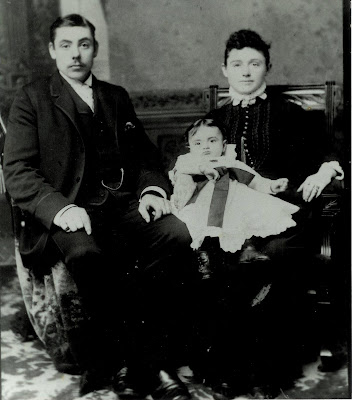
My Irish grandparents, c. 1900

My oldest brother (upper left in the Boston Harbor photo above), a merchant sailor, became radicalized by the Great Depression and went into the Deep South in the late 1940s, a blond northerner, as a labor organizer of blacks. I don’t know how he got out alive.

I graduated from Wesleyan University in Connecticut, and got a Ph.D. from Yale in American Studies, in 1971. I took a few years off from graduate school in the early 60s to go to New York, where I was involved in radical anti-Vietnam War politics. When I went back to Yale, I wrote my dissertation, "The Flesh and the Spirit," on the Indiana writer Theodore Dreiser. My thesis was that, in spite of his hard-boiled naturalistic exterior,
Dreiser was, though he did his best to hide it, a compassionate and religious person, a trait that he inherited not from his stern Catholic father but from his loving Mennonite mother. I placed Dreiser in “the prophetic tradition. "Dreiser and the Prophetic Tradition," was published in 1974 in the journal American Studies. For a link, click here. I aspire to be in that tradition as well, even though I am as opposed to organized religion as much as my grandfather was to Catholicism. But I admire the Old Testament prophets, who felt a deep obligation to stick up for the poor and the underdogs. I also admire their courage in speaking out against the abuse of authority. If I wasn’t going to be cremated, I would have on my tombstone a variation of a line from the poet E. E. Cummings: “There was some shit he would not eat.”

There is so much shit in Portsmouth you wouldn’t believe. My son, whom I’m enormously proud of, has a Ph.D. in Polymer Science and Engineering and is doing research on the genome structure of the DNA and RNA of viruses. He asked me about a year ago, “Dad, now that you’re retired, why don’t you move back to Boston?” I found myself answering, “Portsmouth is like a prison, but I’m deeply bonded with the inmates.” Mayor Kalb is just a figurehead, a lapdog, in that prison, but he is not the worst, unfortunately. Portsmouth has many good points but it has some very bad ones as well. Portsmouth has a reputation as Ohio’s prostitute and drug capital. Check out this You Tube Video by black rappers on Portsmouth. The most notorious drug-dealing pimp in Portsmouth, who is white, was appointed by Kalb & Company to the City Council.
Things like that infuriate me.

The Meetinghouse at Rumney Marsh

I would not like to spend the rest of my life writing River Vices in Portsmouth. What I want most to do with whatever time I have left is finish a book on a three-hundred-year-old church building (shown at left) near Boston that I have over the last twenty-five years tried to make myself an authority on. The building has changed much, but its great oak frame has survived all the changes.

Instead of being a scholar, I am writing a blog about the vices of Portsmouth. If Kalb is defeated next November 3rd (he lost the primary by a 2.5 to 1 margin to a woman), I like to think I will hug all the inmates, wipe away a tear, and take my leave of Portsmouth and the likes of him forever. I've paid my dues. I taught some aspiring Appalachians some grammar and a little Shakespeare. I've done my penance. Penance is the only thing about Catholicism I still believe in.

And, just think, I wouldn’t be writing about myself and River Vices wouldn't have over 100,000 hits in two days if that brainless clown of a mayor,
in response to my open records request, hadn’t called me a broke-down piece of shit he wouldn't piss on. In emailing me at 1:47 AM, he, and I, got the attention of the world, or at least the blogosphere, for 48 hours. Sweet are the uses of adversity.


.

Monday, September 28, 2009

Mayor Kalb: Burning the Midnight Oil


Because of the confusion over where the Kiwanis Playground was supposed to be built in Tracy Park, I requested, under Ohio’s Public Records laws, a copy of the agreement between the city and Kiwanis from Mayor Kalb. I made my request on Thursday, September 24, at 3:30 PM, and he replied by email late Saturday night, or rather very early Sunday morning. Always burning the midnight oil, he emailed his response at 1: 47 AM.
My email and Kalb’s response follows:


--- On Thu, 9/24/09, rforr1@roadrunner.com wrote:

From: rforr1@roadrunner.com
Subject: Freedom of Information
To: portsmouthmayor@yahoo.com
Date: Thursday, September 24, 2009, 3:30 PM
To: James Kalb, Mayor

Under Ohio's Open Public Records Law, I am requesting a copy of the written agreement between the city and the Portsmouth Kiwanis Club for a playground in Tracy Park. A week ago, on Sept. 18th, 2009, at a public meeting in Tracy Park,in response to a question, Rick Morgan of Kiwanis publicly acknowledged that such a written agreement existed, but neither he nor you have yet made that agreement public. Please notify me by email when I can pick up a copy of that agreement.

Thank you.

Robert Forrey


------------------------------------------------------------------------------------------------------------

From: City of Portsmouth
To: rforr1@roadrunner.com
Subject: Re: Freedom of Information
Priority: Normal. Date: Sunday, September 27, 2009 1:47 AM
To: Robert Forrey

Per your public records request;

You are correct in stating that at the meeting in the park the fact was "acknowledged that such a written agreement existed". What I don't understand is why you feel that a confirmation of this fact would necessitate a publication or distribution of the mentioned document.

As you requested, a copy of the document has been prepared for you to pick up at my office. Our regular office hours are from 8:00 AM to 4:30 PM, Monday through Friday.

If there is anything else that I can do for you, which is required by law, don't hesitate to call my office. If it isn't required by law then don't bother asking, because I think that you're a worthless piece of s**t and I wouldn't p**s on you if you were on fire (my opinion). You're a poor, lonely, jealous, old man with aspirations of being a writer. You write your lies and uneducated opinions on people and issues from behind the safety of your slobber stained keyboard with the hope that somebody will read them that doesn't know you and believe that you're more than the pitiful, broke-down, lizard-looking thing that you are, in my opinion. Get a life old man. On second thought, don't bother..............

I do have a question for you. Do you have family and if so do they even like you?

Looking forward to your next Internet issue of "FORREY'S FOLLIES".....NOOOTTTTTT

With little respect for you,
Mayor James D. Kalb

Now that's freedom of speech at its best, in my opinion.

----------------------------------------------------------------------------------------------

In closing, I want to point out that the last sentence above ("Now that's freedom of speech at its best, in my opinion") is by Mayor Kalb, not by me. I have refrained from expressing my opinion in this post because I feel, while he has every right to express his opinions, his reply to my public records request speaks for itself, speaks volumes in fact, about what kind of person we have as mayor. R.F.


.

Sunday, September 20, 2009

Kiwanis Playground: The Hole Truth


The history of America’s fraternal orders is in part the history of a variety of non-denominational quasi-religious sub-groups, groups in which members found a purpose and meaning in life through service to others. But some fraternal orders served other less noble purposes as well. Some orders resembled a college fraternity as much as a benevolent service organization. One of the features of such fraternal orders, like college fraternities, was the opportunity for male bonding. A college fraternity helped its members bond together in making the transition from adolescence to adulthood. A fraternal order helped socially insecure but ambitious male members rise in the world. Fraternal orders were better suited to go-getters than to those who had already gotten. Some orders, particularly those formed in the Midwest, were bastions of middle class conservatism, but not everyone, not even in the Midwest, approved of middle class conservatism. H. L. Mencken, by combining the words bourgeoisie and boob coined the term booboisie for the American middle class, whose stronghold historically has been the Midwest. Sinclair Lewis’s novel Babbitt (1922) added a new word to the American language, babbitry, which meant a smug and materialistic way of life hypocritically cloaking itself in civic boosterism and piety. Lewis’s character George Babbitt lived in the fictional Midwestern city of Zenith, which was thought to be modeled on Cincinnati, where Lewis lived while writing the novel.

By 1900 there were over a thousand fraternal orders in the United States, six hundred of which were secret societies emulating the fraternal order of Masons, which over the centuries had become the most important and influential fraternal organization not only in America but in the world. The Masons had already established the “builder” brand, identifying themselves with the masons who had built the pyramids of Egypt and cathedrals of Europe in the Middle Ages. But Masons claimed to be descended not just from the builders of pyramids and cathedrals but to be descended from the builders of human society, the architects of civilization itself. Without the Masons, whose membership included everyone from George Washington to Ben Franklin and Paul Revere, there probably would not have been an American Revolution, or at least not a United States of America, at least not in 1776. But the Mason’s notorious secrecy, hierarchic structure, and ritualistic rigmarole had turned off many Americans as being undemocratic and un-American. After the Revolution, Masons were suspected of all kinds of skulduggery, including the assassination of members who violated the solemn Masonic oath of secrecy. The fraternal orders that followed in Masonic footsteps by adopting the builder brand were adopting a brand that had become, in the eyes of many Americans, very tarnished. By 1900 there was a need of and a niche for a fraternal organization that would create a new more distinctly American brand, in which backslapping would replace secret handshakes. The way in which Kiwanis emerged as that new brand is an example of how big organizations, like mighty trees, can grow from little nuts.

In a Hole from the Start

In 1915, what would later be called the Kiwanis Club of Detroit Number One, was founded by Joseph C. Prance, a tailor, and Allen S. Browne, a salesman type, who had made a career of starting fraternal organizations, which gives us an idea of how many organizations there were when somebody could make a career of organizing them. Browne and Prance found themselves in a hole right from the start. For example, they named their new fraternal organization the Supreme Lodge of the Benevolent Order Brothers, or B.O.B., for short, not exactly a catchy moniker. In calling what they created a lodge, rather than a club, they were being too Masonic and not clearly American enough. It may have been Browne, since he would have had more marketing sense than his tailor partner, who realized their mistake and came up with a more American name for B.O.B. What could be more American than an Indian name? Look at how many states have Indian names, such as Massachusetts, Minnesota, Missouri, and Ohio? Why shouldn't a fraternal order have an Indian name? Browne and Prance chose a new name based on an Indian expression, "NunKey-wan-is." But, oops, they found themselves in another hole. "NunKey-wan-is" meant, “We have a good time—we make noise,” which might be a fitting name for a fraternity but not for a fraternal order that wants to be taken seriously as a benevolent society. (I got these details from an official source: “Kiwanis: Past to Present,” a brief history.) So the Kiwanis Club of Detroit Number One, as it became known, had to make another change. But having changed its name once already, taking a third name would only make establishing a new brand that much more difficult. Instead of changing the name Kiwanis, they changed the meaning of the phrase "NunKey-wan-is." After all, other than native Americans, of whom we can be fairly sure there were few or none in Kiwanis, who was going to know what the meaning of "NunKey-wan-is" was anyway? The important thing was Kiwanis became an organization that enabled bonded brothers to join together in serving humanity and to scratching each other’s back in business. Some form of insurance came with membership, so the commercial dimension was present in Kiwanis from the start.

So to attain respectability and escape the stigma of having begun an organization that sounded like a bunch of frat brothers, they assigned a new meaning to Kiwanis to suggest something more appropriate to the serious brand they were trying to establish. Instead of changing the word, they changed the word’s meaning. The notion took hold among Kiwanians that "NunKey-wan-is" meant not “We have a good time—we make noise,” but rather “we make and build.” In 1920, the editor of the Kiwanis magazine capped this trend by creating a simple civic-minded slogan: “We Build.” But in rebranding their organization by changing the meaning of "NunKey-wan-is" the Kiwanians got out of one hole only to find themselves in another. The problem with the “We Build” slogan was that it not only sounded Masonic, it sounded a bit moronic. In rebranding themselves as builders, they had reverted to the Masonic brand, and from a marketing perspective that was not the best move. But that was not a problem that Browne and Prance were destined to solve, because the Kiwanis Club of Detroit Number One fell apart after Browne was accused of putting the club in the hole financially by pocketing membership dues. But other Kiwanis clubs were founded in Chicago and Cleveland, and the movement that had begun inauspiciously and somewhat shadily in Detroit grew into a national and international organization, in spite of the marketing mistakes of Browne and Prance. But Kiwanis would remain fundamentally Midwestern in character and spirit, and it was appropriate that its headquarters would end up in Indianapolis in the quintessentially Midwestern state of Indiana. An argument could be made that the quintessential Midwestern state is Ohio and the appropriate site for Kiwanis headquarters would be Cincinnati, where George Babbitt was conceived.

To get out of the marketing hole of the “building” brand, Kiwanis went on to rebrand itself in a way that transformed the field of fraternal orders. It rebranded itself as the fraternal order that cares, and cares above all about children. With caring for kids as their new mantra, Kiwanis struck marketing gold, and ever since, in a kind of endless summer, has been surfing on that marketing wave. And why wouldn’t it? Is there any human emotion more universal and deeper than love of children? Not just parents, but adults in general love children. In children adults can simultaneously glimpse the future and take a trip back to their own past. How could an organization that adopted as its mission the welfare of children not succeed and become a powerful and influential international organization?

Snookered City

But the Kiwanis "kid caring" brand still retained some of the Masonic “builder” brand. “Caring for Kids” became the successful brand and the “building” shtick was subordinated to it. Middle school students can now join Kiwanis “Builders Clubs,” but in terms of marketing, the “builder” brand is about at the middle school level. Kiwanians are still in the building business but only in so far as they build for kids. They build everything from hospital wings to playgrounds for kids. Ka-Boom! and its “Playful” brand, which I have written about before, has managed to horn in on the playground business, and naïve public officials all across America have been snookered into proudly posting signs that proclaim theirs as a “Playful City,” even though in many cases those cities were losers in the Ka-Boom! competition. A sure-fire contest is one in which everybody is a winner, even the losers. Compared to the Kiwanis brand signs at the entrance of many cities, the “Playful City” brand provides about as much brand recognition as British Knights in the sneaker world have vis-à-vis Nikes. It is ironic, in view of the tree and kid issues involved in the current Kiwanis Playground mess in Portsmouth, that on the way into town on Route 23, drivers pass an “Arbor City” brand sign under a “Playful City” brand sign. The sign that drivers should see as they drive into Mayor Kalb’s hometown is “Portsmouth: the Snookered City.” Or, better yet, Portsmouth should be called not "Tree City," but "Paw City," for reasons I gave two postings ago.


Welcome to Snookered City


The controversy over the Kiwanis Playground illustrates the holes Kiwanians are still capable of digging for themselves. The spirit of Prance and Browne lives on. Kiwanis is such a powerful and influential organization that when it finds itself in a community, such as Portsmouth, where local government has atrophied and where the incompetent and the unindicted too often end up in public office, then it is hard for the high-minded mission-oriented Kiwanians not to become arrogant and to overreach, as they apparently have in regard to the Portsmouth Kiwanis playground.

Gathering Round the Hole

I spent an hour or so Friday morning (18 Sept. 2009), one of about twenty-five people who had gathered around a gaping hole in Tracy Park where the playground was supposed to be built. Standing around the hole, we were able to listen to and ask questions of the state forest ranger Ann Bonner about the Tracy Park Kiwanis playground mess. Construction of the playground had been halted the previous week after concerns had been raised about the safety of the trees and more importantly about the safety of the children who would be using the playground. What struck me most about the round-the-hole discussion was why the number of important issues and problems that were being discussed—largely related to environmental and engineering issues— had apparently not even been raised before. What I came away from that discussion with was the sense that the Kiwanis and Mayor Kalb had dug themselves into a public relations crater that was much deeper than the hole we had stood around. That physical hole will soon be filled in and the playground built, but the Portsmouth Kiwanis Club is going to be in a public relations crater for a long time.

Initially, on the basis of what he could see, a Portsmouth horticulturalist, Ray Gibson, didn’t think any tree roots had been destroyed. But James Warnock later said he had witnessed large roots being bulldozed and hauled away. Warnock also said that employees and equipment belonging to Neal Hatcher’s construction company, JNH, had helped the city in bulldozing and trucking the roots away. (Somebody told me Hatcher had denied to the Portsmouth Daily Times that his company was involved in any way.) If large roots had been removed, then the trees might be damaged. But it usually takes trees four or five years to show signs of root damage. Gibson proved to be so knowledgeable about how the playground project should have been built that Rick Morgan, representing Kiwanis, asked him if he would be willing to serve as a consultant on the project. Again I wondered why Kiwanis had not got Gibson or some other horticulturalist on board, and contacted a state forest ranger, in the beginning. It seemed to me like the barn door was being closed after the horse had bolted. Do you get a horticulturalist involved only after tree roots have been ripped out?

The question I asked at the round-the-hole discussion was whether the Portsmouth Kiwanis Club and the city had a written agreement. Rick Morgan, speaking for Kiwanis, replied there was. That written agreement could be a very important document in helping resolve this controversy. Mayor Kalb should make that agreement public. The Portsmouth Daily Times reported that when they finally reached Kalb in North Carolina last weekend, he said “that the first time he heard there were any problems with the project was Thursday [10 September 2009] when he began receiving calls from concerned citizens that digging may be damaging important trees and state-listed trees.” The PDT then quoted Kalb as saying, “For some reason, when they started digging, they moved from the original location and now the playground is around some trees” (emphasis added).


If there is a written agreement, and if Kiwanians changed the agreed upon site in the written agreement, that raises ethical and legal issues. Who do they think they are, changing the location of the site without the city government or even the mayor knowing or approving of the change? By changing the site, the Portsmouth Kiwanis Club may possibly be jeopardizing not only the well-being of the trees but more importantly the well being of the children, the caring of which is supposed to be the essence of the Kiwanis brand. The hazards associated with having the playground on the busy southeast corner of Tracy Park is the reason some people are objecting to the playground. Some residents feel that, ideally, the playground should not be located anywhere in Tracy Park, because the park is like an island surrounded by a heavy flow of traffic. It was certainly surrounded by a loud sometimes fast stream of traffic on Friday morning, when the round-the-hole discussion took place. One passing motorist rolled down his window and angrily shouted something like, "That's no place for a playground!"


Keep Your Eye on the Holy

“The Six Permanent Objects of International Kiwanis," underscore the spiritual and humanitarian goals of the organization. But let us be intellectually honest and recognize those goals as religious, even if the organization itself denies it is a religion. Keep your eye upon the holy and not upon the hole. The Six Objects are the Six Commandments of Kiwanism, and one of those “Objects” is revealing and deserves close scrutiny: To develop, by precept and example, a more intelligent, aggressive, and serviceable citizenship.” “Aggressive” is the revealing adjective in that Kiwanian Object, because aggressive is just what Portsmouth Kiwanis has been from the start in the marketing of the Kiwanis playground project. The two Abrahamic faiths that grew out of Judaism, Christianity and Islam, became progressively more aggressive in marketing their brand until now it seems the rivalry and hatred that exists among the three Abrahamic faiths may result in the nuclear annihilation of civilization. Some “builders” they turned out to be! Masonry was as successful as it was in part because it denied it was a religion at the same time that it secretly acted like one. The Catholic Church knew a rival when it saw one and excommunicated Catholics who joined the Masons. The Kiwanis took after the Masons in acting like a religion, and a very aggressive religion, while denying it is one.


In this Kiwanis Playground controversy, anger and hatred are being stirred up against those who have concerns about the project. James Warnock and his wife Donna are among those who are being demonized because they have expressed safety concerns about the project. They are being accused by politicians of being political. The safety concerns are being dismissed as “political.” The Warnocks are not politicians. They are citizens who happen to have reservations about locating the Kiwanis playground in Tracy Park. The only organization they have been involved with is the Portsmouth Beautification Society. Donna Warnock resigned from the society recently, claiming it had originally been opposed to putting the playground in Tracy Park, but because of political pressure the society had become a backer of the playground in the park. For not agreeing with Kiwanis and the Beautification Society that Tracy Park is the best place for the playground, the Warnocks, a low-key couple, are being characterized as meddlers and trouble makers.


The Portsmouth Kiwanis Club has to understand that they have no monopoly on caring about kids. Their brand may be caring for children, but in this playground mess I think they are showing a callous disregard for children. They may be guilty of wanting to publicize the good they are doing for children so much that they are willing to put the Kiwanis playground on the most dangerous corner in Portsmouth. They may be following that real estate adage—location, location, location. As a result of the aggressive marketing of their brand, the people in the hundreds of thousands of vehicles that will drive by that corner annually will be reminded of what a wonderfully kid-caring organization Kiwanis is, but they better keep their eyes peeled for kids unaccompanied by adults dashing across Rte. 23 to get to the playground.


There has been an attempt by Kiwanis, the mayor, and the media to shift the focus from traffic and kids to trees and roots, and to portray James Warnock as a tree-hugger. But Warnock made clear to the PDT, “My main concern is and always has been, first and foremost the placing of a children’s playground in a busy commercial area and secondarily, the health of the historical trees in Tracy Park.” This is not just about trees and roots; it is about children and traffic. But the party line the PDT is peddling is that it is about trees and roots, as is evident in John Stegman's "Stopping the March of Progress" and Frank Lewis's "Let's Move Forward with the New Playground." I am surprised Lewis could not come up with a quote from Abraham Lincoln in favor of Kiwanis playgrounds.


The cause of the Playground controversy is not the Warnocks, it is Kiwanis and Jim Kalb, our Out-to-Lunch-and Off-to-Another-Motorcycle-Race-in-the-Carolinas-Mayor. I think the image or “brand” Kalb has created as mayor is, “I’ll let you do what you want if you just let me take long lunches and long weekends in the Carolinas living out my Marlon Brando Wild One fantasies.” If the mayor had been minding the store more, if he had been monitoring the playground project better, this controversy might have been avoided. Being out to lunch is one thing, but being in North Carolina and not knowing that Kiwanis had shifted the site of the playground is another.


Unwise and Unlawful

As things now stand, the playground may be not only unwise but unlawful. It may be in violation of Ohio Revised Code 713-02, dealing with a local planning commission’s duties and powers. ORC 713-02 states that nothing, including a playground “shall be constructed or authorized to be constructed in the municipal corporation, or planned portion thereof unless the location, character, and extent thereof is approved by the [planning] commission.” I am not aware that the planning commission, the city council, or any other body has considered and approved the Kiwanis plans for the playground.

Kalb’s motorcycle fantasies, or chickens, may be coming home to roost in the Kiwanis playground mess, and those chickens could morph into vultures, since the lives of the trees and the kids crossing the heavy traffic to get to the playground may be at stake. That may be the truth, the unholy truth, about the Kiwanis playground controversy.


For an important follow-up on this post be sure to read, "Kiwanis Playground: Deathtrap for Tots" (click here).