Tuesday, November 18, 2014

A Brief History of Portsmouth's Psychotropic Addictions


In the last sixty-five years or so, psychotropic (mind altering) drugs  have had a profound  impact on America and on  Portsmouth in particular.  The history of  psychotropic drugs, at least in Portsmouth, can be divided for rhetorical purposes into roughly  five  overlapping stages. Those could be called, based on the psychotropic drug that predominated in each:  (1) the chlorpromazine (2) the meprobamate;  (3) the benzoylmethylecgonine; (4) the paramorphine; and (5) the buprenorphine  stages. Except for the anti-psychotic chlorpromazine, which was marketed in the U.S. as Thorazine, all of these drugs are addictive to varying degrees. However, the withdrawal symptoms associated with Thorazine can be similar to withdrawal from addictive drugs.


The Chlorpromazine (anti-psychotic) Stage


Above: The psychotropic anti-psychotic chlorpromazine in 3D molecular structure

The first important psychotropic drug in America was the powerful anti-psychotic chlorpromazine,  marketed in the United States as Thorazine. First synthesized in 1950, chlorpromazine revolutionized the psychiatric care of psychotics, particularly schizophrenics. According to Wikipedia, “The introduction of chlorpromazine during the 1950s into clinical use has been described as the single greatest advance in the history of psychiatric care, dramatically improving as it did the prognosis of patients in psychiatric hospitals worldwide.”  In the 1950s, I worked as a psychiatric aid in mental hospitals in Massachusetts and Connecticut  and witnessed firsthand the dramatic improvement  in  the treatment of patients brought about in large measure by chlorpromazine.

I began as a psychiatric aid at Boston State Hospital where I  assisted in the use of hydrotherapy and electro-shock to treat psychotic patients. But just several years later I worked as an aid  in a private mental hospital in Hartford delivering chlorpromazine to more tractable patients. In the 1960s and 1970s, because of  the “tranquilizing” effect of chlorpromazine on psychotics, many public mental hospitals closed down, as Boston State Hospital did in 1979 and as the  Receiving Hospital did in in Portsmouth decades later. Because of advances in  anti-psychotic medications  and the subsequent deinstitutionalization of mental patients, today people are walking the streets in  American cities, including Portsmouth, who would  have been institutionalized  in the 1950s. Diversity was not a virtue in the '50s, when there was little tolerance for deviation in sex, politics, or social behavior.

The Meprobamate (tranquilizer) Stage


Above: The 3D molecular structure of the psychotropic diazepam  (Valium) 
The success of Thorazine helped set  the stage for the synthesizing of milder psychotropic drugs for the treatment of patients with emotional rather than mental problems, patients who were classified as neurotic rather than psychotic. The first tranquilizer, meprobamate, was marketed as Miltown in 1955. “Thorazine—which offered the first effective treatment for schizophrenia—had revolutionized the treatment of institutional psychiatry,” Newsweek reported in 2009, “and Miltown seemed to offer a pharmaceutical counterpart to the management of everyday nerves.” People of a certain age will remember what could be called the  Miltowning of America in the late 1950s. To quote Wikipedia again, “Launched in 1955, [Miltown] rapidly became the first blockbuster psychotropic drug in American history, becoming popular in Hollywood and gaining notoriety for its seemingly miraculous effects.” The pharmaceuticals that developed them usually touted the “miraculous effects” of new  drugs, which was the case with meprobamates. The  harmful side effects were downplayed if not denied entirely. Just as the tobacco industry covered up  the carcinogenic risks of tobacco,  the pharmaceuticals downplayed the addictive nature of tranquilizers.

Miltown was followed by Librium and then  Valium (diazepam), which,  after it was introduced in 1963, became the most widely used  tranquilizer in the world.  Valium was prescribed for everything from phobias to depression, and from anxiety to restless leg syndrome. But it became clear over  time that tranquilizers, including  Valium, were addictive, and when used regularly for a long period, became a serious problem. The  withdrawal symptoms that users experienced when they tried to stop taking Valium were  severe. I know a woman  in her nineties who was addicted to Valium for over  a half century, with only her doctors and close relatives knowing that she was. From what I have gathered, the  first prescription drug addicts in Portsmouth were not long-haired youths but respectable, responsible members of the community who were victimized by the pharmaceuticals that synthesized meprobamates and  by the  doctors who overprescribed them.

The Benzoylmethylecgonine  (cocaine) Stage


It was illegal drugs such as heroin and meth, and particularly cocaine (benzoylmethylecgonine), that became the drug of choice in Portsmouth for so-called recreational users. One of the consequences of the  cocaine stage was that the money it illegally generated remained in the underground economy. Drug dealing is a cash only business. That's especially the case with cocaine. The on-line  National Geographic News, of all soures, reported in 2009 that nine out of ten American bills show traces of cocaine. The traces get there when the bills change hands in a drug deal or when addicts use the bills to snort coke.  The coke trade  did little for the chronically depressed economy of Portsmouth. Instead of helping the economy, the money generated by  the cocaine trade  created havoc.  Another problem with cocaine, especially crack cocaine,  was that  too many of  the dealers and  their customers went to jail or died of overdoses. The high incarceration and mortality rate was not good for the coke business. If you have a business that caters to customers who end up behind bars or dead, you do not have customers you can bank on.

As a sign of the extraordinary pervasiveness of the drug problem in Portsmouth’s cocaine stage, the son of the mayor, the son of the police chief, the son of a prominent judge, the son of a prominent lawyer, and the sons and daughters of other prominent fathers became addicted, with some of those sons becoming  dealers themselves. Though more sons than daughters became addicts, the daughters were by no means closeted, for many of the  streetwalkers in Portsmouth were hooked on drugs.  Some years ago I talked to an addicted prostitute on John Street who told me she was related to a bail-bondsman. There was no escape from drugs no matter what family or which social class or which side of the law you were on, or whether your dad was a criminal or a judge. 

 During the crack stage, local, state, and federal governments spent much more money on  than for addicts, much more money arresting, prosecuting and incarcerating than  rehabilitating addicts. There was much more money to build jails to lock addicts up than there was for clinics to treat them.  In 2006,  at the tail end of the crack craze, the $12.5 million dollar Scioto County Jail opened for business with the expectation that if you built it they would come. But with the attrition of crackheads, the new jail had  trouble maintaining full occupancy. That meant the county was losing money while  still having to pay about  $350,000 or so annually to service its debt for the jail.

Jailing addicts for  crimes that were both directly and indirectly related to drugs became  a highly competitive business. The financially strapped Scioto County Jail sought to have prisoners from other counties’ crowded jails transferred to its underutilized facility. Under this arrangement, the other  counties picked up the tab. The Huntington Herald-Dispatch reported in 2014 that ten Lawrence County prisoners had  been incarcerated  at the Scioto County Jail in 2013 at an annual  cost of $230,869 to Lawrence county. When Lawrence county sought to have the empty former youth prison in  Franklin Furnace serve as a less expensive backup to its crowded jail in Ironton, the Scioto County commissioners and sheriff strongly objected, calling the Lawrence County plan not only unfair and in violation of state statutes but also “stupid.”  For competing contiguous counties to be calling each other names is just one of the indirect consequences of the drug epidemic in southern Ohio where addiction, at least for law enforcement agencies, has been  a growth industry. Much of the breaking and entering of homes and automobiles in the Portsmouth area was done by addicts desperate for money to buy drugs. Incidentally, many  drug-related petty crimes were not reported to the police during chief Horner’s stewardship, so Portsmouth’s official crime rate was probably a lot higher than statistics suggested, though those rates were already quite high.

The Paramorphine (oxycodone) Stage

Above: The 3D molecular structure of the psychotropic drug  oxycodone 

The oxycodone stage of addiction in Portsmouth was more profitable than the cocaine stage at least for the pill-mills and those connected to them. Instead of the illegal cocaine, heroin, and meth that fueled the cocaine stage, the oxycodone stage was fueled by a  less potent but  fairly expensive and widely available psychotropic prescription drug. The best selling  brand of oxycodone, Oxycontin helped alleviate pain, including the pain  associated with withdrawal from more potent narcotics, but without producing the high that addicts crave. What made Oxycontin less potent was its timed-release formula. The user did not experience its potency all at once but  gradually, over time. But the timed-release formula was far from foolproof.  An addict was able to easily unleash Oxycontin’s  potency immediately by  chewing, pulverizing, or liquefying it, in which forms it could be swallowed, snorted, or injected.  Even the addition of nalaxone to produce nausea when the drug  was taken in large doses did not stop Oxycontin addiction in the Portsmouth area from  increasing exponentially.

On 9 April 2011, a New York Times reporter wrote of Portsmouth, “This industrial town was once known for its shoes and its steel. But after decades of decline it has made a name for itself for a different reason: it is home to some of the highest rates of prescription drug overdoses in the state . . .” Things got so bad in the Portsmouth area that Governor Kasich said publicly that, when it came to pill-mill prescription drug abuse, “The devil is in control in Scioto County.” One public health official reported one in ten babies born in Scioto County were addicted. The police chief reported that more people had died in Ohio from drug overdoses in 2008 and 2009 than had died in the 9/11 World Trade Center attack. What the police chief, Charles Horner, did not report was that his addicted, drug-dealing son was one of those responsible for the overdose deaths. I was told by someone in a position to know that Horner’s  son brazenly dealt drugs in a restaurant directly across the street from the police station.

Typically, the local  media at first  turned a blind eye to the pill mills as chief Horner had to his son.  In the same downtown office building and on the same floor as the local radio station WNXT, one shady  out-of-town doctor opened a pill-mill office with patients from the tri-state region lining up like customers at  the popular DariCreme on 2nd Street. When a veteran WNXT newscaster learned  a  pill-mill down the hall had been raided,  its existence was news to him.

The doctors who indiscriminately prescribed and the people who owned and operated the pill-mills made  millions of dollars, and in doing so gave a boost to the  local economy, but at  what a cost. Oxycontin became so  widely used and abused that Portsmouth became known as the Oxycontin capital of the nation with one Portsmouth doctor reportedly writing more prescriptions than any other doctor in the country.  The Portsmouth pill-mills became so out of control in their pursuit of profits that they were finally raided by federal, state, and local federal law enforcement agencies. Some of the pill-mill owners and doctors  were arrested and convicted, bringing a reduction, though certainly not an end, to Oxycontin  addiction in Portsmouth.

The Buprenorphine (Suboxone) Stage


Above: The 3D molecular structure of the psychotropic buprenorphine (Suboxone) 


Much more savvy and public-relations oriented, and much better connected politically, the counseling centers in the Portsmouth area, were ready to take up the slack created by the closing of the pill-mills.  While some addicts have been helped by the centers,  profits and politics, not the Hippocratic oath and humanitarianism,  have been dominant in the   buprenorphine stage of Portsmouth’s drug history.  The cost of treating addicts in counseling centers has been paid for primarily  by the government and ultimately by the  taxpayers through Medicaid and since 2014 by the Affordable Care Act, which Republicans have dubbed Obamacare. The cooperation and  collusion between pharmaceutical executives,  U.S. government officials, and unscrupulous professionals,  who were involved in a revolving door arrangement, account in part for the success of counseling centers in the Portsmouth area.

The Counseling Center, Inc. and the Community Counseling and Treatment Services (CCTS), operate clinics and halfway houses in Portsmouth where what they euphemistically call “clients” are treated. A key component of that  treatment of addicts now includes the psychotropic drug buprenorphine,  of which Suboxone became the most  controversial example.  Outselling even Viagra, Suboxone generated $1.5 billion in American  sales in 2010. Suboxone was developed not by an American pharmaceutical but by a British company,  Reckitt and Benckiser (RB), that specialized in health and household products, such as Clearasil and Lysol. The U.S. government spent $89 million to help RB develop and market Suboxone  on the grounds that it was safer than methadone. Safer? A  firefighter  whose son became fatally addicted to Suboxone remarked that  the difference between more potent drugs and Suboxine was like the difference between Budweiser and Bud Lite, meaning an alcoholic who switched to Bud Light was still a drunk and an addict who switched from Oxycontin to Suboxine was still an addict. Reckitt and Benckiser tried to  discourage addicts from abusing Suboxone by adding  nalaxone, an “abuse deterrent,” to it. If addicts crushed and injected Suboxone, the nalaxone was supposed to produce excruciating pain and nausea, but that apparently was  not enough to stop addicts from abusing it. Suboxone  is one of the drugs that has made overdoses rather than car accidents the leading cause of accidental death in the U.S.

The U.S. government tried to control the abuse of Suboxone  by allowing only designated doctors to prescribe it and by limiting those doctors to thirty patients, but that number  was later raised to 100. In spite of these controls, the illegal use of Suboxone proliferated.  In 2011, the number of emergency room visits resulting from the illegal  use of Suboxone were well over 21,000, which was nearly five times what they had been five years earlier.  The doctors who prescribed Suboxone were far from simon-pure and some of  them had even been law-breakers. Rather than the Hippocratic, they appeared to have taken the hypocrite oath. Their primary objective was not to help the addicted but to get rich. As reported in the New York Times  (15 Nov. 2013), Dr. Robert L. DuPont, the first director of the national drug abuse institute, said that at  a recent meeting of the addiction medicine society, “the buprenorphine sessions were all packed with doctors who wanted to get in on the gold rush.” Too many of the doctors who became Suboxone  prescribers did so because they saw it as a bonanza for their faltering practices. Among them were doctors who had been sanctioned for drug addiction; or convicted of Medicaid fraud and of smuggling steroids from Mexico; or of conducting an “excessive number of invasive procedures”; or of failing to report a case of rape of a pediatric patient and of  having intercourse with patients in the office. The government’s screening process was clearly lax. In Ohio, it turned out that nearly 17 percent of the doctors given permission to prescribe  Suboxone had been previously disciplined by authorities whereas only 1.6 percent of Ohio doctors in general had been. If it was 17 statewide, it is easy to believe the percentage was even higher in Portsmouth, one of state’s most addicted cities.

The Treatment Services (CCTS) recently had its clinics in Portsmouth raided by police. According to channel WNXT, CCTS owner Paul Vernier and his employees had been engaged in trafficking in drugs, laundering money, and defrauding insurance companies and the U.S. government by forging prescriptions. In addition to searching for evidence in Vernier’s Portsmouth clinics, the police also used a search warrant to look for incriminating records and papers at his palatial hillside house in West Portsmouth. The other Portsmouth operation, Counseling Center, Inc., which has influential friends in the county government and in the state legislature, continues doing  business as usual in Portsmouth. The raiding of Vernier’s clinics removes Ed Hughes’ chief competition. Business for Counseling Center, Inc., with its motto “We believe in miracles,” is prospering and expanding, especially in the historic Boneyfiddle district.

When I began my blog River Vices in 2004, I said Mark Twain felt river cities had more than their share of vices and I thought that Portsmouth was no exception. I never knew a city that had more religion and less morality than Portsmouth, which calls to mind  Twain’s remark that “religion began when the first con man met the first fool.” The  slogan of Counseling Center, Inc., suggests Hughes might be using the Almighty to cloak his lucrative business in religion, as Vernier seems to have done by naming a real estate business he owns Blessed Realty, L.L.C. Blessed are the realtors in spirit for they shall profit from the First Commandment of Portsmouth politics (click here). That reminds me that Tammy Faye Bakker and her convicted televangelist husband Jim Bakker named their profitable non-profit televangelist racket PTL, short for "Praise the Lord!" That's what she used to exclaim tearfully and often on the Jim and Tammy Show, heavy mascara running down her rouged cheeks.  Incidentally, it may not be coincidental that Tammy Faye turned out to be addicted to Valium. Whether or not  Ed Hughes’s Counseling Center turns out to be a racket, he has become a multi-millionaire, according to Austin Leedom, the dean of Portsmouth's investigative reporters. What I will explore in my next post is the possibility that Hughes may be addicted not to any of the five drugs discussed above  but to the most powerful and pervasive drug in the world. What is that drug? Stay tuned.

Relevant Posts

"From Pill Mills to Counseling Centers" (click here).

Thursday, November 06, 2014

The Houses of Hughes and Vernier

Vernier's $425,000 house and 2.5 acres on a hill in West Portsmouth


Who’s the more remote caregiver?
Hughes prefers a house on a hill with a view.
Vernier prefers a hill near the river.
Hughes owns one big house, Vernier two.

Like teetotalers selling booze to souses,
Or the Wolf pimping for Red Riding Hood,
They profit from putting halfway drug houses 
In somebody else’s neighborhood.

Hughes' big house on a hill in Sciotoville


Some call Vernier a crook, he says he ain’t.
He christened his real estate company Blessed.
His addicted  “clients” consider him a saint,
But he’s less Joan of Arc and more Mae West.

They say Hughes is worth multi-million,
That he’s got the coroner in his corner.
He's sort of like a hooker at a cotillion
Snatching the plum from Jack Horner.

The plum's the Counseling Center
With its front-end—Compass Point Housing—
And its rear-end, like a centaur,
Badly in need of delousing.

A centaur badly in need of delousing


Relevant Links (click below)

http://oh-scioto-auditor.publicaccessnow.com/PropertyInfo.aspx?mpropertynumber=15-1951.000&mtab=property&p=15-1951.000


Monday, November 03, 2014

SUBOXONE BLUES

An aerial view of Ed Hughes' big house high on a hill


It takes a whole lot of Suboxone
To detox a toxic oxen.”
                          Bob Dylan

Ed Hughes profitably arouses
Subsidized “clients” in halfway houses
Suboxoned by counseling louses
Who then put the bite on House mouses.

Hughes lives not in a humble abode
But in a big house located on high
Where the floods never flowed,
Up close to the Guy-in-the-Sky.

Hughes lives not in a humble abode
But in a big house located on high,
Which ain't exactly Tobacco Road,
Way above addicted small fry.

Hughes lives not in a humble abode
But in a big house located on high
Far from houses that don’t meet code
Where addicts overdose and die.

Hughes lives not in a humble abode
But in a big house located on high
Where the grass is always mowed
And crack houses are a far cry.

Hughes lives not in a humble abode
But in a big house located on high
Where his garden’s always hoed
By the best tools money can buy. 

Hughes lives not in a humble abode
But in a big house located on high
Where taxpayers always get snowed
And his PR men always lie. 

                           Robert Forrey, 2014

House mouse coronoritus terryonus

Wednesday, October 29, 2014

"Something There Is That Doesn't Love A Wall"


And the Wall Came Tumbling Down


“Something there is that doesn’t love a wall,” Robert Frost wrote in one of his unforgettable poems. Because the walls stand in the way of their roots growing in that direction, roots are among the things that don’t love walls.

Sometime  early in the morning a few days ago, the wall at the northwest corner of Washington and 4th Street collapsed, sending bricks and large cinder blocks on the sidewalk. Because the roots had finally had enough of the tall brick wall, the wall had to make way for the roots that had undermined it. The wall is part of the property at 633 4th Street, which is currently owned by Dr. Alain Asher, the heart surgeon who recently moved to Arizona. The previous owners of the property and the lovely, landmark house on it, had neglected the tree.

If the wall had collapsed during the day, a pedestrian or the elderly man in a motorized wheelchair who passes there almost daily could have been injured. More menacingly, if the towering dying tree shown in the photo above fell  in the direction of Washington Ave.which with its roots exposed on its eastern side is the direction it likely would fall—it will probably hit the utility pole, and the tree and pole could fall on one of the many passing vehicles with such force that anyone in the vehicle could either be killed or seriously injured. Every hour that the tree remains in its current precarious position poses a serious public danger. Until that ancient, dying tree is removed, Washington Street should be cordoned off in that block and traffic detoured.


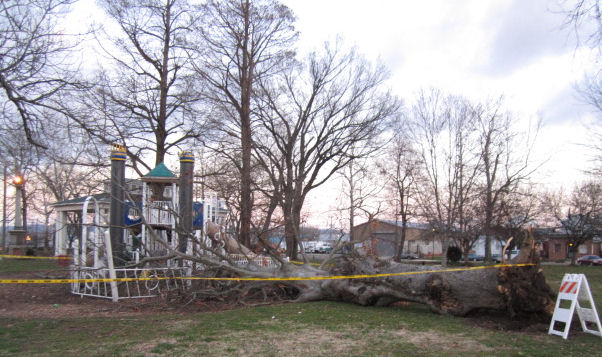
The situation at the northwest corner of Washington and 4th Street reminds me of the situation that existed in the southwest corner of Tracy Park when the city allowed Kiwanians to build a playground  in the southeast corner of the park, near trees that were in danger of falling on the playground because  some of their roots would be cut during the construction.    In spite of warnings from concerned citizens, the playground was built and within a couple of years a tall tree fell directly on the slide that children often used during the day and on a bench that parents sometimes sat in to keep an eye on their kids. Fortunately, the tree on the southeast  corner fell late at night and no one was injured.

The incompetent Jim Kalb was the mayor back when the Kiwanis playground was built, and he is mayor again. The more things change, the more morons end up being mayor of Portsmouth. But we now have a city manager, whom some people believe is not a moron, so maybe something will be done promptly to end the hazardous situation at the northwest corner of Washington and 4th. I will forward this post to his office.

Kiwanis Playground and Fallen Tree


The Cover-up: An Update on 633 4th Street

Since I last wrote on the fallen wall at 633 4th Street (see article above), there have been developments. Dr. Alain Asher, who now lives and practices medicine in the Southwest, tried for several years to sell the house. That attempt failed and to make matters worse the wall fell under pressure from tree roots  in late October of last year,  making a sale all the more difficult. In addition to the falling wall, the exhorbitent price he paid the Clayton Johnsons $440.500 for the property, which was almost twice what the Auditor's Office valued the property at, which was $244.150. So Asher paid almost $200,000 more than  the Auditor's valuation. If the property had been on the Hill, that would have been one thing, but 633 4th is in the heart of the Boneyfiddle district where the value of property, already low because of chronic poor Portsmouth housing market,  is falling further because of the presence of the Counseling Center, which has been attracting drug addicts from the tri-state area for decades. The reported crime rate in Boneyfiddle is high; the unreported rate is appreciably higher because residents often do not report petty crimes because it is a waste of time.

One of the new developments at 633 4th is that Asher  has reportedly leased the property to a doctor at the Southern Ohio Medical Center. Coinciding with the leasing of the house, the fallen wall is being rebuilt, but nothing is apparently being done about the tree whose exposed roots bulldozed the previous wall. One of the purposes of the new wall is to cover up the old problem of the huge trees at the northeast corner of the property. Asher is not prepared, perhaps is not financially able, to pay for the huge costs that would be associated with removing those trees, and in particular the tree whose roots are exposed. But by allowing him to cover up what is a hazardous situation with a new wall,
the city bears some of the moral and financial responsibility for any injuries or deaths that might result should that tree, sooner or later,  fall. The fact that we now have a city manager makes very little difference. He is surrounded by and collaborates with the same kind of crooked city officials who previously got away with cover-ups in the past. Jim Kalb is still the incompetent crook he had always been and he will soon be joined on the city council by Jo Ann Aeh  who deserves the title Coordinator of Corruption for the role she played in the past as the city clerk.


Relevant Posts: "Kiwanis Playground: Deathtrap for Tots?" Click here
                             "The Hole Truth": click here

http://rivervices.blogspot.com/2013/03/kiwanis-playground-deathtrap-for-tots.html
http://rivervices.blogspot.com/2009/09/test-playground.html

Thursday, October 09, 2014

Here Comes the Judge!


ROACHES OVERWHELMINGLY FOR JONES


                               1

Listen voters and you shall hear
Of candidate Jones’ incompetent career,
Getting less done from nine to five
Than any man now alive
On any day, in any year,
In one and out the other ear.
As Portsmouth city solicitor,
His performance was so poor
In the office and the courtroom,
He didn’t know his who from his whom.
In fact, he was so ill-suited for the job  
That he prosecuted Harald Daub
For allegedly shoplifting a shopping bag
From Aldi’s—Yes,  a shopping bag!—
But the jury unanimously acquitted
Daub, Jones having proved himself half-witted
And guilty of gross incompetence,
Revealing himself as very dense
By showing an Aldi videotape
Over and over again as if a rape
Was being committed, as if Daub
Was attempting to brazenly rob
Or commit a felonious assault
While doing a double summersault. 
But he was doing nothing of the sort,
As the jurors could see clearly in court,  
As shown by the security camera,
Which was very different from Jones’ chimera.
Having been found unanimously not guilty. 
Daub deserved an apology, not a penalty, 
For Jones had shown himself to be not Perry Mason
But Inspector Clouseau, avec très peu de raison,
Bumbling ahead without a clue,
Worthy of inclusion in The Fool’s Who’s Who.

                                       2

A fool in court, without any ands, ifs, or buts,
Jones was a royal dunce when it came  to donuts.
His name will forever be Crispie Cremed
With the  roaches with which his donut shop teemed—
Roaches in display cases, on the counter,
More roaches than you would ever encounter
In roach motels or in greasy diners
Or in all the pantries in the Carolinas—
Roaches on the ceiling, roaches on the floor,
Roaches lining up impatiently at the door,
Roaches with reservations, roaches without,
Roaches without pull, roaches with clout,
All waiting to fulfill their crummy dream,
Of carte blanche at Jones’ Crispie Creme
Where appalling, unsanitary conditions
Led the neighbors to circulate petitions.
For the roaches, Crispie Creme was all the rage, 
But customers avoided it like the plague.
Now, if those roaches were allowed to vote
That would sure be all she wrote,
For Jones would be judge in a landslide,
With swarms of insects by his side 
Because roaches don’t know from incompetent.
To the  roaches Mike Jones was heaven-sent,
Which is why they’ll shout, “Here comes the Judge!”
And from him they will never budge, 
And in Portsmouth the future tense
Will be drugs, drugs, drugs and the usual nonsense—
Counseling Centers, half-way houses,
And judgeships filled with incompetent louses.

                                Robert Forrey, 2014


The kind of shopping bag Daub was falsely
accused of shoplifting from Aldi's

      Other relevant posts from River Vices

Donuts, Obesity, and Diabetes (click here)
La Cucaracha (click here)
From Dollars to Donuts (click here)
The Trial of Harald Daub (click here)


http://rivervices.blogspot.com/2014/06/donuts-obesity-and-diabetes.html
http://rivervices.blogspot.com/2012/04/la-cucaracha.html
http://rivervices.blogspot.com/2009/03/from-dollars-to-donuts.html
http://rivervices.blogspot.com/2009/03/trial-of-harold-daub.html

Wednesday, October 08, 2014

KWJ's Three Harmful Legacies


First Harmful Legacy


"It was not long after the change back to the City Manager form of government that KWJ became President of City Council in which capacity, with his shaved head, he bore some resemblance to  Mussolini, il Duce, the dictator of Italy during the Second World War." 

I have already written a post on Kevin W. Johnson’s most harmful legacy in Portsmouth, (click here) which is the misnamed City Manager form of government. It should be called the City Council form of government. Under the City Manager form the mayor is either eliminated completely or retained as a political eunuch. The City Manager form of government increases the authority of the City Council. The City Manager, in the absence of a mayor, becomes  subordinate and answerable to the City Council, which has the authority to hire and fire him or her. The City Council has the authority to formulate the policies it wants the City Manager to carry out. Though Portsmouth had already tried and eventually rejected the City Manager form of government, KWJ, with his characteristically dictatorial tendencies, engineered the change back to City Manager in an off-year coup d'etat election without most residents being aware of what was happening.

It was not long after the change back to the City Manager form of government that KWJ became President of City Council in which capacity, with his shaved head, he bore some resemblance to Mussolini, il Duce, the dictator of Italy during the Second  World War. When the City Manager and other members of the City Council saw what a tyrant KWJ was, they united against him and forced him to resign as President of City Council. KWJ agreed to resign, but to save face he claimed he was resigning because of health problems. He reportedly has had health problems for some time, so they were probably not the real reason for his resignation.

 The City Manager form of government did not work in Portsmouth in the past, is not working now, and probably will not work in the future, not even if we had a city manager whose primary residence was in Portsmouth, not Piqua, some 150 miles away. If it were not for KWJ, Portsmouth would not have the albatross of the misnamed City Manager form of government around its neck.

Second Harmful Legacy

Another harmful legacy of KWJ is the virtual canonization of his late business and same-sex partner, Paul E. Johnson. In canonizing his late partner, KWJ, an inveterate politician, is trying to improve  the very negative image of himself he has created. I am not opposed to same-sex marriage, but I am opposed to anyone who thinks that same-sex marriages are made in heaven and acts, as KWJ does, as if his same-sex partner was a saint or at least someone who deserves to be memorialized with an annual “Paul E. Johnson Memorial Fund Soiree,” to quote the obsequious Portsmouth Daily Times reporter Frank Lewis’ description of what he claims is “One of the area’s favorite charity fundraisers.” Just what did Paul E. Johnson do for Portsmouth that prompted Main Street Portsmouth to memorialize him with an annual charity "Soiree"? In failing in the upscale antique business in Appalachia, was Paul E. Johnson a martyr to taste? Is that why he is being memorialized? Speaking of taste, the use of the phony French word soiree for the annual event underscores the pretentiousness of KWJ with his wine-tastings and his campaign to change the Portsmouth city seal because he wants something less gauche, something more au courant, as the French would say.  There is even a plaque on one of the least historic and most commercial looking Portsmouth buildings that the most prominent same-sex couple in the city lived above before their upscale antique business went bust.

If I have this right, both Paul and Kevin Johnson were originally from Appalachia. But you can’t cross-pollinate Appalachia with San Francisco anymore than you can Peoria with Paris, as the Paul E. Johnson Soiree will annually serve to remind us. And speaking of bad taste, what about those ugly funereal flower pots that detract from the beauty and constitute a hazard for joggers along the Floodwall Murals? Adding insult to ugliness, those pots now display advertising plugs for Main Street Portsmouth and for KWJ’s apotheosized late partner.


Third Harmful Legacy

I will conclude briefly with KWJ's third harmful  legacy, which is the confusing charter amendment he has got placed on the ballot for next month’s election. That amendment seeks to repeal the spending restraints placed upon the city government in a previous charter amendment. Our city officials are so addicted to spending that if there were half-way houses for fiscal addicts, city officials would be confined to them. If Johnson’s charter amendment is passed, it will be one more reason why we will live to regret that KWJ ever returned to Appalachia. Don't  be confused by the language of KWJ's amendment, which implies we won't have money for sewers if his amendment doesn't pass. That is a canard that even the City Manager has publicly said is not true.  As in the sample ballot below, vote against KWJ's charter amendment!


Thursday, October 02, 2014

Drug Addicts and Clients, Prostitutes and Euphemisms


Who are the honest public officials and who are the political prostitutes? Who are the Salvation Army Ladies and who are the Shady Ladies? Who are the Scioto County Commissioners? They are the shady public officials who got Scioto County placed on emergency fiscal watch by the State of Ohio because of their fiscal mismanagement. One example of their fiscal mismanagement was when they provided the juvenile detention center in the historic Boneyfiddle neighborhood of Portsmouth,  rent-free, to Ed Hughes. The Scioto County Commissioners recently signed a letter of support for   Compass Community  Health (CCH), a front company for Counseling Center, Inc. CCH has applied to the Health Resources and Services Administration (HRSA), to be reclassified as a Federally Qualified Health Center (FQHC).

Why does CCH want to be reclassified as a FQHC? Soine Hash Program Director of CCH told the Portsmouth Daily Times (PDT) that one of the advantages of FQHC status is that it will give CCH "access to enhanced reimbursement for services provided." What the hell does "enhanced reimbursement" mean? If it's not clear what it means that's because it's a euphemism. A euphemism is a word or phrase used to cover up something unethical or illegal. For example if you form a business one of whose services is to provide drugs to drug addicts,  then you call that service "counseling" and you call your drug addicted customers clients.   Here's  another example of a euphemism. If a  hooker walks up and down John Street in a Salvation Army uniform she's  a euphemism. What  the euphemism "enhanced reimbursement" really means is that Ed Hughes will be able to squeeze even more money from the federal, state, and local  governments for housing, transporting, treating, and coddling addicts with the result that he will become even wealthier than he already is.

I have written a letter to the Health Resources and Services Administration (HRSA), a division of the U.S. Dept. of Health and Human Services, urging them to reject the CCH request for FQHC status. I believe Counseling Center, Inc., and its front companies, are partly responsible for Portsmouth being not just anecdotally but also statistically, one of the worst cities for drug-abuse in the country. Because it has attracted drug addicts from other counties in Ohio as well as from neighboring states since its establishment ten years ago, the Counseling Center, Inc., with its medicine-man promise of miracle cures, has made drug abuse in the Portsmouth area worse, not better

Before HRSA grants CCH FQHA status, it should require Counseling Center, Inc., to make public verifiable statistics to justify its claims to miraculous recovery rates. Recidivism is notoriously high among addicts. Are Hughes' "clients" exceptions to that rule? In 2013, the FBI indicted forty-four individuals in the southern Ohio area–including three counseling center owners in a health care fraud and distribution scheme. On September 25, 2014, local, state, and federal law enforcement officials raided two Portsmouth counseling centers owned by Paul Vernier, an Ed Hughes wannabe. What is Ed Hughes? What is Paul Vernier? A humanitarian or a hustler? A drug counselor or con-artist? In Portsmouth it's hard to tell the sweet talkers from the street walkers or the Salvation Army ladies from the shady ladies. Before it grants CCH the FQHA status, the HRSA better be sure it knows the difference.


Sunday, September 28, 2014

Snuffy Says, "Just Say No to Counseling Centers!"


"I tolled you drugs iz the ruination of this nation!"


“Hey, Gramps, ‘gratulate  me,” my  gud fur nuthin’gransun sez to me who  I aint sean in a  munth of mondaze.
“Gratulate you? Wat fur?” I sez.”
“I’m a client,” he sez.
“Yur a wat?” I sez.
“A client,” he sez, like  sumbuddy impotent.
“Wat’s a client?” I sez.
“Sumbuddy who gits sum respeck,” he sez.
“You meen you aint a drug addick enymore?”
        “I’m not sayin that,” he sez, “but I dun turned over a new leef.”
“A knew leef? You  aint started ‘nuther marywanna plantasion haf  you?”  I sez. He surved six munths in the hoosegow fur growin’  weed in one of the hollers hearabouts fore the revenooers  swooped in like a flock of crows and burnt the hole crop and hawled him  away in  hancufs.
“Nuthin’ like that,” he sez. “I’m a residint in a hafway howse at the Counsling Senter.”
“The wat?”
        “The Counsling Senter  hafway howse,” he  sez.
        “Wat’s that?”  I sez.
“Thats wear the  clients live,” he sez.
“The clients?”
“That’s rite,” he sez.
“Acrost the rivur?” I sez.
“That’s rite,” he sez. “They take care of ev’rythin’ crosst the river.  Grub, cloase, medsin . . .”
“Medsin?” I sez spitious cuz I think medsins bin the ruination of this country. 
“Yes medsin,” he sez.
"Yore gramma Daisy Mae wuz fine till sum docktor  bak in the nineteen-sixtees give hur a medcin called Vallyum  fur hur ressless leg sindrome  and she wuz addickted fur the rest of hur life, God rest hur soul.
“The  medsin’s free,”  he sez.
“It aint Vallyum, is it?” I sez.
“No,” he sez.
“Watz it called I sez,” seein’ heez hidin’ sumpin’.
Not lookin’ me in the eye, he sez,  “Suboxycotton.”
“Aint that wat you waz busted fur sellin’ last summer?” I sez.
“No, that waz full strenth Oxycotton,” he sez. “This is wartered down Oxycotton.”
“Wartered down?  Why’re they  givin’ you watered down addicktin’ drugs?” I sez.
“You don’t think anybuddy can quit cold turkey, do you?” he sez.
“Your unkle Zeke qwit moonshine cold turkey plenty  of times,” I sez. “I never seed anywon who cud qwit easier than  Zeke.”
“Sure, Gramps, but drugs iz diffurint.”
“Diffurint!  I donut no wat this kuntrys cummin’ to. Moonshine was gud enuf fur yore father and it waz gud enuff fur my father, and we maid  it our selfs, and yore granma pitched in, stompin' grapes restless leg and all. We didn’t wate for  govinmnet handowts in some hafass howse.”
Hafway, Gramps,” he sez.
“Watever,” I sez.
“Life aint that simple anymore, Gramps.”
“Yore sure rite it aint,” I tells him. “And just wat govinment ajensee iz payin’ for all this?”
“The Department of Health and Human Services,” he says proud as a peecock, as tho he had a skulorship to Shawnee State.”
“Then how cum yore not at the hafway house now?” I sez. “Iz this yore semister brake?” I sez sarkastick.
“Coarse not,” he sez.
“Then why’re you hear?”
“Cuz the FBI raided the hafway house.”
“Wat in tarnasion for?” I sez.
“They ‘cused the owner of  cookin’ the books makin’ funny muney on Medicare and ‘rested him.”
“You meen won govinment ajency supplies the halfass  howse with drugs and muney and anuther govinment ajency raids the hafway howse for breakin’ the law?”
“I gess that’s pritty much it,” he sez.
“I hope you aint hear looking for a handout?”
“No, I aint,” he sez. “I just wanted to show you I ‘mounted to somethin’.”
“’Mounted to a client you meen?” I sez.
“That’s rite,” he sez.
“Then wat you goin’ to do? Go  back to cookin’ meth?”
“No, there’s plenty of  Counsling Senters  and  Ive been ‘cepted in another one.”
“So the Deportment of Hell and Hellish Servises, or whatever itz called,  pays the bills till  the Justiss Deportment or some other govinment ajency raids the hafass howse and 'rests the owner?”
“I gess that’s how it works,” he sez, like a client who duzn’t care who pays the bills as long as it aint him.

“Well, I’m glad you aint no client of mine,” I sez as he gows off and I waves to him and he waves bak and I sez to myself, “Wat’s this country comin’ too anyway?”


Tuesday, September 23, 2014

The Multiple Chance Drug House


"Beware of snake-oil salesmen peddling miracle cures."

In a flyer distributed for the 20th anniversary of the Marsh House, Counseling Center, Inc.'s,  founder Ed Hughes wondered what the late Jim Marsh, after whom the halfway house is named,  would have said about the 20-year-anniversary and celebration. "I think he [Jim Marsh] would find it just perfect," Hughes wrote. Just perfect? The sign in front of the facility advertises "miracles." From what I have learned about Ed Hughes, I would say Counseling Center, Inc., and its Compass Point affiliate, rather than being perfect, are perfectly awful. As Mark Twain might have said, "Beware  of snake-oil salesmen peddling miracle cures." I believe the Counseling Center, Inc./Compass Point  is a curse and is one of the reasons Portsmouth has a reputation, backed up by statistics, of being among the most drug-ridden cities in Ohio. Counseling  Center, Inc., is a business, not a humanitarian operation, and the more addiction there is in Portsmouth the more prosperous Hughes' business becomes. Counseling Center, Inc., has attracted drug addicts from other  Ohio counties and from other states as well for a decade because Hughes knows how to get the government and the tax-payers  to pay for housing and feeding and transporting his "clients," as he calls his drug-addicted customers.

Business is so good that Counseling Center, Inc./Compass Point Housing keeps on expanding  in Portsmouth and beyond, buying residential houses and converting them into half-way houses, which lowers property values in the neighborhood because people don't want to live near these so-called half-way houses where, their critics claim, based on their personal observation, that at least some of the addicts continue to obtain drugs because of lax supervision. This is particularly the case, according to  Shawnee Sentinel reporter Wally Leedom,  at the Counseling Center's facility that claims to have the highest level of security, what he calls the Second Chance Drug House, which occupies the former juvenile detention center in Boneyfiddle, for which Hughes pays no rent to the county, according to Austin Leedom, Wally's father.   I am reprinting a succinct interview with a woman Wally Leedom posted last summer because it suggests that the Counseling Center's Second Chance facility is much less than perfect, in spite of the claim "We believe in miracles,"  and might more accurately be called the Multiple Chance Drug House.


Wednesday, September 17, 2014

644 4th Street: The Turning Point?


The misinformed, misleading classified ad that
appeared in the Portsmouth Daily Times, 9/9/2014

It is too early to say for sure, but something happened in the Municipal Building in connection with 644 4th Street  on Tuesday September 16th, that may turn out to be an important date in the history of the reform movement in Portsmouth. The scam sale of the Marting’s building a dozen years ago was the turning point in the struggle against the Johnson-Hatcher poverty-fueled racket that milked the state and federal governments of money that was supposed to alleviate poverty in Portsmouth but actually increased it. What happened on September 16th may be the turning point in the struggle against the new crook on the block, Thurman “Ed” Hughes and his rapidly expanding drug-fueled “counseling” businesses, which are supposed to be reducing Portsmouth’s dependency on illegal drugs but are actually increasing it.

The classified ad above, which I have enlarged,  appeared in the Portsmouth Daily Times (PDT) where it was buried, in very small type, in the back pages where it would not likely be seen by neighbors living near 644 4th Street, in Boneyfiddle, or by anyone else either. But even if they had seen it, would they have known what it meant? In the deceptive language of the ad, the words “counseling” and “dormitory” and “client” are used but there is no mention whatsoever of drugs, addiction, or rehabilitation. Until just a few days before the hearing on the 16th, nobody in the 4th St. neighborhood had seen that ad or known about the hearing scheduled by the City Planning Commission (CPC) in the Municipal Building until somebody put a flyer with a copy of the ad under the door of a 4th St. resident, around September 13th, and within hours most of the neighborhood knew that 644 4th St., along with a house at 1327 Kinney’s Lane, were to be converted into "residences" for "clients" of Ed Hughes' lucrative counseling businesses. For the fiscal years 2011-2012 and 2012-2013, Hughes' Scioto County Counseling Center reported revenue of over $20,000,000 (that's twenty-million dollars!) to the Internal Revenue Service.

The CPC Lacks the Authority

About twenty-five people showed up for the City Planning Commission hearing at the Municipal Building, more than had been expected, so it was moved from the Engineer’s Office to Council Chambers. The City Manager Derek Allen, who chaired the hearing, surprised everybody  by declaring at the outset  that Item # 1 on the agenda, Compass Point Housing's request to "utilize" the houses on 4th St. and Kinney's Lane for "dormitory style living for up to 10-14 "residents," was out of order because the CPC had no authority to authorize such a utilization and that the item should not have been on the agenda in the first place. The Counseling Center and its Compass affiliate would have to take their request to convert 644 4th St. and 1327 Kinney’s Lane into drug rehabilitation “dormitories” to the City Council. The CPC lacked the authority? The hearing should not have been held? How could that be when the City Planning Commission itself had submitted and paid for the classified ad in the PDT?  Hadn’t the City Manager, who chairs the CPC, read the ad before it appeared in the PDT? And if the City Manager hadn’t read it beforehand, hadn’t the City Solicitor, and shouldn’t he, as the city's chief legal officer, have understood that it was a mistake to bring the issue before the CPC? But the City Solicitor apparently  didn't know.  Was this an example of the right hand not knowing what the left hand was doing? Was this  snafu the result of the City Solicitor’s notorious cluelessness?

The City Manager’s announcement that the hearing was a mistake was not the only surprise. When he got a chance to say something, Craig Gullion, executive director of Compass Point Housing, said his organization was no longer interested in acquiring 1327 Kinney’s Lane, anyway, because it was too small for the 10 to 12 “clients” he had wanted to house there. Isn’t the size of a house the first and most obvious thing one notices, and wouldn’t the County Auditor’s website have provided the exact square footage for the executive director to determine whether 1327 Kinney’s Lane was a house he wanted to utilize? The size may not have been the only problem with the house. Since 1327 Kinney's Lane is owned by Municipal Court Judge Steven Mowery’s family, wouldn’t the sale of it to the Counseling Center/Compass Point Housing have raised the issue of his  possible conflict of interest, and might that not have been a possible additional reason why the Mowery property was not  suitable for a half-way house?

Boneyfiddle Saturated with Counseling Center, Inc.

The question now is whether the Counseling Center/Compass Point Housing is going to request the City Council to allow it to acquire 644 4th Street, which, if I understood correctly, they would need to do since that house is at present a private residence rather than a commercial property. But if they make such a request of the council and if they go ahead with their plans for 644 4th, they may wish they hadn’t because now as a result of those attending the-hearing-that-shouldn't-have-been-held, the 4th St. residents know what the Counseling Center and Ed Hughes are up to and they are strongly opposed to it, having signed a notarized petition to that effect that was handed to the CPC at the hearing. The Boneyfiddle district is now the most saturated Counseling Center neighborhood in Portsmouth. There is for starters the Counseling Center's Stepping Stone house for pregnant girls at the corner of Front and Court Street. Then there is the large Counseling Center facility located in the former Scudder School on the corner of 4th and Court Street, and not far from that is the Second Chance facility, at 521 5th Street, which previously had been a detention center for delinquents. In "Neighbors in Terror at Second Chance Drug House," Wally Leedom interviewed a middle-aged housewife who lives near that facility. She told him that drug deals go down  day and night through the metal fence. We owe to Austin Leedom, the retired but tireless former deputy sheriff and his son Wally deep thanks for being the first to expose the government-financed racket Hughes is running in Portsmouth.

When it comes to the patience of Boneyfiddle residents, 644 4th St. may be the straw that breaks the camel’s back, just as the Marting’s building had been for for the whole city a dozen years ago. The 4th St. residents are united now and could lead a campaign against Ed Hughes’ rapidly spreading cancerous Counseling Center businesses. If they do, then we should be thankful that the misleading and mistaken classified ad appeared in the PDT, for out of its misbegottenness may grow a movement that might put Counseling Center, Inc., out of business, like the racketeering SOGP was by the FBI in 2012.
644 4th St.: the house the Counseling Center has designs on

Earlier must-read posts on Ed Hughes and the Counseling Center

"Just Say No to Ed Hughes" (click here)

"From Pill Mills to Counseling Centers" (click here)


Wednesday, August 20, 2014

Miracle on 2nd Street

318 2nd St. before . . .
and after . . .

Before you read further, look at  the webpage on  Facebook for 318 2nd St. Street (click here). What has happened architecturally at 318 2nd St. is not just a renovatation, it is a remarkable transformation, if not a miracle, especially in the interior. Going against the American grain, in which appearance is everything, the exterior of the new 318 is simple and unprepossessing. Contrast it in that respect with the Marting building, which is really three old buildings with a phony, pretentious soulless façade hiding a dark, dank interior.

The owners, Gary and Tim,  have turned the the former crack house into a state-of-the-art student residence that makes the dormitories in Hatcherville look like Hoovervilles, and they have done it, if what they told me is accurate, without the kind of public assistance, tax breaks, and  financial guarantees that Neal Hatcher squeezes out of local public officials, who are his political puppets. 

The history of  the building at  318 2nd St. reflects the history of Portsmouth in the last half century when hundreds of  buildings fell into disrepair, and ended up like orphans after a plague, the plague of drugs. For a while, the way a pimp might corral  desperate down-and-out dollar prostitutes, Shane DeSimone had bought 318 2nd St. from a Kentucky bank along with a number of  other abandoned Portsmouth buildings.  For a previous post on DeSimone, click here. But DeSimone could not keep up with the payments on the buildings, declared bankruptcy, and the city was stuck with his buildings, including 318 2nd St., which had been a crack house where drug deals went down at the back door day and night.The neighbors complained and the city condemned the building, which meant it was destined to be torn down. But like a prisoner on death row, it had to wait its turn before it could be demolished, and there were lots of others in line ahead of it. That’s when Gary and Tim bought the building for a couple of thousand dollars with the aim of raising it, like Lazarus, from the dead.

It would take many more thousands of dollars and a lot of work, but in  an incredible display of entrepreneurial  daring they took the risk. Some people thought they were loco,   but they displayed just the kind of entrepreneurial, competitive spirit that Portsmouth needs.  They hope that the members of one of SSU’s athletic teams might be tenants, say the women’s basketball team, because the building is ideal for a group of students who have bonded together, as athletic teams tend to do.   In the deal Hatcher has with SSU, he cannot lose, there is no risk, because the university guarantees that if the occupancy rate in Hatcherville residence halls falls below a certain percent, he will be reimbursed by the university. (For more on Hatcherville, click here.) Corruption and non-competitive sweetheart deals are the norm when it comes to buying and selling property in Portsmouth, as it was in the notorious sale of the Marting building.  Gary and Tim have no such sweetheart deal. But they have heart and imagination. They have a dream, a beautiful dream, and it looks like the dream is becoming a reality.